On December 30, 2006, twitter.com asked its visitors one question, highlighted in yellow: What are you doing?
Below it ran the answers, from people nobody had to follow. One of them, in full, reads haircut
. It was posted half a minute ago from im
.
Scrub through the captures with the slider, or read on.
This is twitter.com’s homepage from 2006 to 2026 in 21 captures, one per year. The thread is its question: What are you doing?
in 2006, What is Twitter?
in 2008, What’s happening?
in 2017, and from 2021 a two-word headline, Happening now
, which outlives the bird. By our 2024 capture an X stands in its place.
2006 Haircut, from im
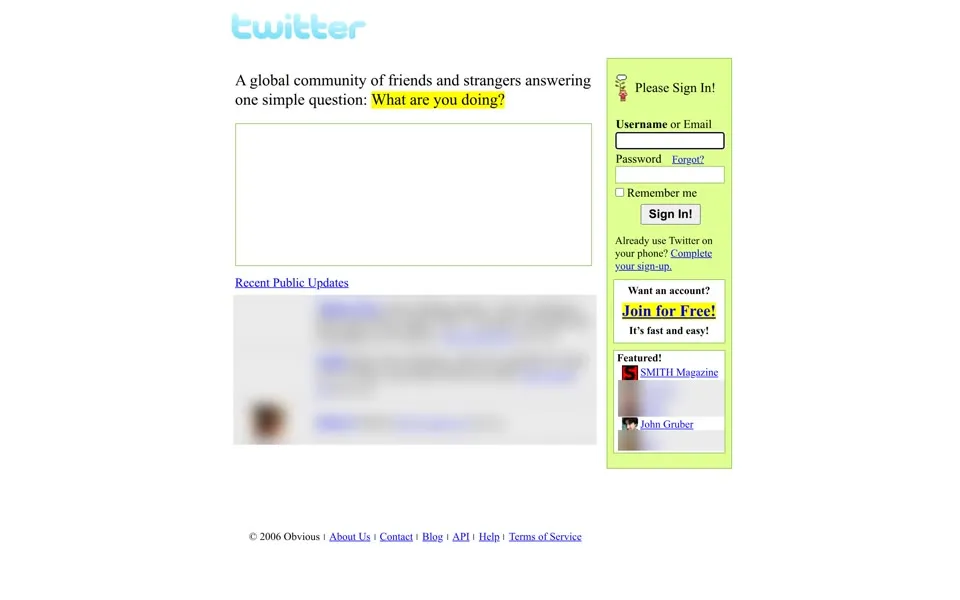
Our first capture, from December 30, 2006, has the word twitter in pale blue bubble letters at the top left. Under it: A global community of friends and strangers answering one simple question: What are you doing?
On the right, a green box says Please Sign In!
, and lower down, Join for Free! It’s fast and easy!
The big white frame under the question held a Flash slide show, slide_show.swf
, which we hid for the screenshot. Below it, Recent Public Updates
lists three answers from members, sent from the web or by instant messaging. We blurred them; the quotes here come from the capture’s HTML.
The footer reads © 2006 Obvious
, with no Twitter in the copyright line. Under the sign-in fields sits a line whose relatives turn up in our captures until 2013: Already use Twitter on your phone? Complete your sign-up.
The service was nine months old. Jack Dorsey had posted the first Tweet in March 2006, when it was still called Twttr.[1][2]
Biz Stone later wrote that he and Jack Dorsey even published our phone numbers on the front page.
[3] None of the captures we picked shows them.
2007 From txt: where 140 characters came from
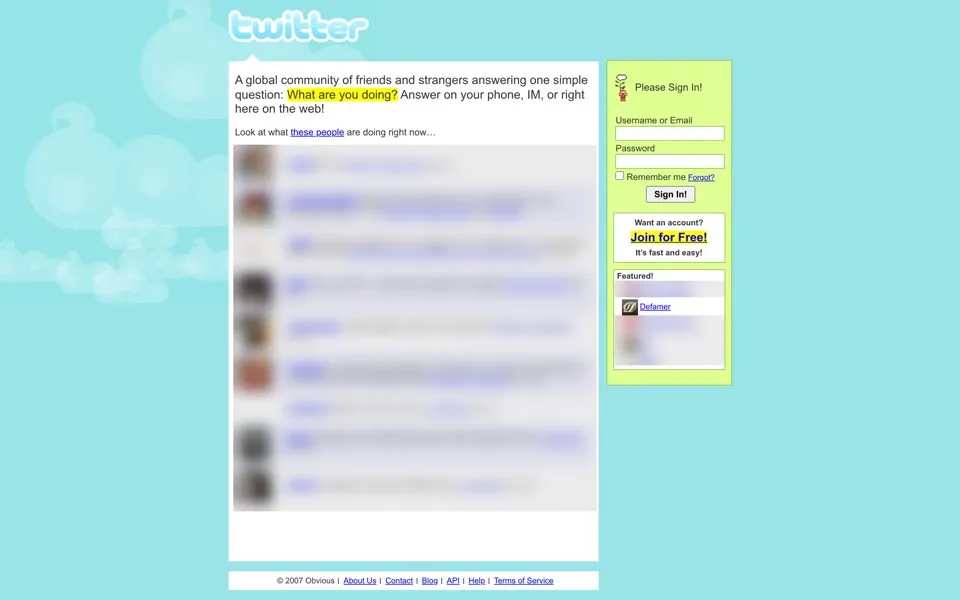
By March 4, 2007, the page sits on a turquoise background patterned with pale round birds, and the question has grown a second sentence: Answer on your phone, IM, or right here on the web!
Under Look at what these people are doing right now…
come nine updates.
We blurred them, but the HTML keeps the stamp on each one, how long ago it arrived and where it came from: less than 5 seconds ago from txt
, from im
, from web
, and once from twitterrific
. The phone, the messenger and the browser from the question all turn up in the stream.
The phone explains a famous number. Twitter’s 2013 IPO filing traces the 140-character limit to the service’s origins as an SMS-based messaging system
.[4]
The copyright line still says Obvious, and the phone link under the sign-in box is missing from this capture. The very end of the code holds a note for anyone who reads it.
An HTML comment at the end of the 2007 capture’s code. The June 2008 capture signs off the same way, from twitter-web063.twitter.com, in 9 ms.
2008 – 2009 A bird on a branch and the Fail Whale
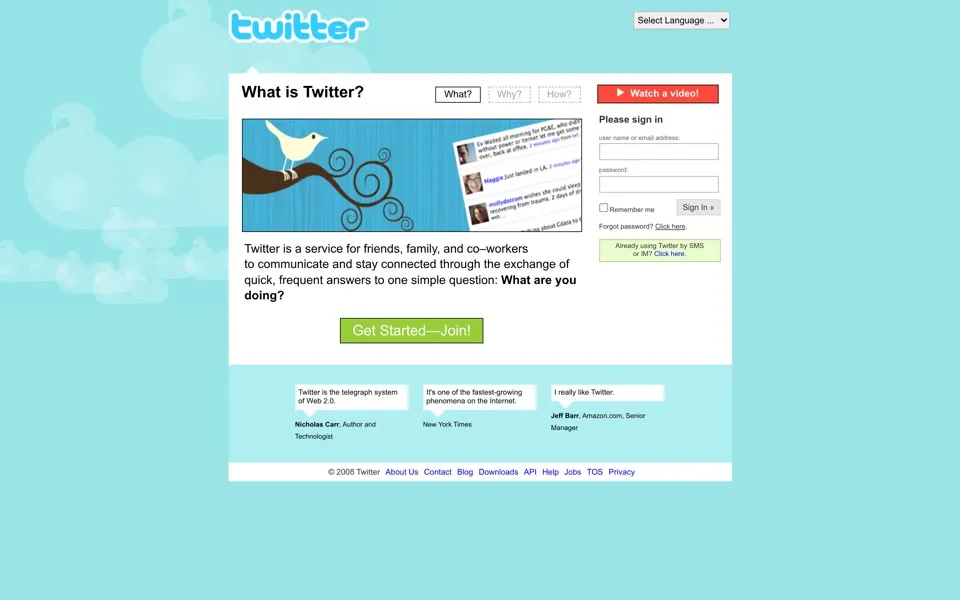
In June 2008 the stream is gone, and Twitter’s homepage explains itself. A white card asks What is Twitter?
, with three small tabs, What?
, Why?
and How?
, over a drawing of a bird on a curly branch. The text under it: Twitter is a service for friends, family, and co–workers to communicate and stay connected through the exchange of quick, frequent answers to one simple question: What are you doing?
Three press quotes do the selling. Twitter is the telegraph system of Web 2.0.
(Nicholas Carr). It's one of the fastest-growing phenomena on the Internet.
(New York Times). And from Jeff Barr of Amazon.com, simply: I really like Twitter.
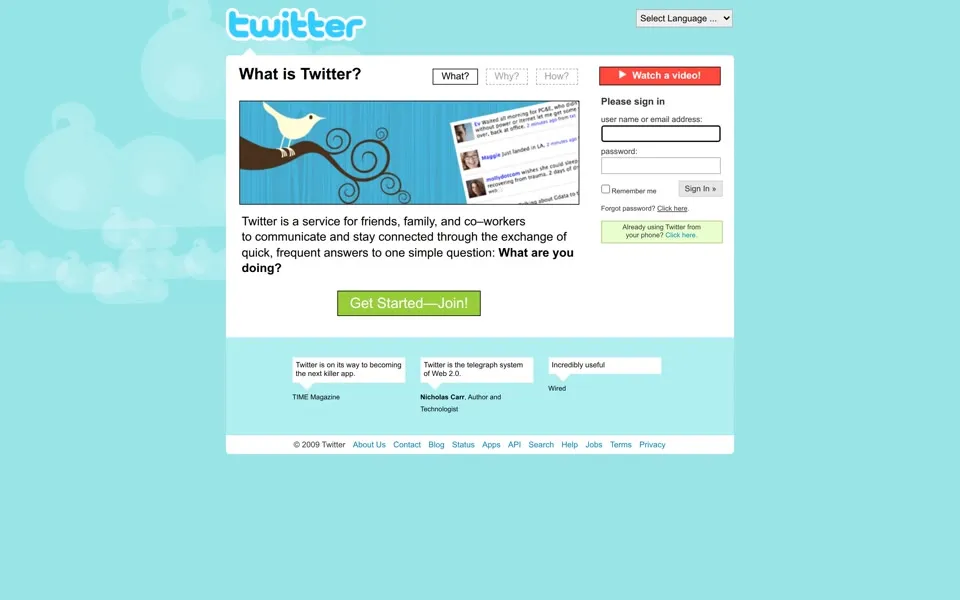
By June 2009 Barr and the Times have made room for TIME, Twitter is on its way to becoming the next killer app.
, and Wired, Incredibly useful
. Carr stays.
The phone link under the sign-in box reads Already using Twitter by SMS or IM? Click here.
in 2008, and Already using Twitter from your phone? Click here.
in 2009.
Twitter had one more drawing, for when things went wrong. None of our captures shows it.
Yiying Lu’s illustration, shown to users when Twitter’s servers were overloaded and known as the Fail Whale.[5] When it first and last appeared isn’t established.
In June 2009 the browser tab still says Twitter: What are you doing?
On November 19, 2009, Twitter changed the question in its posting box to What’s happening?
and noted we’ve shortened it by two characters
.[6] Two days later the code of a homepage capture explains its trends: New Moon, the second Twilight movie, was released to theaters Nov. 20.
2010 Sure, we’ll get right on that
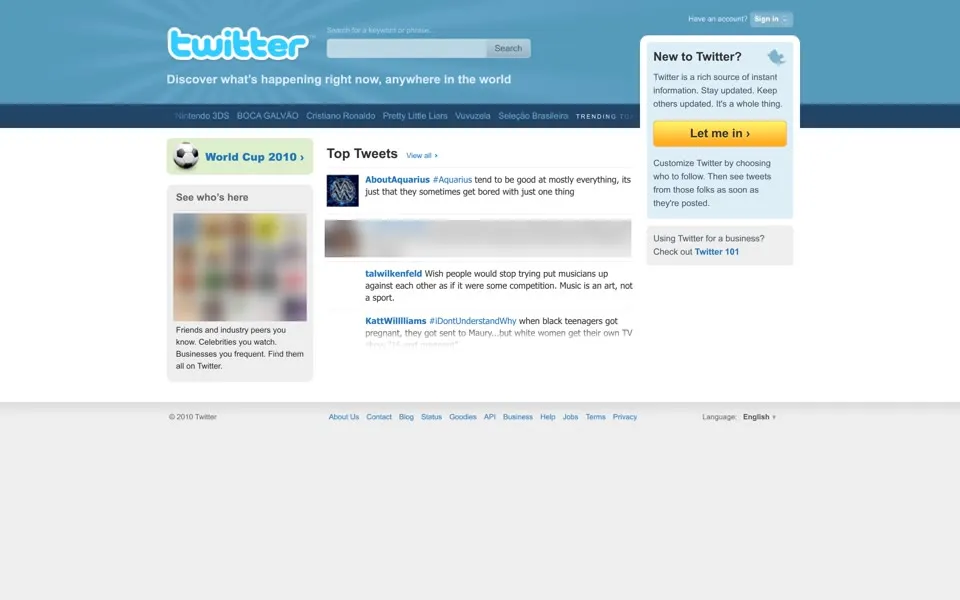
On June 15, 2010, the homepage opens a window on Twitter. A blue band at the top holds a search box, then Discover what’s happening right now, anywhere in the world
, then a row of trending topics: Nintendo 3DS, BOCA GALVÃO, Cristiano Ronaldo, Pretty Little Liars, Vuvuzela, Seleção Brasileira. A green button leads to World Cup 2010
. Beside it run Top Tweets
, and a box called See who’s here
shows 20 small profile pictures. We blurred the grid and one Top Tweet.
The trends come with explanations in the page’s code, hidden on the screenshot. CALA BOCA GALVÃO refers to Galvão Bueno, a Brazilian soccer narrator/commentarist.
Kinect is The recently released name for Microsoft's Project Natal, which is a video game system.
In March Twitter had tested this kind of homepage, with top tweets that automatically appear every few seconds
.[7]
The trend list in the code includes #worldcup
, and hashtags were a user’s idea. Chris Messina suggested them while the team was fixing an outage. Biz Stone, by his own account, ended the conversation with Sure, we’ll get right on that.
He dates the first hashtag Tweet to August 23, 2007.[3]
Twitter is a rich source of instant information. Stay updated. Keep others updated. It's a whole thing.The “New to Twitter?” box on the June 2010 homepage, above a button that says “Let me in ›”
The phone link has moved into the closed sign-in drop-down. The code still has it: Already using Twitter on your phone?
2011 Follow your interests
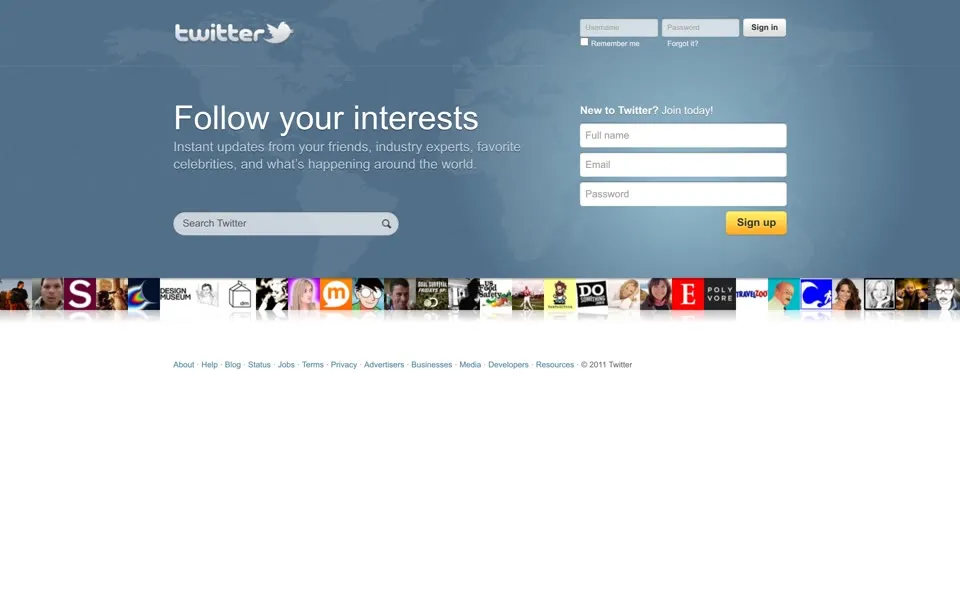
June 16, 2011: a gray-blue world map with a white headline, Follow your interests
, and under it Instant updates from your friends, industry experts, favorite celebrities, and what’s happening around the world.
The sign-up form sits beside it with a yellow Sign up
button. At the top left, the word twitter now has a small bird after it.
Along the bottom runs a strip of profile pictures. Their alt texts in the code name 30 accounts, from Zooey Deschanel, Jimmy Kimmel and NASA JPL to The Economist, Polyvore, the Design Museum and Winnebago Man
. In 2007 the page showed strangers’ updates. This strip shows accounts to follow.
The code also holds the next step of the form, hidden until you start typing: We’ve picked a username for you.
The phone link is still in the closed sign-in drop-down, renamed: Already using Twitter via SMS?
2012 – 2013 A bird drawn from circles
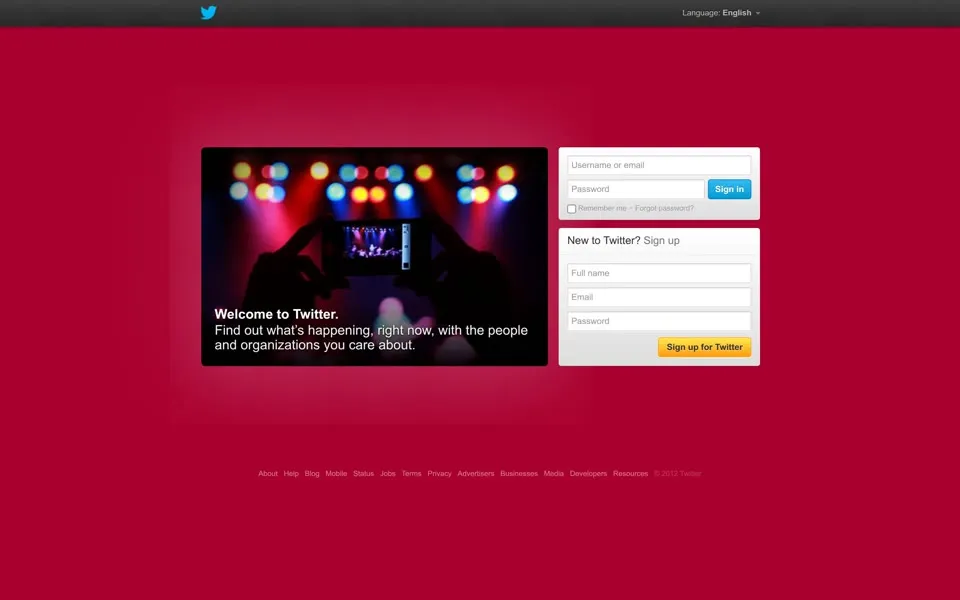
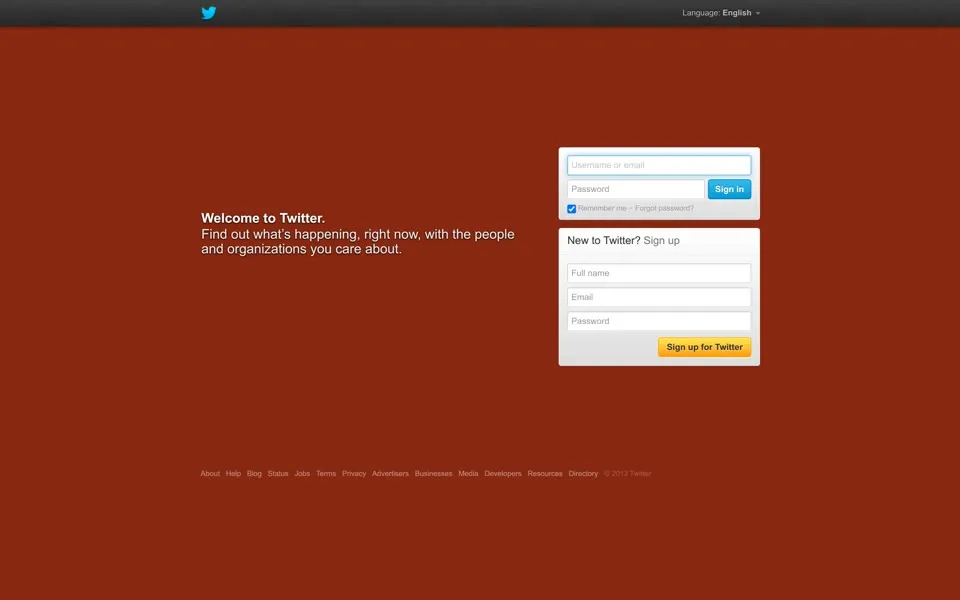
In June 2012 the homepage turns red. A concert photo fills the left side: stage lights, a dark crowd, one phone held up toward the stage. Over it: Welcome to Twitter. Find out what’s happening, right now, with the people and organizations you care about.
To the right are two forms, one to sign in and one to sign up.
The capture is from June 16, ten days after Twitter introduced a new bird. At the top left the word twitter is gone, and a small blue bird sits alone. Twitter said the bird was drawn from three sets of overlapping circles
and that There’s no longer a need for text
, nor for bubbly type or a lowercase t.[8]
By June 2013 the photo is gone and the red has turned brown. The page is the same sentence and the same two forms. Its code shows how far Twitter had spread: the language selector has 28 options in 2012 and 36 in 2013, counting the selected English. One of the 2013 additions is LOLCATZ
.
The phone link survives one last time, in the code of the sign-in menu: Already using Twitter via text message?
The 2014 code no longer has it.
options in the homepage’s language selector
- 2008
- 2009
- 2010
- 2012
- 2013
- 2014
LOLCATZ; 2014 adds
EnglishUK.
2014 Two phones and two badges
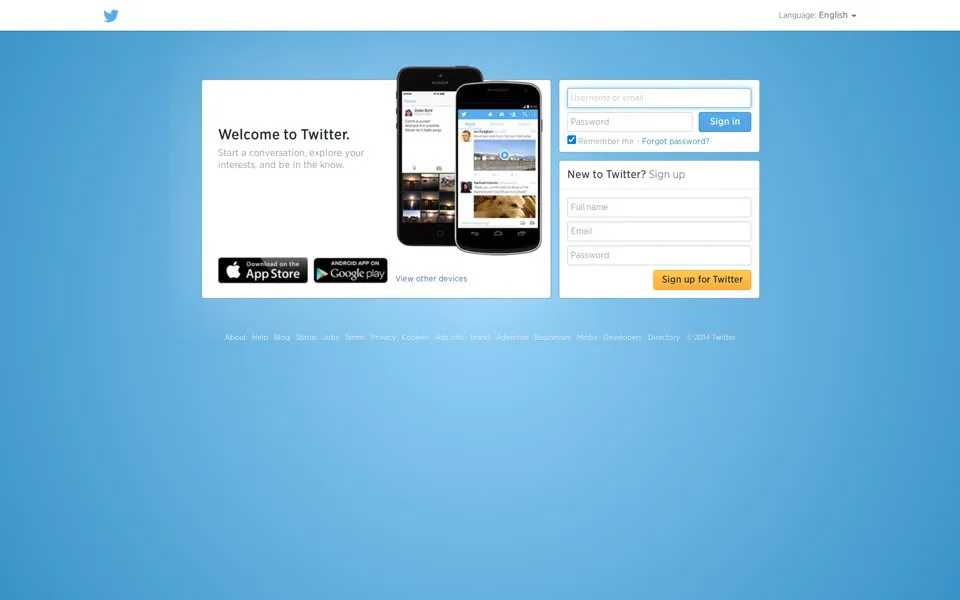
June 16, 2014: a soft blue gradient, and in the middle a white card with two smartphones showing Twitter’s app. Welcome to Twitter.
The line under it has changed: Start a conversation, explore your interests, and be in the know.
Below the phones are badges for the App Store and Google Play and a link, View other devices
.
The homepage is selling the app. In the second quarter of 2013, according to Twitter’s IPO filing, 75 percent of its average monthly active users had reached the service from a mobile device.[4]
The footer has a new Cookies
link, and the code still carries the warning first seen in 2013: Twitter.com makes heavy use of browser cookies
. Nothing on the page or in its code asks any more whether you already use Twitter on your phone.
2015 Cute animals
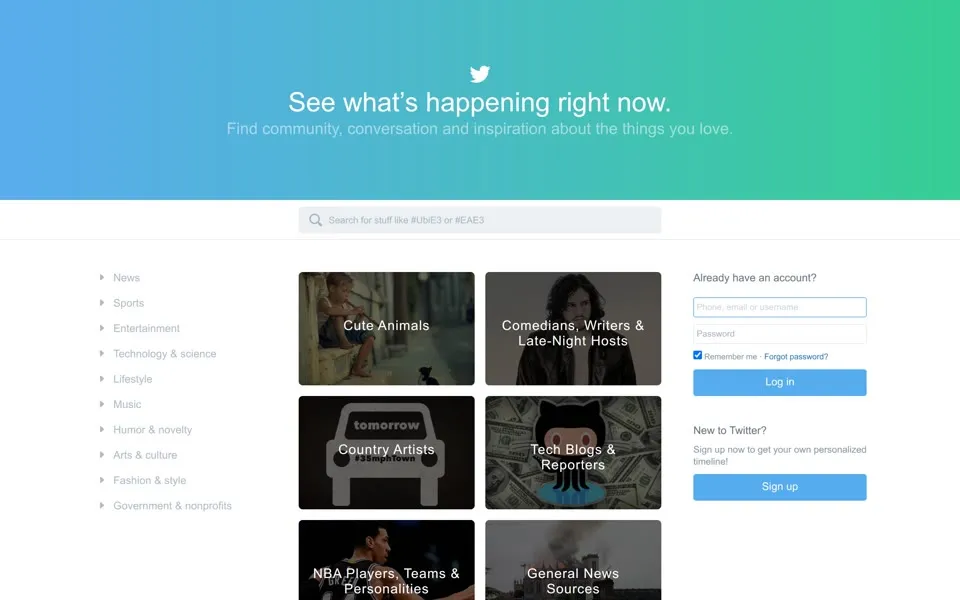
In June 2015 the homepage turns into a directory. A green-to-blue header says See what’s happening right now.
Below it sit 18 photo tiles, each one a kind of account: Cute Animals
, Comedians, Writers & Late-Night Hosts
, Country Artists
, Space News & Publications
, NASCAR Drivers & Teams
, High-End Fashion Labels
.
The code goes further: 10 groups with 58 subcategories, from WWE wrestlers & personalities
to Wedding guides
. Each tile names three accounts. Cute animals is featuring Cats, Animal Planet, Baby Animals & more
, and the politics tile features The Hill, The First Lady and Sarah Palin.
Five months after this capture, on November 3, 2015, Twitter replaced its favorite star with a heart and started calling favorites likes
.[9] The next capture counts them.
2016 – 2017 Moments
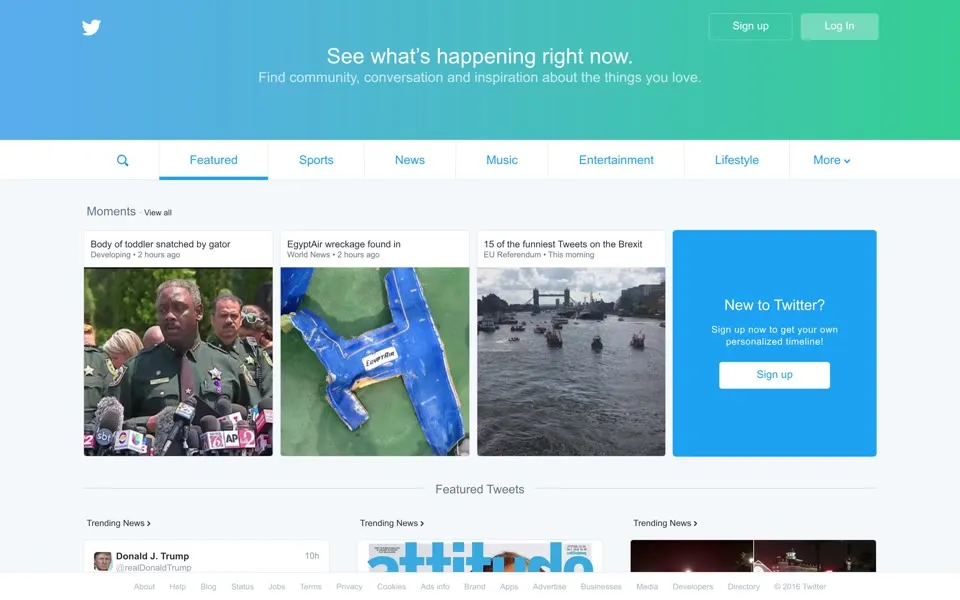
June 16, 2016: the same header, now above a row of tabs, Featured, Sports, News, Music, Entertainment, Lifestyle and More. Under them come Moments
, picture stories of the day. The cards’ titles are cut short on the screenshot; in full, in the code, one is EgyptAir wreckage found in Mediterranean, officials confirm
and another 15 of the funniest Tweets on the Brexit flotilla
. Scroll down and Featured Tweets
fill the page, from Donald J. Trump and Hillary Clinton to Lady Gaga, each with its retweets and likes.
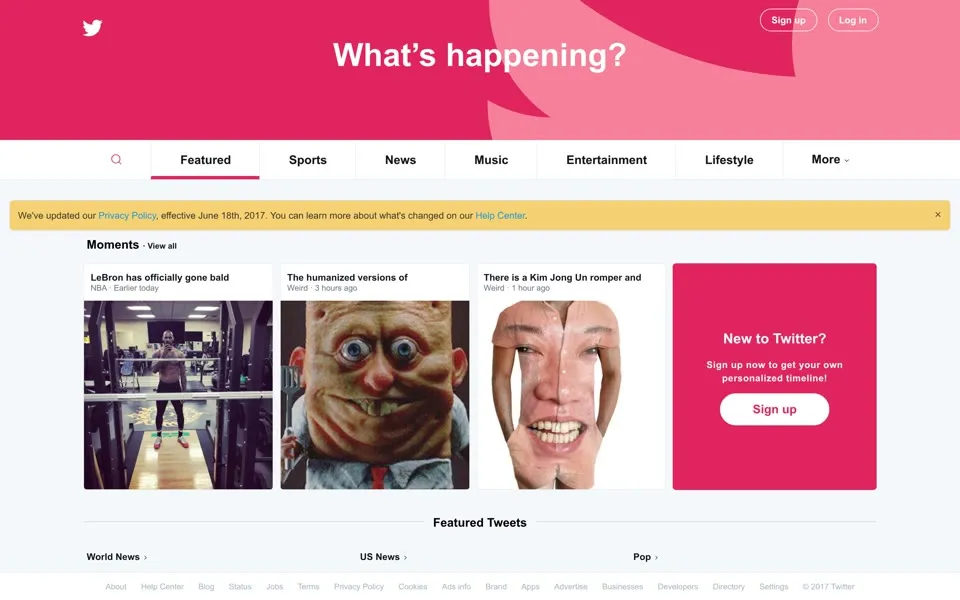
In June 2017 the header is pink, and it asks the posting box’s question: What’s happening?
The browser tab now says Twitter. It's what's happening.
The Moments are lighter. Their full titles in the code: LeBron has officially gone bald
, The humanized versions of SpongeBob & Patrick are deeply unsettling
and There is a Kim Jong Un romper and you can buy it
.
A yellow strip announces a privacy policy effective June 18th, 2017
, three days after the capture. Five months later Twitter raised the limit from 140 to 280 characters, except in Japanese, Korean and Chinese.[10]
2018 – 2020 Join Twitter today.
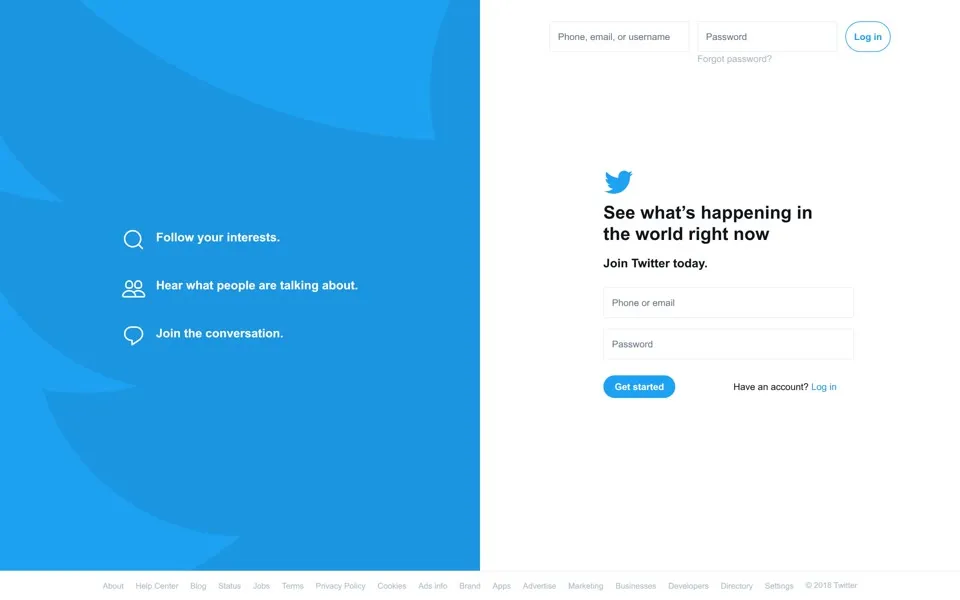
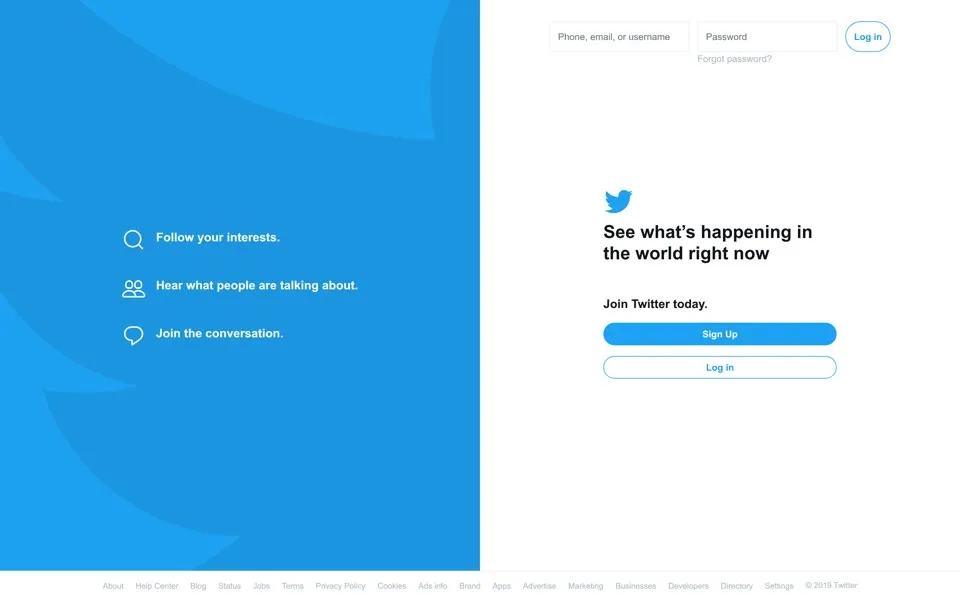
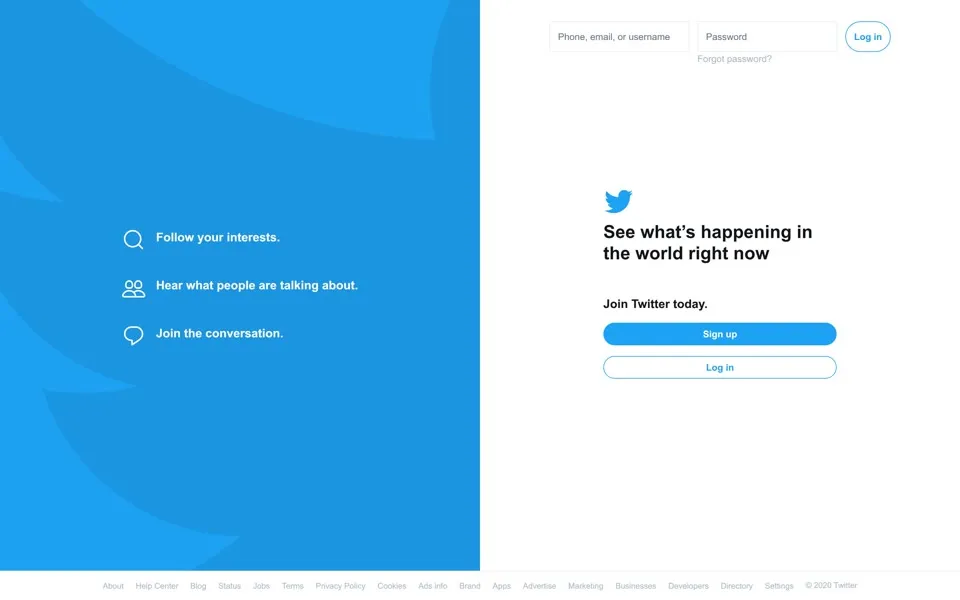
In 2018 the homepage splits in two. On the left, a blue panel with a large pale bird and three lines with icons: Follow your interests.
, Hear what people are talking about.
, Join the conversation.
On the right, a small bird, See what’s happening in the world right now
and Join Twitter today.
Our capture is from March 2, 2018.
Signing up starts with Phone or email
, and for the phone route the code holds the line that comes next: We will text a verification code to this number. Standard SMS, call, or data fees may apply.
In 2007 a text message was one way to post. Here it carries a code to prove the number is yours. One bird on the page is a drawing in the code, with a comment left by the program that made it: Generator: Sketch 45.2
.
By June 2019 the phone field is gone, replaced by two buttons, Sign Up and Log in. In July 2019 Twitter launched a new twitter.com for its users, with side navigation and two dark modes, Dim and Lights Out.[11] A signed-out visitor, like the archive’s crawler, still got the split screen. The June 2020 capture looks identical, and comparing the two captures’ text finds exactly two changes.
Every difference between the visible text of the two captures. The layout, the panel and the three lines stay the same.
2021 Happening now
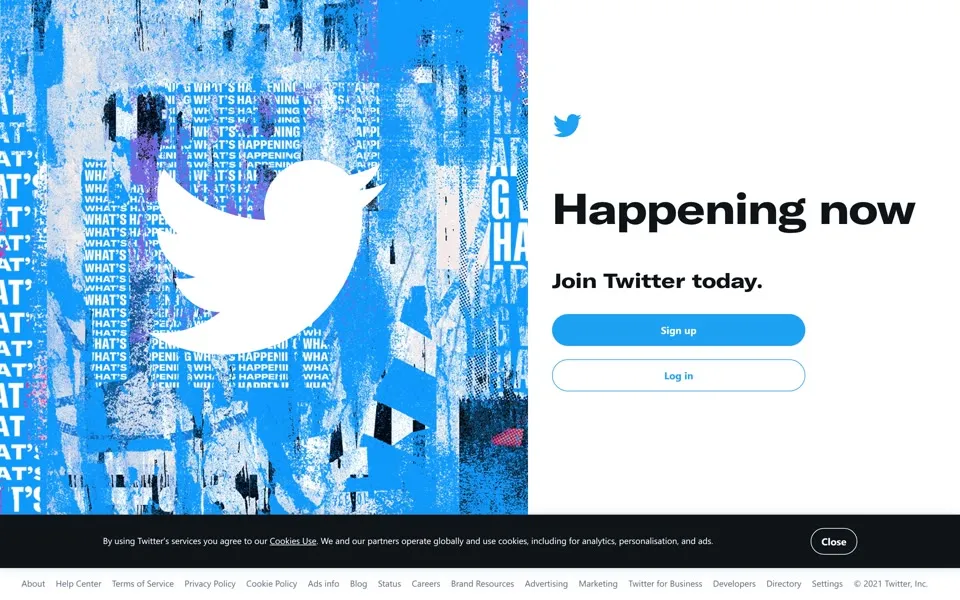
In June 2021 the headline shrinks to two words. Next to a collage of torn blue posters printed over and over with WHAT'S HAPPENING
, with a white bird on top, two words stand in heavy black type: Happening now
. Below: Join Twitter today.
, Sign up
, Log in
. A black bar across the bottom begins By using Twitter’s services you agree to our Cookies Use.
2022 – 2023 The bird at 00:00:16 UTC
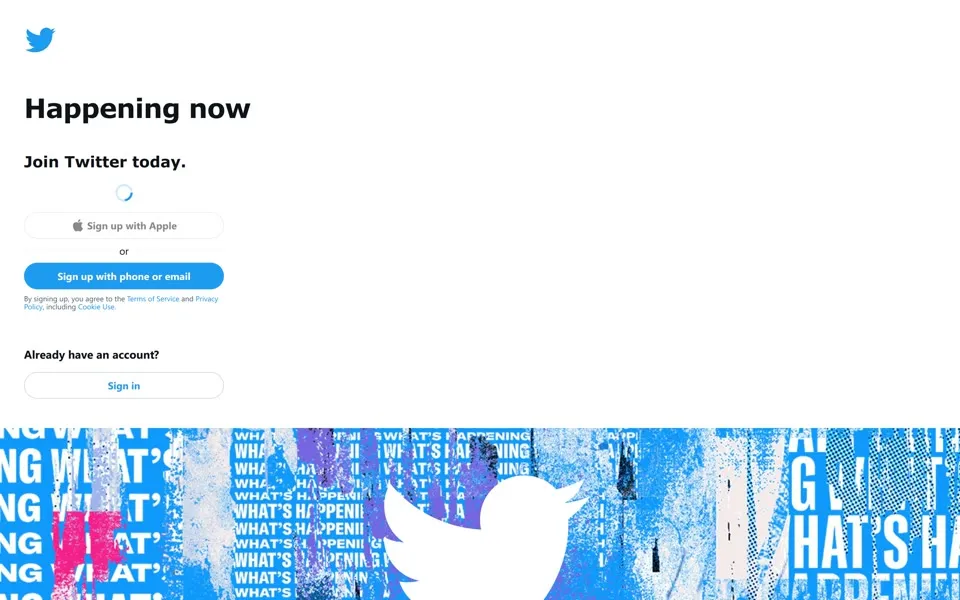
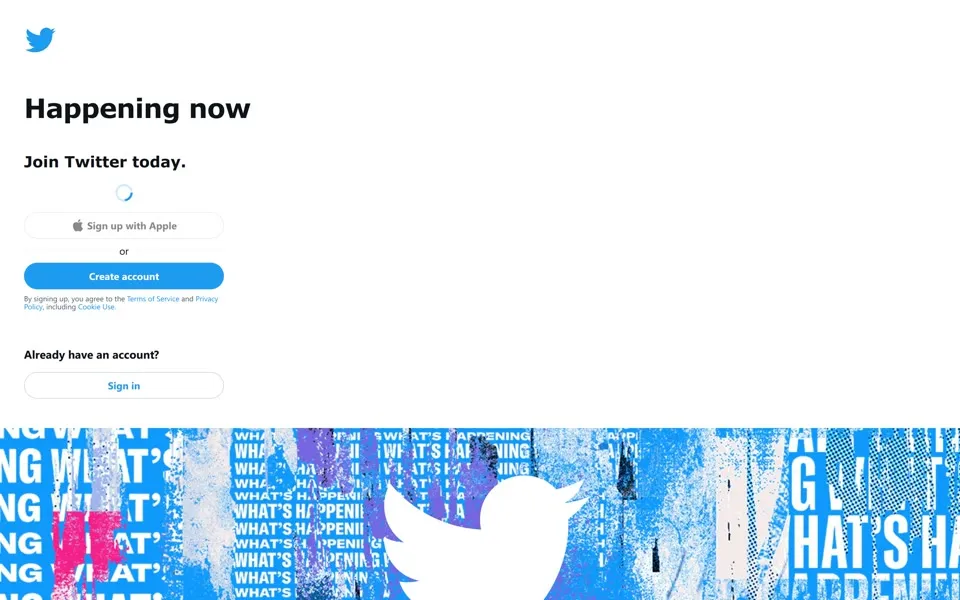
In June 2022 the collage moves to a band under the form, and a small blue bird sits at the top left. A Sign up with Apple
button appears above Sign up with phone or email
. From 2022 to 2025 our captures render the page as a narrow column at the left. The footer reads © 2022 Twitter, Inc.
That spring the company had agreed to a sale to Elon Musk valued at about $44 billion; the deal closed on October 27, 2022.[12][13]
Our 2023 capture was made at 00:00:16 UTC on July 24, 2023. The page still says Join Twitter today.
, the bird is still blue at the top left, and the footer still lists Twitter for Business
. The copyright line has moved on: © 2023 X Corp.
Twitter was rebranded as X that month,[14] and later on July 24 TechCrunch reported that the X logo was already live on the website (reported).[15]
Each browser-tab title in our captures, listed at the first capture that shows it after a different one.
2024 – 2025 Join today.
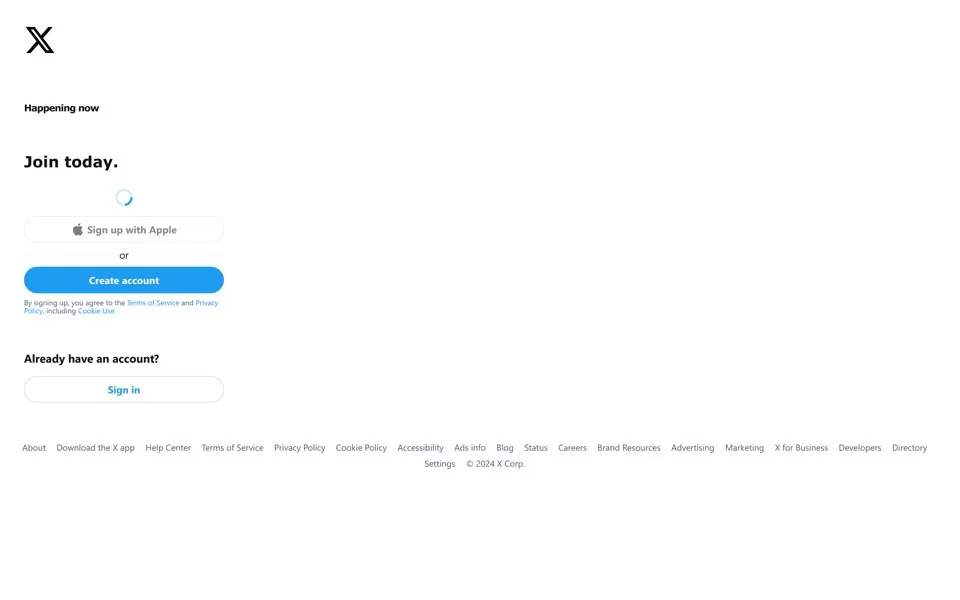
March 1, 2024: the same narrow column, with a small black X where the bird was. Happening now
, then Join today.
The word Twitter is gone from the sentence, from the browser tab and from the footer, which now offers Download the X app
and X for Business
. The copyright line says © 2024 X Corp.
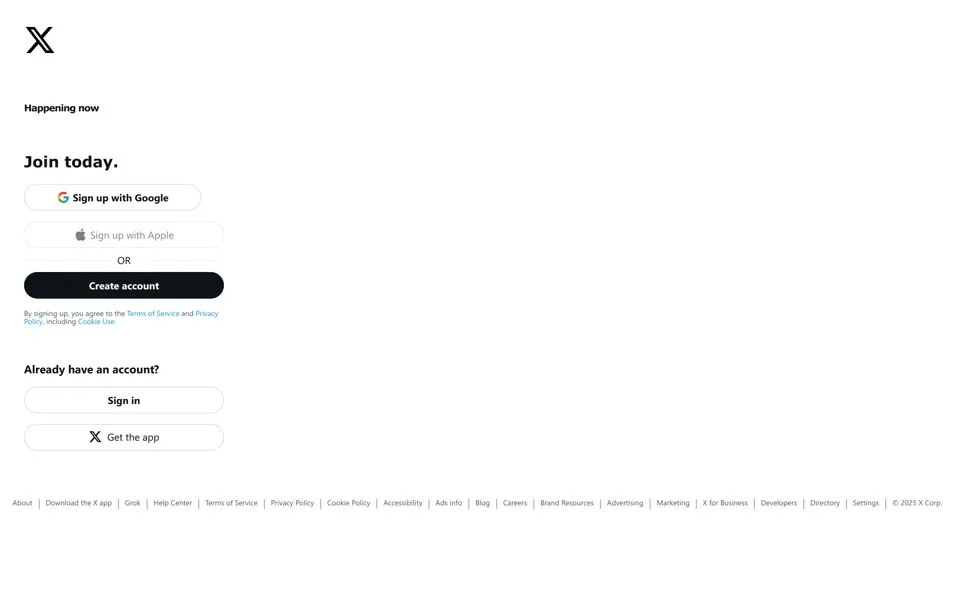
In May 2024 X moved its core systems to the x.com domain, AFP reported (reported).[16] Our October 2, 2025 capture adds a Sign up with Google
button to the Apple one, Create account
turns black, and a new button at the bottom says Get the app
. The footer adds a link named Grok
.
2026 Get Grok
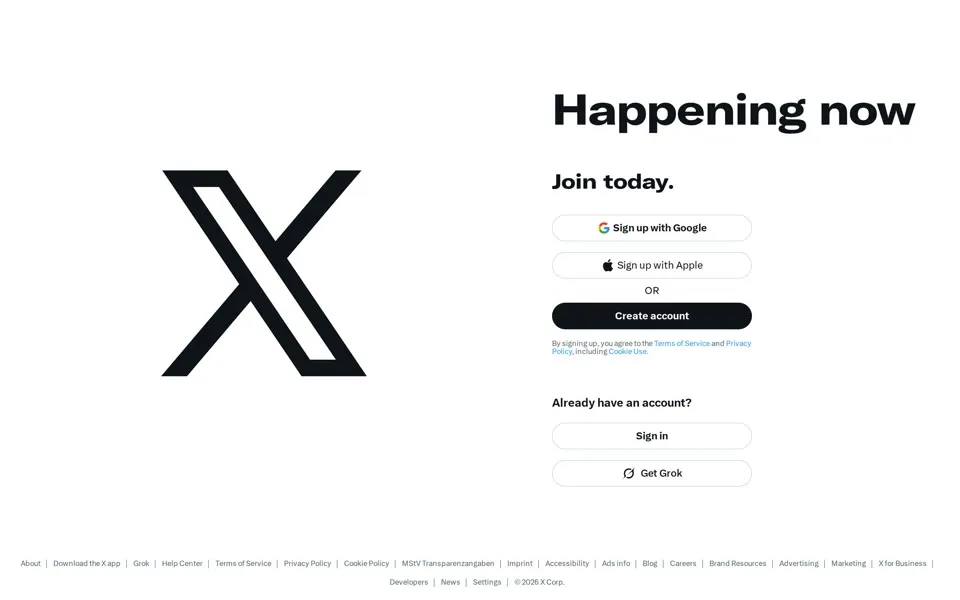
In March 2026 the page fills the window again. A giant black X takes the left half. On the right: Happening now
, Join today.
, buttons for Google and Apple, a black Create account
, and under Sign in
one more button, Get Grok
. Our capture, requested at twitter.com, is filed by the archive under x.com.
The footer has two links the earlier footers lack, one of them in German: MStV Transparenzangaben
and Imprint
. The capture doesn’t say where the archive’s crawler was visiting from.
2006 · question2026 · XWhat are you doing?in yellow, recent public updates and a green sign-in box. March 2026: a giant X,
Happening nowand a
Get Grokbutton. Drag to compare.
2006 → 2026 A two-word headline
The first capture asked What are you doing?
and answered with strangers’ updates, half a minute old. The last one shows no Tweets at all. In place of the question stands a headline, Happening now
, and a button to join.
The copyright line at the bottom tells the rest in four steps: © 2006 Obvious
, © 2008 Twitter
, © 2022 Twitter, Inc.
and © 2026 X Corp.
In our captures the yellow question appears until 2007, and the browser tab asks it until 2009. The phone link shows up, visible or in the code, until 2013. The bird is last seen at 00:00:16 UTC on July 24, 2023.
- When was the oldest twitter.com homepage in this story archived?
- The oldest capture here is from December 30, 2006, in the Internet Archive's Wayback Machine. Twitter’s homepage in December 2006: “What are you doing?” in yellow, recent public updates and a green sign-in box (updates blurred).
- What does the twitter.com homepage look like in 2026?
- In the newest capture here (March 1, 2026): X in March 2026: a giant black X beside “Happening now” and a “Get Grok” button.
- How many Twitter homepage captures does this story show?
- 21 captures between 2006 and 2026, at most one per year; the timeline above shows which years are included.
- How did the Twitter logo change on its homepage?
- The logo evolution below shows 4 logo versions we picked from the captures, from 2006, 2011, 2012 and 2024. Logos from before 2006, the first capture, aren't included.
 2006Pale-blue 'twitter' wordmark with rounded lowercase letters, no bird
 2011White wordmark gains the bird: 'twitter' + a small bird on the right
 2012Wordmark dropped; the simplified bird alone, in Twitter blue
 2024Bird retired: black X after the 2023 rebrand
Each logo is cut from that year's homepage capture (the year is the capture's); click one to see it on the page. Logos from before the first capture (2006) aren't shown, and some are missing where the logo images don't render in our captures. More logo histories.
◀ drag ▶20062026
The oldest capture in this story (2006) over the newest (2026). Drag across the picture.
Which homepage should we open next?
Tell us on the PageRewind YouTube channel, and subscribe for more histories of the pages we used to visit.
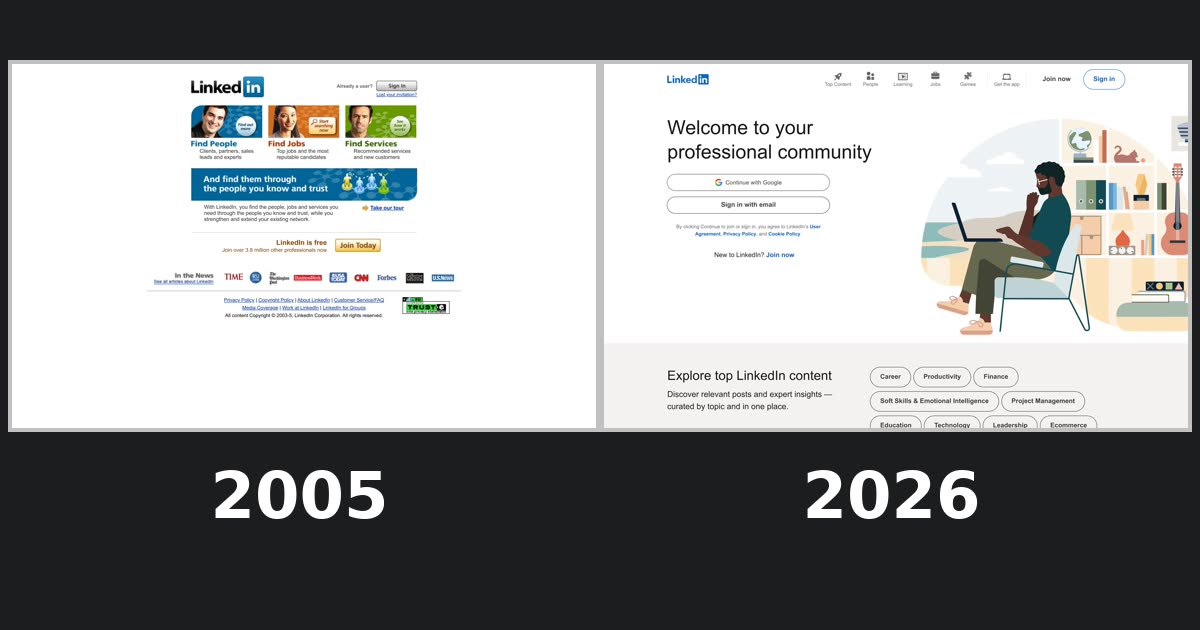 Linkedin.com, 2005–2026From “Relationships Matter” to “Log In or Sign Up”.
Sources
Each screenshot links to its dated Wayback capture. Observations about layouts and wording refer to those screenshots; lines read from a page’s code are identified as such. External history uses the sources below; “(reported)” marks claims the research rates as likely, not confirmed.
- Twitter Blog · Nine years and counting: the first Tweet, posted “when the service was called “Twttr.””; March 21, 2015. Read source ↗
- Library of Congress · How tweet it is!: the archive of every public tweet since Twitter’s “inception in March 2006”; April 14, 2010. Read source ↗
- Twitter Blog / Biz Stone · The hashtag at ten years young: the founders’ phone numbers on the front page, Chris Messina’s suggestion and the first hashtag Tweet on August 23, 2007; August 23, 2017. Read source ↗
- Twitter, Inc. / SEC · Form S-1 registration statement: the 140-character limit and the “origins as an SMS-based messaging system”; 75% of average MAUs on mobile in Q2 2013; October 3, 2013. Read source ↗
- Yiying Lu · Fail Whale: the illustrator’s page on the drawing of birds lifting a whale, shown when Twitter’s servers were overloaded; undated. Read source ↗
- Twitter Blog · What’s happening?: the new prompt, “we’ve shortened it by two characters”; November 19, 2009. Read source ↗
- Twitter Blog · Tweaking the Twitter homepage: top tweets “that automatically appear every few seconds”; March 30, 2010. Read source ↗
- Twitter Blog · Taking flight: the new Twitter bird, built from “three sets of overlapping circles”; June 6, 2012. Read source ↗
- Twitter Blog · Hearts on Twitter: favorites become likes, the star becomes a heart; November 3, 2015. Read source ↗
- Twitter Blog · Tweeting made easier: 280 characters, except in Japanese, Korean and Chinese; November 7, 2017. Read source ↗
- Twitter Blog · Introducing a new Twitter.com: side navigation and the Dim and Lights Out dark modes; July 15, 2019. Read source ↗
- Twitter, Inc. / PR Newswire · Elon Musk to acquire Twitter: a “transaction valued at approximately $44 billion”; April 25, 2022. Read source ↗
- Twitter, Inc. / SEC · Form 8-K: the merger completed on October 27, 2022, and Twitter became a wholly owned subsidiary. Read source ↗
- U.S. District Court, District of Delaware · X Corp. v. Operation Bluebird: X Corp. “rebranded the Twitter platform to X in July 2023”. Read source ↗
- TechCrunch · Twitter has officially changed its logo to X: “The change is already live on the website”; July 24, 2023. Read source ↗
- CBS News / AFP · Elon Musk confirms Twitter’s transformation complete: “All core systems are now on X.com”; May 17, 2024. Read source ↗
We selected one homepage capture of twitter.com for every year from 2006 to 2026, 21 in all, most of them from June. For 2006 we used December 30; for 2007, March 4; for 2018, March 2, because the June 2018 capture showed the page in Kannada; for 2023, July 24, sixteen seconds after midnight UTC; for 2024, March 1; for 2025, October 2; and for 2026, March 1. Each preview is the first screen of a 1440-pixel-wide still; click it for the captured page, up to 2,700 pixels tall, and its Wayback link. The browser frames are illustrations of the eras.
The archive’s crawler visits as a logged-out user, so the captures show signed-out pages, with the limits described here. We hid the Wayback toolbar and, in 2006, the Flash player; part of the 2006 stylesheet is missing in the archive. We blurred the public updates of 2006 and 2007 and the members in their Featured lists, one Top Tweet and the grid of profile pictures in 2010, and one Featured Tweet each in 2016 and 2017. Some images are missing in several captures from 2013 to 2017, and in the 2016 and 2017 full pages the footer links float across the page at the height of the first screen. From 2022 to 2025 the page renders as a narrow column at the left. The archived code of the 2021 and 2026 captures holds only an error fallback, so their words come from the screenshots.
PageRewind is independent and is not affiliated with X Corp. or Twitter. Screenshots and trademarks appear for historical commentary; archived pages are provided by the Internet Archive.
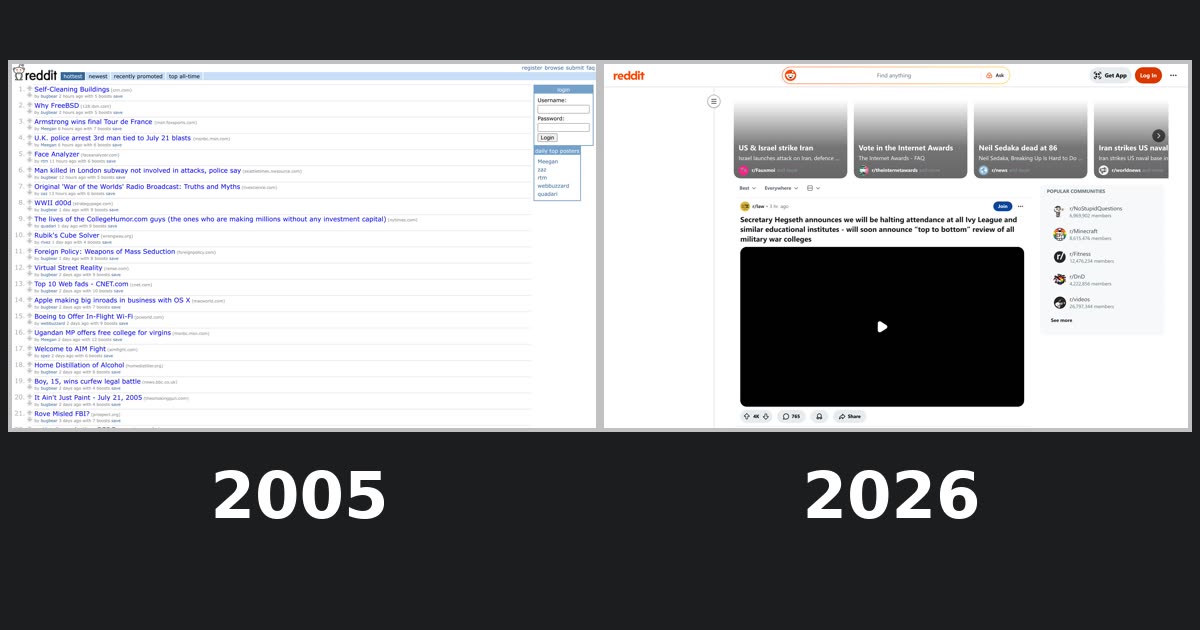 Reddit homepage history
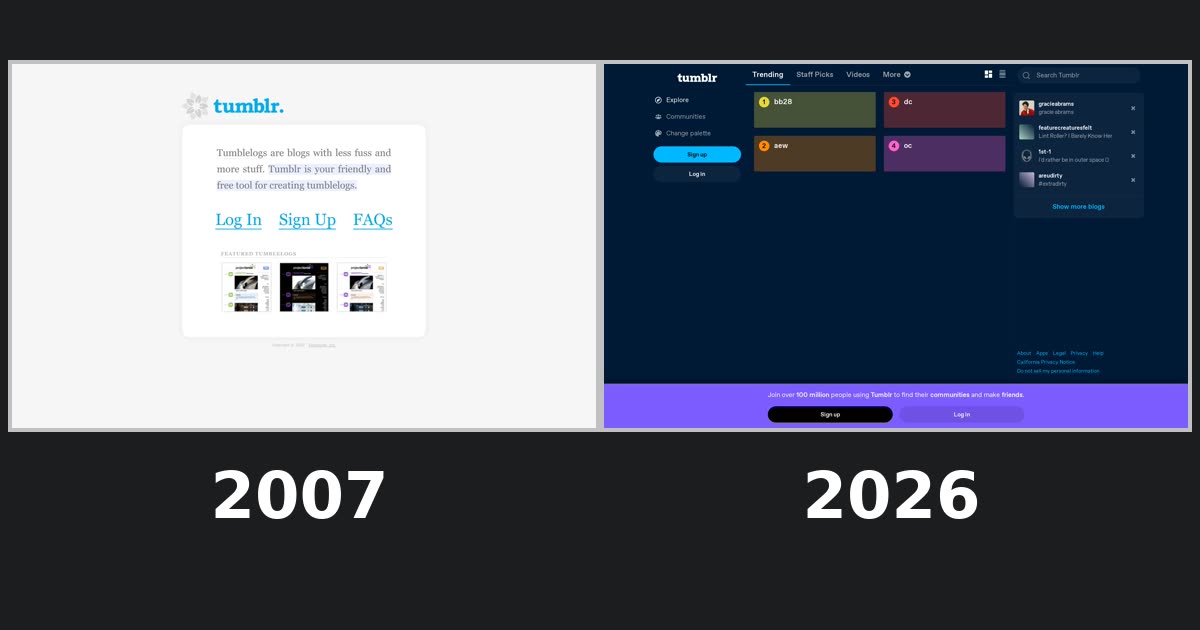 Tumblr homepage history