In October 2005 LinkedIn's homepage had three buttons with stock photos on them: Find People, Find Jobs, Find Services. Under them sat a yellow Join Today button and a line that did the counting for you: Join over 3.8 million other professionals now
.
Scrub through the captures with the slider, or read on.
That number is the thread through 22 captures of linkedin.com, one a year from 2005 to 2026. On the page it climbs to over 100 million by 2011. From our 2012 capture on it is no longer printed on the page and lives only in the code, in the meta description that search engines read: 150 million+ members
in 2012, 1 billion members
from 2024. Around it the browser title goes from Relationships Matter
to Log In or Sign Up
, and the smiling member photos give way to a drawing of a man with a laptop and a guitar on the shelf behind him.
2005 Find People, Find Jobs, Find Services
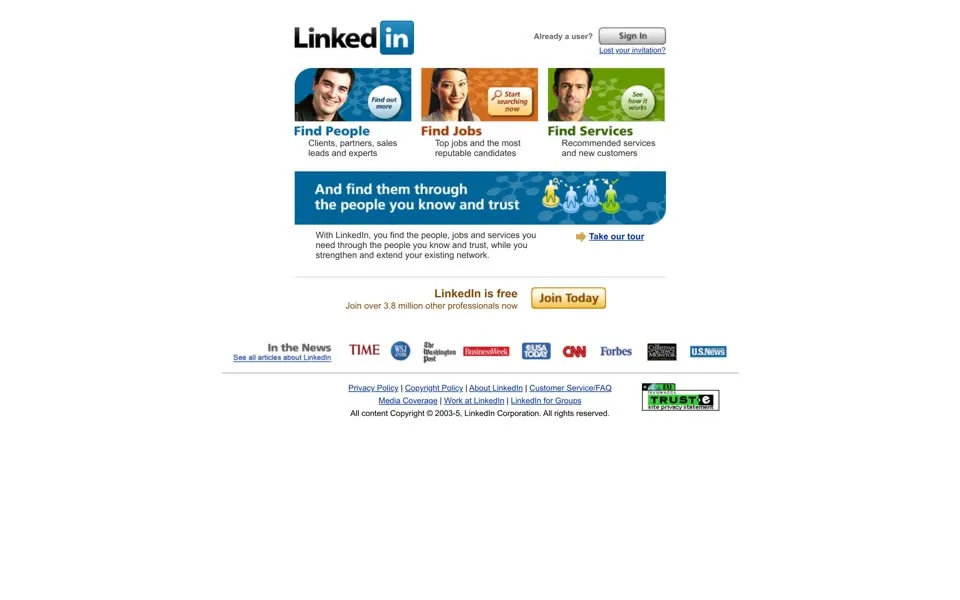
The oldest capture we use is from October 15, 2005; we found no usable homepage capture from 2003 or 2004. LinkedIn had gone live on May 5, 2003.[1] Reid Hoffman later wrote that he co-founded it in his living room, and that a month after launch the network had 4,500 members.[3] Two and a half years later its front page is a short sales pitch. Each photo button carries a promise in small type: Clients, partners, sales leads and experts
, Top jobs and the most reputable candidates
, Recommended services and new customers
. A blue banner adds the catch: And find them through the people you know and trust
.
Jobs was new. LinkedIn started earning money from LinkedIn Jobs in March 2005 and from its first premium subscription in August.[2] Lower down, an In the News
row shows nine press logos, from TIME to U.S.News, next to a TRUSTe privacy seal. The page's source holds one more line, inside an HTML comment: (Guest) build-250_1_0903; STATUS: GOOD
. Somebody at LinkedIn was keeping score of builds. The 2006 and 2007 pages carry the same note with build 319 and build 396.
2006–2007 “What do you want to do today?”
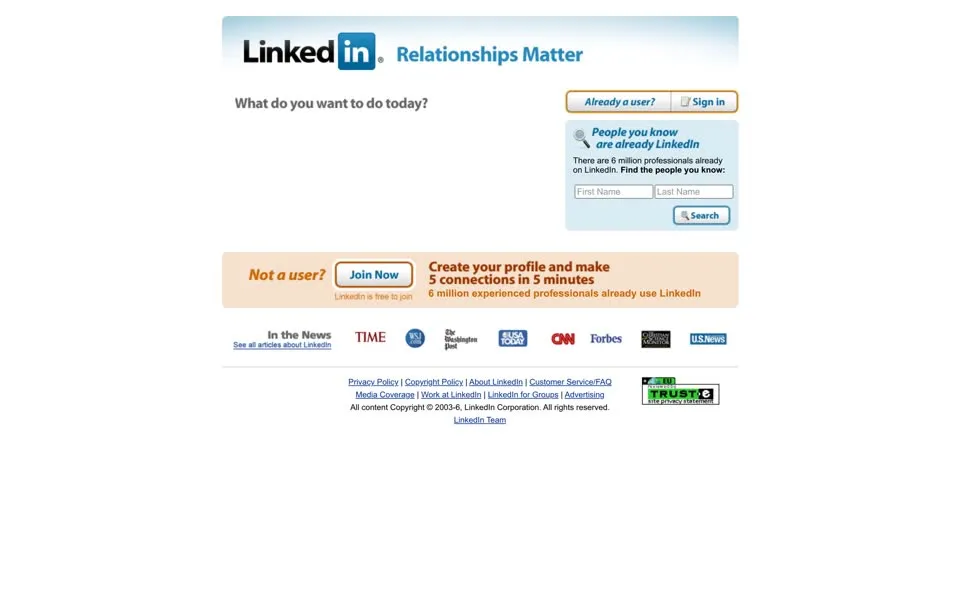
By June 2006 the photo buttons are gone. The logo has a slogan beside it, Relationships Matter
, and the page asks What do you want to do today?
The answer on the right is a people search with two fields, first name and last name.
An orange bar below says Not a user?
and promises Create your profile and make 5 connections in 5 minutes
. The count has moved on: 6 million experienced professionals already use LinkedIn
.
The slogan is older than the page. Hoffman's 2013 post says LinkedIn launched with the tagline Relationships matter.
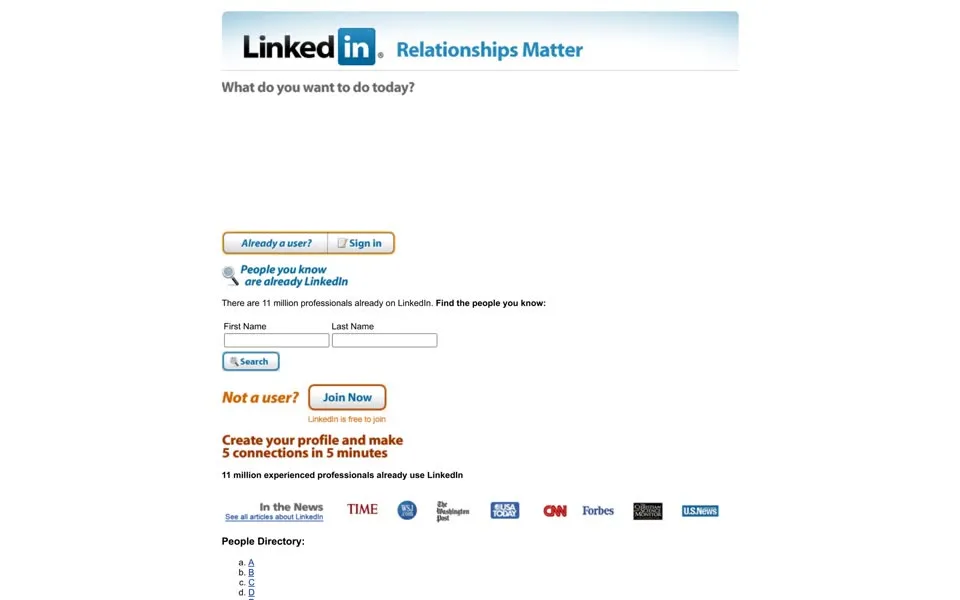
[3] In June 2007 it reaches the browser title as well, LinkedIn: Relationships Matter
, while the counter says 11 million. That replay renders with part of its styling missing. What's left is mostly white space with a long A to Z People Directory
running down the middle.
2008 Find people from your company
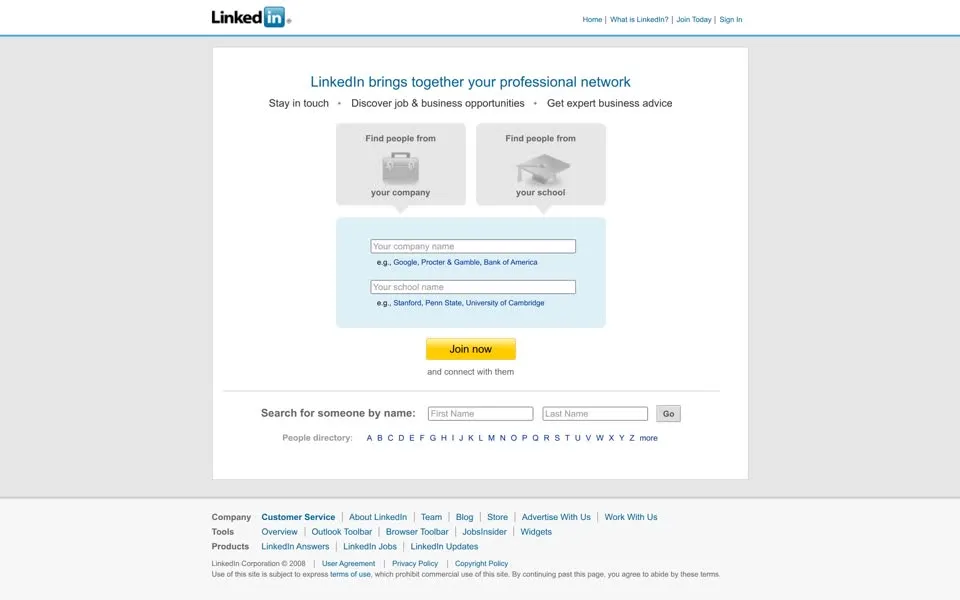
The June 2008 page drops the counter and tries another hook: LinkedIn brings together your professional network
. Two gray tiles offer Find people from your company
and Find people from your school
, with examples in small blue type: Google, Procter & Gamble, Bank of America; Stanford, Penn State, University of Cambridge. A yellow Join now
button sits under them.
The footer reads like a product catalog of its year: Outlook Toolbar
, Browser Toolbar
, JobsInsider
, Widgets
, LinkedIn Answers
and a Store
. Under the links runs a line of legal small print. Use of the site, it says, is subject to express terms of use, which prohibit commercial use of this site. By continuing past this page, you agree to abide by these terms.
The code also holds a hidden feedback box that asks Have an idea to improve LinkedIn?
and then lowers expectations: Comments submitted here will not result in a response.
2009–2011 477 days for a million, then 12
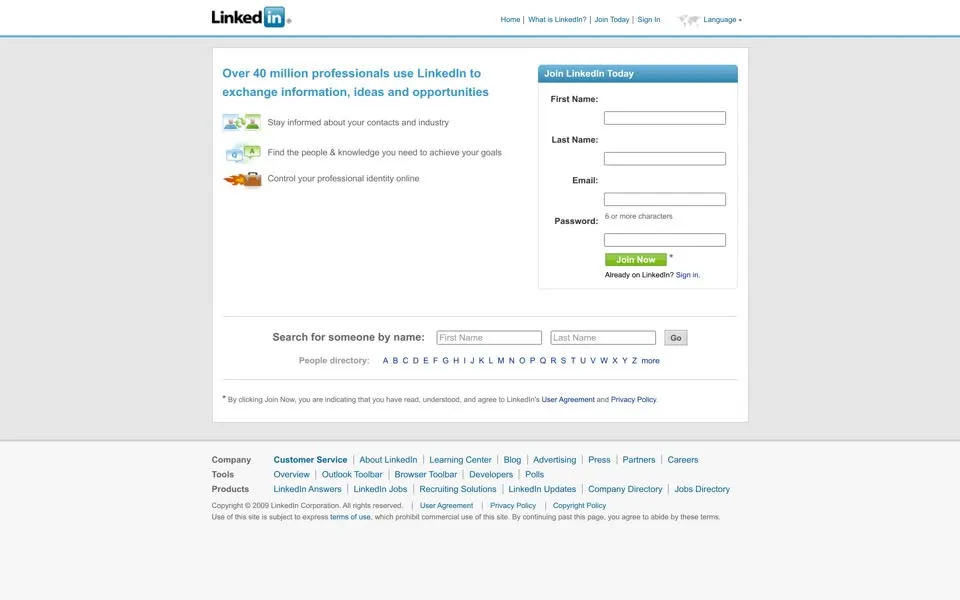
In our 2009 capture the counter is back, and now it is the headline. June 2009: Over 40 million professionals use LinkedIn to exchange information, ideas and opportunities
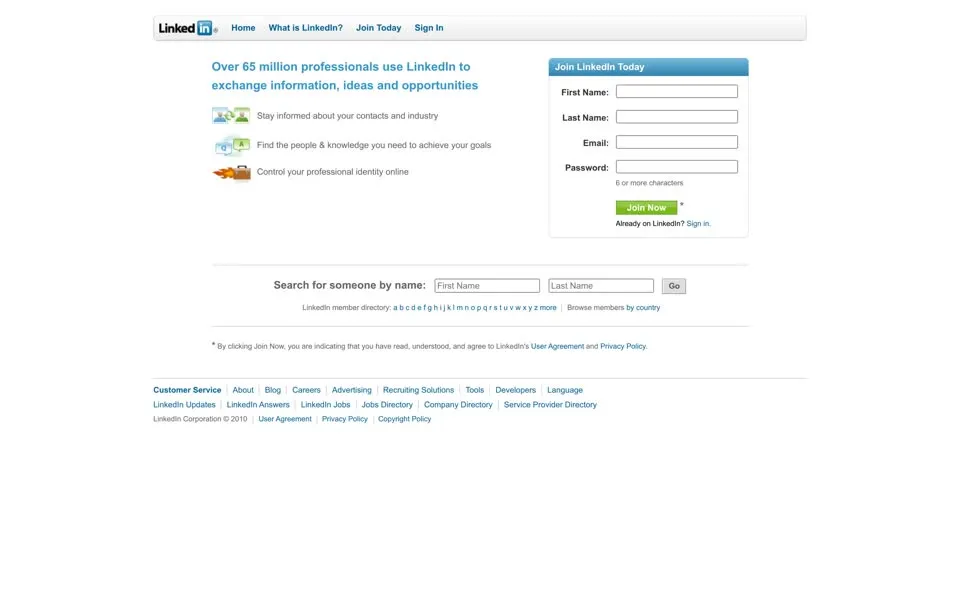
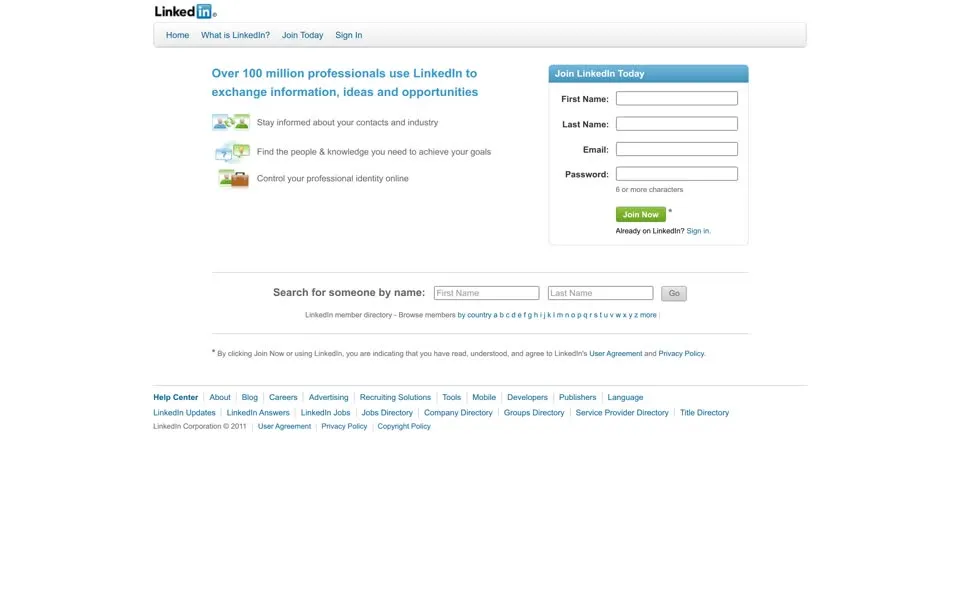
. June 2010: over 65 million. June 2011: over 100 million.
The navigation and the frame around it change, but the core stays. Three promises with small icons remain, including Control your professional identity online
, and so does a Join LinkedIn Today
form that wants a password of 6 or more characters
.
LinkedIn kept its own stopwatch. It published those two numbers in October 2009, when it passed 50 million members. Four months earlier, the page in our capture still said Over 40 million
. By June 2011 the page had caught up with the company: over 100 million, the figure LinkedIn's IPO prospectus gave for March 31, 2011.[2]
The small print grows with the number. The language menu's code lists four languages in 2009 (English, Deutsch, Français, Español), when the menu sits in the header, and six in 2010, with Italiano and Português, by then in the footer. The 2011 meta description already carries the count too, 100 million+ members
. In 2011 the browser title drops Relationships Matter
for World's Largest Professional Network
.
Members, as the homepage counted them
2012–2013 “Be great at what you do.”
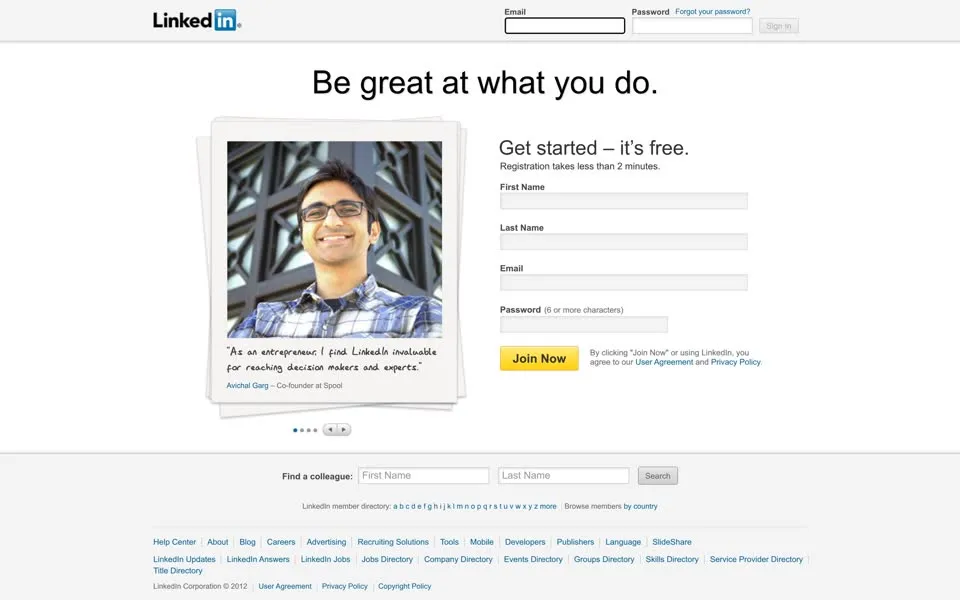
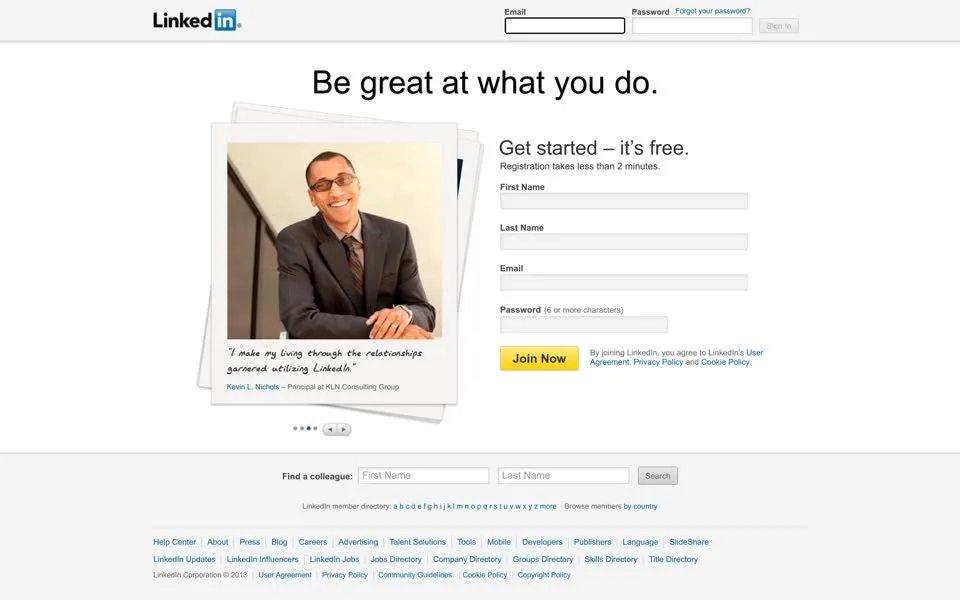
Our June 2012 capture no longer prints the member count. In its place: Be great at what you do.
in big type, a Polaroid-style photo of a member and a quote under it. The 2012 still shows Avichal Garg, Co-founder at Spool
: As an entrepreneur, I find LinkedIn invaluable for reaching decision makers and experts.
The code holds four quotes that take turns in that frame. The boldest is a social media strategist's: I haven't made a cold call since 2005 thanks to LinkedIn.
The number didn't go away. It stays in the meta description, where the 2011 capture already had it: 150 million+ members
in 2012, 225 million+ members
in 2013. Nothing on the June 15, 2012 page mentions the stolen passwords LinkedIn had confirmed nine days earlier.[5] A year later the signup small print names a third document, the Cookie Policy
, and the language list in the footer's code is up to 19, Polski among them.
2014–2015 “Male Headshot” and Cats You May Know
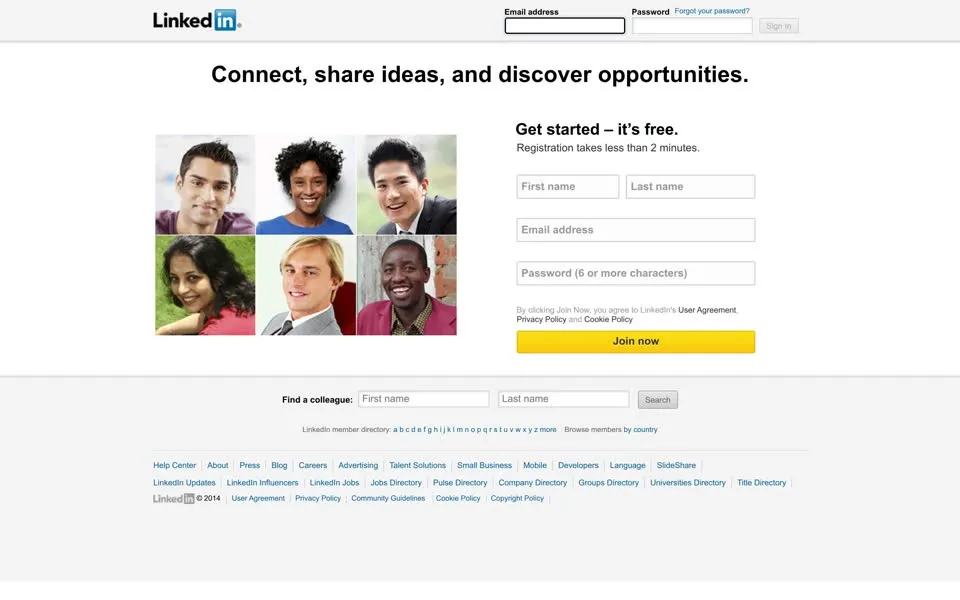
June 2014 swaps the single member for a grid of six smiling faces under a new line: Connect, share ideas, and discover opportunities.
The signup box keeps Get started – it’s free.
and a yellow Join now button. The alt text on the photos, the words a screen reader announces, is less warm. It says Male Headshot
and Female Headshot
.
Ten weeks before this capture, on April 1, 2014, LinkedIn's blog announced Cats You May Know
, a joke feature for connecting with cats. Members could endorse them for random feet attacks, kitty somersaults, and napping in the sun
.[6] The June homepage shows no sign of the joke: six headshots and a yellow Join now button.
LinkedIn’s revolutionary new Cats You May Know recommends new potential cat contacts
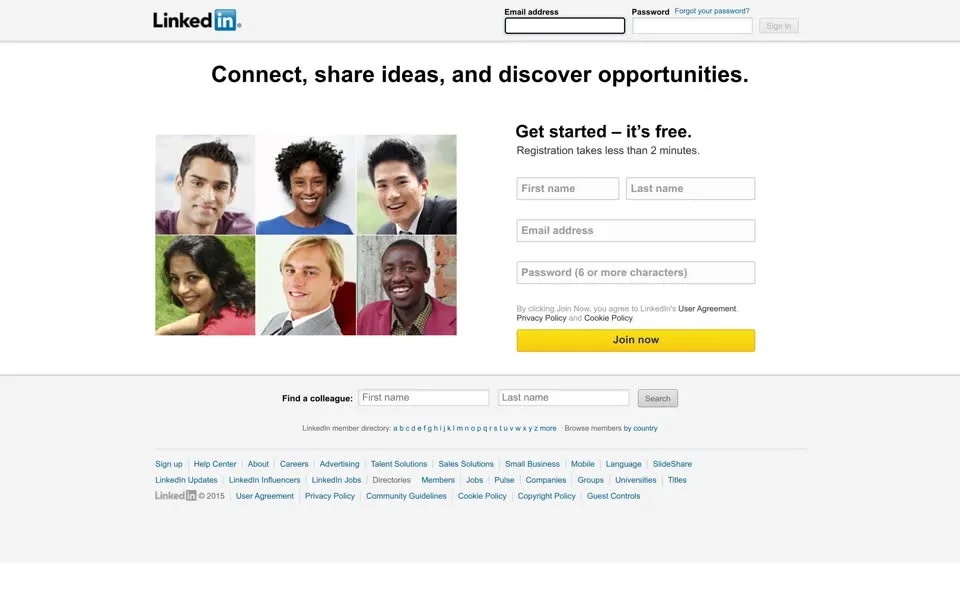
The June 2015 capture keeps the six-headshot signup layout while the footer links change, adding Guest Controls
. In the code, the meta description stays at 300 million+ members
and the language list grows from 22 to 24, adding 正體中文 and العربية.
2016 A wall of faces and a cookie notice
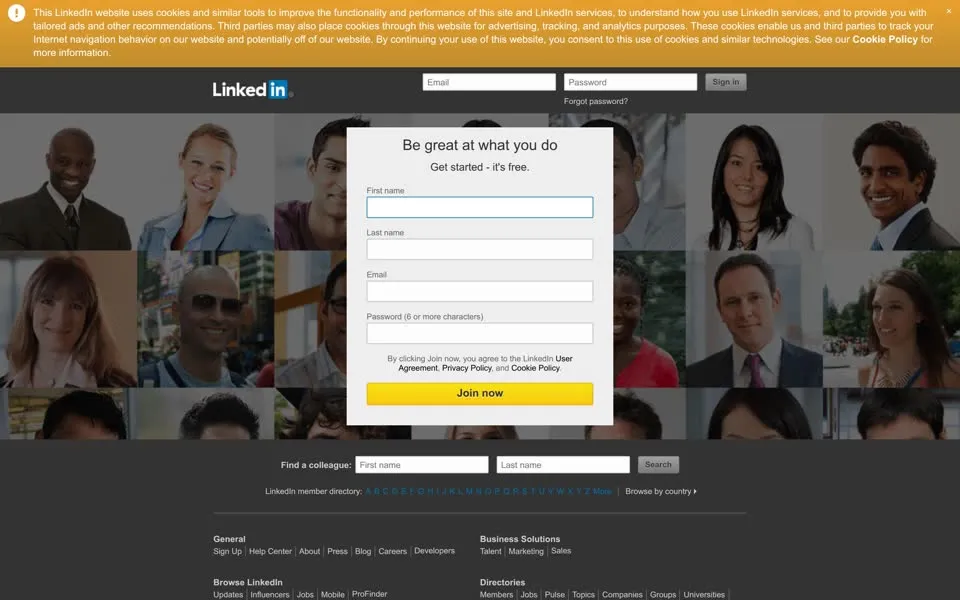
The 2016 page turns dark. A wall of portraits fills the screen and a white box floats over it with Be great at what you do
and Get started - it's free.
Across the top of our capture runs an orange cookie notice, one long paragraph that includes: By continuing your use of this website, you consent to this use of cookies and similar technologies.
On June 13, 2016 Microsoft announced it would buy LinkedIn in a deal valued at $26.2 billion, and said LinkedIn would retain its distinct brand, culture and independence
.[7] Our capture comes from after the announcement, and the page's code doesn't mention Microsoft once. The meta description now says 400 million+ members
. The footer keeps the Guest Controls
link from 2015, a hint at who this page is for: people who are not signed in.
The 2012 theft came back that spring. LinkedIn's help notice says it learned on May 17, 2016, that data stolen in 2012 was being made available online. The notice adds: This was not a new security breach nor were our systems compromised.
[12] Like the 2012 page, our 2016 capture says nothing about it.
2017–2018 The tab that still says “Log In or Sign Up”
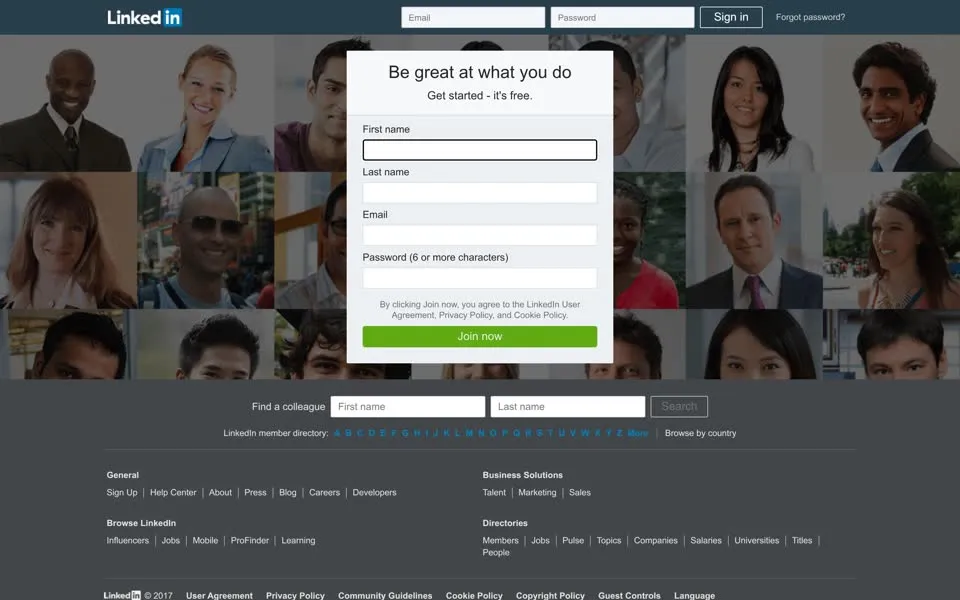
June 2017 keeps the wall of faces, but the browser tab gets the name it still has in 2026: LinkedIn: Log In or Sign Up
. In January LinkedIn had rebuilt the desktop site its members see after signing in, with seven areas in the top bar.[8] The signed-out homepage in our captures kept its 2016 layout. Its meta description reaches 500 million+ members
; LinkedIn had crossed half a billion in April.[1]
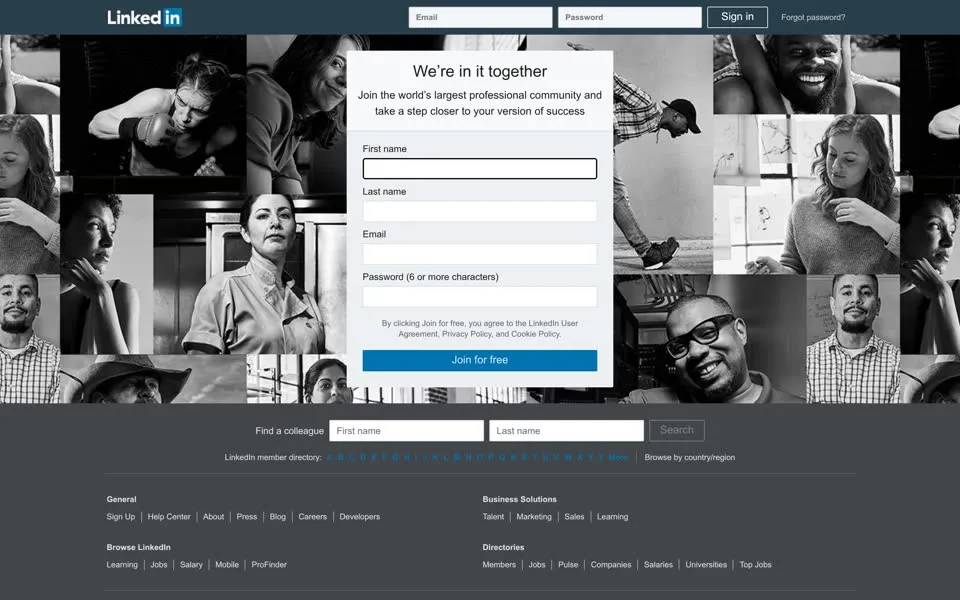
In June 2018 the photos turn black and white and the box gets a new headline, We’re in it together
, with a line under it: Join the world’s largest professional community and take a step closer to your version of success
. The button turns blue and changes its words from Join now
to Join for free
. One small edit in the footer: Browse by country
becomes Browse by country/region
.
2019 “Welcome to your professional community”
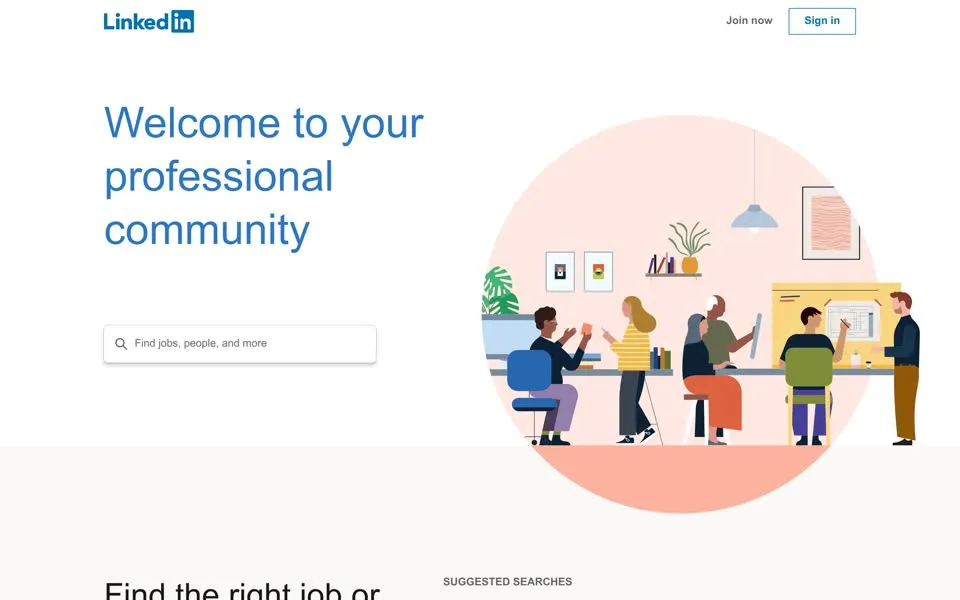
The June 15, 2019 capture looks like a different site. White space, a blue headline, Welcome to your professional community
, and a drawing of people working at a long table inside a big pink circle. The photo collage is gone from the top of the page. Two days earlier LinkedIn had presented the results of a two-year brand project code-named Project Otis.[9] The page is also longer than any before it, with suggested job searches from Sales to Information Technology, Post your job for millions of people to see
and Learn the skills you need to succeed
.
The member count stays in the code, and it's out of date. The meta description still says 500 million+ members
, while LinkedIn's announcement that week counted more than 630 million.[9] The code holds one more clue about the visit. The job search's location field, hidden in this still, contains San Bruno, CA
in the HTML.
2020 “Help and resources during the COVID-19 outbreak”
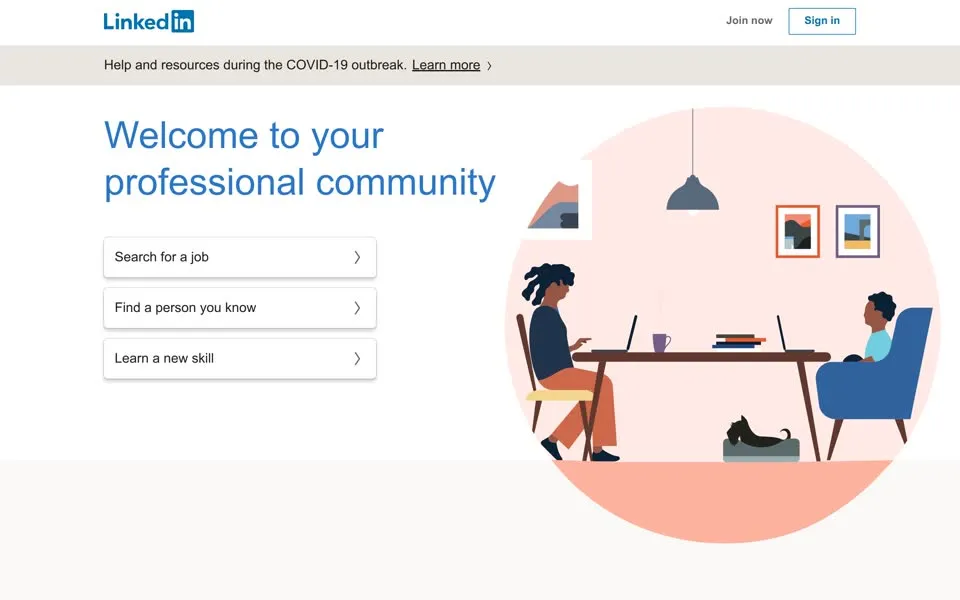
A thin bar tops the June 2020 page: Help and resources during the COVID-19 outbreak.
The drawing moves indoors, one person at a table with a laptop, another in a blue armchair, a cat under the table. Three links replace the search box: Search for a job
, Find a person you know
, Learn a new skill
. Two course tiles read Remote Working: Setting Yourself and Your Teams Up for Success
and Finding a Job during Challenging Economic Times
, and the suggested job searches now start with Remote Jobs
, Warehouse Jobs
and Amazon Jobs
.
Further down, our still shows a member's story headed Noel got a job after being unemployed
; the code holds two more slides. The location field in the HTML now says Phoenix, AZ
. And the code of the closed course menu picks up a small slip that outlives the pandemic. Its topics with a four-digit count end in course
, as in 1,000+ course
. The June 2026 code still has it on 13 of its 19 four-digit topics.
2021–2023 The man with the guitar on the shelf
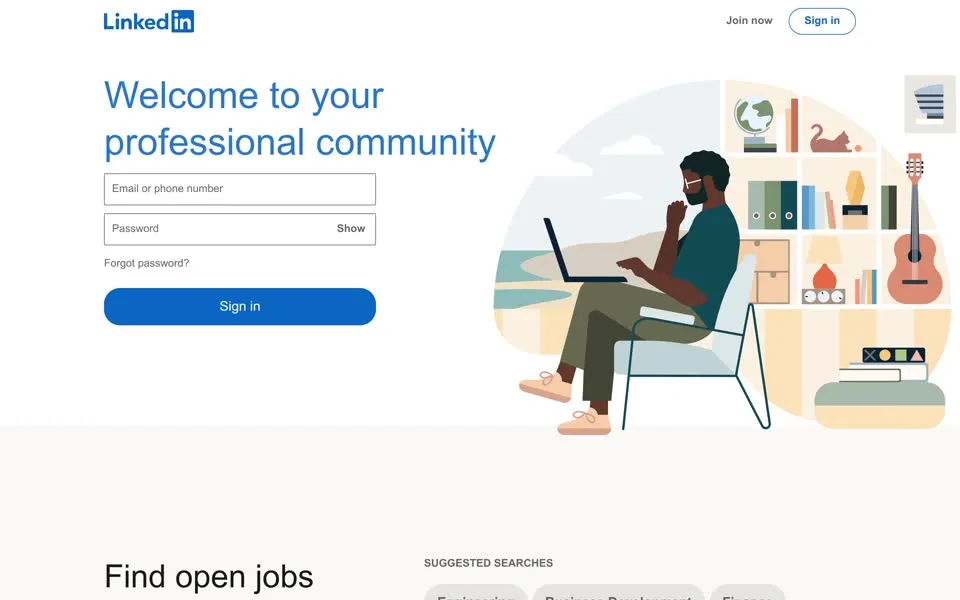
In June 2021 the drawing changes once more, and this time it stays. A man sits sideways in a chair with a laptop; behind him are shelves with a globe, books, a cat and a guitar. The same scene is in every capture from 2021 to 2026. LinkedIn had announced a warmer, simpler look, with illustrations, in September 2020.[10]
What changes around the man is the form. The 2021 page puts a sign-in box on the front page, email or phone and password, with Sign in with Google
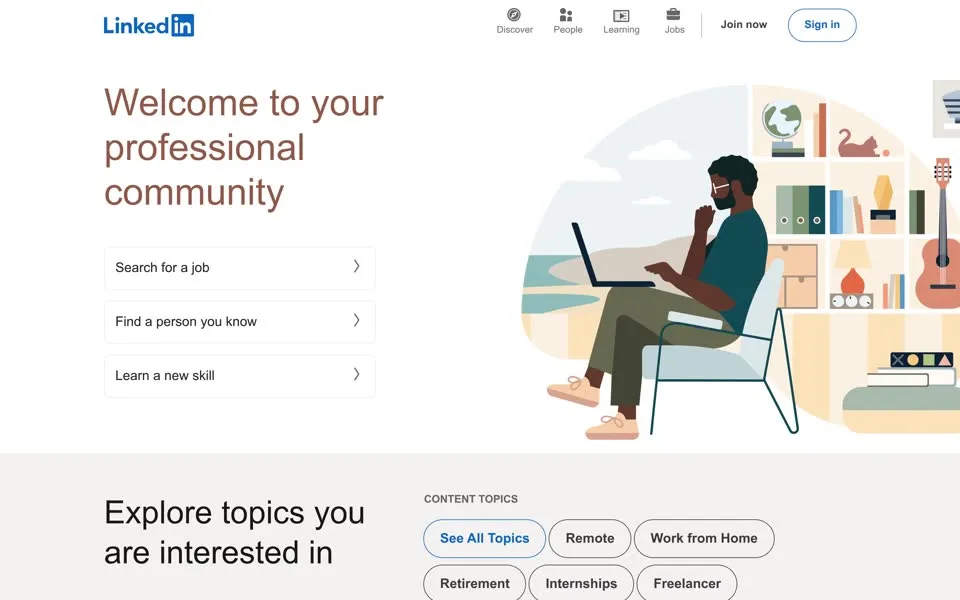
in its code. In 2022 the three links come back, the headline turns a reddish brown and a new row says Explore topics you are interested in
, with buttons such as Remote
and Work from Home
.
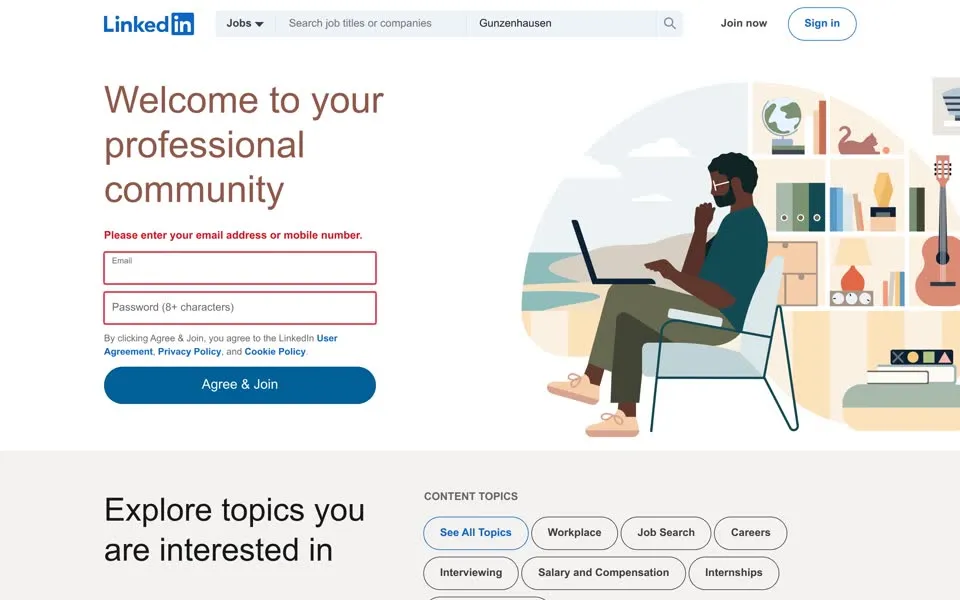
The 2023 still shows an Agree & Join
form with a red line above the email field: Please enter your email address or mobile number.
In the archived HTML the same message sits in hidden code. The meta description says 750 million+ members
all three years.
2024 “Continue with Google”
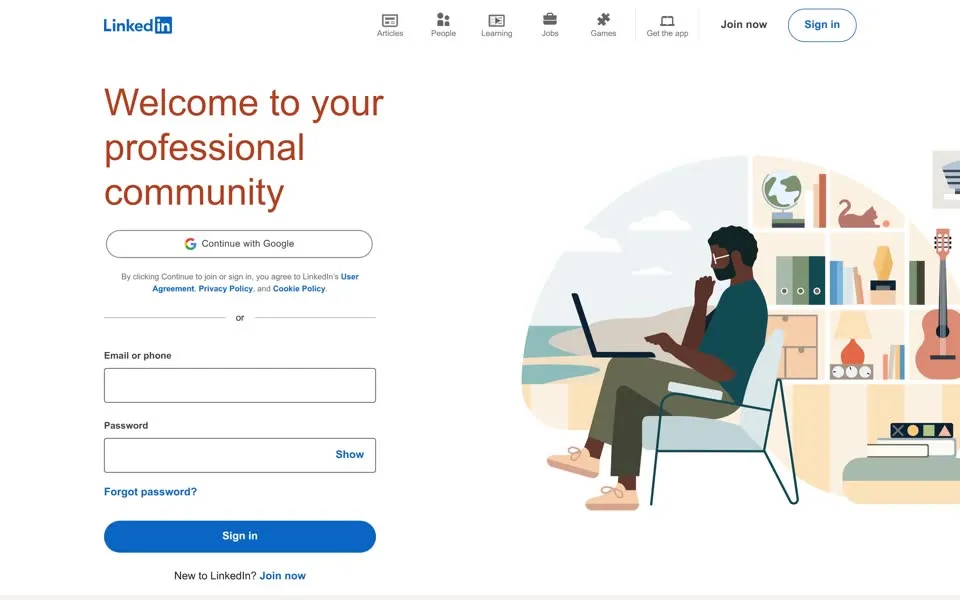
In 2024 the meta description finally says 1 billion members
. LinkedIn's engineering blog was already counting one billion in November 2023.[11] The top of the page is about signing in fast: Continue with Google
in 2024, then a Google button and Sign in with email
stacked in 2025 and 2026. Below come new rows. Explore collaborative articles
explains itself in one line, Experts add insights directly into each article, started with the help of AI.
The same blog post says the feature launched in 2023.[11]
2024–2026 “Keep your mind sharp with games”
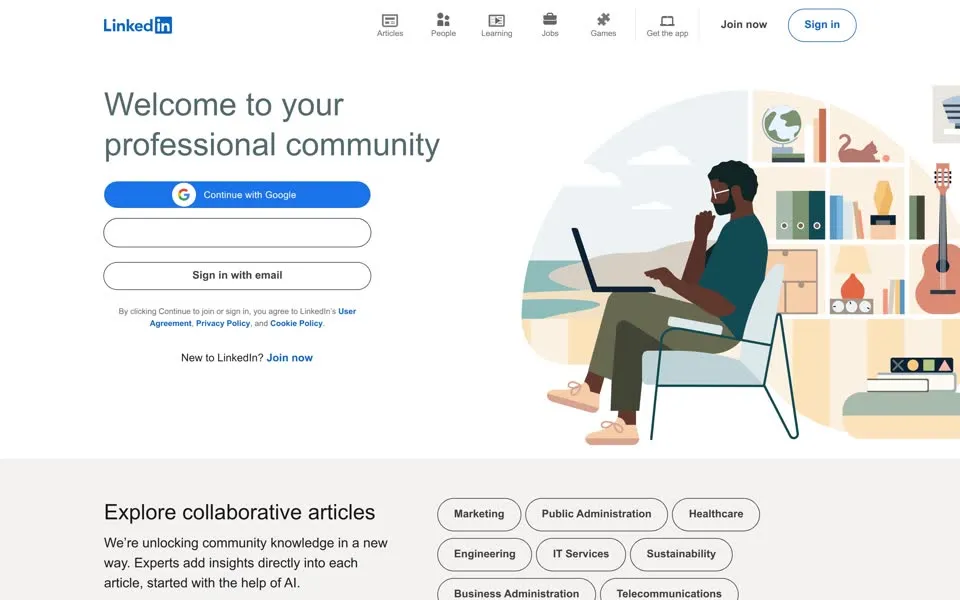
At the bottom of the 2024 full-page still, Keep your mind sharp with games
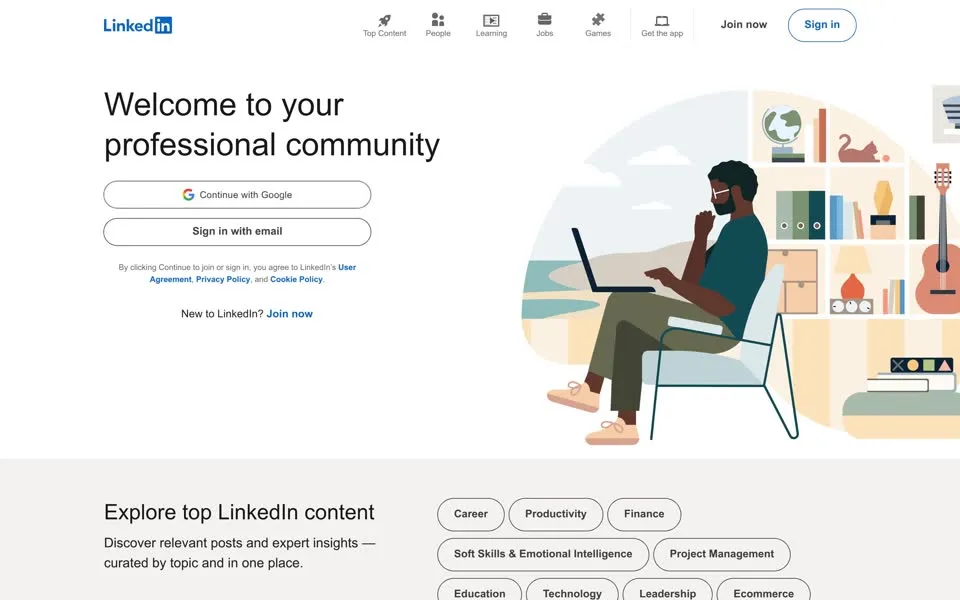
offers three buttons: Pinpoint, Queens and Crossclimb. The code also advertises a Windows app. In 2025 the row has five: Tango and Zip have joined. The June 2026 capture lists seven, adding Patches and Mini Sudoku, and swaps the articles row for Explore top LinkedIn content
.
In 2005 the homepage advertised the size of the club: Join over 3.8 million other professionals now
. The 2026 page says only Post your job for millions of people to see
. The exact number, one billion, is still there, in the line written for search engines.
The 2005 page printed its member count. The 2026 page keeps it in the code.linkedin.com, October 2005 → June 2026
- When was the oldest linkedin.com homepage in this story archived?
- The oldest capture here is from October 15, 2005, in the Internet Archive's Wayback Machine. LinkedIn in October 2005: Find People, Find Jobs and Find Services buttons above “Join over 3.8 million other professionals now”.
- What does the linkedin.com homepage look like in 2026?
- In the newest capture here (June 15, 2026): LinkedIn in June 2026: “Explore top LinkedIn content” and seven daily games, under the drawing first seen here in 2021.
- How many LinkedIn homepage captures does this story show?
- 22 captures between 2005 and 2026, at most one per year; the timeline above shows which years are included.
- How did the LinkedIn logo change on its homepage?
- The logo evolution below shows 5 logo versions we picked from the captures, from 2005, 2008, 2019, 2021 and 2024. Logos from before 2005, the first capture, aren't included.
 2005Black 'Linked' + glossy blue 'in' box
 2008Smaller, lighter wordmark with a brighter 'in' box and ®
 2019Flat blue wordmark and 'in' box, no gradient, no ®
 2021Same shape in a brighter blue (#0A66C2)
 2024Same mark, set smaller in the header
Each logo is cut from that year's homepage capture (the year is the capture's); click one to see it on the page. Logos from before the first capture (2005) aren't shown, and some are missing where the logo images don't render in our captures. More logo histories.
◀ drag ▶20052026
The oldest capture in this story (2005) over the newest (2026). Drag across the picture.
Which homepage should we open next?
Tell us on the PageRewind YouTube channel, and subscribe for more histories of the pages we used to visit.
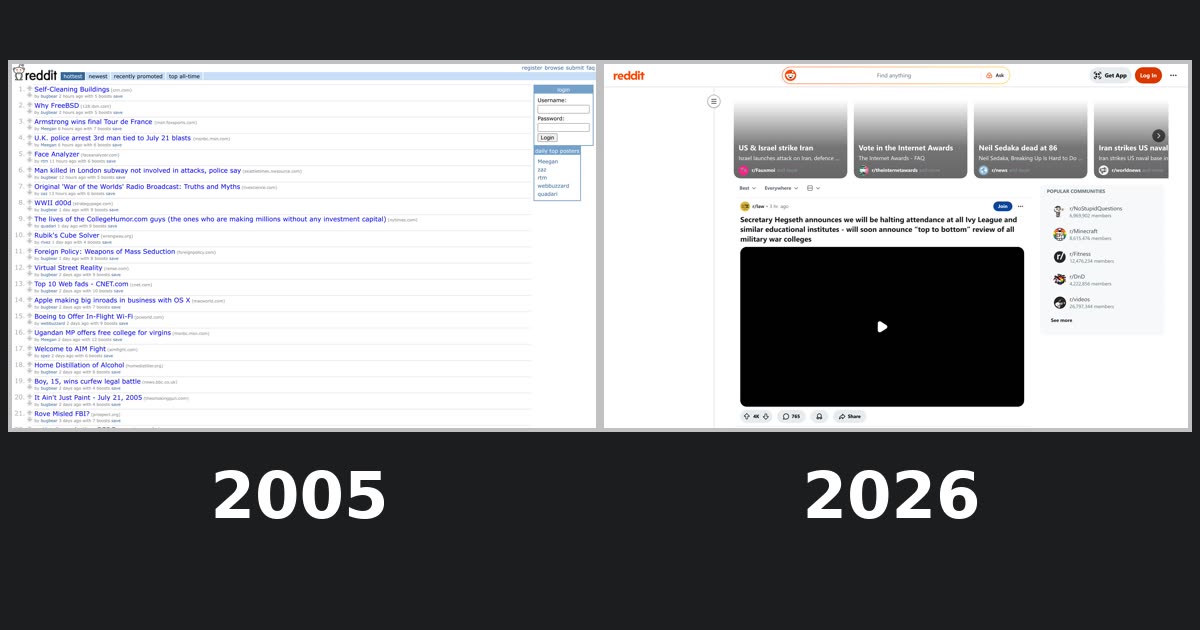 Reddit.com, 2005–2026From “what's new online” to “The heart of the internet”
Sources
External history links here. Homepage wording comes from the dated captures shown alongside it: click a screenshot for the full-page image or its date for the Wayback replay.
- LinkedIn Marketing Blog, “How LinkedIn Has Evolved as a B2B Marketing Tool in Two Decades”, May 5, 2023. LinkedIn ↗Source for the public launch on May 5, 2003 and half a billion members in April 2017.
- LinkedIn Corporation, IPO prospectus (Form 424B4), filed with the SEC in May 2011. SEC EDGAR ↗Source for LinkedIn Jobs revenue from March 2005, the first premium subscription from August 2005 and over 100 million members on March 31, 2011.
- Reid Hoffman, LinkedIn Blog, “LinkedIn Turns 10”, May 5, 2013. LinkedIn ↗Source for the launch tagline “Relationships matter.”
- LinkedIn Blog, “LinkedIn: 50 Million Professionals Worldwide”, October 14, 2009. LinkedIn ↗Source for 477 days to the first million members and 12 days for the latest million.
- LinkedIn Blog, “An Update on LinkedIn Member Passwords Compromised”, June 6, 2012. LinkedIn ↗Source for LinkedIn confirming that compromised passwords belonged to LinkedIn accounts.
- LinkedIn Blog, “Announcing LinkedIn Cats You May Know”, April 1, 2014. LinkedIn ↗Source for the April Fools' feature and its endorsements for napping in the sun.
- Microsoft News Center, “Microsoft to acquire LinkedIn”, June 13, 2016. Microsoft ↗Source for the $26.2 billion deal and the promise that LinkedIn keeps its own brand.
- LinkedIn Pressroom, “Introducing the New LinkedIn Desktop”, January 19, 2017. LinkedIn ↗Source for the signed-in desktop redesign and its seven navigation areas.
- LinkedIn Pressroom, “The LinkedIn Brand: Finding Our Voice and Showing Our Colors”, June 13, 2019. LinkedIn ↗Source for Project Otis, the two-year brand evolution, and more than 630 million members.
- LinkedIn Blog, “A New Look for LinkedIn, From the Inside Out”, September 24, 2020. LinkedIn ↗Source for the warmer, simpler design with illustrations.
- LinkedIn Engineering Blog, “How LinkedIn Built the Engineering Infrastructure to Ignite Professional Knowledge Sharing”, November 20, 2023. LinkedIn ↗Source for one billion members and the launch of collaborative articles earlier in 2023.
- LinkedIn Help, “Notice of data breach: May 2016”. LinkedIn ↗Source for the May 2016 notice that data stolen in 2012 was online again.
How this was made. One capture of the signed-out homepage for each year, 2005–2026: 22 Wayback Machine replays, mostly from mid-June. We found no usable capture from 2003 or 2004. It is a sample of the homepage over time, not every redesign, and it shows what a visitor who is not signed in saw. Some style sheets and images are missing from the replays (2005–2007 most of all), the 2016 capture carries a cookie notice, and full-page views stop at 2,700 pixels. The screenshots show the rendered archive; references to closed menus, alt text, meta descriptions and comments come from each capture's HTML.
PageRewind is independent and not affiliated with LinkedIn. LinkedIn and the “in” logo are trademarks of LinkedIn Corporation.
 Orkut homepage history
 Digg homepage history