In October 2026, spotify.com took us straight to a music player. In our capture from Poland a search box asks What do you want to play?
, a row of trending songs runs across the screen, and a purple bar along the bottom says Sign up free
. On November 8, 2006, the homepage had a contact address spelled out in words, info at spotify dot com
, and one box: Enter your email below to be informed when exciting stuff happens
.
Scrub through the captures with the slider, or read on.
This is the story of spotify.com’s homepage from 2006 to 2026, told through 17 yearly captures and one extra from the last day of 2015. Spotify launched in October 2008, in six European countries, and for most of the years after that its homepage was a sales page: it promotes a beta, invitation codes, a download and three months of Premium for $0.99. Our June 2022 capture is still a sales page. By January 2025 the homepage is the player itself. On the way there is a name nobody planned, a new green that users begged Spotify to take back, and a Swiss flag on Wall Street.
2006 – 2007 A misheard name and an email box
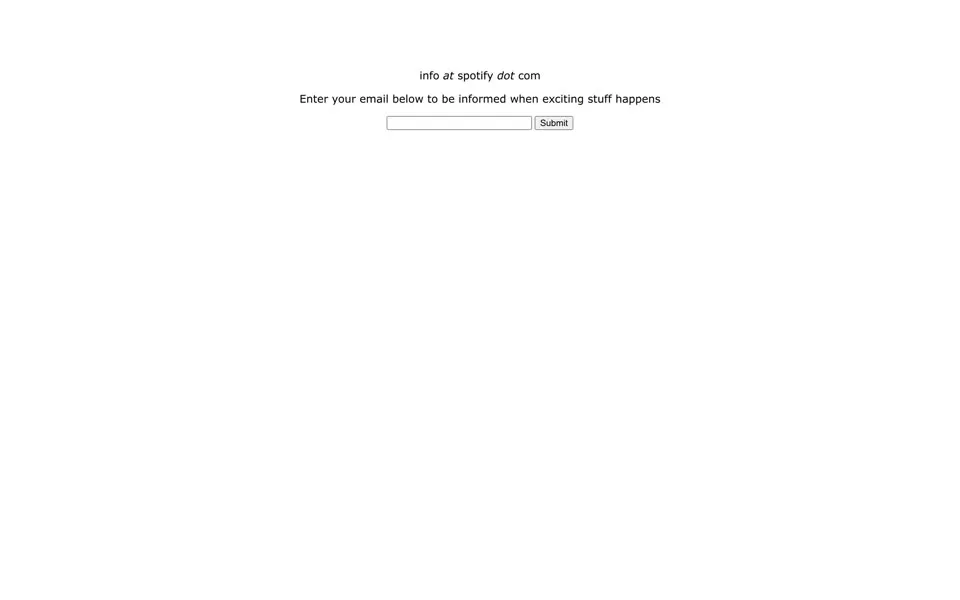
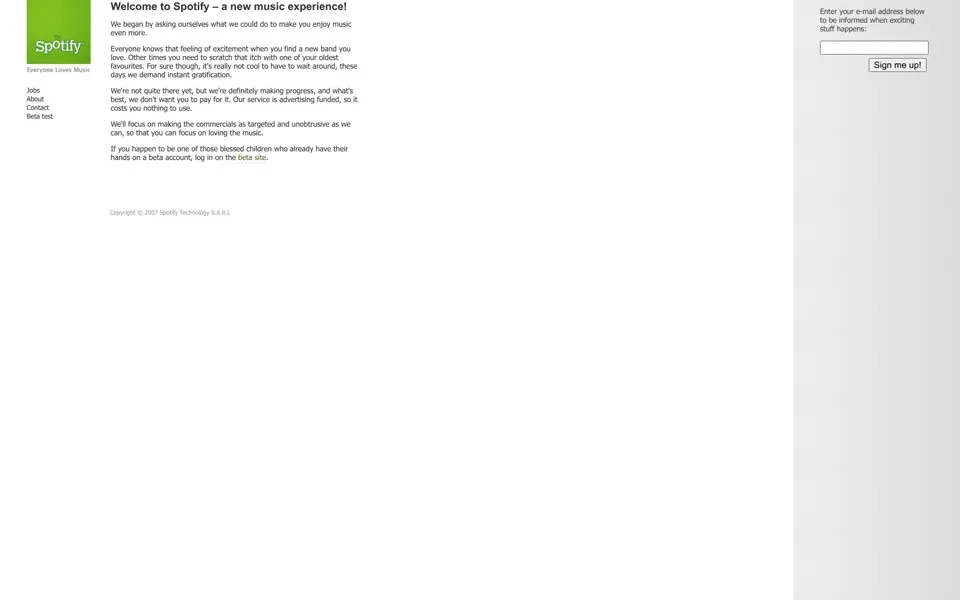
The November 2006 capture, on the left, is the oldest homepage we use, and it holds three lines of text: a logo whose image is missing from this replay, the spelled-out address and the email box. Daniel Ek and Martin Lorentzon had founded Spotify that year.[1]
Even the name was an accident. Spotify’s brand team says it was misheard in a brainstorm
while the two founders were throwing around ideas, and the meaning came later
. The explanation most people know, a blend of spot
and identify
, is what the team calls the lore.[2]
By June 2007, on the right, the page has a green square logo with a tagline under it, Everyone Loves Music
, and a headline: Welcome to Spotify – a new music experience!
The text is chatty, these days we demand instant gratification
, and the business plan fits in two sentences: we don’t want you to pay for it. Our service is advertising funded, so it costs you nothing to use.
Still no music to play. The email box now has a button, Sign me up!
, the menu has a Beta test
link, and the last paragraph is for insiders: If you happen to be one of those blessed children who already have their hands on a beta account, log in on the beta site.
2008 – 2009 Not available in your country yet
We have no picture for 2008. The replays we checked are unstyled, and the code of the January 2008 capture still lists Beta-test
in its menu. In October 2008 Spotify launched in Finland, France, Norway, Spain, Sweden and the UK.[1] The company later described what it set out to build as a legal, better alternative to piracy
.[3]
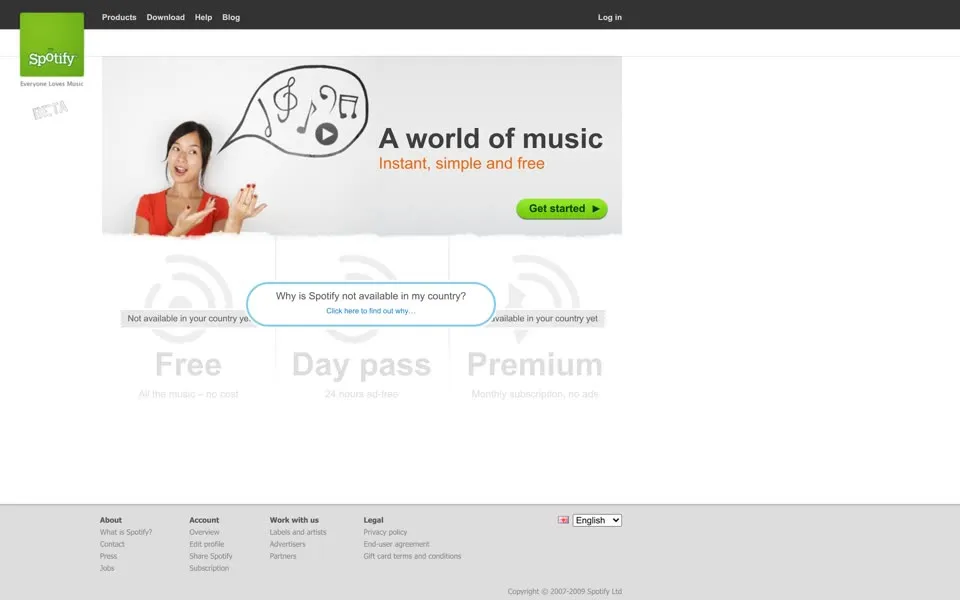
The June 2009 homepage is the first one that looks like a product page. A woman in red stands beside a speech bubble full of notes, next to A world of music
and Instant, simple and free
. A green button says Get started
. Below are three plans: Free, All the music – no cost
; Day pass, 24 hours ad-free
; and Premium, Monthly subscription, no ads
. All three are greyed out.
Day pass: Not available in your country yet
Premium: Not available in your country yet
Why is Spotify not available in my country? Click here to find out why…
That is what the archive’s crawler was told, three times. A faded BETA
stamp sits under the logo. The page’s code explains the rest: Spotify free is currently in an invitation-only beta, which means you need to have received an invitation token to access the service.
Spotify went mobile that September.[1]
2010 – 2011 Sorry, the invitations are running late
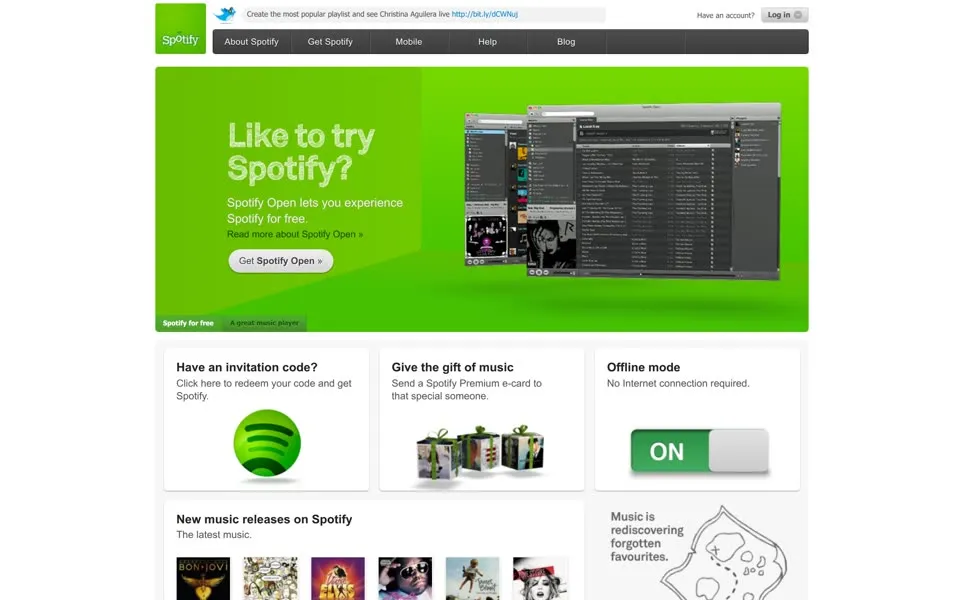
In June 2010 a small blue Twitter bird sits beside the logo, next to a line from the company’s feed: Create the most popular playlist and see Christina Aguilera live
. The big green banner asks Like to try Spotify?
and offers Spotify Open, which lets you experience Spotify for free
. Under it, three tiles: Have an invitation code?
, Give the gift of music
and Offline mode
, with a switch set to ON.
The invitation tile had a problem, and the page’s code admits it, typo and all:
The country menu in that code lists Finland, France, International, Netherlands, Norway, Spain, Sweden and United Kingdom. In September 2010 Spotify reported 10 million users.[1]
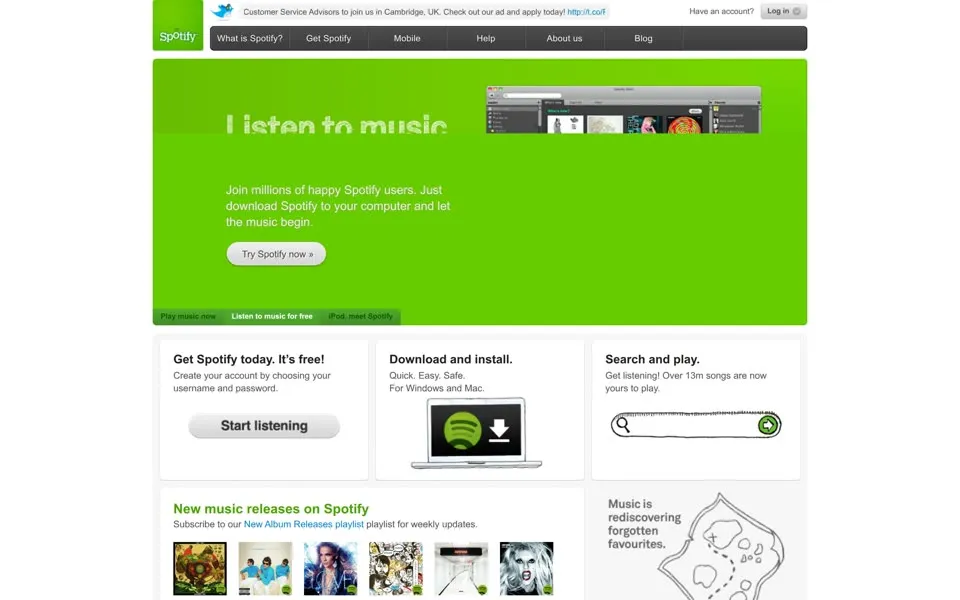
The June 2011 page keeps the green and drops the invitations. The slideshow is caught on Listen to music
: Join millions of happy Spotify users. Just download Spotify to your computer and let the music begin.
Three boxes walk you through it, from Get Spotify today. It’s free!
to Search and play
, where Over 13m songs are now yours to play.
The feed line at the top is a job ad for Customer Service Advisors
in Cambridge, UK. Spotify launched in the United States a month later, in July 2011.[1]
2012 The download goes to the small print
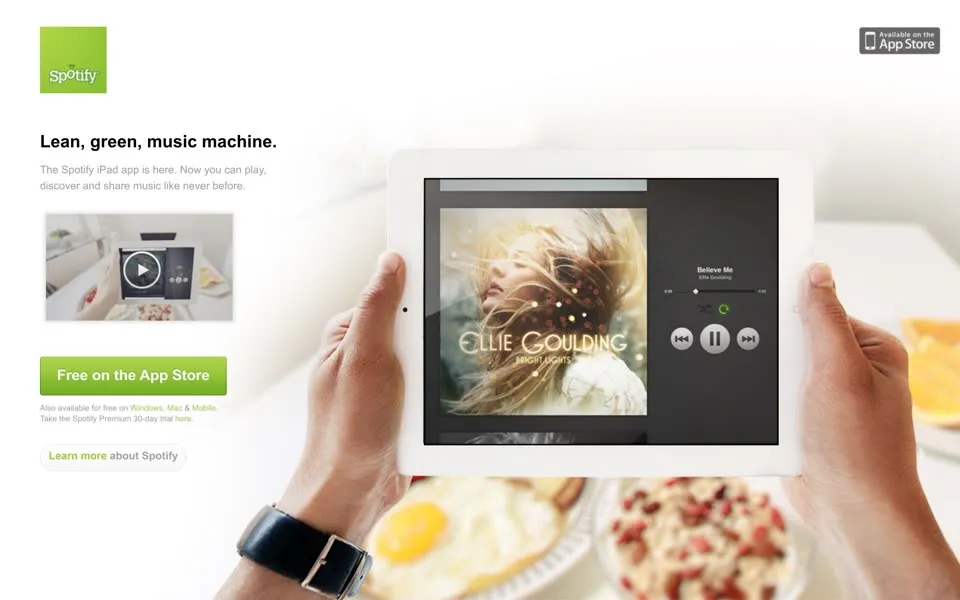
A year after Just download Spotify to your computer
, the desktop app gets one line of small print: Also available for free on Windows, Mac & Mobile
. The June 2012 capture is Spotify’s US page, and it sells the iPad app. A hand holds one over a breakfast table, with Ellie Goulding on the screen, under Lean, green, music machine.
The main button says Free on the App Store
, and the browser tab reads iPad - Spotify
.
2013 – 2014 Soundtrack your life
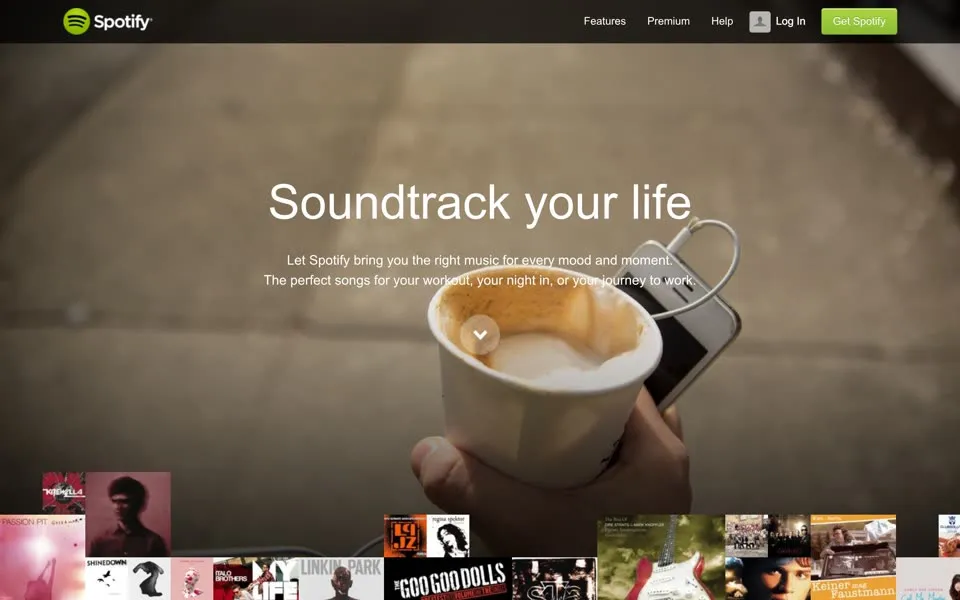
In June 2013 the screenshots of the software are gone. A photograph fills the screen: a cup of coffee, and Soundtrack your life
. The perfect songs for your workout, your night in, or your journey to work.
Along the bottom runs a strip of album covers. The page’s code left a note about it: 128px is the bottom area covered by the toplist album artwork strip; number is somewhat arbitrary.
The logo has changed too. The green square is now a green circle with three curved sound waves, next to the word Spotify. Further down, the code lists three plans: Free, Made possible by ads
; Unlimited at $4.99 a month
; and Premium at $9.99 a month
. Its footer has a link, Find us on Google+
.
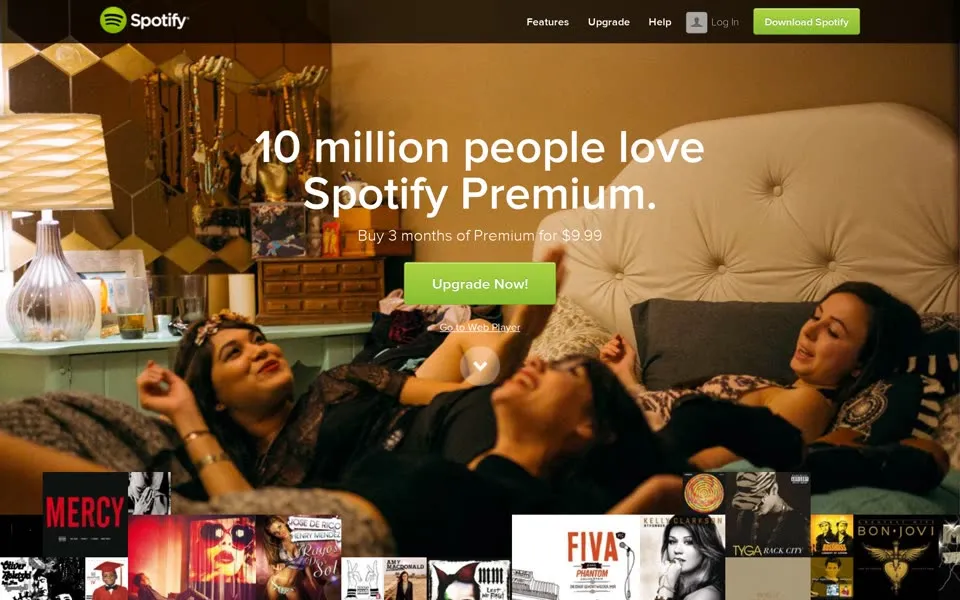
The June 2014 still opens on friends lying on a sofa, under 10 million people love Spotify Premium.
and Buy 3 months of Premium for $9.99
. That banner isn’t in the page’s saved HTML, which has a different headline: Music for everyone. Spotify is now free on mobile, tablet and computer.
Spotify first offered free listening on mobile in 2013.[1]
2015 $0.99, and a hazardous green
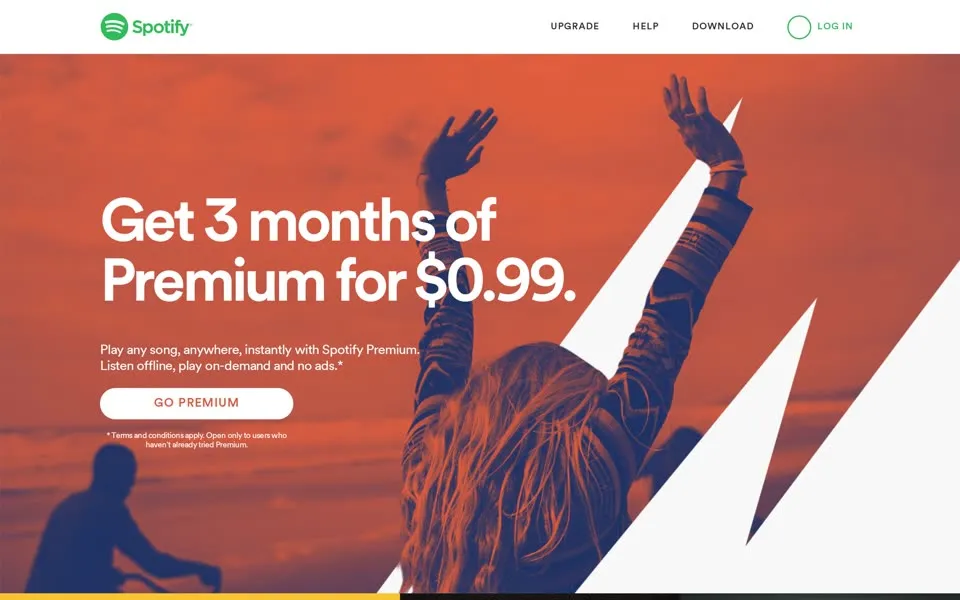
The June 2015 US page is orange and red. A woman with raised arms is printed in two tones, next to Get 3 months of Premium for $0.99.
Below, a yellow block says Music for everyone.
and a white one says Your daily soundtrack.
According to the agency COLLINS, its Spotify identity work included this two-tone treatment, a technique that draws from the duotone screen-printing used throughout music’s history
.[5]
About two weeks after this capture, Spotify changed something smaller: an update to its iOS app brought a brighter green logo. That was enough. Digiday described it as a bright shade of hazardous green
and quoted Twitter reactions calling it hideous
and comparing the logo to something slimed by Nickelodeon
.[4] On Spotify’s own forum, one user asked for a reversal:[10]
2015 – 2018 A billion streams, and a Swiss flag
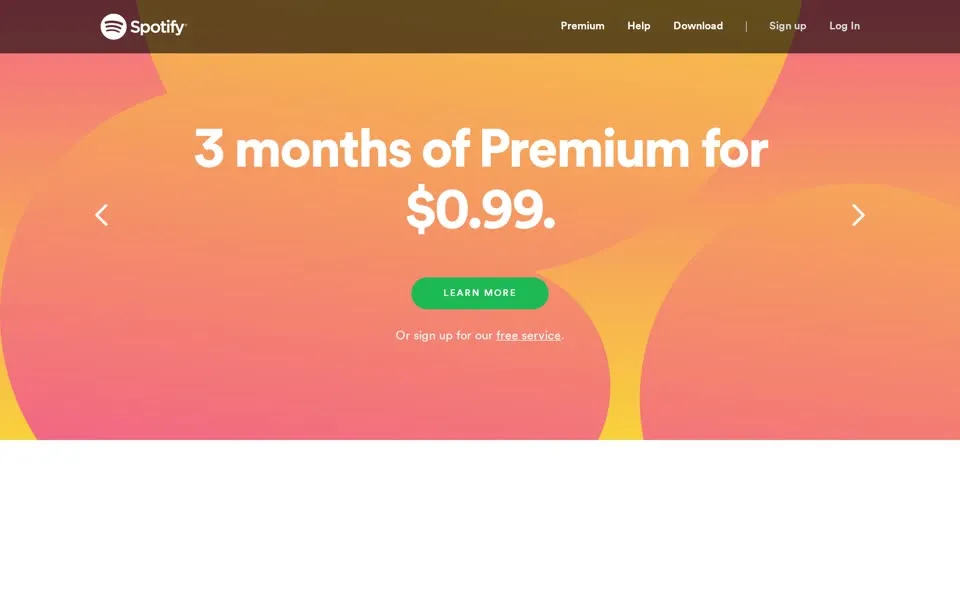
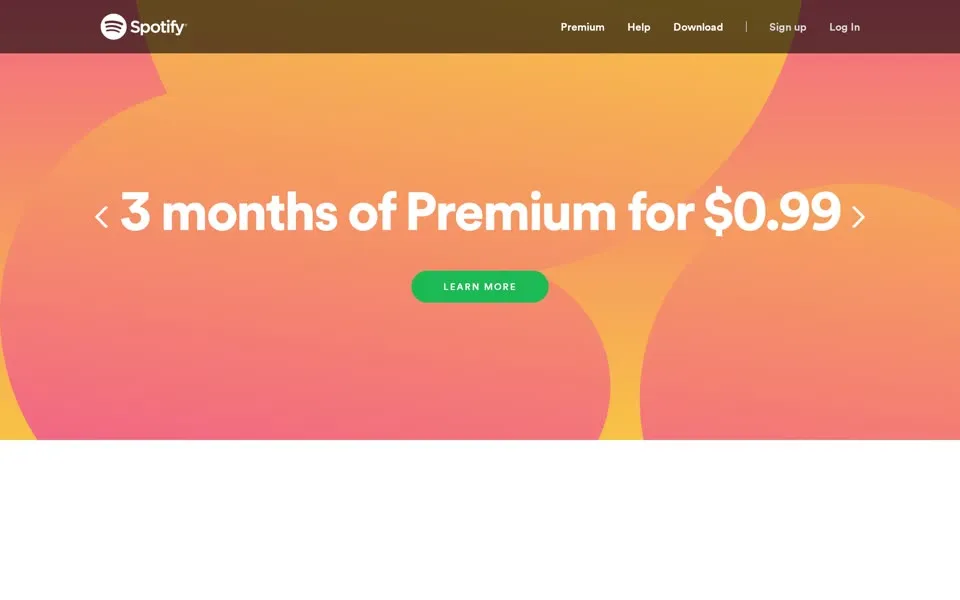
The June 2015, December 2015, June 2017 and June 2018 captures all show the same top-banner offer. On the last day of 2015 it is dark blue: 3 months of Premium for $0.99
, Only $9.99/month afterwards.
In June 2017 it is a coral gradient with soft circles, and in June 2018 it looks almost the same.
The slides behind it, in the code, change more: from Premium for your whole family. Just $14.99.
in 2017 to Premium for Students, now with Hulu. Only $4.99/month.
and Xbox One in 2018.
Scroll down the December 2015 page and a pink band asks How did 2015 sound to you?
, with a button, Get Spotify’s Year In Music
. Spotify dates its Wrapped tradition to that month, when it still went by that name.[1]
We have no usable homepage from 2016. The year still left a mark in Spotify’s records:
The change that mattered in 2018 is in the footer, which the stills don’t reach but the code keeps. In 2017 it lists About, Jobs, Press and News. In 2018 the press links give way to For the Record
, and a new link appears: Investors
. Two months before, in April 2018, Spotify had listed on the New York Stock Exchange as SPOT.[1]
On the day of the debut, the exchange welcomed the Swedish company by flying a Swiss flag at its entrance.[6]
2019 – 2020 No credit card needed
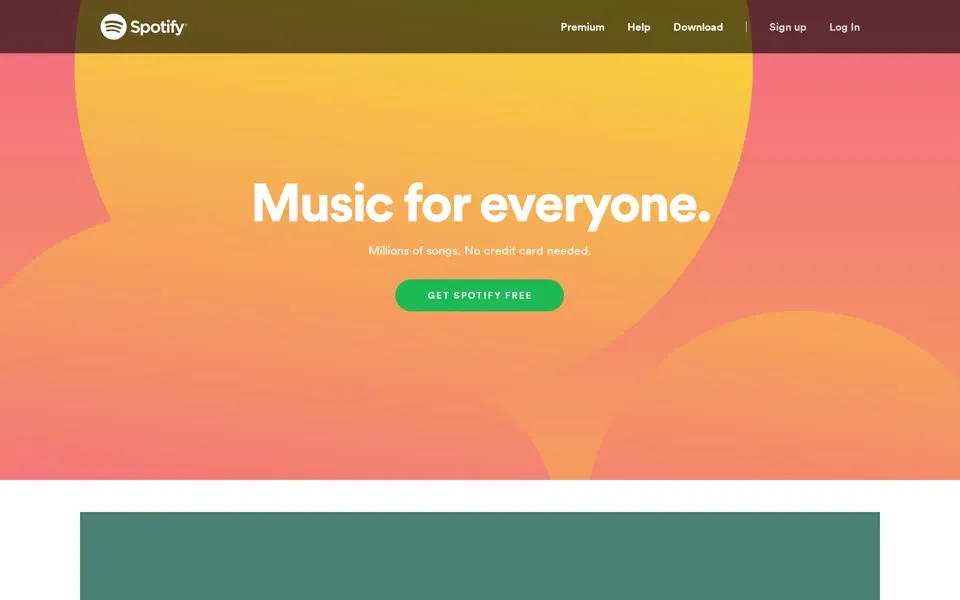
The June 2019 homepage leads with the free plan. The gradient banner says Music for everyone.
and Millions of songs. No credit card needed.
, with a green button, GET SPOTIFY FREE
. The $0.99 offer drops to a green box further down, with a deadline: Offer ends Jun 30, 2019.
That February, Daniel Ek had announced the purchase of two podcast companies, Gimlet and Anchor.[7] The June banner still says songs, not podcasts.
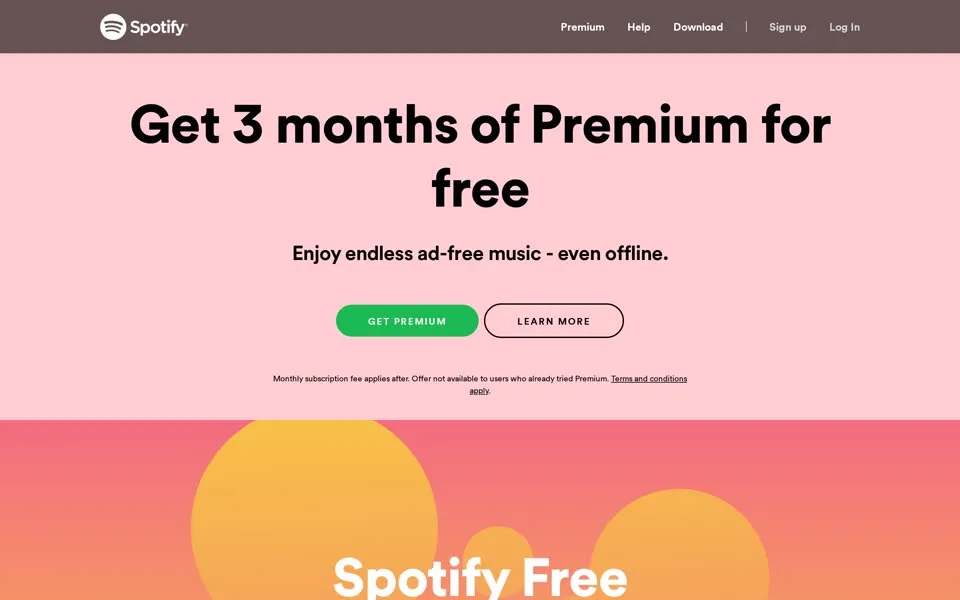
In June 2020 Premium is back on top, now with three months for free. The banner is flat pink: Get 3 months of Premium for free
, Enjoy endless ad-free music - even offline.
Below it, an orange band repeats the free plan. The footer gains a line of fine print for one US state: Additional CA Privacy Disclosures
.
That December, the year-end list that began as Year in Music crowned someone new. Bad Bunny became the world’s most-streamed artist on Spotify Wrapped, the first non-English-speaking artist with the title.[1]
2021 – 2022 Listening is everything
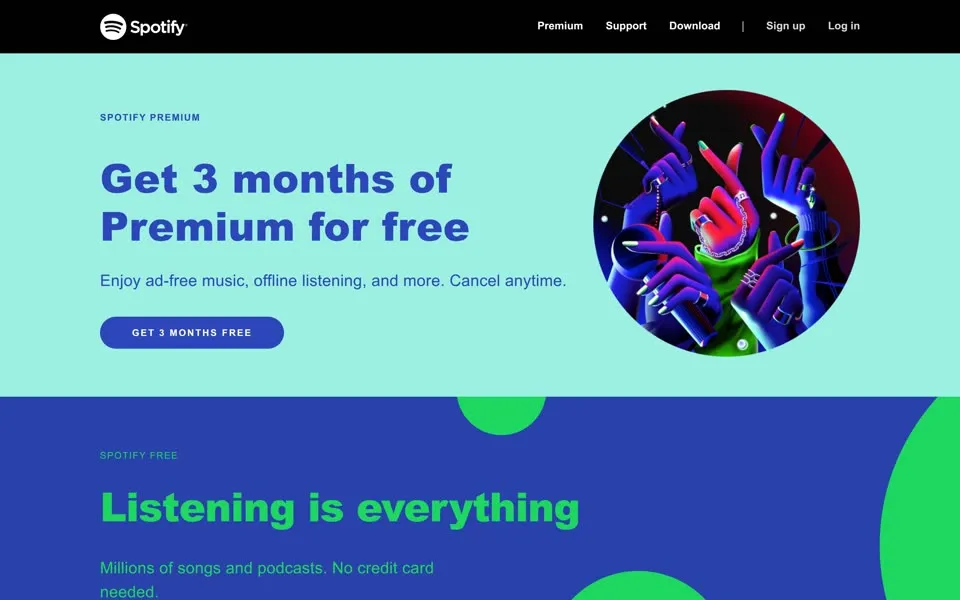
The May 2021 US capture, on the left, stacks a mint-green Premium banner, Get 3 months of Premium for free
, above a new slogan on blue: Listening is everything
. The line under it adds a word that wasn’t in the 2019 or 2020 banners: Millions of songs and podcasts. No credit card needed.
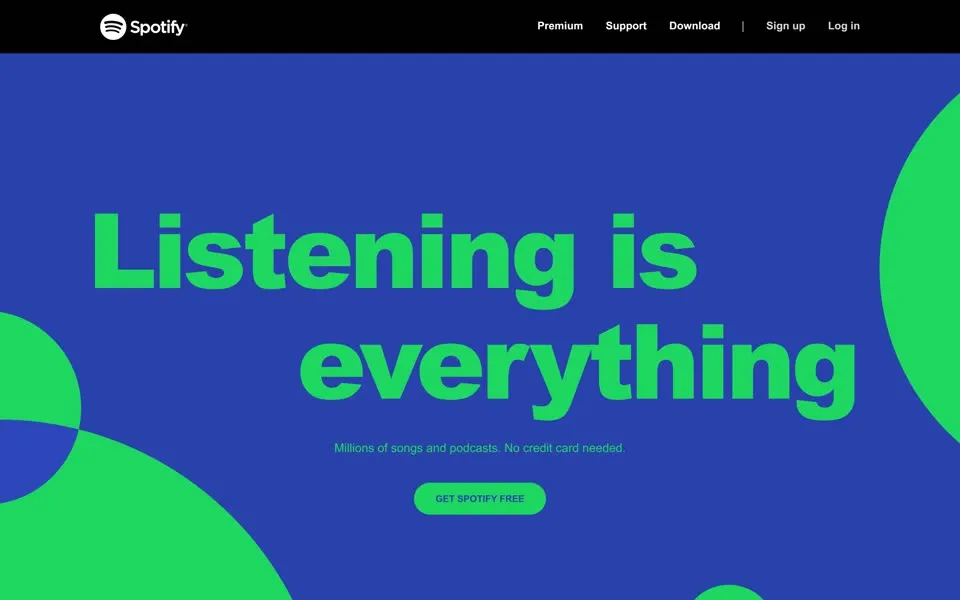
By June 2022 the slogan is the whole page. Listening is everything
runs across the blue in huge green letters, over the same small line and one button, GET SPOTIFY FREE
. No price, no photo. The footer has a new product link, Car Thing
, and that year Spotify moved into audiobooks.[8] It is the last capture here that looks like a sales page.
2023 – 2026 What do you want to play?
For 2023 and 2024 the archive’s replays show only a loading skeleton or an error. The homepage had become the web player, and the player doesn’t replay well.
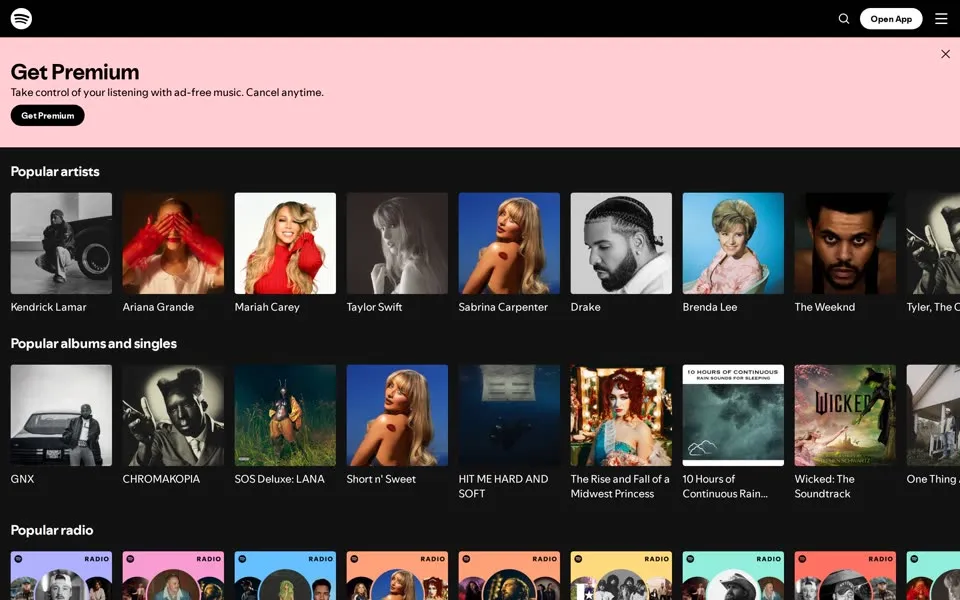
The January 1, 2025 capture does. The browser tab says Spotify - Web Player: Music for everyone
. A pink banner says Get Premium
, and under it come rows of covers: popular artists, albums and radio stations.
Kendrick Lamar and Taylor Swift share the popular-artists row with Brenda Lee. It is New Year’s Day, and the row continues in the code with Bobby Helms, Frank Sinatra, Wham!, Michael Bublé and Dean Martin. Among the popular albums, between HIT ME HARD AND SOFT and Wicked: The Soundtrack, sits 10 Hours of Continuous Rain Sounds for Sleeping.
That December, Wrapped set a record: over 200 million fans looked back at their year within the first 24 hours.[1]
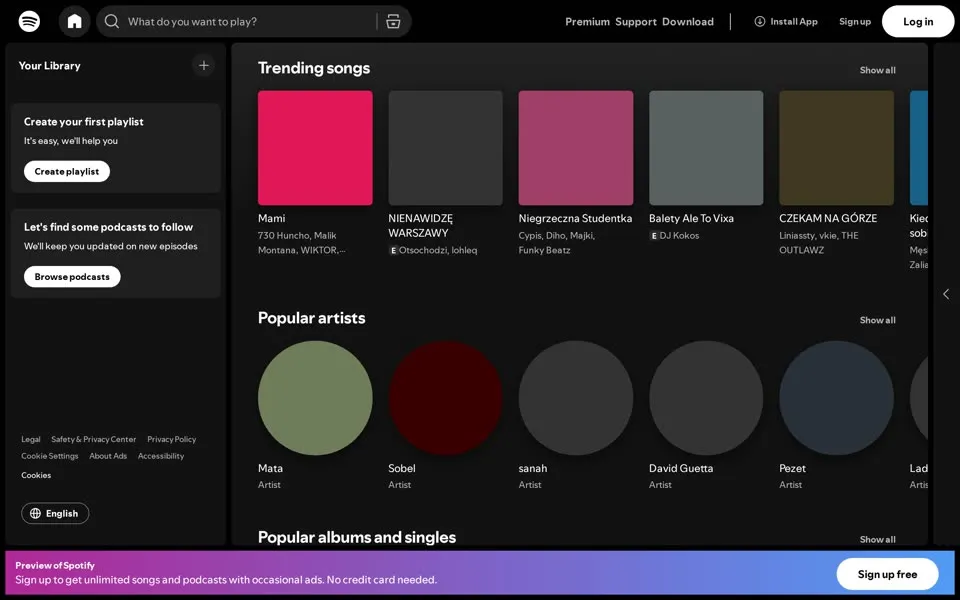
The last frame is the live site, which we shot from Poland, so the trending songs are the ones Spotify showed in Poland: Mami
, NIENAWIDZĘ WARSZAWY
, Balety Ale To Vixa
. On the left, Your Library
suggests Create your first playlist
. When we checked the US address on October 8, 2026, www.spotify.com/us/ redirected to this player.[9]
The search box at the top asks What do you want to play?
Spotify knows the most common answer:
Lovesince December 2018, when Spotify began counting. In April 2026 Spotify reported it as its most searched word across all languages.[11]
2006 → 2026 Sign up, then and now
In 2006 the only thing on spotify.com you could use was a box for your email, so the company could tell you when exciting stuff happens
. In 2007 the button under it said Sign me up!
.
In 2026 there is still a sign-up button. It sits at the right end of a bar at the bottom of the screen, Sign up free
, next to a line that reads Sign up to get unlimited songs and podcasts with occasional ads. No credit card needed.
Above it are the songs.
2007 · Sign me up!2026 · Sign up freeSign me up!button. October 2026, live site: the web player, trending songs and a
Sign up freebar. Drag to compare.
- When was the oldest spotify.com homepage in this story archived?
- The oldest capture here is from November 8, 2006, in the Internet Archive's Wayback Machine. Spotify’s homepage in November 2006: “info at spotify dot com” and one email box, to be told “when exciting stuff happens”.
- What does the spotify.com homepage look like in 2026?
- In the newest capture here (live): Spotify’s homepage in October 2026 (live site): the web player, “What do you want to play?”, trending songs and a “Sign up free” bar.
- How many Spotify homepage captures does this story show?
- 17 captures between 2006 and 2026, at most one per year; the timeline above shows which years are included.
- Where does the name Spotify come from?
- Spotify’s brand team says the name was misheard in a brainstorm between the founders, Daniel Ek and Martin Lorentzon, and the meaning came later.
- When did Spotify launch?
- In October 2008, in Finland, France, Norway, Spain, Sweden and the UK. The United States followed in July 2011.
- Why was there a Swiss flag at Spotify’s stock market debut?
- When Spotify listed on the New York Stock Exchange in April 2018, the exchange welcomed the Swedish company by flying a Swiss flag at its entrance.
- How did the Spotify logo change on its homepage?
- The logo evolution below shows 4 logo versions we picked from the captures, from 2007, 2010, 2013 and 2015. Logos from before 2006, the first capture, aren't included.
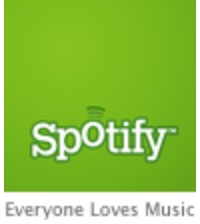 2007Green square with 'Spotify' wordmark and 'Everyone Loves Music' tagline
 2010Tagline dropped, flatter wordmark in the green square
 2013Green square becomes a circle with sound waves, wordmark in clean sans
 2015Brighter, more saturated green, same circle shape
Each logo is cut from that year's homepage capture (the year is the capture's); click one to see it on the page. Logos from before the first capture (2006) aren't shown, and some are missing where the logo images don't render in our captures. More logo histories.
◀ drag ▶20062026
The oldest capture in this story (2006) over the newest (2026). Drag across the picture.
Which homepage should we open next?
Tell us on the PageRewind YouTube channel, and subscribe for more histories of the pages we used to visit.
 Youtube.com, 2005–2026From a dating form to a grid of thumbnails
Sources
Each screenshot links to its dated Wayback capture or, for 2026, the live site. Observations about layouts and wording refer to those screenshots; lines read from a page’s code are identified as such. External history uses the sources below.
- Spotify Newsroom · Spotify timeline: founding by Daniel Ek and Martin Lorentzon (2006), launch in six countries (October 2008), mobile (September 2009), 10 million users (September 2010), US launch (July 2011), free mobile listening (2013), “Year in Music” (December 2015), NYSE listing as SPOT (April 2018), Bad Bunny as Wrapped’s first non-English-speaking top artist (December 2020), Wrapped’s over 200 million fans within its first 24 hours (December 2025). Checked October 8, 2026. Read source ↗
- Spotify Newsroom · The Look Behind the Sound (Spotify design history): the name “was misheard in a brainstorm” and “the meaning came later”; April 23, 2026. Read source ↗
- Spotify Newsroom · Celebrating a decade of discovery on Spotify: “a legal, better alternative to piracy”; October 10, 2018. Read source ↗
- Digiday · Spotify changed the color of its logo and everyone is freaking out; June 16, 2015. Read source ↗
- COLLINS · Spotify brand identity case study: the duotone “Lens” technique. Read source ↗
- ABC News · Wall Street welcomes Swedish outfit’s debut with Swiss flag; April 4, 2018. Read source ↗
- Spotify Newsroom · Daniel Ek, Audio-first: the acquisitions of Gimlet and Anchor; February 6, 2019. Read source ↗
- Spotify Newsroom · Company info: “In 2022, we took the next leap, entering the fast-growing audiobook market”. Checked October 8, 2026. Read source ↗
- Spotify · Live check of www.spotify.com/us/, which redirected to the web player at open.spotify.com; October 8, 2026. Read source ↗
- Spotify Community · Forum thread “Spotify 3.3.0 green update”: “Please change back to the appealing, original logo.”; June 16, 2015. Read source ↗
- Spotify Newsroom · What 20 Years of Spotify Data Reveals About Our Listeners: One Dance, the first song to 1 billion streams (December 16, 2016); “Love”, 4.3 billion searches since December 2018; April 23, 2026. Read source ↗
We selected one homepage capture of spotify.com for each year we could use, 2006 to 2026, mostly from June: 16 Wayback captures in the timeline, one more from December 31, 2015 in the 2015–2018 chapter, and a live-site frame for 2026, shot on October 9, 2026 from Poland. There is no picture for 2008 (the replays we checked appear unstyled), 2016 (the 2016 replays we checked had largely blank main banners) or 2023 and 2024 (the web player replayed as a loading skeleton or an error). For 2012, 2015, December 2015 and 2021 we used the US address, www.spotify.com/us/, because the main address gave a blank page or another country’s version. Each preview is the first screen of a 1440-pixel-wide still; click it for the captured page, up to 2,700 pixels tall, and its link. Where consecutive years look almost the same (2006 and 2007, December 2015 to 2018, 2021 and 2022) they are shown side by side at a smaller size. The browser frames are illustrations of the eras.
A replay can mix a dated page with files saved at other times: the 2014 banner isn’t in that capture’s HTML. Parts of the 2013, 2014, 2017 and 2018 stills are blank where sections didn’t render (the code still has them, for example “What’s on Spotify?” in 2017 and 2018), and the 2019 footer’s social icons show as empty circles. The 2006 logo image is missing, and the 2026 covers show as plain squares. We hid cookie-consent banners while shooting.
PageRewind is independent and is not affiliated with Spotify. Screenshots and trademarks appear for historical commentary; archived pages are provided by the Internet Archive.
 Hulu homepage history
 Last.fm homepage history