In June 2004, Orkut put a collage of faces between its introduction and a surprisingly mathematical invitation: Join orkut to expand the circumference of your social circle.
A username and password box waited on the right. Your friends were somewhere on the other side.
Orkut's homepage history from 2004 to 2026 follows that invitation as it changes destination. These 23 captures move from joining a social network to browsing its public community archive, then reading letters from the engineer whose name was on the logo. The address kept finding something to say after the conversations ended.
Scrub through the captures, or follow the story below.
2004–2007 A friend had to let you in
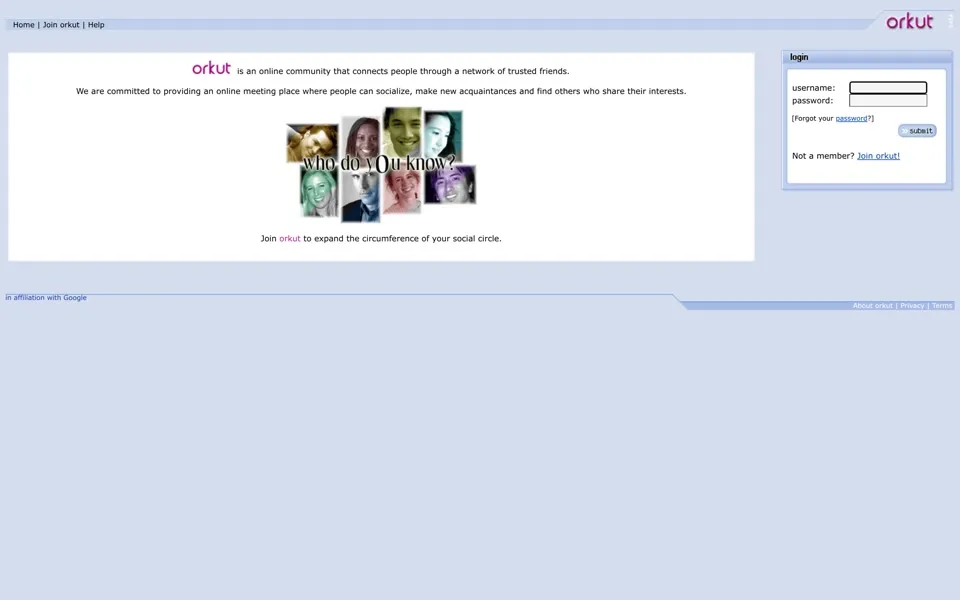
Orkut's 2004 page puts a small pink wordmark above a large lavender background. The introduction describes a network of trusted friends, while the navigation offers Home
, Join orkut
and Help
. The faces do much of the explaining, arranged below a description of the network and above the invitation to expand your social circle, while the actual entrance is two fields in a narrow box.
Orkut began as a test in January 2004, named for its creator, Google engineer Orkut Büyükkökten. New members initially needed an invitation from someone already inside.[1] The invitation links on this page belong to that early service; they don't establish when unrestricted registration began.
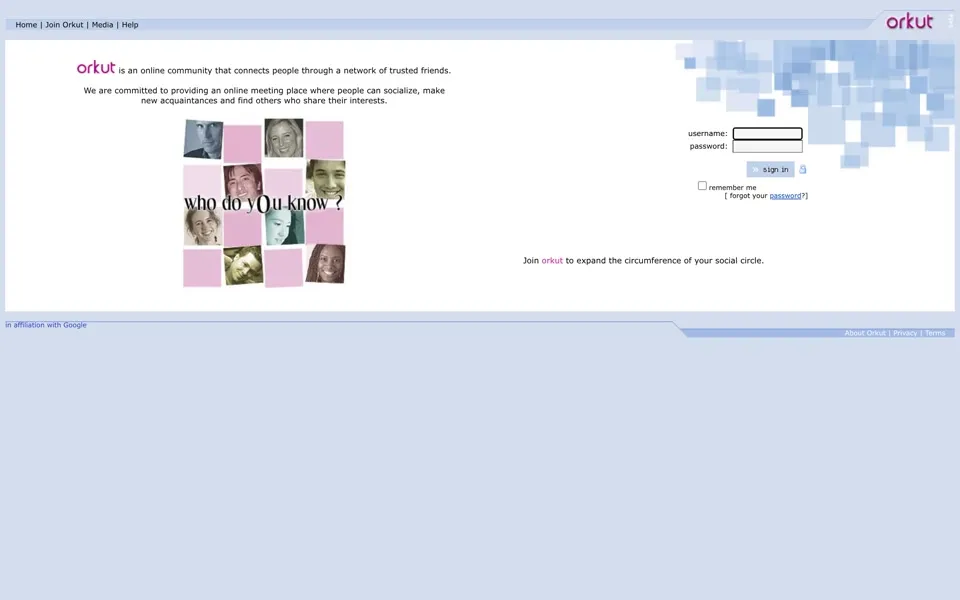
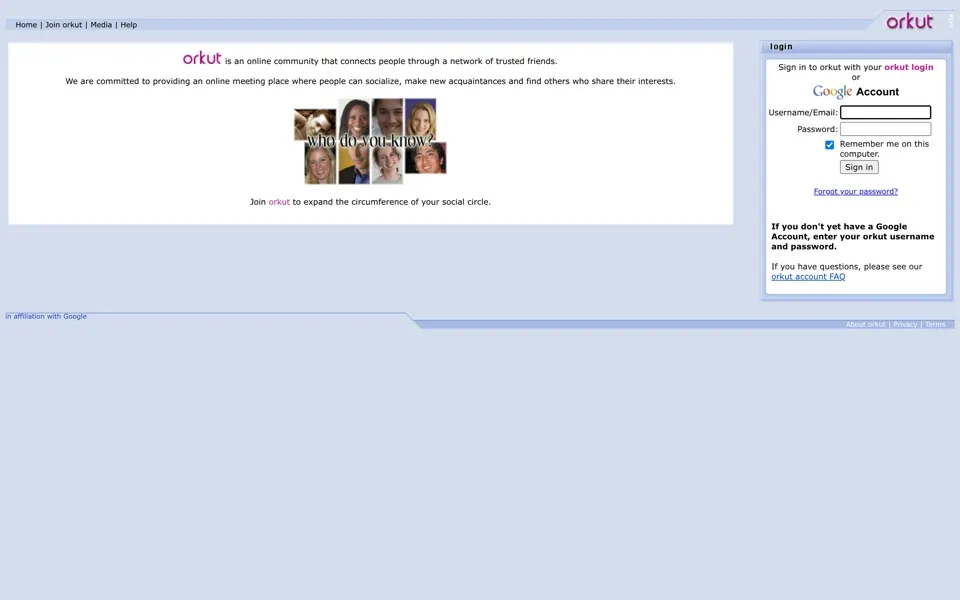
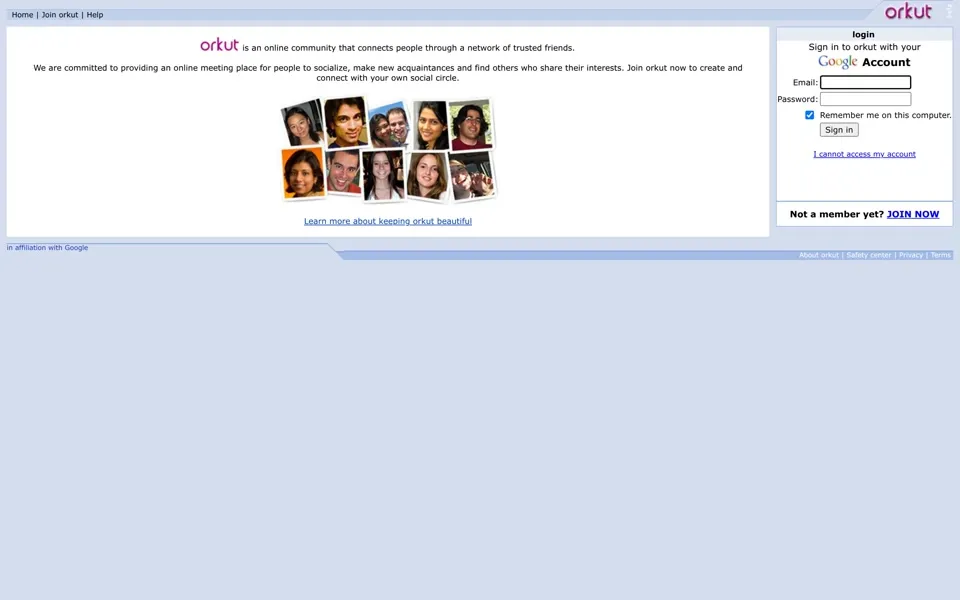
The 2005 mosaic changes the arrangement of the faces. By our 2006 capture the box asks for a Google Account, and the 2007 page places its faces in a wider row. Look below the white panels in 2004: in affiliation with Google
sits alone at the left. Google's name starts as a small line outside the main invitation.
2008–2010 93 million Christmas scraps
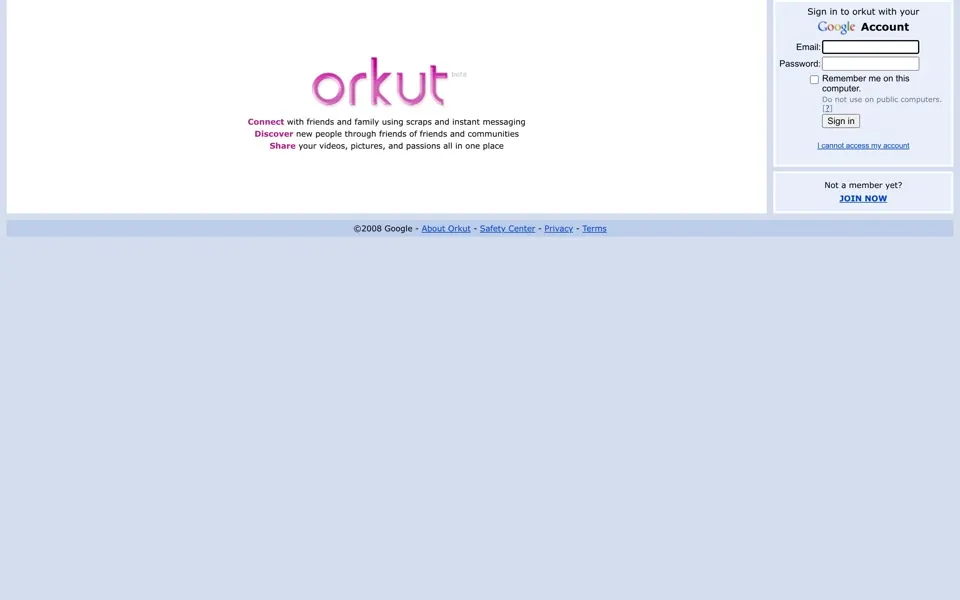
Orkut's 2008 landing page replaces the faces with a much larger pink logo. Beneath it, Connect
, Discover
and Share
introduce scraps (the messages members left in each other's scrapbooks), instant messaging, friends of friends, communities, pictures and other things to exchange. The sign-in box still occupies the right side. In its small print, a warning tells visitors to avoid remembering their login on public computers.
Scraps were one of the exchanges behind that sign-in box. On Christmas Eve 2010, Orkut users shared a record 93 million of them, according to Google's seventh-birthday post the following January.[2] A short word in the homepage pitch covered an enormous holiday correspondence.
The June 2009 and January 2010 captures keep the same compact pitch. Below the form, JOIN NOW
gives newcomers their own entrance. Safety and privacy links remain in the footer.
2011–2013 A magenta logo, billions of seeds
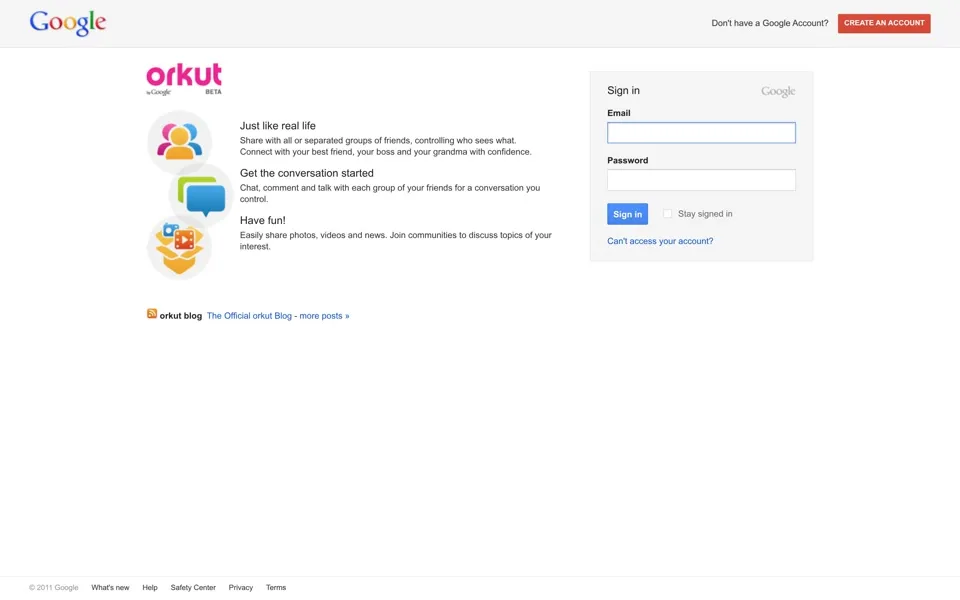
Orkut's November 2011 page moves a thicker magenta logo to the upper left of a white layout. The illustrated pitch starts with Just like real life
and explains sharing with separate groups of friends, moves to starting a conversation, then ends with Have fun!
and invitations to share photos, news and other interests; a Google sign-in panel faces it on the right. Google announced the new logo on May 17, after more than seven years with the earlier mark.[3] The product introduction now has pictures again, although the collage of faces has gone.
Mini Fazenda puts a number behind the fun. In January 2011, Google reported 17 million users for the game and 2.5 billion virtual seeds planted each month.[2] The homepage could fit its invitation into a few illustrated lines; farming inside Orkut ran to billions of little actions.
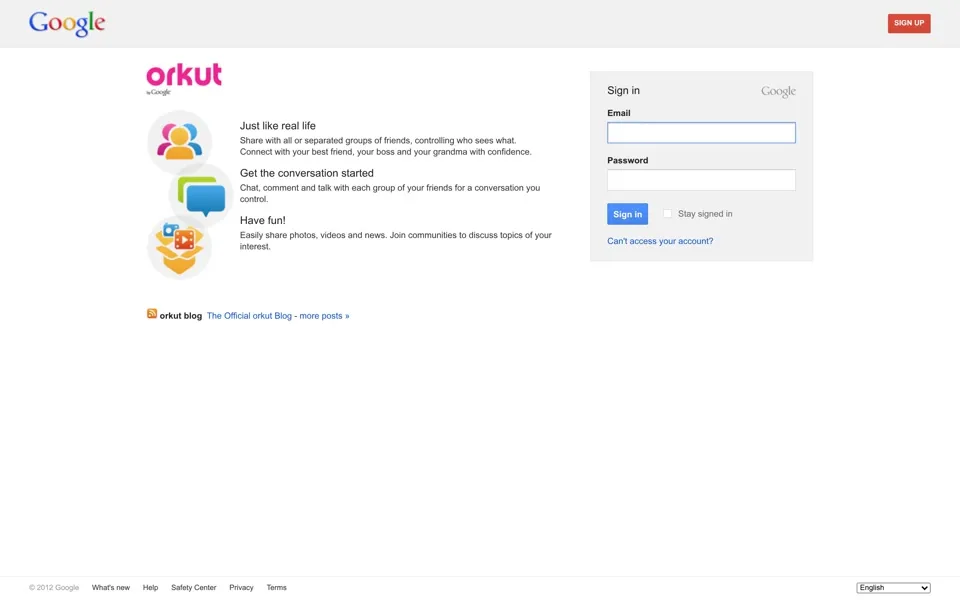
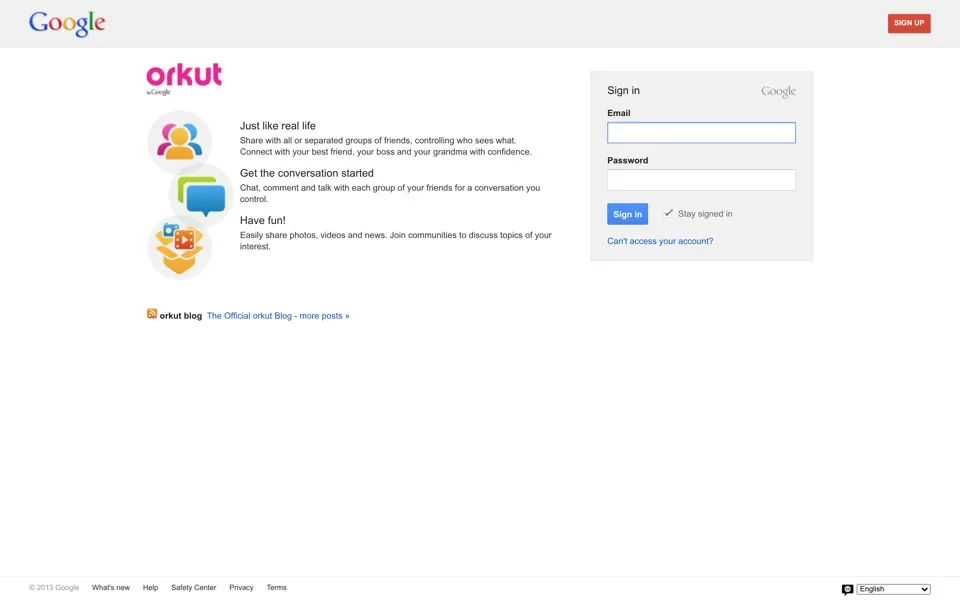
A longer feed had already failed a test. Google said it showed 40 friend updates instead of 20 to 1% of users, found that some interacted less because reading took longer, and dropped the idea.[2] This experiment concerned the page members saw after signing in. Our 2012 and 2013 captures stay outside, where the illustrated introduction and small password panel barely change.
2014–2015 The password box becomes an alphabet
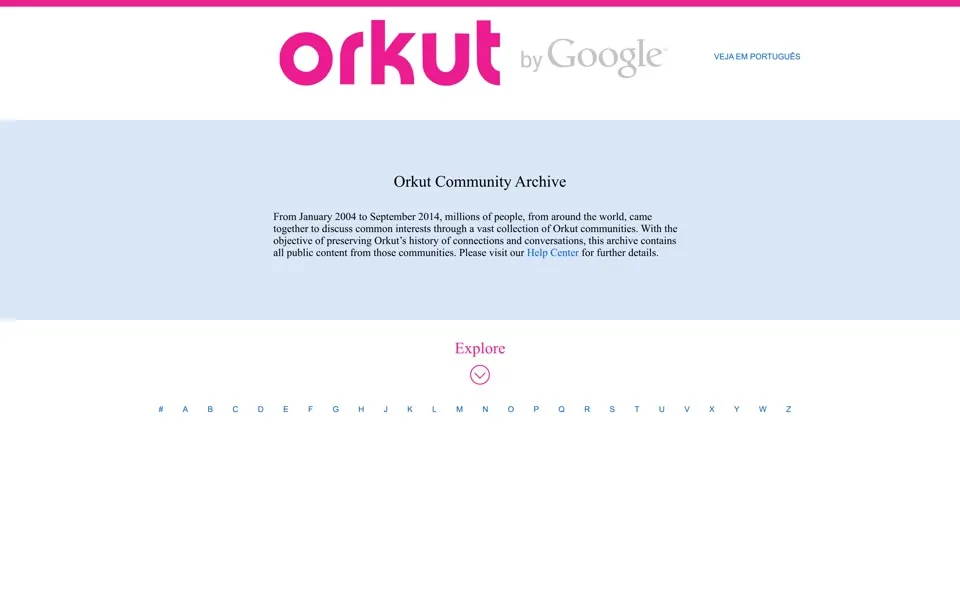
Orkut's October 2014 landing page has a large logo, a pale blue introduction and an alphabet under Explore
. The Google sign-in panel is gone. Google closed Orkut on September 30, 2014, and preserved its public communities in the Orkut Community Archive.[4] The address now leads into something you can browse without joining.
That archive held 51 million communities, 120 million topics and more than a billion interactions, according to Google's announcement.[4] The counts describe preserved public material. Profiles and private scraps were a different part of the service.
One community remembered by Google concerned wanting ice cream and getting beans. Others were about hating early mornings and ringing doorbells before running away.[5] These were some of the shared jokes behind the sober alphabet on the archive page.
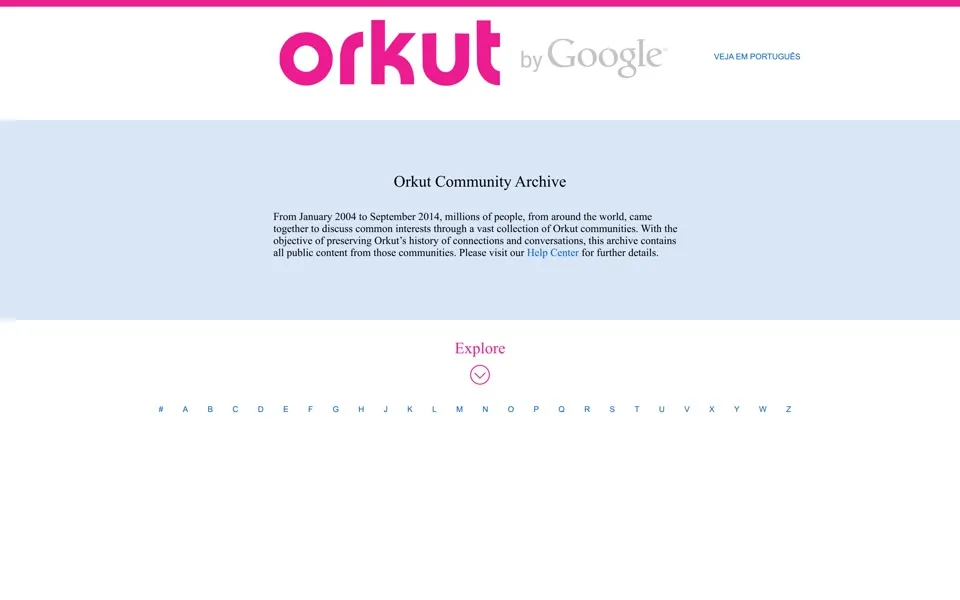
The 2015 capture keeps that alphabet and the archive's short introduction. Below the logo, the page speaks about Orkut in the past tense. Its next invitation is to read what people left behind.
2016–2017 The founder writes; the archive says goodbye
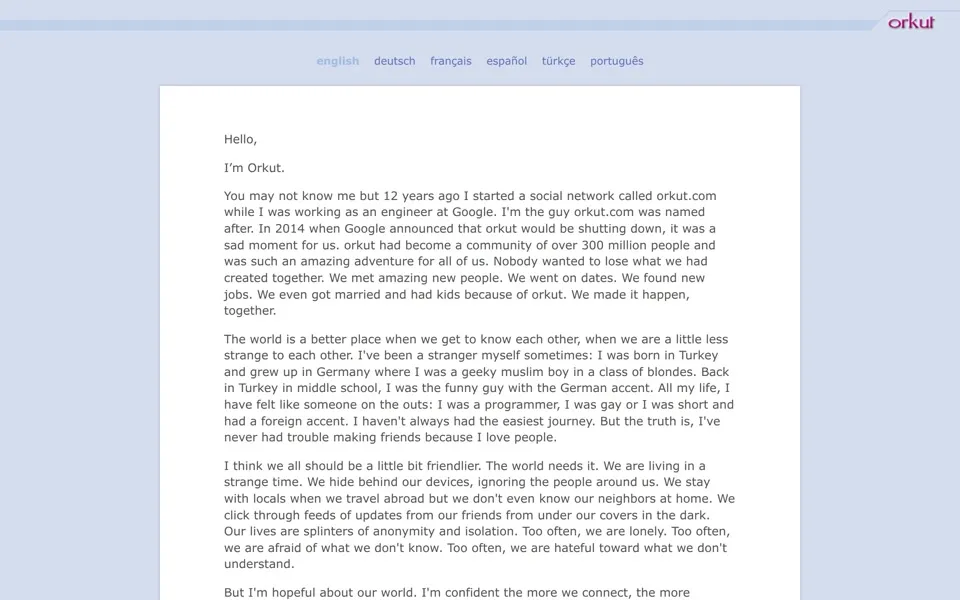
Orkut's June 2016 capture opens a personal letter at hello.com/orkut. Lavender surrounds a narrow white column, and the old thin pink wordmark returns in the header. The writer introduces himself as Orkut. The name that once sat beside a login form now belongs to the person addressing the reader.
The public archive received a second farewell in April 2017. Google said it would discontinue the preserved communities and that visitors could look through them until May 15.[5] The September 2014 closure had ended the service; this announcement gave its public conversations another deadline.
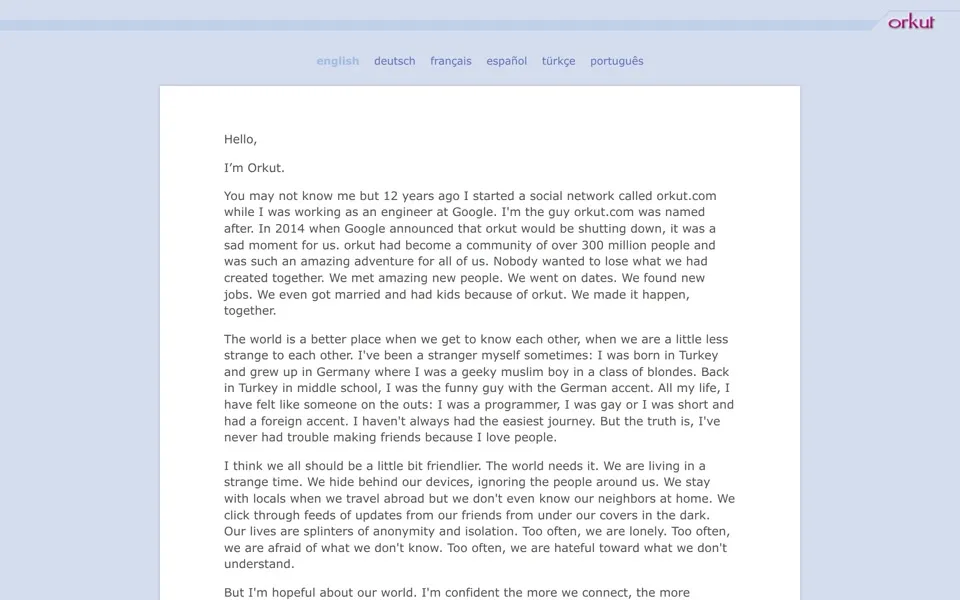
Our June 2017 capture is back at orkut.com/index.html and still carries the founder's letter. Language links run above it. The separate community archive and the familiar domain have different destinations now: Google's notice concerns the former, while the latter is already introducing another project.
2018–2021 Orkut shares the banner with hello
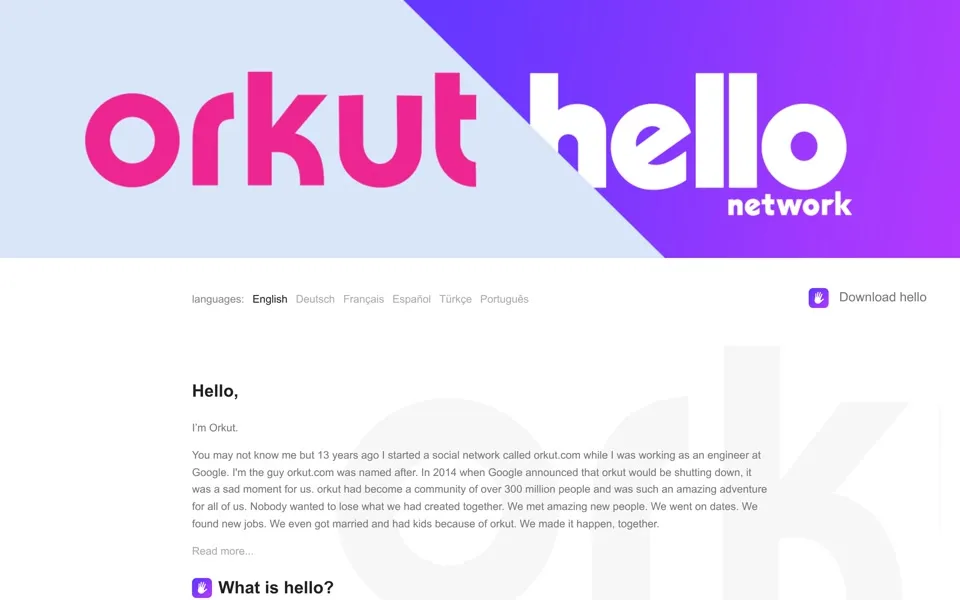
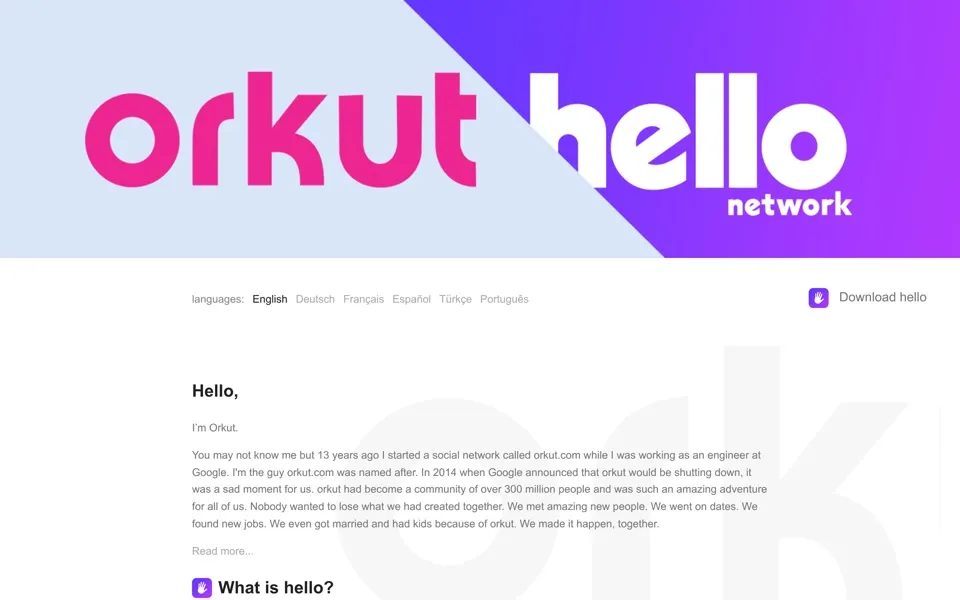
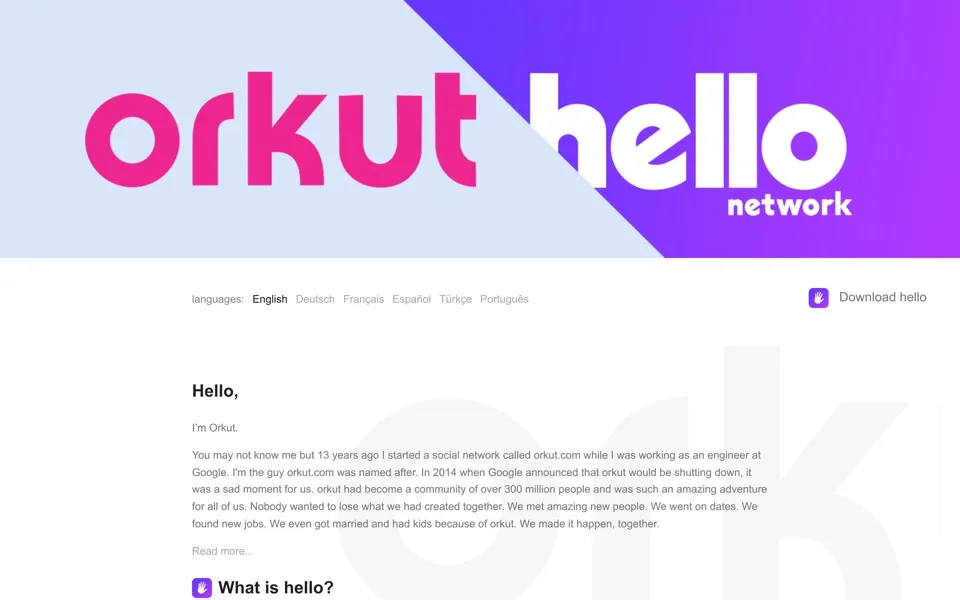
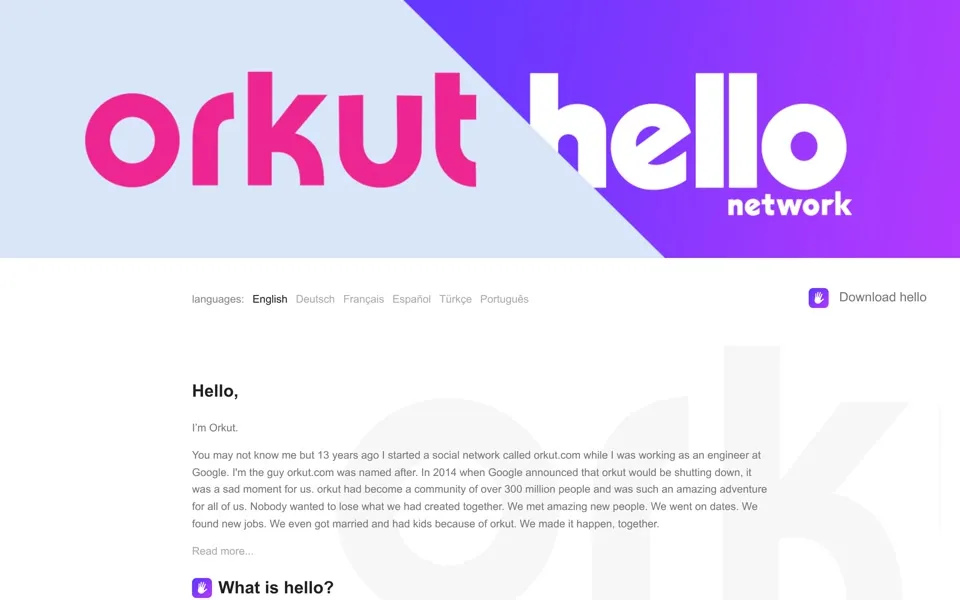
Orkut's 2018 page gives the letter a much larger header: pink Orkut lettering meets a white hello network logo on purple. A diagonal divides the two names. The row below offers language choices and a Download hello
link. The older address has become an introduction to hello.
The letter continues below the banner, followed by a section introducing hello. Those are two distinct names on the same landing page. The download invitation is for hello; these captures don't show Orkut's profiles or scraps returning.
Our 2019, 2020 and 2021 captures keep the split banner and the letter beneath it, so they share one strip here. The small download link does the practical work. Where the 2004 page asked for a username and password at this address, these pages send a visitor toward a different service.
2022–2026 A new letter, an email field
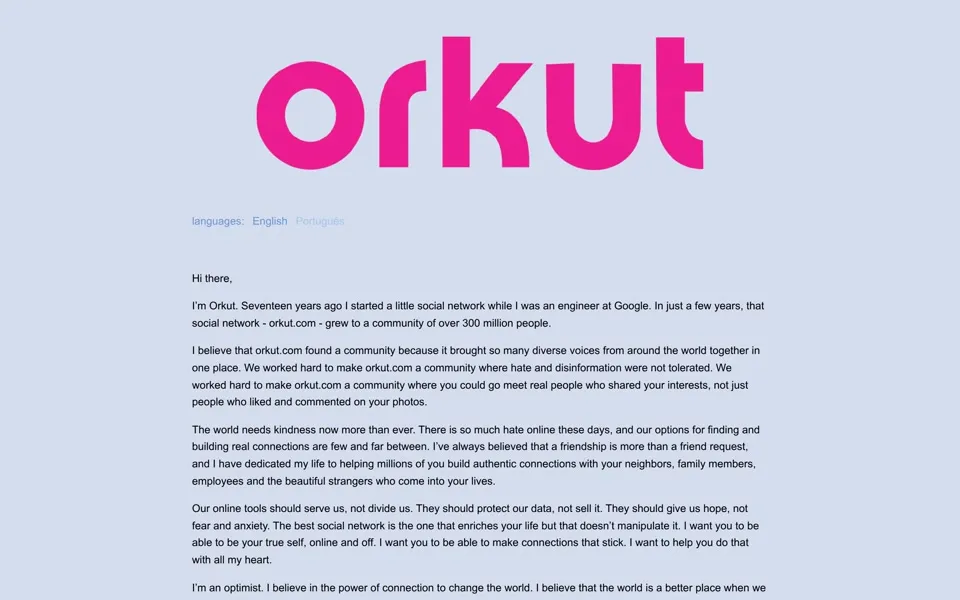
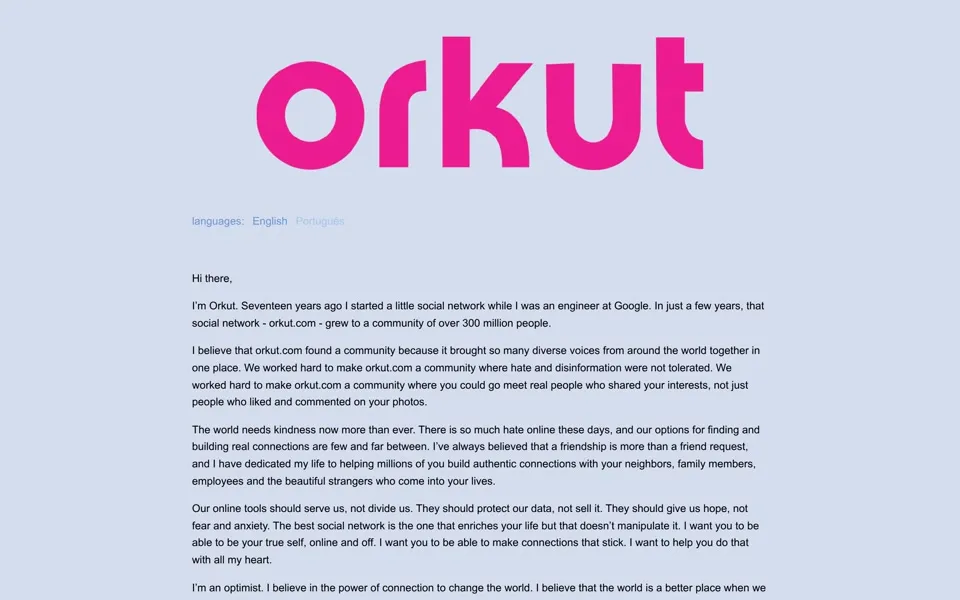
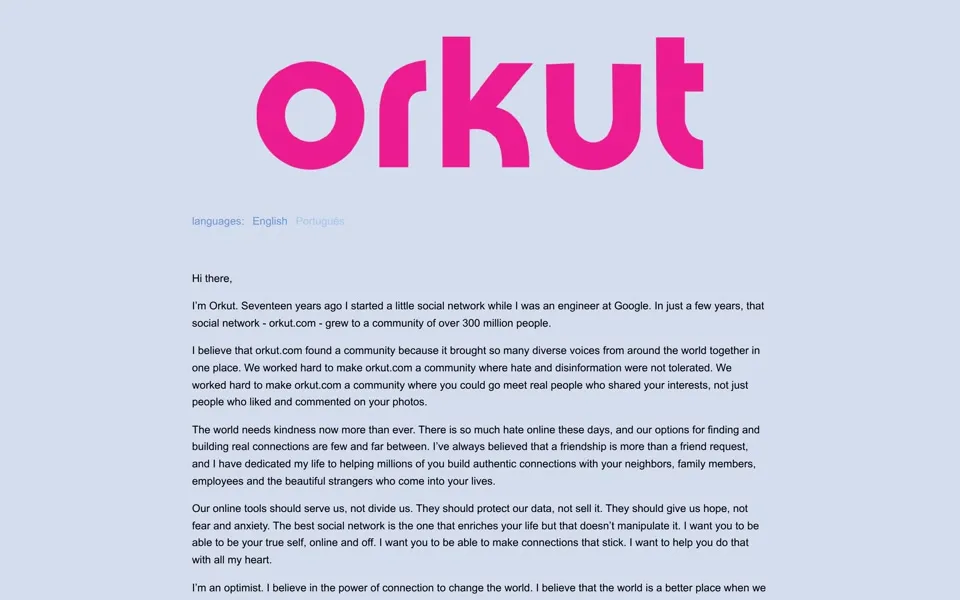
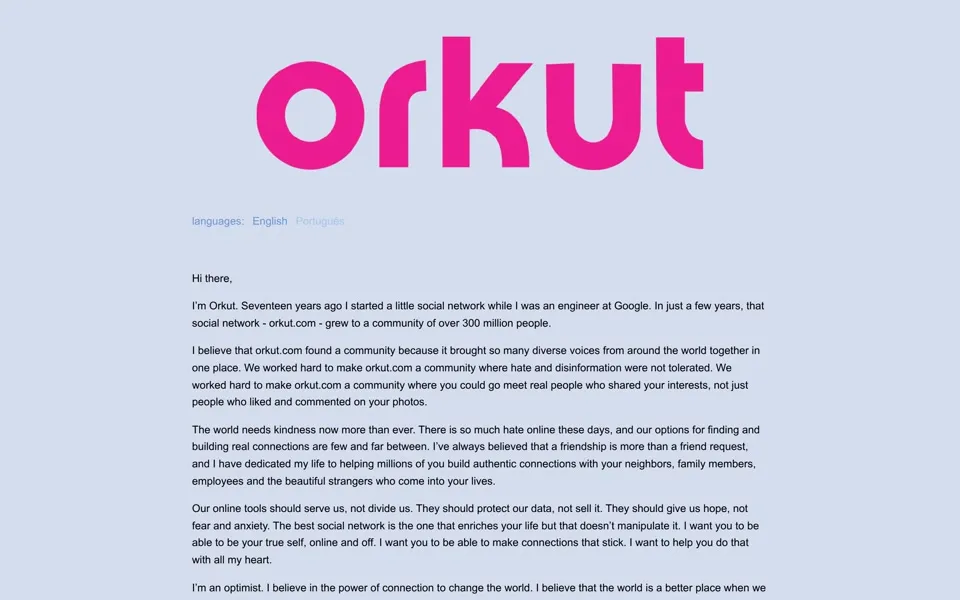
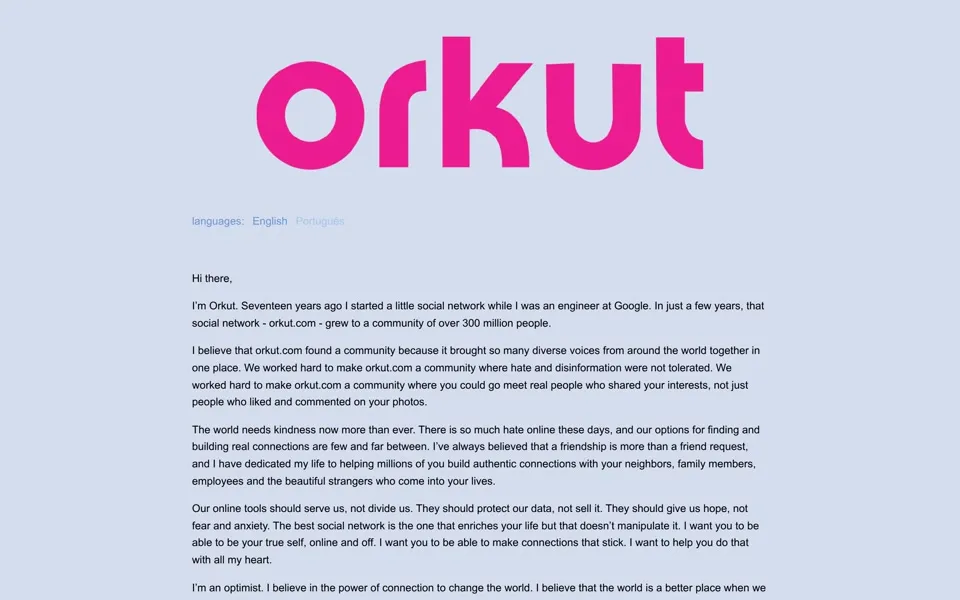
Orkut's June 2022 page removes hello from the banner. A huge magenta wordmark sits on lavender above a new letter. The greeting is Hi there,
and the founder says he is building something new. The page had drawn attention that April when the message appeared.[6] This is a promise from the founder, not a working Orkut account screen.
The 2023, 2024, 2025 and June 2026 captures keep that letter. Below its final paragraphs is an email field for updates. The last still here is dated June 15, 2026: the letter, a field, a small submit button and the founder's signature.
In 2004, a short line asked you to expand your social circle. By this last capture, the faces and password box have gone, and the invitation is to leave an email address and wait for news. The name above it still says Orkut. The person signing the letter does too.
- When was the oldest orkut.com homepage in this story archived?
- The oldest capture here is from June 16, 2004, in the Internet Archive's Wayback Machine. Orkut's 2004 landing page: a face collage, a trusted-friends introduction and a username/password box.
- What does the orkut.com homepage look like in 2026?
- In the newest capture here (June 15, 2026): Orkut's June 15, 2026 landing page shows the founder's letter, an email-updates field and his signature.
- How many Orkut homepage captures does this story show?
- 23 captures between 2004 and 2026, at most one per year; the timeline above shows which years are included.
- How did the Orkut logo change on its homepage?
- The logo evolution below shows 2 logo versions we picked from the captures, from 2004 and 2011. Logos from before 2004, the first capture, aren't included.
 2004Thin pink wordmark with a shaded edge
 2011Bold magenta letters replace the thin wordmark
Each logo is cut from that year's homepage capture (the year is the capture's); click one to see it on the page. Logos from before the first capture (2004) aren't shown, and some are missing where the logo images don't render in our captures. More logo histories.
◀ drag ▶20042026
The oldest capture in this story (2004) over the newest (2026). Drag across the picture.
Sources
Homepage wording comes from the dated captures alongside the text. Open a screenshot for the full page or follow its date to the Wayback replay. The links below support events and figures beyond those public landing pages.
- InfoWorld / IDG News Service, “Google eyes social networking with Orkut”, January 23, 2004. InfoWorld ↗Contemporary reporting on the test launch, invitation-only membership and the engineer behind the name.
- Google Brasil, “O orkut continua crescendo depois de sete anos”, January 26, 2011. Google Brasil ↗The Christmas scraps record, Mini Fazenda's users and seeds, and the experiment with 40 friend updates.
- Google Brasil, “Novo visual para o logo do orkut”, May 17, 2011. Google Brasil ↗Announcement of the thicker magenta logo after more than seven years with the previous mark.
- Google India Blog, “Preserving Orkut’s history”, September 30, 2014. Google India ↗Closure of the service and preservation of 51 million communities, 120 million topics and more than a billion interactions.
- Google Brasil, “Agora é pra valer: tchau mesmo, Orkut”, April 28, 2017. Google Brasil ↗The announcement that the community archive would close, access until May 15, and examples of remembered communities. This is the announced deadline, not an independently verified shutdown time.
- UOL Tilt, report on the founder's new letter, April 28, 2022. UOL Tilt ↗Contemporary coverage of the 2022 message about building something new.
How this was made. One selected public landing page capture per year, 2004–2026, replayed through the Internet Archive. These are signed-out pages and their redirect destinations, including Google sign-in, the community archive and hello.com/orkut. They show a sample of the site's public appearance, with account interiors, redesigns between capture dates and live changes after the final June 15, 2026 archive all outside the sequence.
A repeat archive lookup for a representative community URL returned only one dated capture, too little for a four-to-six-era side track. No member profile or scrapbook is reproduced. The early face mosaics are the landing page's promotional graphics. Browser frames are PageRewind's presentation; selected Wayback and obsolete embedded-player elements are hidden for capture.
PageRewind is independent and is not affiliated with Google, Orkut or hello. Names and logos belong to their respective owners.
 Digg homepage history
 Facebook homepage history
 LinkedIn homepage history