In February 2004 Facebook’s homepage was a white box under a blue banner, with the name in square brackets: [ thefacebook ]
. One sentence said who it was for. We have opened up Thefacebook for popular consumption at Harvard University.
Scrub through the captures with the slider, or read on.
This is the story of facebook.com’s front page from 2004 to 2026, told through 23 captures, one per year. It is the page people see before they sign in, so it never shows the News Feed. What it shows is the invitation, and that keeps changing: Harvard first, then two Facebooks
for college and high school, then Everyone can join.
, then a sign-up form that was free and always will be
, and from 2020 a login card for people who already have an account. The free promise sits above the sign-up form in all nine of our captures from 2011 to 2019.
2004 A Mark Zuckerberg production
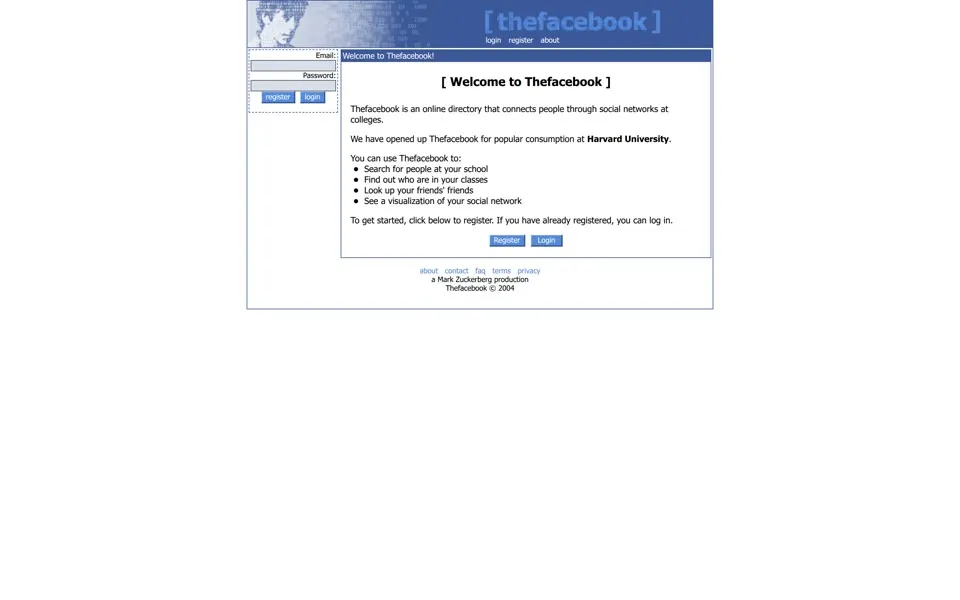
Thefacebook launched at Harvard on February 4, 2004.[1] Our capture is from February 12, eight days later, and it is almost all text. The banner carries the name in brackets and a grey face dissolving into a cloud of ones and zeros. Under [ Welcome to Thefacebook ]
the page explains itself: Thefacebook is an online directory that connects people through social networks at colleges.
Four things you can do follow. Search for people at your school
, Find out who are in your classes
, Look up your friends' friends
and See a visualization of your social network
. Then two buttons, Register and Login. There isn’t a single member photo on the page.
The small print is the best part. Under five footer links the page signs itself a Mark Zuckerberg production
, like the credits of a student film. Nobody else is named.
The face in the banner has no name either. In 2010 ABC News, citing David Kirkpatrick’s book The Facebook Effect, reported that it was a manipulated photo of Al Pacino.[2] If the book is right, the first face on Facebook’s front page belonged to a film star.
2005 – 2006 Now there are two Facebooks
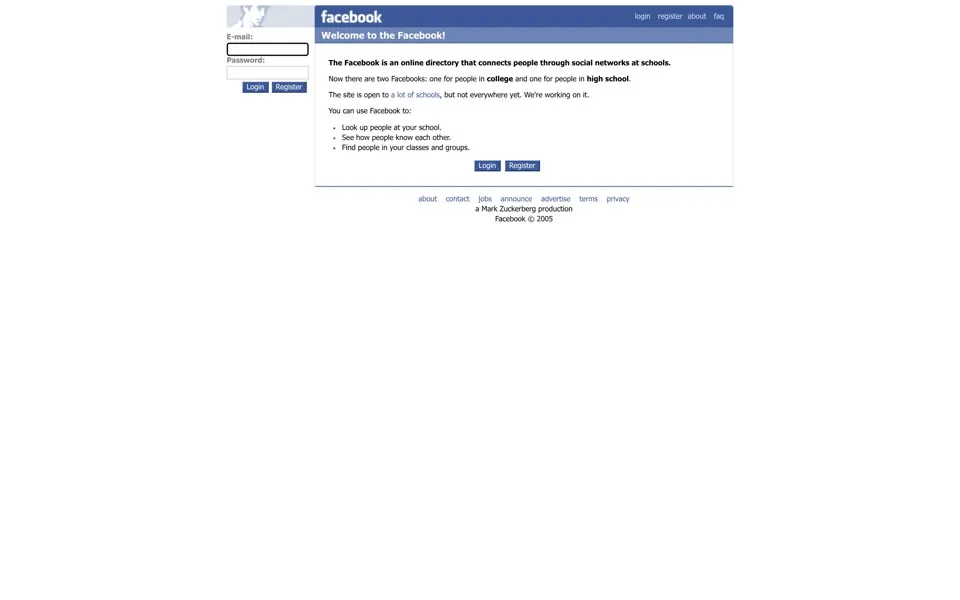
By October 2005 the brackets are gone, and so is the “the”. A plain white facebook
sits on a blue bar. The Crimson reported that September that the site had dropped “the” from its name.[3] Inside the company, the paper said, the redesign had a code name: Operation Quail. The text on the page hasn’t caught up. It still starts The Facebook is an online directory that connects people through social networks at schools.
Schools now, not only colleges. The next line is worth reading twice: Now there are two Facebooks: one for people in college and one for people in high school.
Then something close to an apology. The site is open to a lot of schools, but not everywhere yet. We're working on it.
The face from 2004 is still there, shrunk to a pale tile above the login box. The footer still credits a Mark Zuckerberg production
.
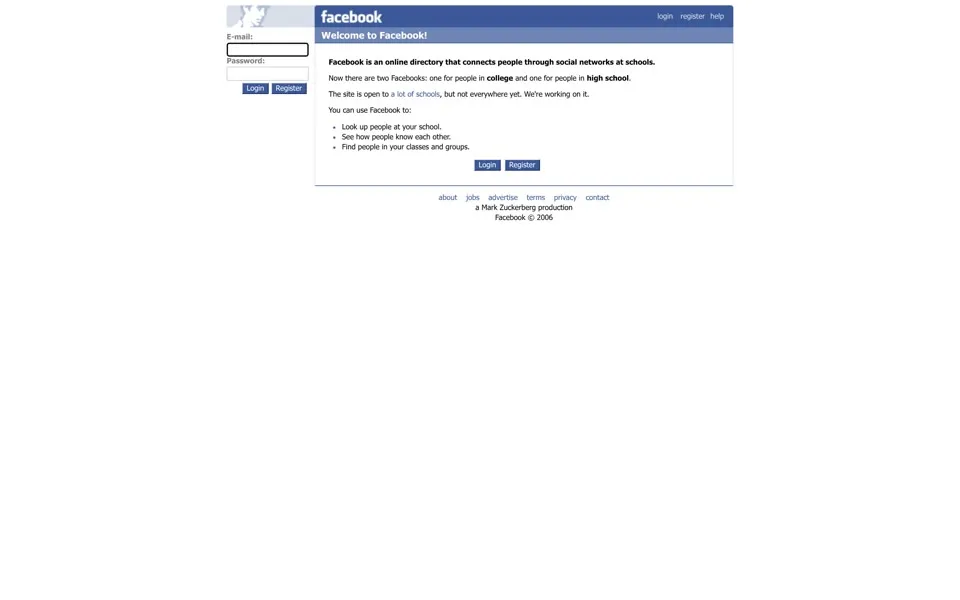
February 2006 keeps the same layout and drops the “the” from the text too. The heading says Welcome to Facebook!
and the first sentence begins Facebook is
. A few links change: help
replaces about
and faq
at the top, and announce
leaves the footer.
Seven months later, on September 5, News Feed launched for signed-in members. They protested.[4] Three days later Facebook added privacy controls for the feed, and the feed stayed.[5][6] The protest was organized on Facebook itself.
2007 Everyone can join.
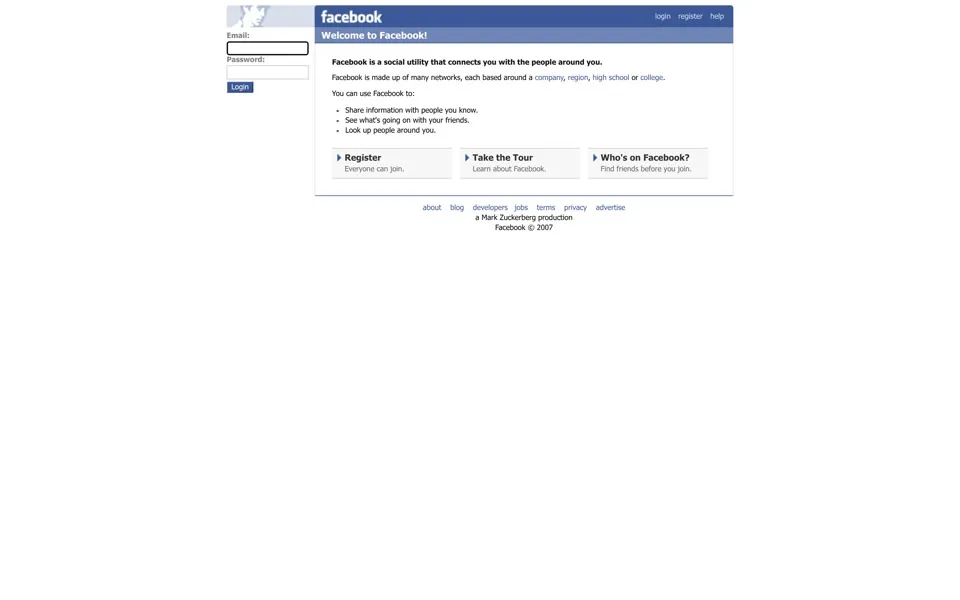
On September 26, 2006 Facebook opened registration to anyone with a valid e-mail address.[7] The February 2007 capture says it in three words, under the first of three grey boxes: Register
, Everyone can join.
The other two boxes are Take the Tour
(Learn about Facebook.
) and Who's on Facebook?
(Find friends before you join.
).
The word “directory” is gone. Facebook is now a social utility that connects you with the people around you
, made of networks each based around a company, region, high school or college
. The footer has new links to a blog
and to developers
.
This is the last capture with the pale face in the corner. It is also the last one signed a Mark Zuckerberg production
. Our next capture, from July 2008, has neither.
2008 – 2010 It's free and anyone can join
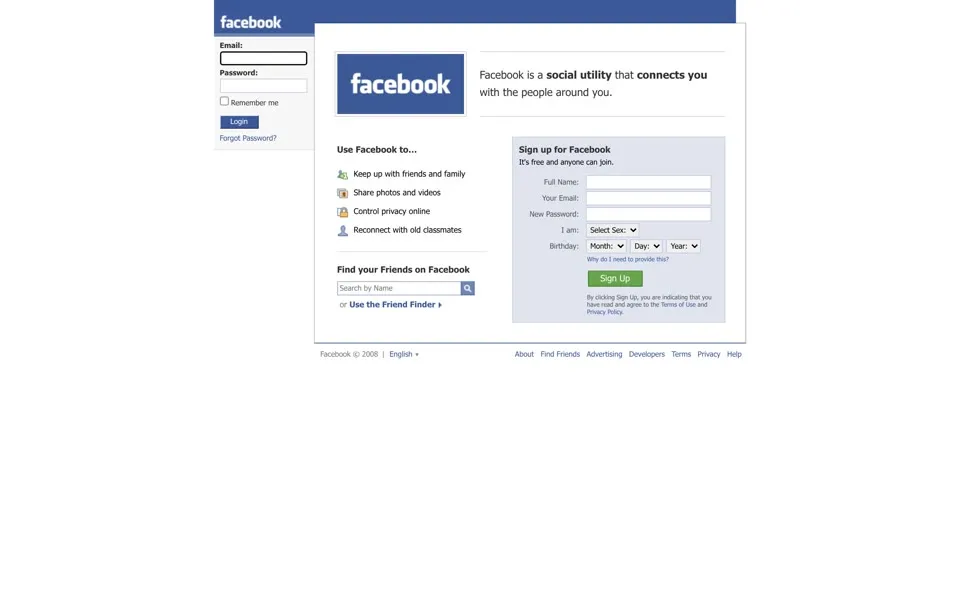
In July 2008 the front page finally looks like a sign-up page. A big rectangular logo, white letters on blue, sits next to the line Facebook is a social utility that connects you with the people around you.
On the right a pale blue form asks for Full Name
, Your Email
, New Password
, your sex and your birthday.
Above the form: It's free and anyone can join.
Remember that line. The reassurance changes in later captures.
The left column lists four uses, each with a small icon: Keep up with friends and family
, Share photos and videos
, Control privacy online
and Reconnect with old classmates
. Under them sits a search box, Find your Friends on Facebook
.
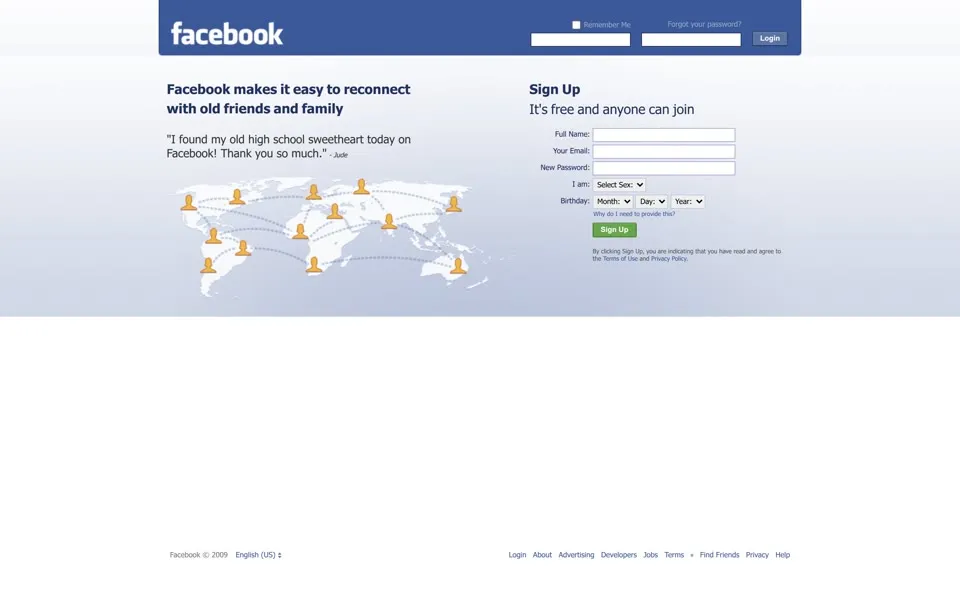
February 2009 swaps the lists for a world map dotted with little orange figures joined by dashed lines. The headline reads Facebook makes it easy to reconnect with old friends and family
, and a quote backs it up: I found my old high school sweetheart today on Facebook! Thank you so much.
It is signed with a first name, Jude.
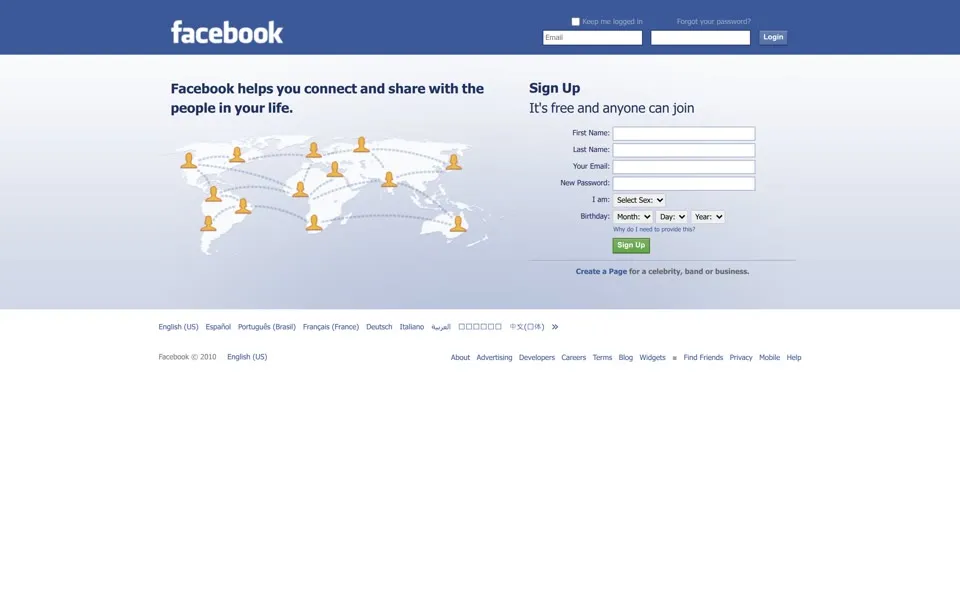
A year later, in February 2010, the map stays and the headline changes again: Facebook helps you connect and share with the people in your life.
The form now wants a first and a last name in separate boxes. Its code also holds a security check that only appears when needed: Enter both words below, separated by a space.
2011 – 2012 Free and always will be
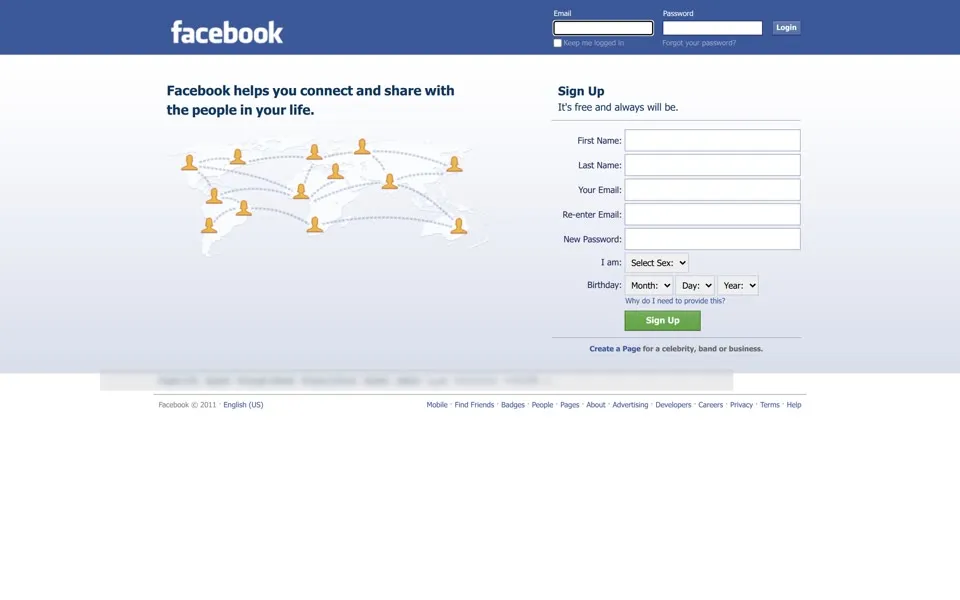
By March 2011 the line above the form has a new ending: It's free and always will be.
The map and the headline are the same as in 2010. The form asks for your e-mail twice (Re-enter Email:
), and the browser tab gets a longer title, Welcome to Facebook - Log In, Sign Up or Learn More
.
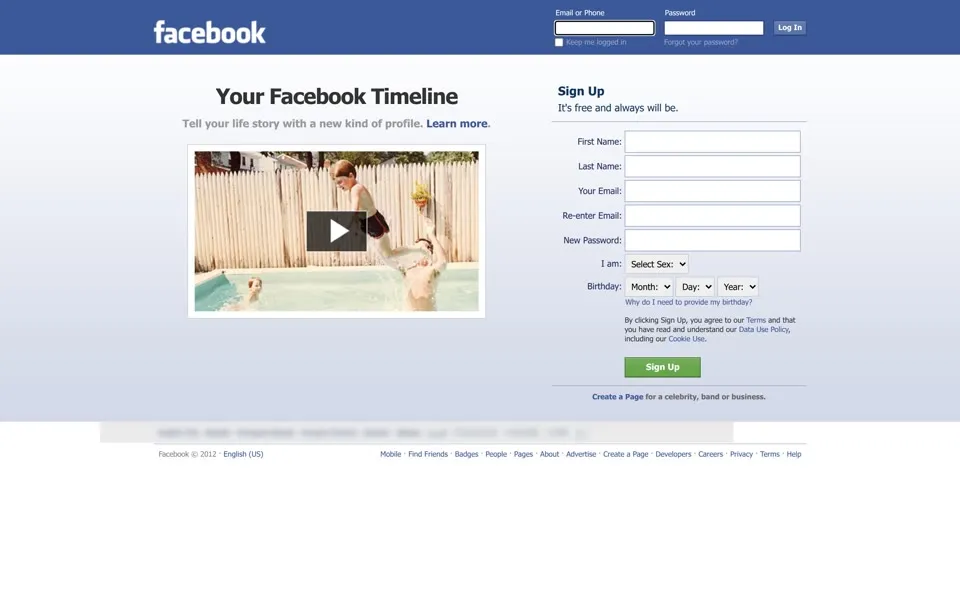
In June 2012 the front page advertises a feature to people who aren’t members yet. The map gives way to Your Facebook Timeline
and Tell your life story with a new kind of profile.
Below is a frame from a promotional film with a play button over it: a boy in mid-jump over a backyard pool. Facebook announced Timeline in September 2011 and made it available worldwide on December 15, 2011.[8][9]
The switch came with a grace period. Members who upgraded had seven days to review their Timeline. Unless they published it earlier, it went live by itself after that.[9]
Smaller changes sit around it. The login box at the top now takes Email or Phone
. The small print under the form points to a Data Use Policy
and to Cookie Use
.
2013 Sign Up, over a photograph
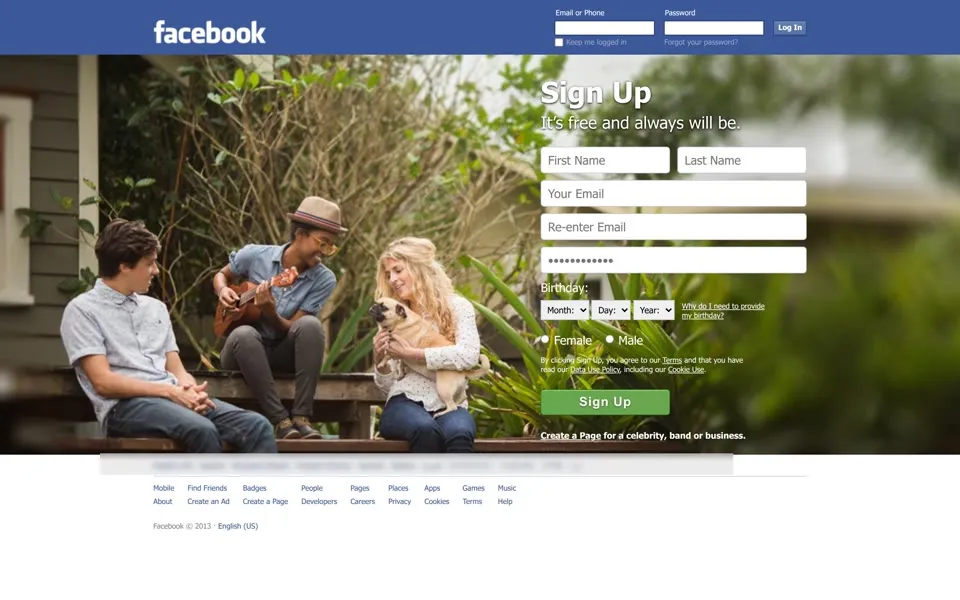
February 2013 is the only capture in this set with a photograph across the whole page. Three young people sit on a wooden porch, one playing a ukulele and one holding a pug. The sign-up form floats over them in white: Sign Up
, It’s free and always will be.
The map and the headline are gone.
Most fields have lost their labels. They say what they want inside the box instead: First Name, Last Name, Your Email, Re-enter Email. In the code the photo is a single JPEG, stretched to at least 1600 pixels wide. The footer below it has grown into two rows of links, with Badges
, Apps
and Music
among them.
2014 – 2017 Graph Search, then Facebook Search
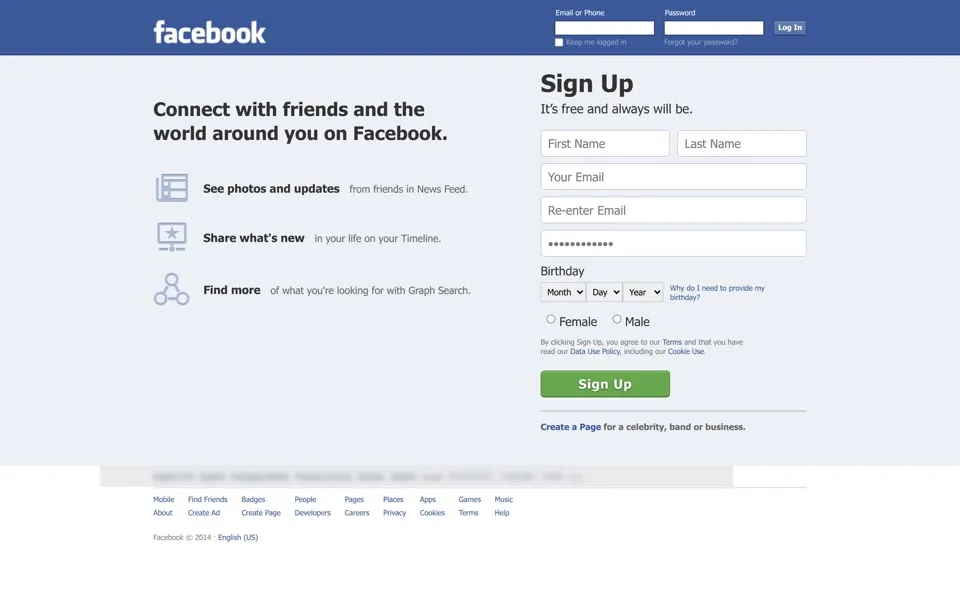
In February 2014 the photo is gone and the page is flat and pale again. A new headline sits on the left, Connect with friends and the world around you on Facebook.
, with three lines and three icons under it: See photos and updates from friends in News Feed.
, Share what's new in your life on your Timeline.
and Find more of what you're looking for with Graph Search.
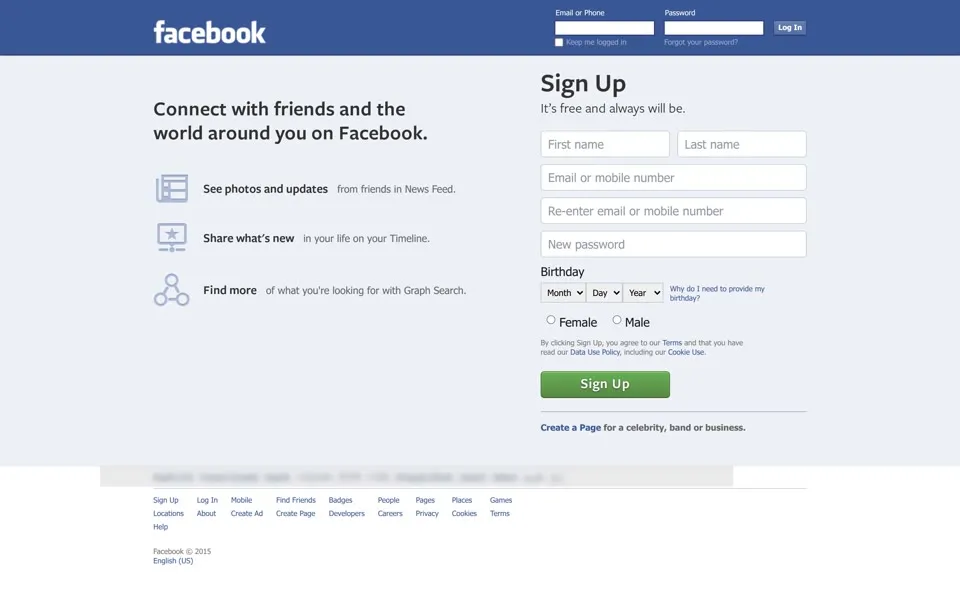
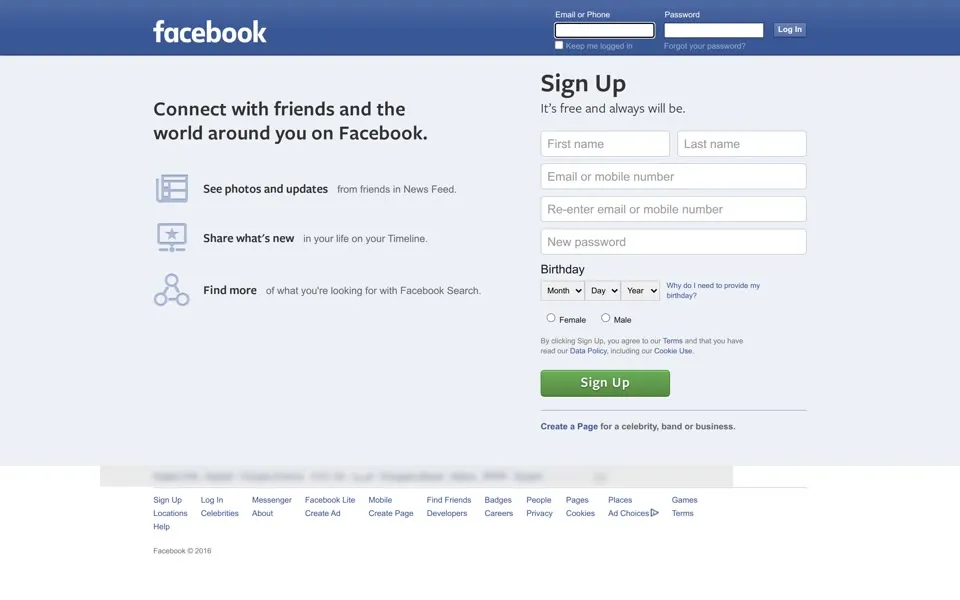
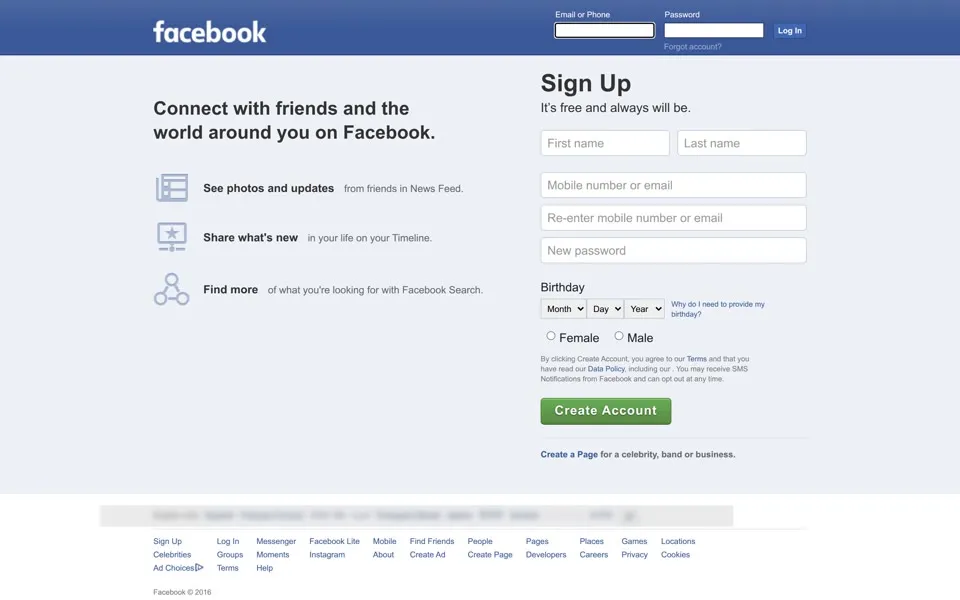
This basic layout appears in our six captures from 2014 through 2019, so the changes are small and worth hunting for. By March 2016 the third line says Facebook Search
instead of Graph Search, and the tab title is shorter, Facebook - Log In or Sign Up
. On January 1, 2017 the green button under the form says Create Account
instead of Sign Up
, and the small print adds a line: You may receive SMS Notifications from Facebook and can opt out at any time.
The promise above the form hasn’t moved. Every capture from 2014 to 2017 says It’s free and always will be.
The yellow strip across the top of the 2018 capture, as it shows in our rendering of the archived page.
2018 – 2019 A birthday 25 years back
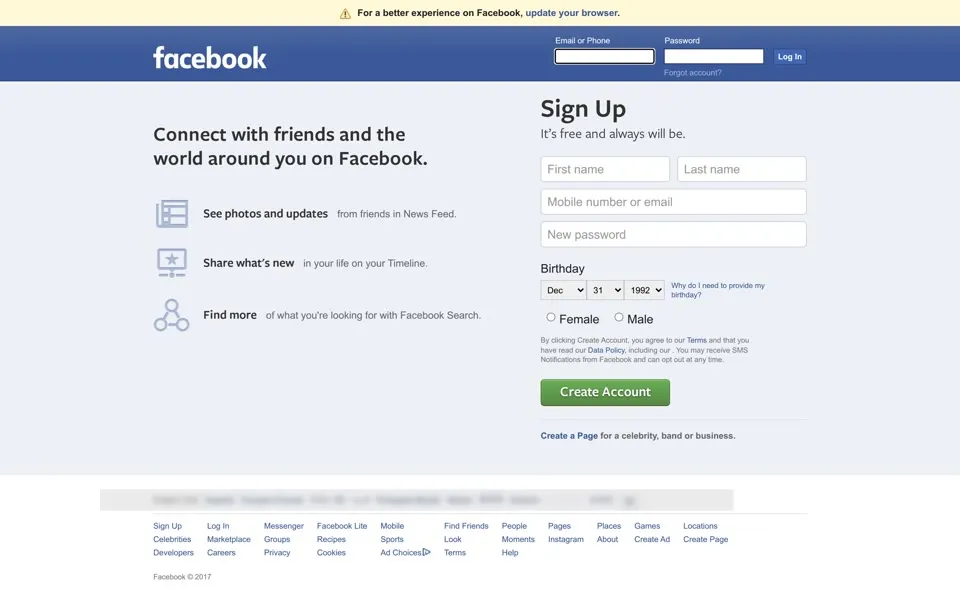
The January 1, 2018 capture opens with a yellow warning about the browser. Below it, the sign-up form already has a birthday filled in: December 31, 1992. The capture was made 19 minutes after midnight UTC, when it was still December 31, 2017 in California. The pre-filled birthday is exactly 25 years earlier.
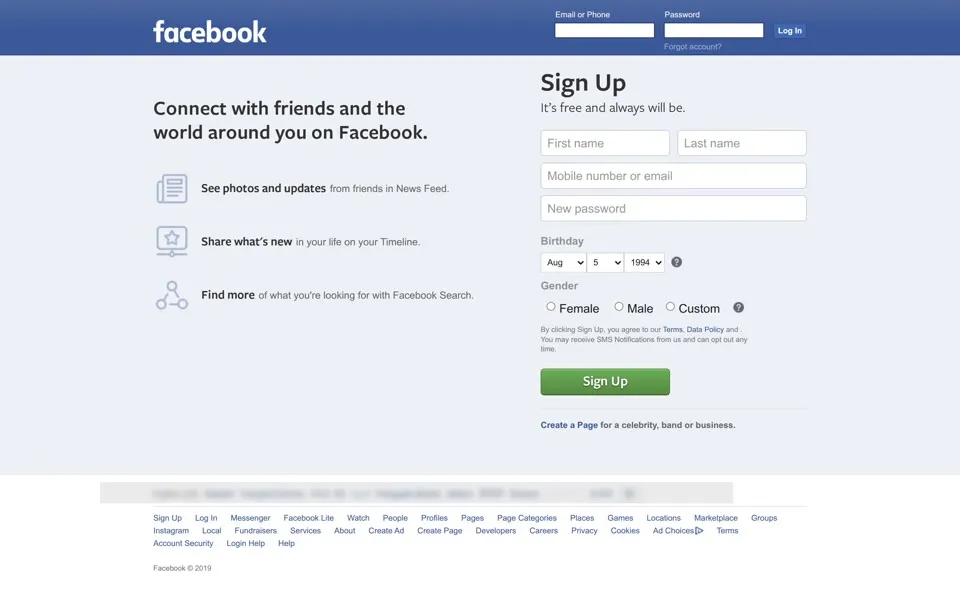
The August 6, 2019 capture does the same thing. It was made at 5:02 p.m. on August 5, California time, and the form suggests August 5, 1994.
Under Gender there is now a third choice, Custom
. Its pronoun menu is hidden in the still. The code lists three pronouns with the birthday greeting each one would get, among them They: "Wish them a happy birthday!"
This is the last capture with the old promise. Above the form it still says It’s free and always will be.
On August 28, 2019 ABC News reported that the line now read It's quick and easy.
[10] Our next capture, from February 2020, has no sign-up form on the front page at all.
The first line is on all nine of our captures from 2011 to 2019. The second is the wording ABC News reported on August 28, 2019.
2020 – 2025 Create New Account
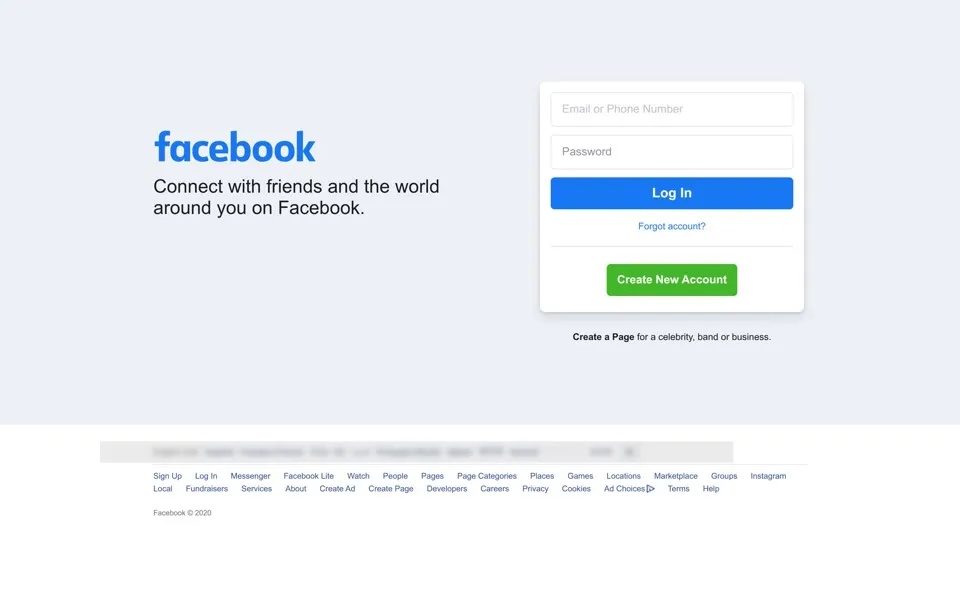
By February 2020 the sign-up form has left the front page. A large bright blue wordmark sits on the left, over Connect with friends and the world around you on Facebook.
On the right is a white card: two fields, a blue Log In
button, Forgot account?
and a green Create New Account
button. The promise about money appears nowhere.
That May, Facebook admitted that its focus on mobile had left the desktop site behind.[11] On May 8, 2020 it announced the worldwide rollout of its redesigned desktop site for signed-in members, first announced at F8 in 2019. The public front page in our February capture already has the login card.
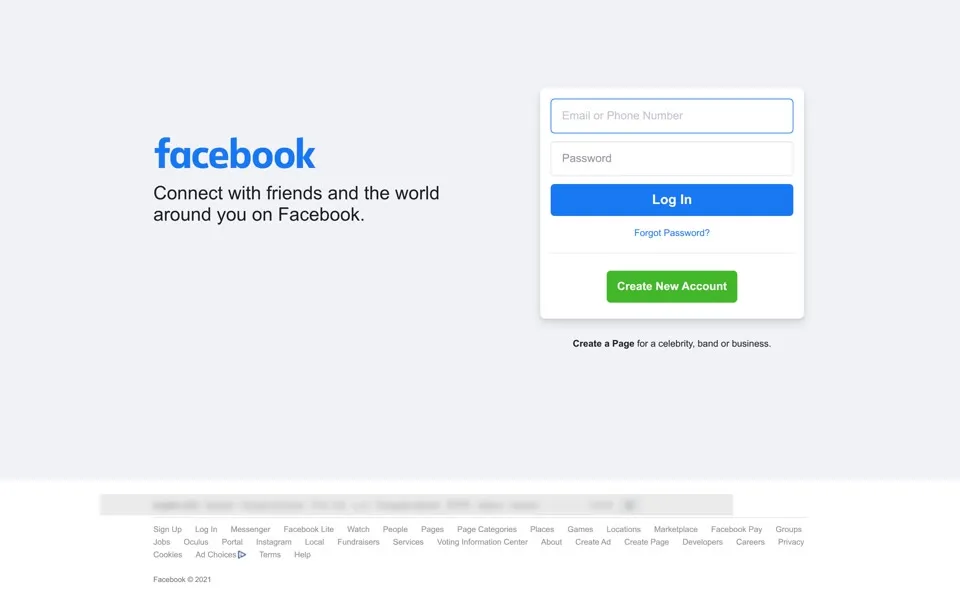
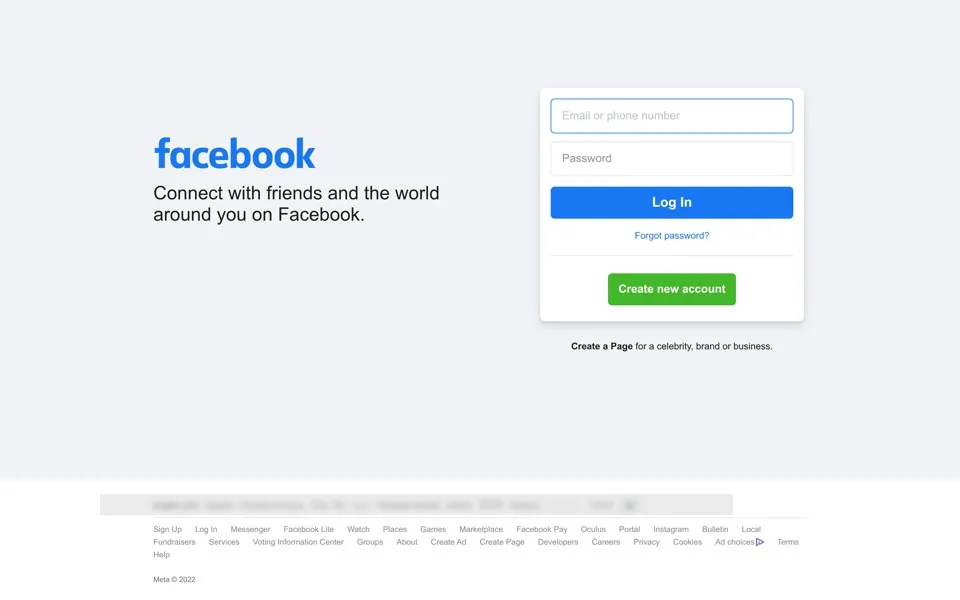
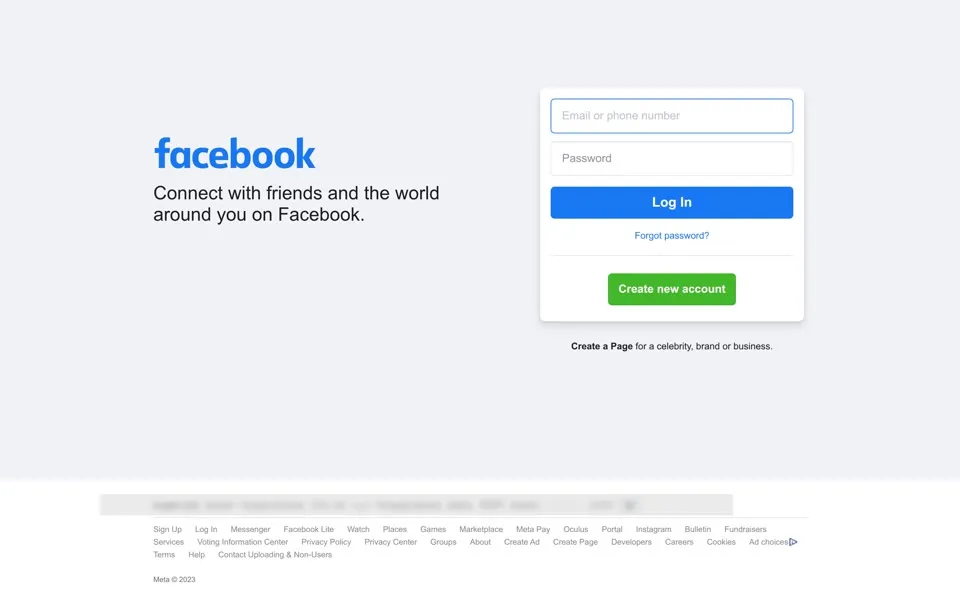
The wordmark and the login card stay for six captures, 2020 to 2025, and the biggest change hides in the footer. The copyright line reads Facebook © 2021
in February 2021 and Meta © 2022
a year later. In October 2021 the company had taken the name Meta, and said its apps would keep their own names.[12] So the page still says Facebook in big blue letters, and signs itself Meta at the bottom. The capitals go next: the card says Forgot password?
and Create new account
in sentence case in our 2022 capture, and by February 2023 the tab title follows, Facebook - log in or sign up
.
Facebook’s own engineering account of the October 4 outage, published the next day.[13] Our February captures don’t show it.
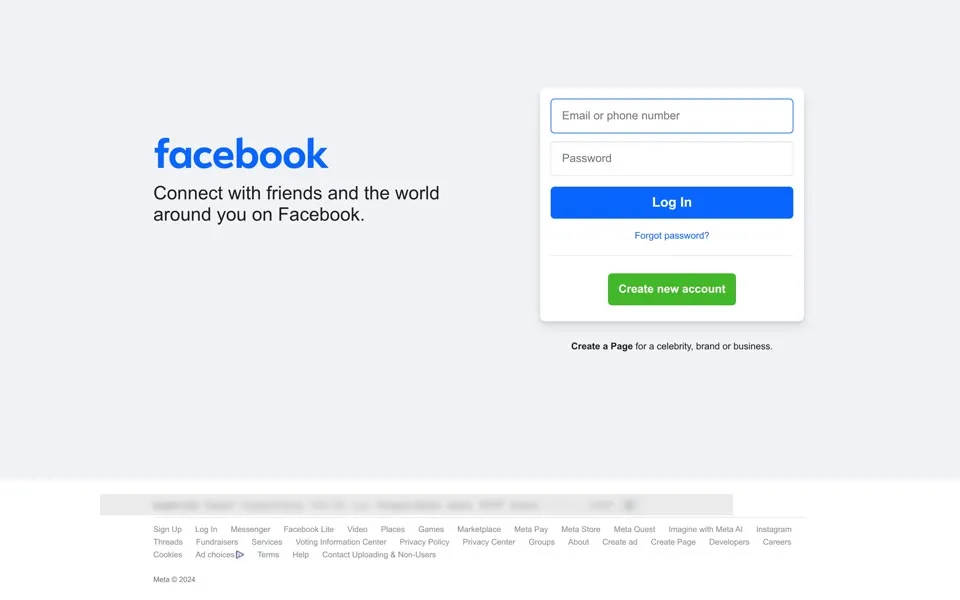
Some of the links in the 2024 footer. The 2020 footer linked to Instagram, but to nothing with Meta in its name.
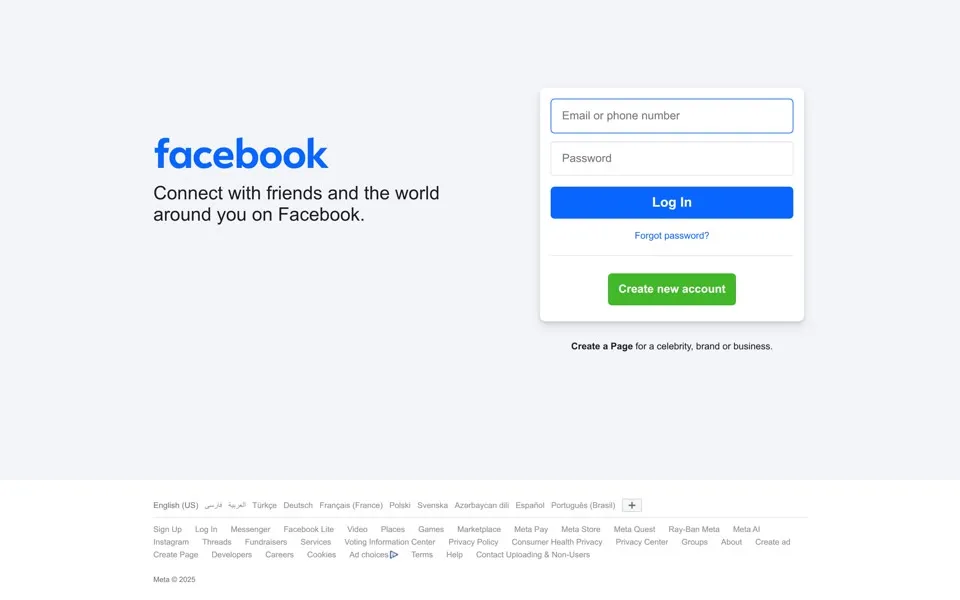
A year later the March 2025 footer adds Ray-Ban Meta
, and Imagine with Meta AI
has become plain Meta AI
.
2026 Explore the things you love.
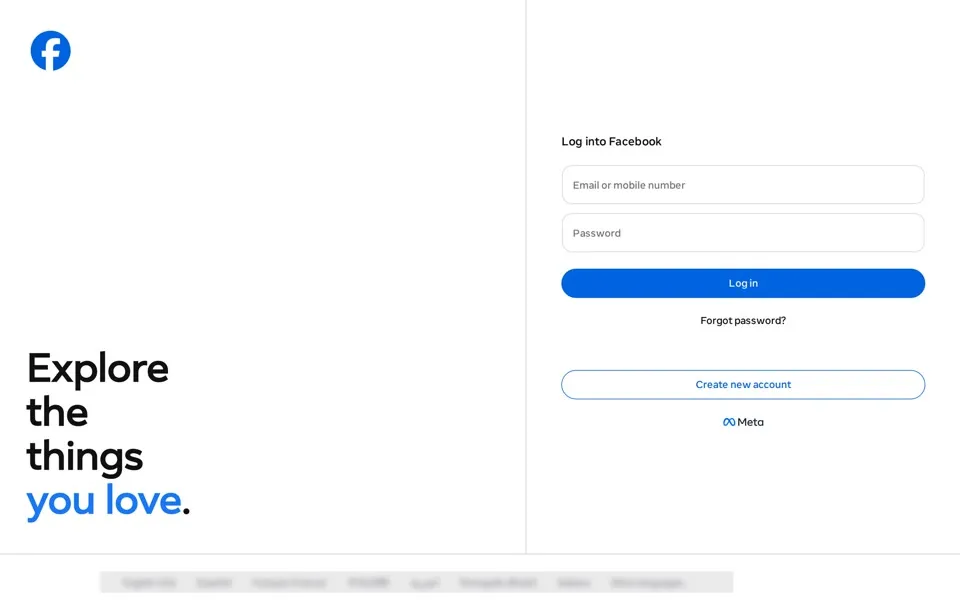
In our June 2026 capture the big wordmark of 2020 to 2025 is gone, replaced by a round f
: a blue circle with a white letter, alone at the top left. Below it, near the lower left corner, a big black headline stacks into four lines: Explore the things you love.
, with you love
in blue.
The card on the right is headed Log into Facebook
. Create new account
has turned into an outlined button, with the Meta logo under it. The footer links to Ray-Ban Meta
, Meta AI
and Consumer Health Privacy
, and ends with Meta © 2026
. The tab title is one word: Facebook
.
2004 · Thefacebook2026 · Log in2004 → 2026 Register or log in
In 2004 the page ended with two buttons, Register and Login, after four reasons to press the first one. In 2026 the choice is the same pair, Log in
or Create new account
. Harvard, the two Facebooks, Everyone can join.
and the promise that it would always be free have all come and gone in between. The page that once explained what Thefacebook was now assumes you already know.
- When was the oldest Facebook homepage in this story archived?
- The oldest capture here is from February 12, 2004, in the Internet Archive's Wayback Machine. Thefacebook in February 2004: “[ Welcome to Thefacebook ]”, an online directory “at Harvard University”, signed “a Mark Zuckerberg production”.
- What does the facebook.com homepage look like in 2026?
- In the newest capture here (June 1, 2026): Facebook in June 2026: “Explore the things you love.”, a round “f” logo and a “Log into Facebook” card.
- How many Facebook homepage captures does this story show?
- 23 captures between 2004 and 2026, at most one per year; the timeline above shows which years are included.
- How did the Facebook logo change on its homepage?
- The logo evolution below shows 4 logo versions we picked from the captures, from 2004, 2005, 2020 and 2026. Logos from before 2004, the first capture, aren't included.
 2004"[ thefacebook ]" in square brackets, lowercase, on a banner with a binary-code portrait
 2005The brackets and "the" are gone: a plain white lowercase "facebook" on the blue bar
 2020White-on-blue block becomes a bright blue wordmark on white, rounder letters
 2026The wordmark steps back: only the round blue "f" icon is left in the corner
Each logo is cut from that year's homepage capture (the year is the capture's); click one to see it on the page. Logos from before the first capture (2004) aren't shown, and some are missing where the logo images don't render in our captures. More logo histories.
◀ drag ▶20042026
The oldest capture in this story (2004) over the newest (2026). Drag across the picture.
Which homepage should we open next?
Tell us on the PageRewind YouTube channel, and subscribe for more histories of the pages we used to visit.
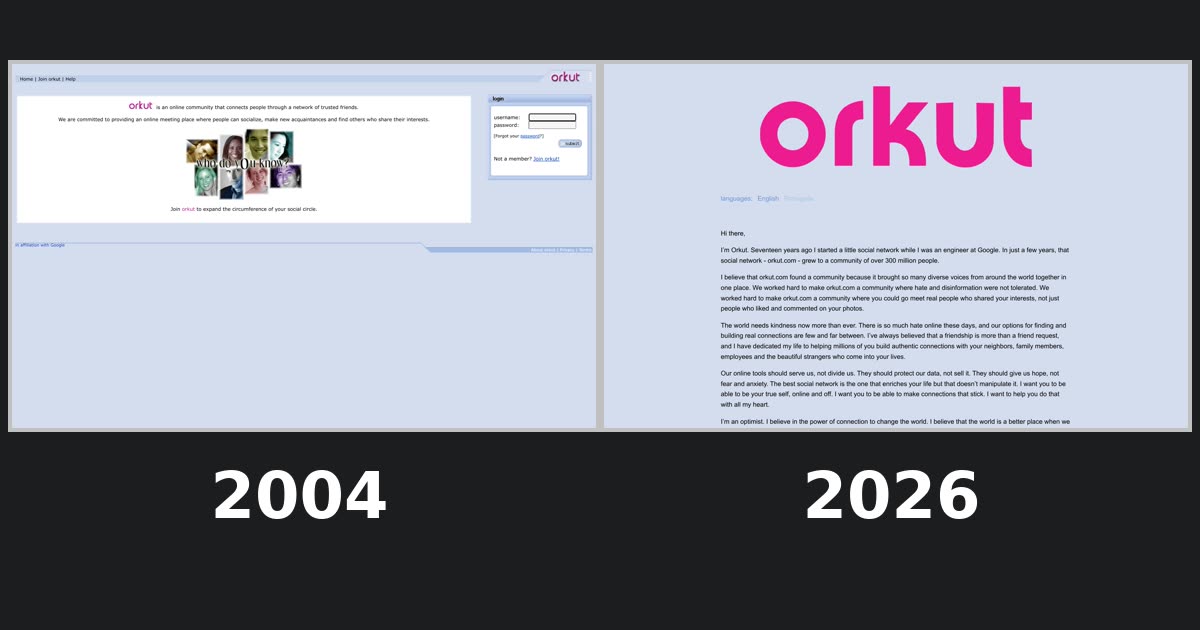 Orkut.com, 2004–2026From “Join orkut” to a letter from Orkut
Sources
Each screenshot links to its dated Wayback capture. Observations about layouts and wording refer to those screenshots; image labels, closed menus, hidden boxes and other details read from a page’s code are identified as such. External history uses the sources below.
- The Harvard Crimson · on Thefacebook’s first year: the launch at Harvard on February 4, 2004 and the first server at $85 a month; February 24, 2005. Read source ↗
- ABC News · Amy-Mae Elliott · 10 fascinating Facebook facts: the face in the early header was a manipulated photo of Al Pacino, citing David Kirkpatrick’s book The Facebook Effect; July 23, 2010. Read source ↗
- The Harvard Crimson · Facebook.com gets a facelift: “the” dropped from the name, the redesign called Operation Quail inside the company; September 16, 2005. Read source ↗
- TIME · Victor Luckerson · Facebook at 10: News Feed launched on September 5, 2006 and drew a backlash; February 4, 2014. Read source ↗
- Facebook Newsroom · Additional privacy controls for News Feed and Mini-Feed, in response to user feedback; September 8, 2006. Read source ↗
- The Harvard Crimson · News Feed causes dissent: the leading anti-feed group had over 744,000 members on the evening of September 10, 2006, and the feed remains; September 11, 2006. Read source ↗
- Facebook Newsroom · Facebook expansion: registration open to anyone with a valid e-mail address; September 26, 2006. Read source ↗
- Facebook Newsroom · Tell your story with Timeline: Timeline announced; September 22, 2011. Read source ↗
- Facebook Newsroom · Timeline now available worldwide, with seven days to review it before it goes live; December 15, 2011. Read source ↗
- ABC News · Kelly McCarthy · What we know about the small change to Facebook’s slogan: “It’s free” replaced by “It’s quick and easy” in the sign-up section; August 28, 2019. Read source ↗
- Facebook Newsroom · The new Facebook.com: the redesigned desktop site, first announced at F8 in 2019, rolls out worldwide; the mobile focus had left desktop behind; May 8, 2020. Read source ↗
- Meta Newsroom · Mark Zuckerberg · Founder’s letter: the company becomes Meta, its apps and their brands keep their names; October 28, 2021. Read source ↗
- Engineering at Meta · Santosh Janardhan · More details about the October 4 outage: a maintenance command disconnected the backbone, and a bug in the audit tool failed to stop it; October 5, 2021. Read source ↗
We selected one homepage capture for every year from 2004 to 2026, 23 in all. Each preview is a 960×600 image of the first 1440×900 screen of the page, with a link to the original Wayback capture; the full-size view adds the extra height we captured in 2017, 2018 and 2026. The browser frames are illustrations of the eras. The 2004 capture is thefacebook.com; every later one is facebook.com.
On some dates the archive holds facebook.com in another language or without its styles (January, March and April 2026, for example); we used English captures that load their styles. In most footers from 2011 on we blurred the row of language links, where our browser lacked the fonts for Chinese. Details read from a page’s code (closed menus, hidden checks, the birth-year menus) are named as such. No member photos appear on these pages; the people in the 2012 and 2013 captures are in Facebook’s own promotional images.
PageRewind is independent and is not affiliated with Meta or Facebook. Screenshots and trademarks appear for historical commentary; archived pages are provided by the Internet Archive.
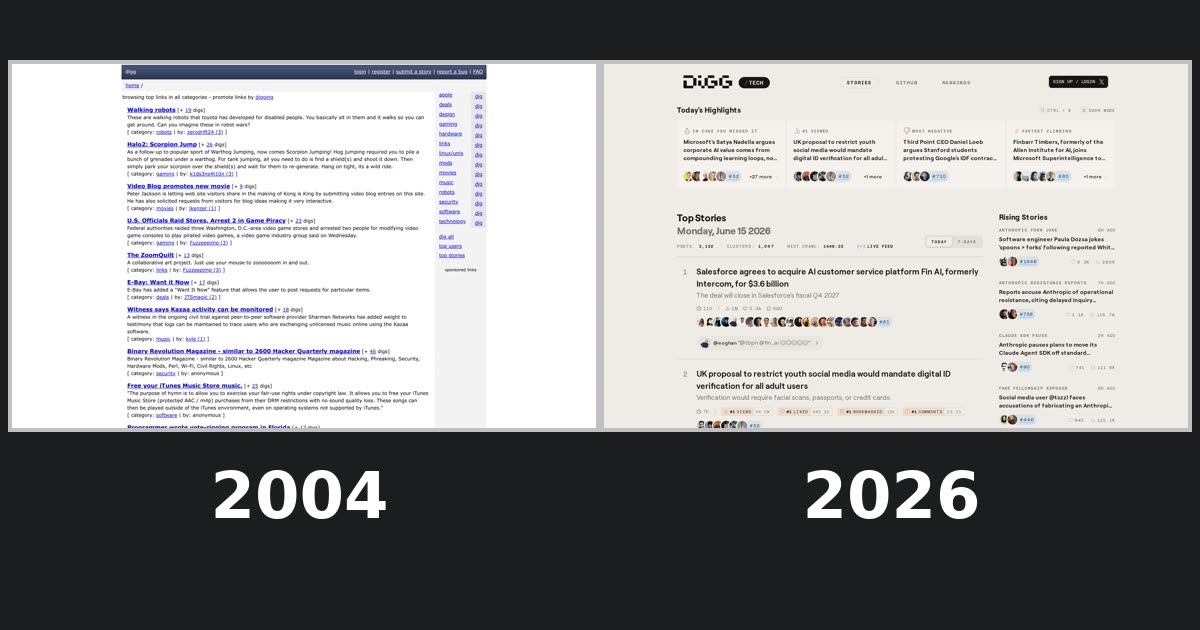 Digg homepage history
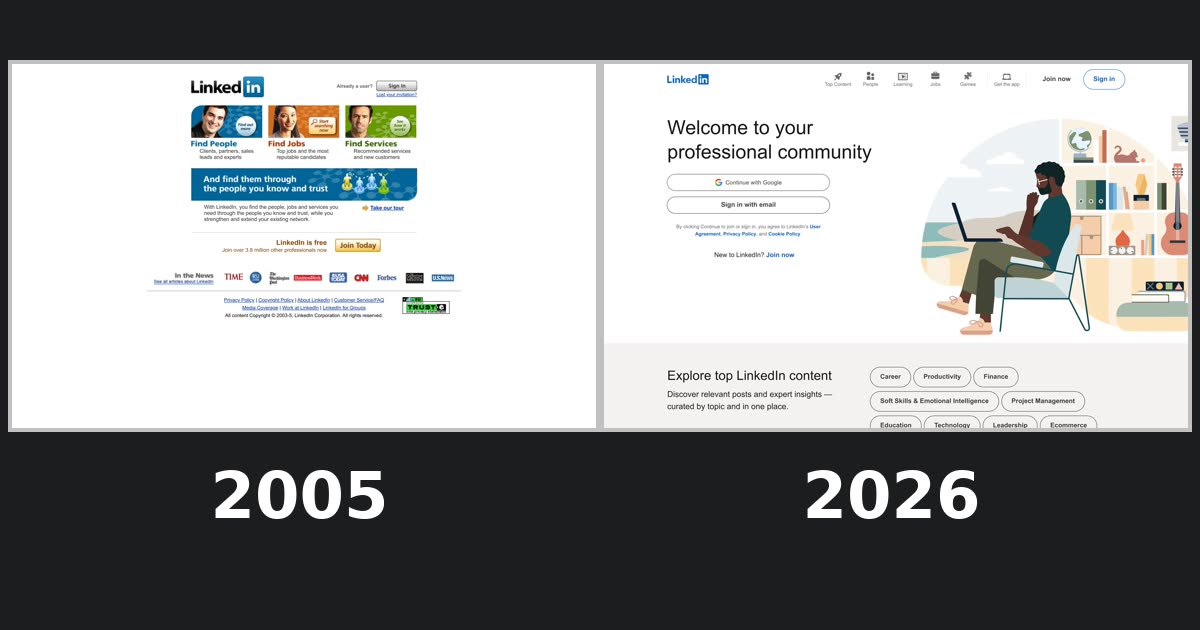 LinkedIn homepage history