On December 21, 1996, the BBC's homepage was a navy page with the three BBC blocks at the top and two buttons in the middle: About the BBC
and Programmes
. Two years before it, in September 1994, the BBC had started a transcript service over FTP. At its peak it had 122 accounts, FBI bureaus among them.
Scrub through the captures with the slider, or read on.
This is bbc.co.uk's homepage from 1996 to 2026, one capture per year. The BBC's own history dates the first www.bbc.co.uk to about April 1994. In November 2001 the Guardian reported the portal's rename to BBCi. In December 2007 the BBC announced a homepage of boxes you could rearrange, and on 30 November 2011 a carousel replaced the British page in a full redesign. The address never changes, but in many years the archive's crawler was handed the BBC's international page instead of the British one.
1996 Two buttons on a navy page
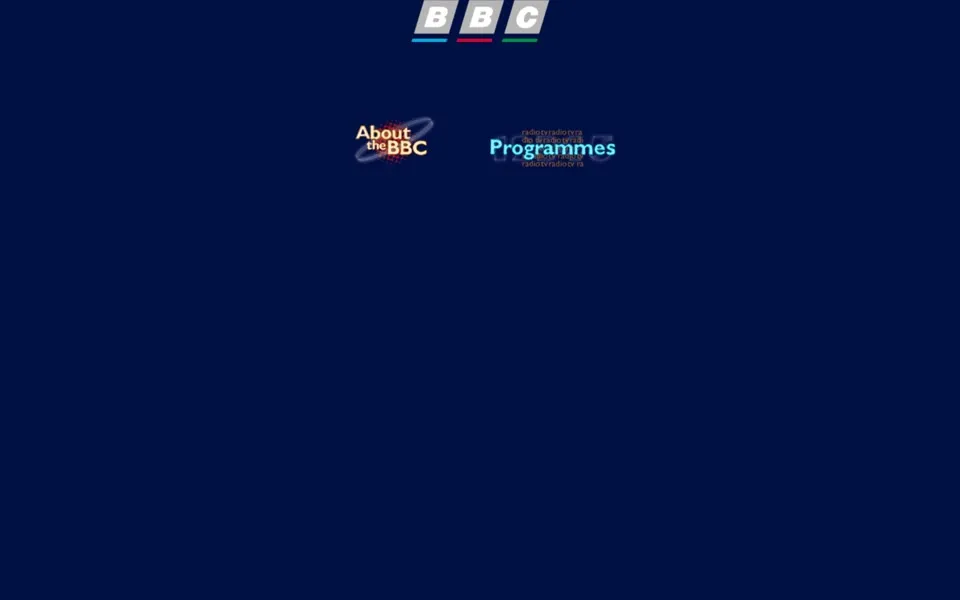
The December 1996 capture is the oldest homepage in this story. The page color is set to #001042, a dark navy, and everything on it is a picture: the BBC logo, a button that says About the BBC
and one that says Programmes
. Behind the second button, in faint letters, the words radio
and tv
repeat like a pattern on wallpaper.
The address itself was older than the page. BBC Internet Services' own history says the BBC registered bbc.co.uk in October 1991, and that the form had to be signed by a director so nobody could spoof the domain
.[1] The signature came from the BBC's Director of Engineering. The same history dates the first www.bbc.co.uk to about April 1994, mostly regional
pages and some studio information.[1]
The transcript service with the FBI bureaus among its accounts ran from the BBC's Caversham site and sent them daily updates from 12 feeds.[1] Two years later, the front door to the BBC's web still had two buttons.
1997 Frames, and about 8,000 election pages fed by Ceefax
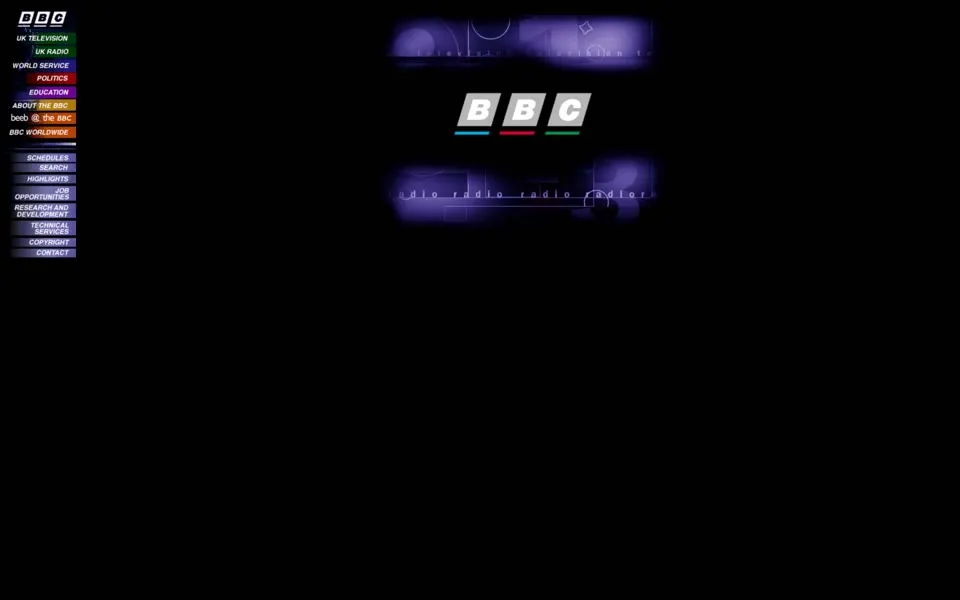
By June 1997 the tab says The BBC Online
and the page is black. It is built from two frames: a narrow strip of menu buttons on the left, 130 pixels wide in the code, and the main page beside it. The buttons run from UK TELEVISION
and UK RADIO
down to JOB OPPORTUNITIES
and CONTACT
. The fallback for browsers without frames keeps a note from whoever looked after the page: 97/06/06 last edited by gcj
. The capture is from June 16, ten days later.
Ceefax, the BBC's teletext, fed the web that spring. For the May 1997 general election the BBC built approx 8000 pages
automatically from live Ceefax and election feeds, one for each constituency and candidate.[1] An Oracle publishing system turned those feeds into HTML, so teletext data became web pages.
In August, after Diana died, the team organized a webcast of her funeral with several internet providers. The history says the BBC's news managers then realized it's big and have to do something about a site soon
.[1]
1998–1999 “Your gateway to over 200 sites”
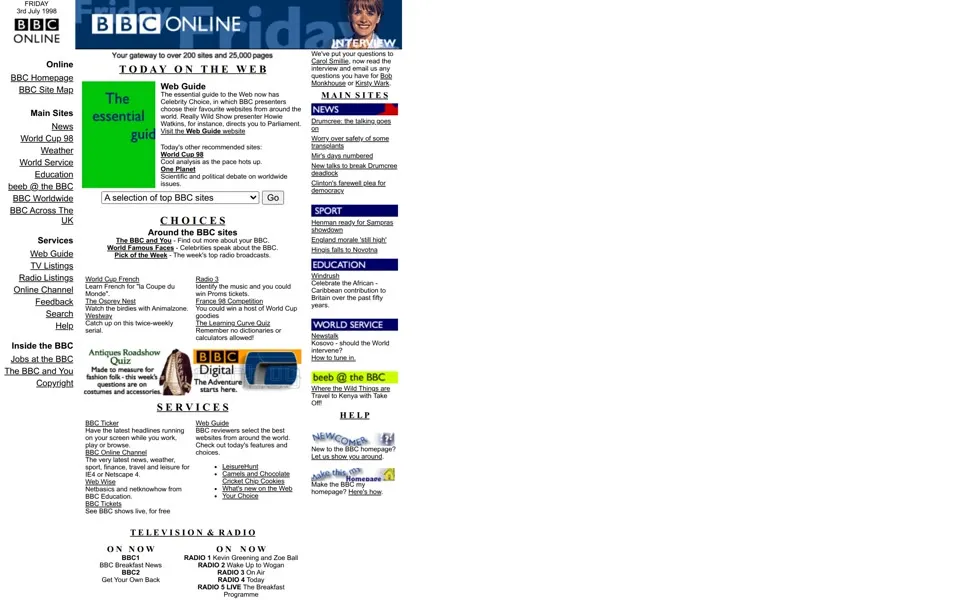
BBC News went online in November 1997, and BBC Online had its full launch in December.[1] The July 1998 capture shows the result. A blue bar reads BBC ONLINE
, and under it the page explains itself in one line: Your gateway to over 200 sites and 25,000 pages
. Below come TODAY ON THE WEB
, CHOICES
, SERVICES
and TELEVISION & RADIO
, the last with what is ON NOW
on BBC1, BBC2 and five radio stations.
The address bbc.co.uk did not hold this page itself. The archived root file is a redirect to /home/today/index.shtml, and it carries a version stamp in its code: 15_12_97
. That is December 15, 1997, the month of the full launch.
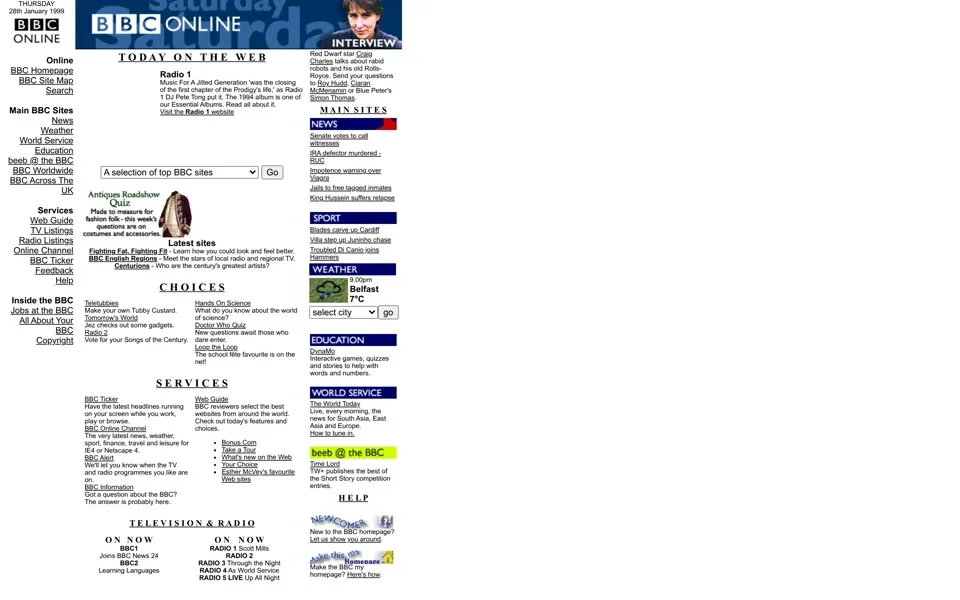
The January 1999 page is the same design with new stories. TODAY ON THE WEB
has Radio 1 on the Prodigy, and a weather box shows Belfast at 7°C. Near the bottom, a small graphic asks Make the BBC my homepage?
and answers Here's how
.
→ 2 million+
over 200 sites and 25,000 pagesin July 1998,
More than 2 million amazing BBC pagesin June 2004.Read on the captures
2000–2001 “Welcome to the UK's favourite website”
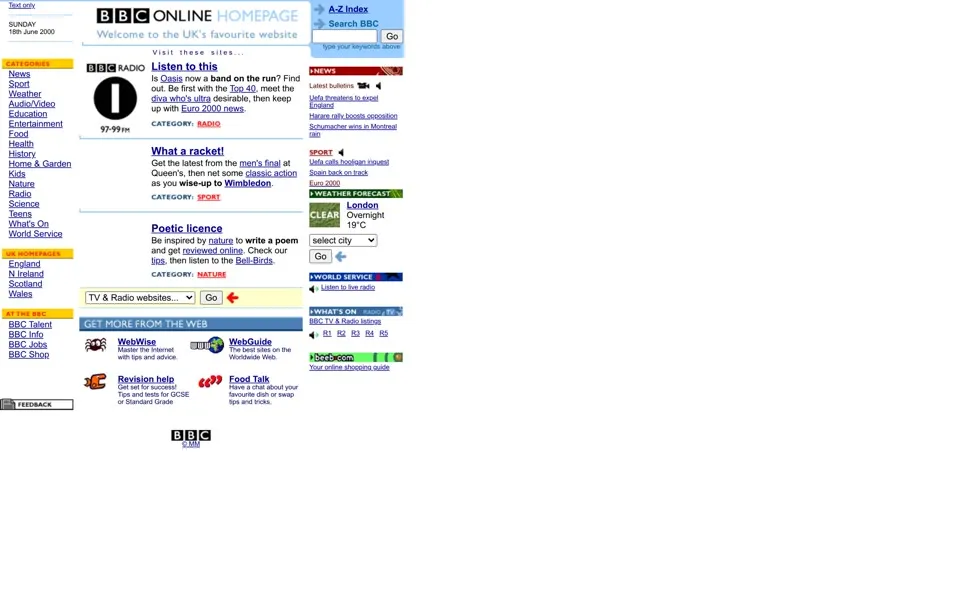
In June 2000 the banner says BBC ONLINE HOMEPAGE
and the line under it is a boast in pale blue: Welcome to the UK's favourite website
. Under an orange-on-yellow CATEGORIES
heading, blue links run down the left from News
to World Service
. The middle column has three promos written as puns: Listen to this
, What a racket!
for Wimbledon and Poetic licence
.
The code has its own small print. At the start of the middle column a comment explains a table that exists only to fix a layout problem: THIS TABLE CRUSHES FORM SPACE IN NN
. NN is Netscape Navigator, the other big browser of the time.
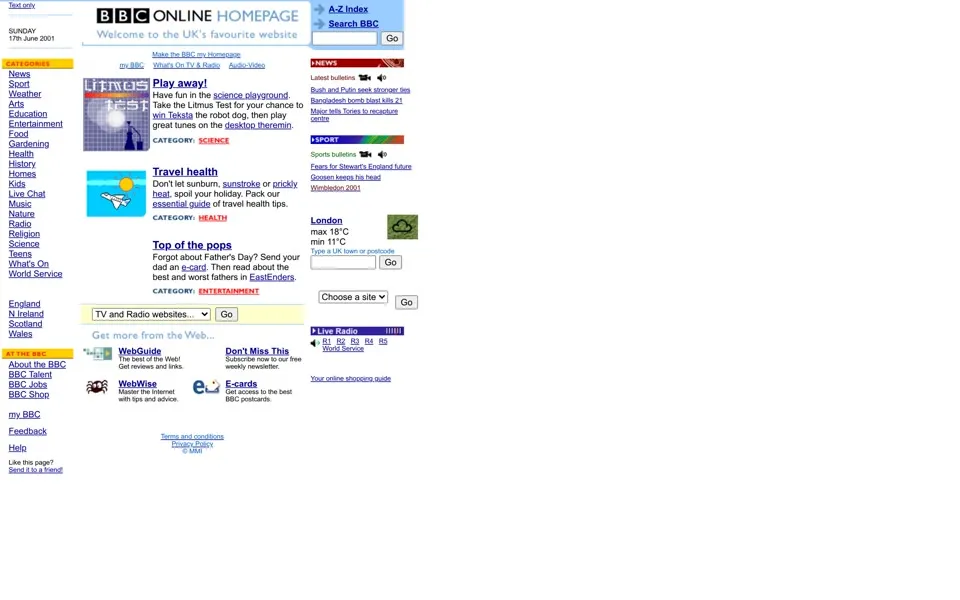
A year later the design is the same. The June 2001 page has Make the BBC my Homepage
and my BBC
near the top, and Like this page? Send it to a friend!
at the bottom of the left column. The June 2001 promos are a science playground with Teksta the robot dog
to win and a desktop theremin
, and a Father's Day e-card.
2002–2003 BBCi, “the UK's number one digital destination”
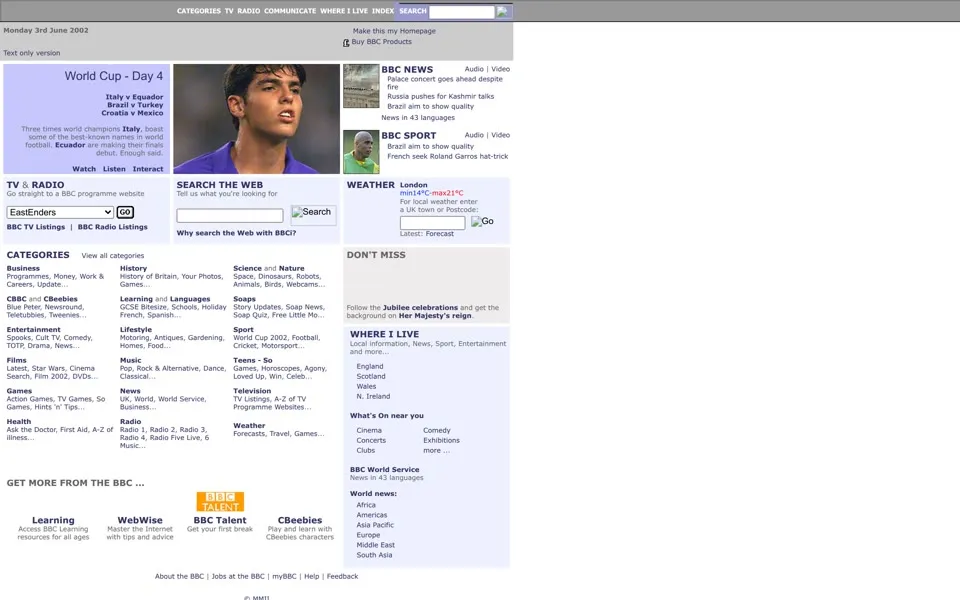
The June 2002 capture has a new name in its browser tab: BBC - BBCi - the UK's number one digital destination
. A gray bar of sections runs along the top, from CATEGORIES
to SEARCH
. The page opens on World Cup - Day 4
, with Italy v Ecuador, Brazil v Turkey and Croatia v Mexico. Underneath is a directory of categories, from Business to Weather, the way a web portal had them.
In November 2001 the BBC had renamed its online, interactive TV and mobile services BBCi, and the Guardian wrote that the redesign made the site look more like the Yahoo! and MSN portals (reported).[3]
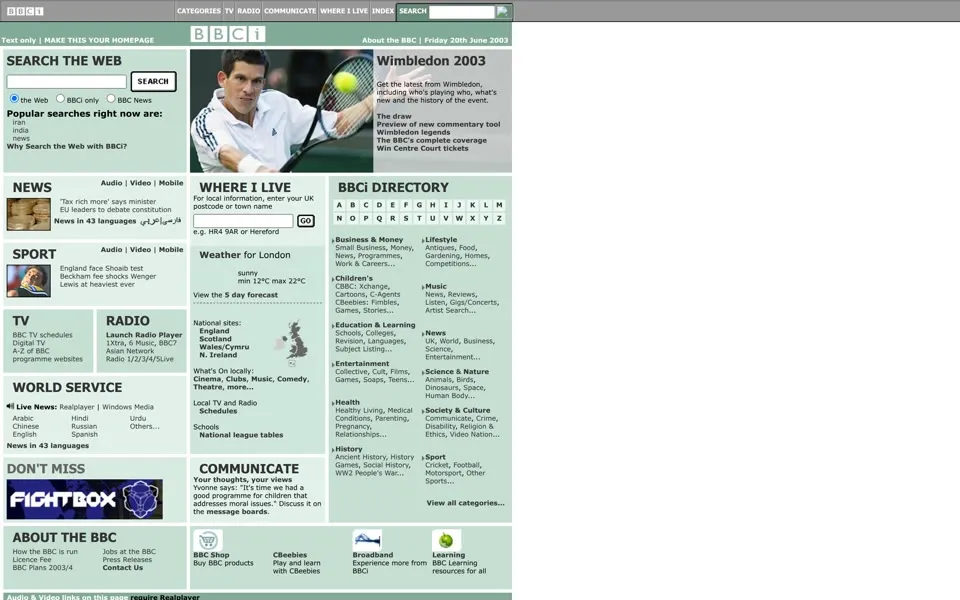
In June 2003 the BBCi logo sits on a green page, and the first box is a web search. Under it the page reports Popular searches right now are:
iran
, india
and news
. A comment in the code, left for BBC staff, points to an address on the BBC's intranet: do not copy, see http://intracat/ssi/ for usage
.
2004–2005 “More than 2 million amazing BBC pages”
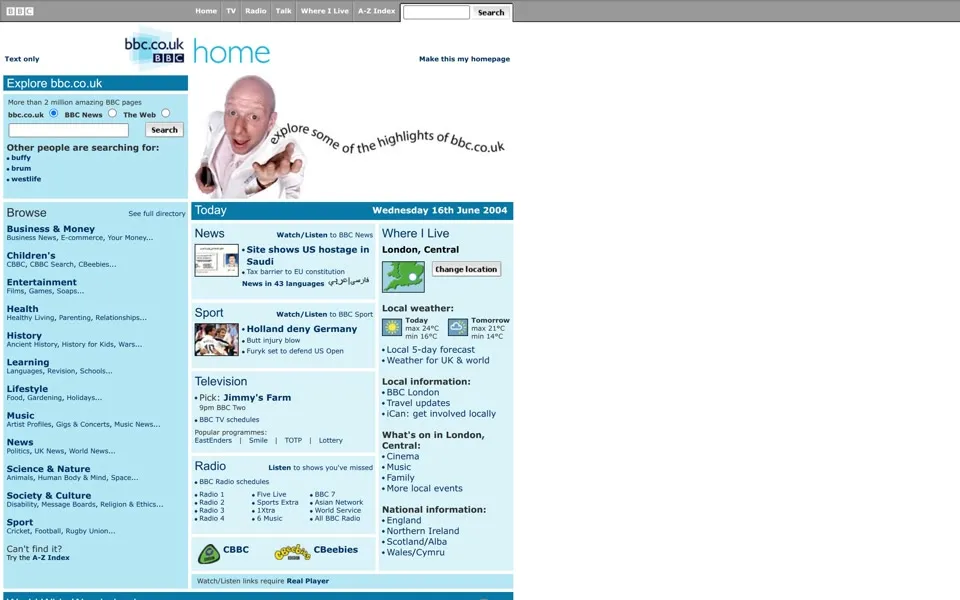
BBCi is gone from the June 2004 capture. The logo is now a small bbc.co.uk
above the BBC blocks, followed by a large light-blue word, home
. Light-blue panels fill the page: a search box that promises More than 2 million amazing BBC pages
, a Browse
directory, a Today
column with News, Sport, Television and Radio, and Where I Live
, set to London, Central
.
The search box has a habit that makes each capture a time capsule. Under it, a line reads Other people are searching for:
and lists three searches. In June 2004 they were buffy
, brum
and westlife
.
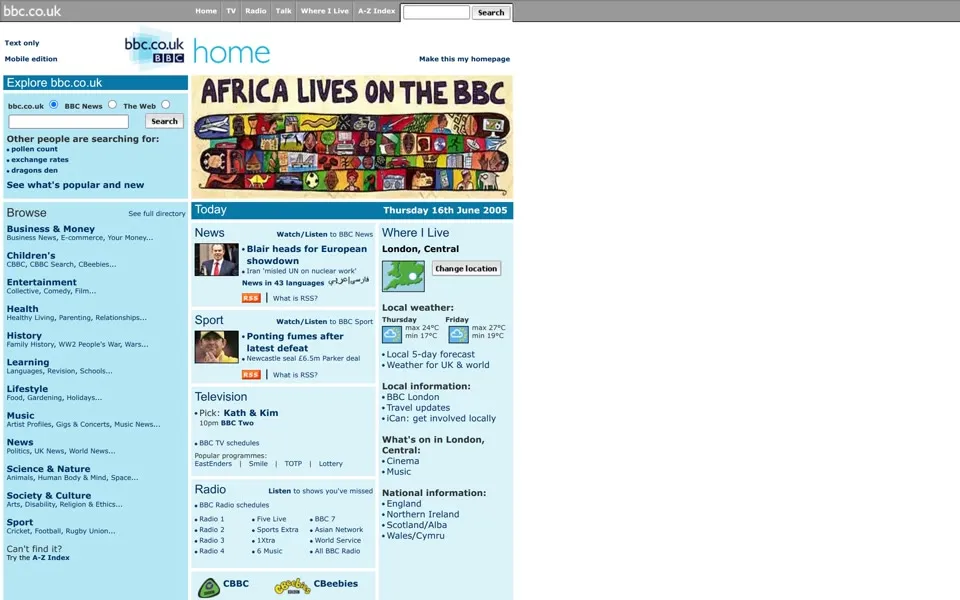
The June 2005 page keeps the layout and adds a Mobile edition
link under Text only
. The big promo is a colorful banner, AFRICA LIVES ON THE BBC
. People were searching for pollen count
, exchange rates
and dragons den
.
2003 iran · india · news (“Popular searches right now are:”)
2004 buffy · brum · westlife
2005 pollen count · exchange rates · dragons den
2006 history · music · weather
2007 racism · switzerland · beach boys
2006–2007 UK version or International version
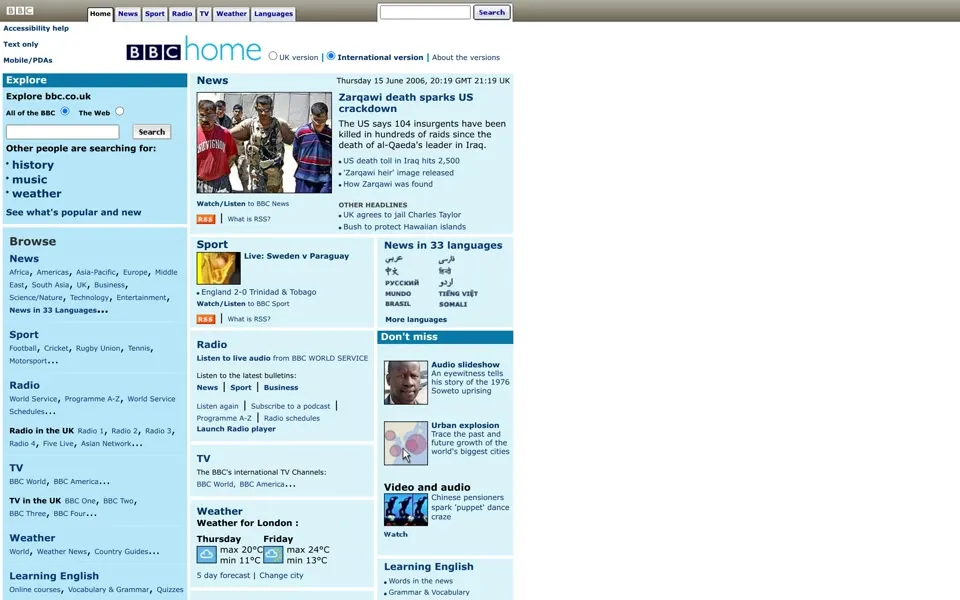
The June 2006 capture shows a choice at the top of the page, next to the BBC logo: two radio buttons, UK version
and International version
, and a link, About the versions
. In this capture the second one is ticked, and the page shows it. The Browse
list starts with News from Africa
, Americas
and Asia-Pacific
, the TV box lists The BBC's international TV Channels
, and the top story is Zarqawi death sparks US crackdown
.
This is the first of many captures in which the crawler sees the BBC for readers outside Britain. The BBC had bought bbc.com in 1999 from Boston Business Computing, a Massachusetts company, for $375,000 (reported).[2]
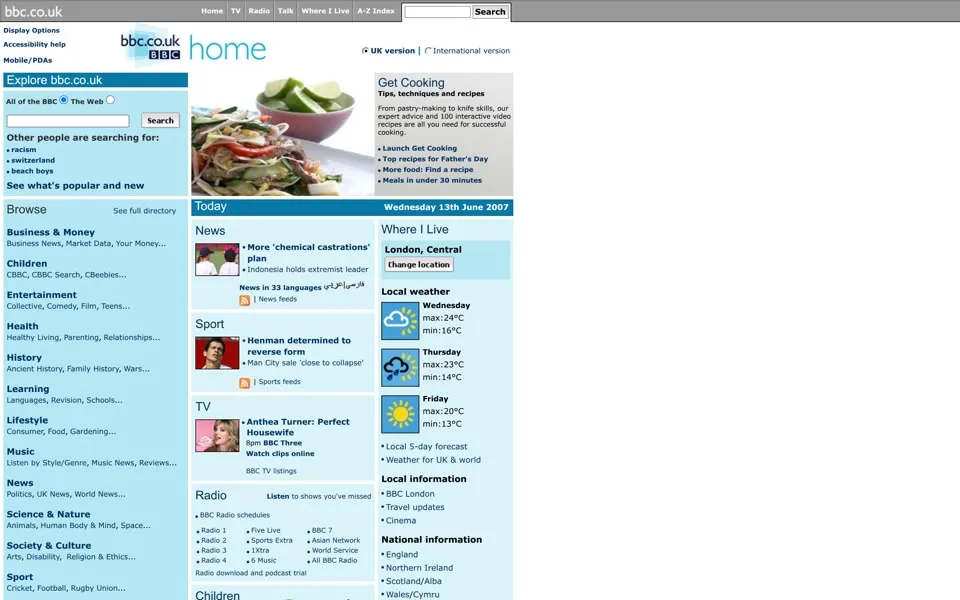
In June 2007 the same radio buttons have UK version
selected, and the page is the British one again: a Get Cooking
promo, local weather for London, Central
and links to England, Northern Ireland, Scotland and Wales.
2008–2010 Boxes you could move, and a clock set by your own PC
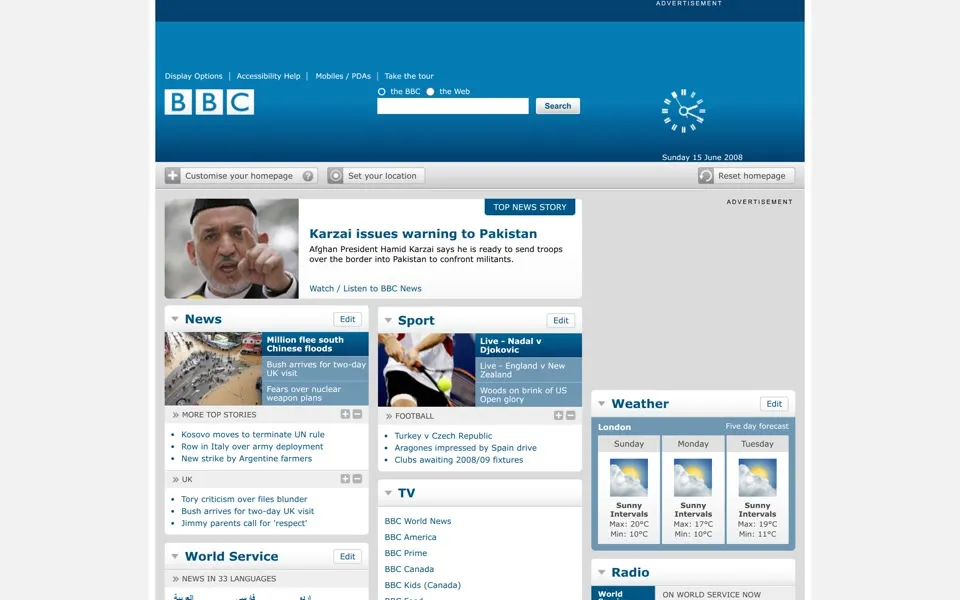
In December 2007 the BBC's Richard Titus announced a new homepage. He wanted to get away from the tired and monotonous blue base colour of the original page
, and said the widgetization adopted by Facebook, iGoogle and netvibes
had shaped the team's thinking.[4] Visitors could add, remove and rearrange the boxes; football fans could put up to eight football stories
in the sport box.[4]
The June 2008 capture has all of it. Under a deep blue masthead are Customise your homepage
, Set your location
and Reset homepage
, and the News, Sport and Weather boxes carry Edit
buttons. On the right of the masthead is a white analogue clock. Titus called it a BBC 1 analogue clock, added as a bit of fun
; users found it bizarrely reassuring
.[4] This 2008 page is the international one, with Advertisement
labels.
The clock had a flaw. In its April 2010 version it took the time from each visitor's own computer, not from a BBC time source, so it was only as accurate as that machine. In April 2013 the BBC Trust upheld a complaint about it.[5]
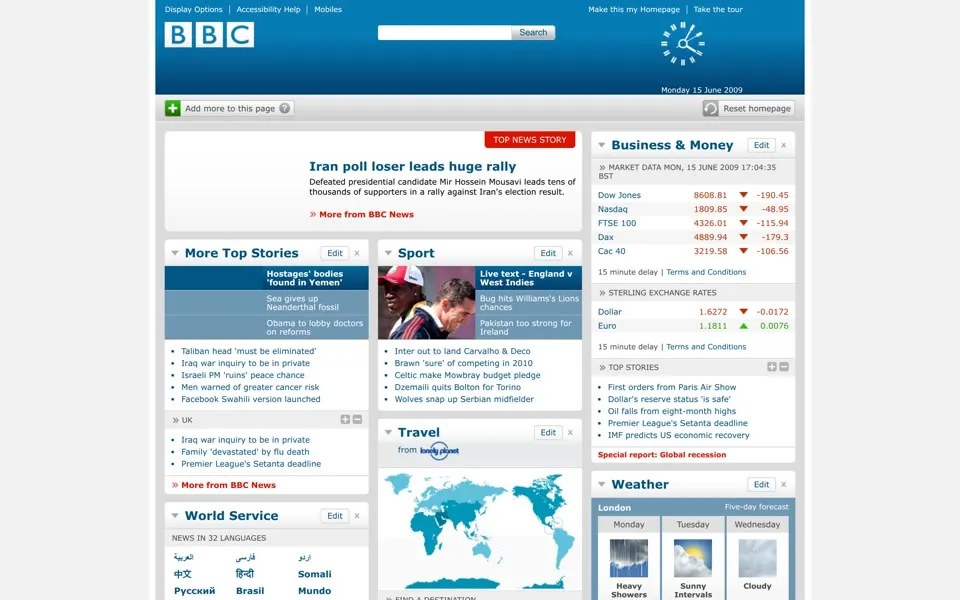
In June 2009 the button says Add more to this page
, and Business & Money
shows market data from the Dow Jones to the Cac 40, dated MON, 15 JUNE 2009 17:04:35 BST
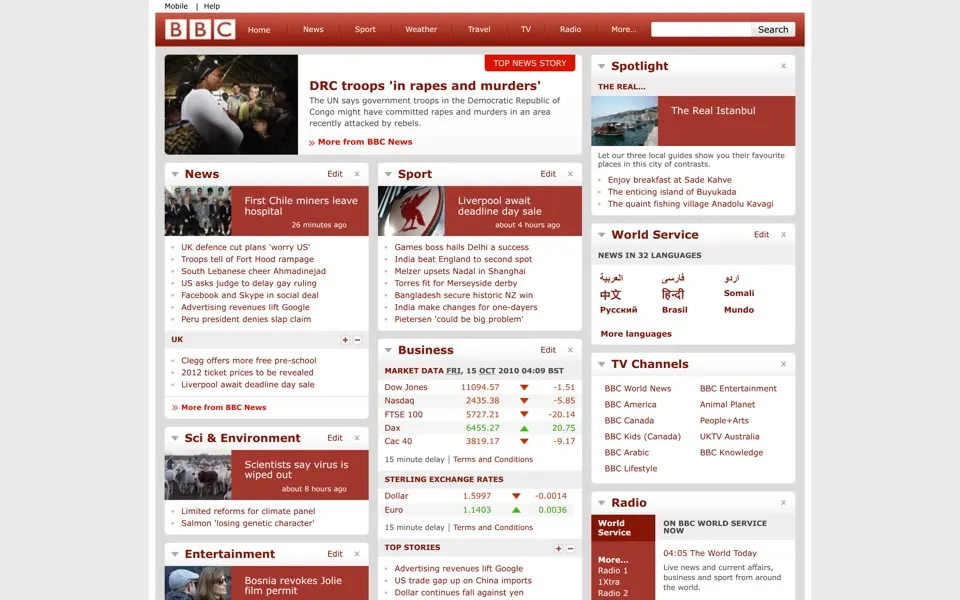
. The October 2010 capture swaps the blue for red: a red masthead, red heading text on pale bars, and a red TOP NEWS STORY
tab on the lead. The boxes keep their Edit
buttons, and NEWS IN 32 LANGUAGES
marks the page as international again.
“News in … languages”
- 2002
- 2005
- 2006
- 2008
- 2009
- 2010
2011–2014 The day the boxes went away
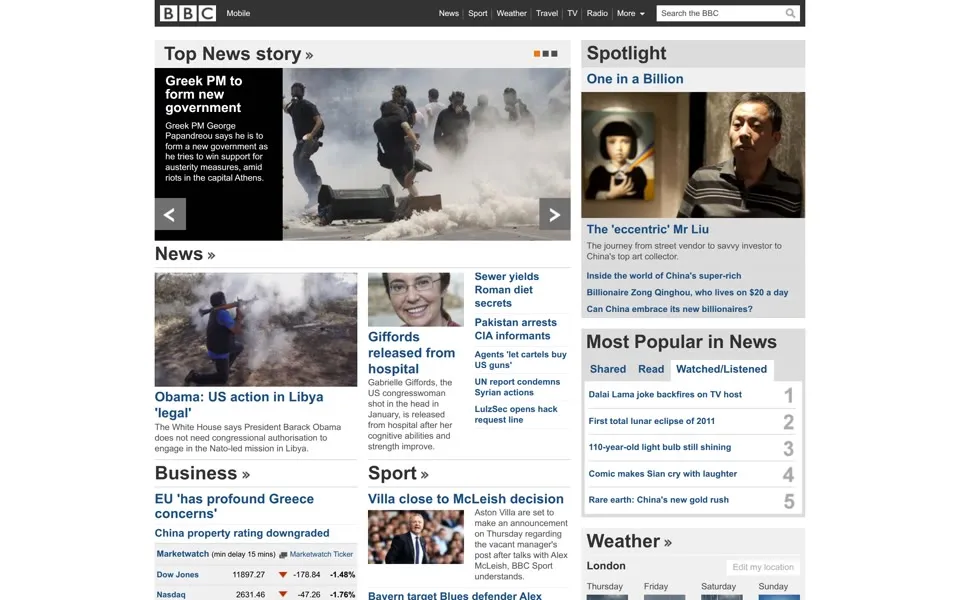
On 30 November 2011 the BBC replaced its British homepage, the page of boxes you could rearrange, with one built around a color-coded carousel. The same day it admitted that some beta users didn't like losing the more detailed customisation
of the old page, and said the team was working on ways to introduce customisation back
.[8] The homepage had nine million or so users
a week by the BBC's count.[8]
The carousel had been tried before. The Guardian reported a homepage beta in March 2010 with a moving carousel of stories and a Topic Tracker
, and noted that customised pages had to be set up again (reported).[6]
The archive's June 2011 capture is from before that switch, and it is the international page, with a Marketwatch
ticker under Business. It already opens on Top News story »
: one big photo with a dark text panel and arrows to the next story. The boxes have lost their Edit
buttons; only Weather keeps Edit my location
.
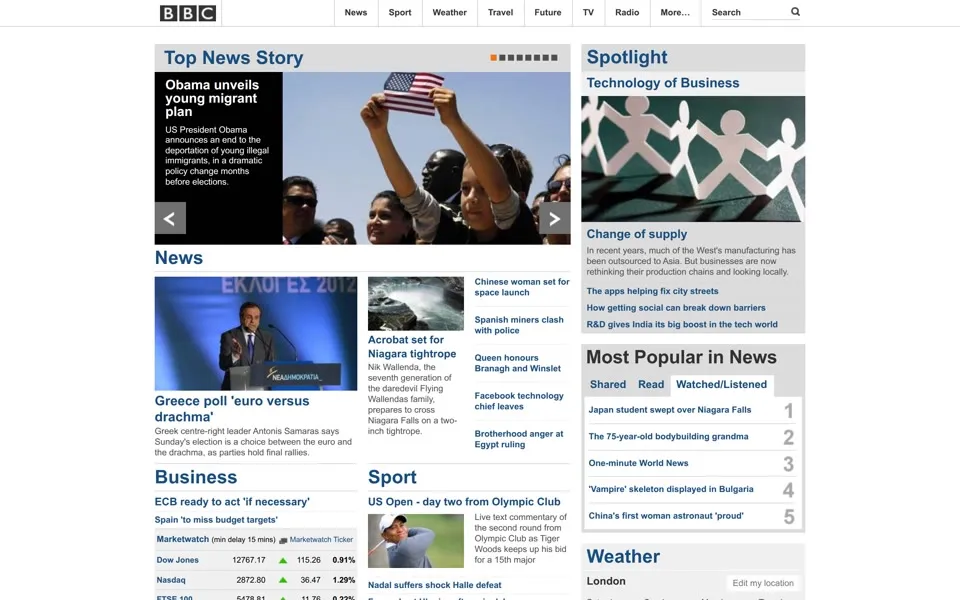
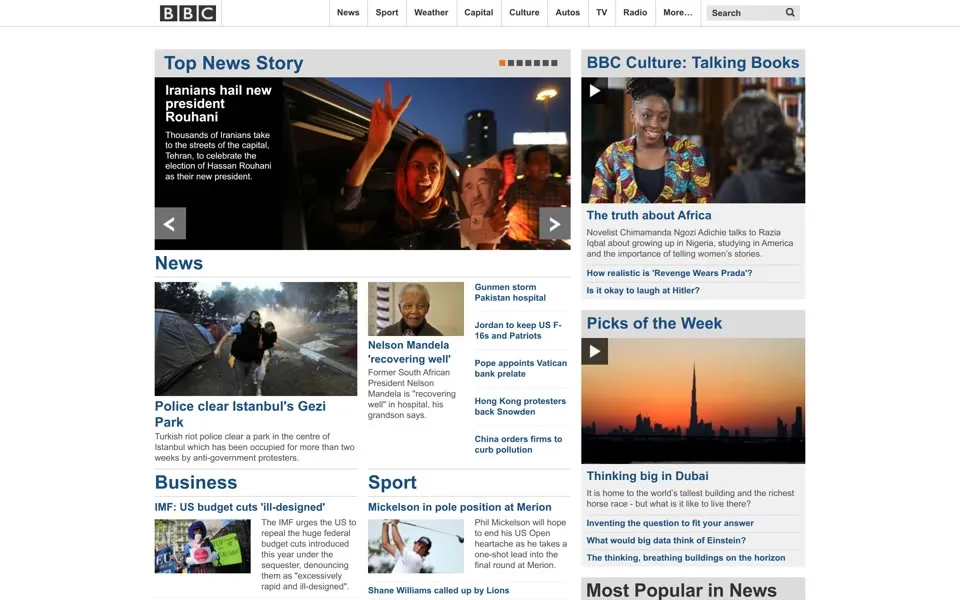
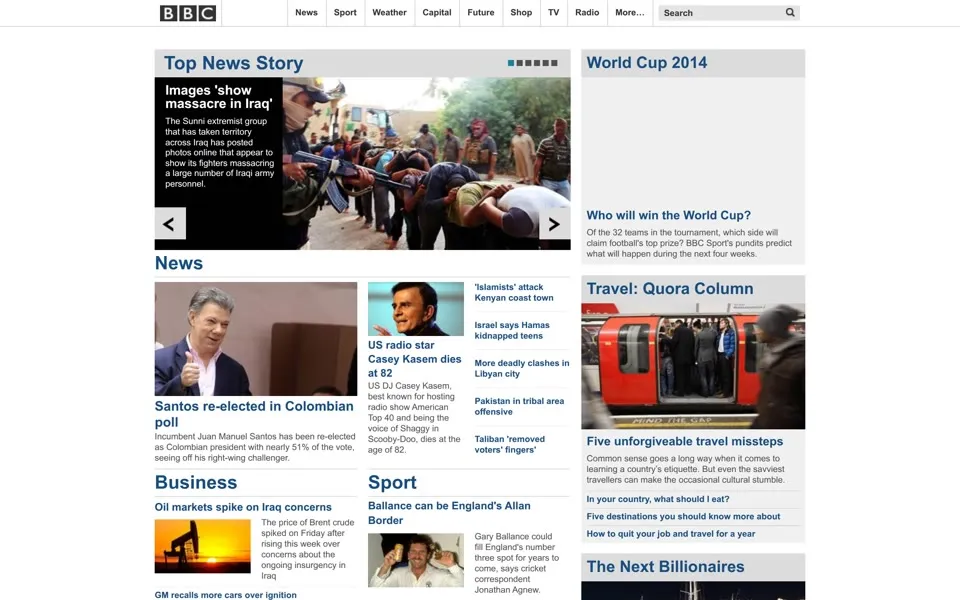
The 2012, 2013 and 2014 captures keep the carousel, then News, Business and Sport. By June 2013 the right column has BBC Culture: Talking Books
. In June 2014 a World Cup 2014
panel beside the carousel asks Who will win the World Cup?
The movable boxes of 2008 do not come back in any of them.
2015 The carousel is gone
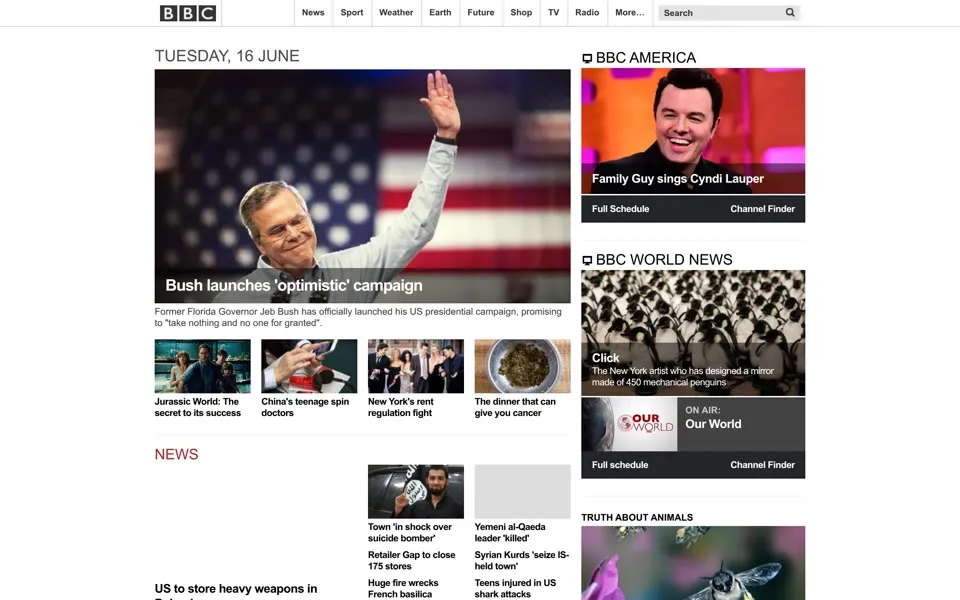
In June 2015 the page opens on a date, TUESDAY, 16 JUNE
, a large photo of Jeb Bush and the headline Bush launches 'optimistic' campaign
. On the right are two schedule boxes for the BBC's own channels abroad: BBC AMERICA
, where Family Guy sings Cyndi Lauper
, and BBC WORLD NEWS
.
A BBC work plan for 2015/16 promised to roll out a responsive homepage that fits tablets and phones.[9] Already in September 2011 the homepage team said 15–25% of its traffic came from handsets.[7]
2016–2017 “Welcome to BBC.com” at a .co.uk address
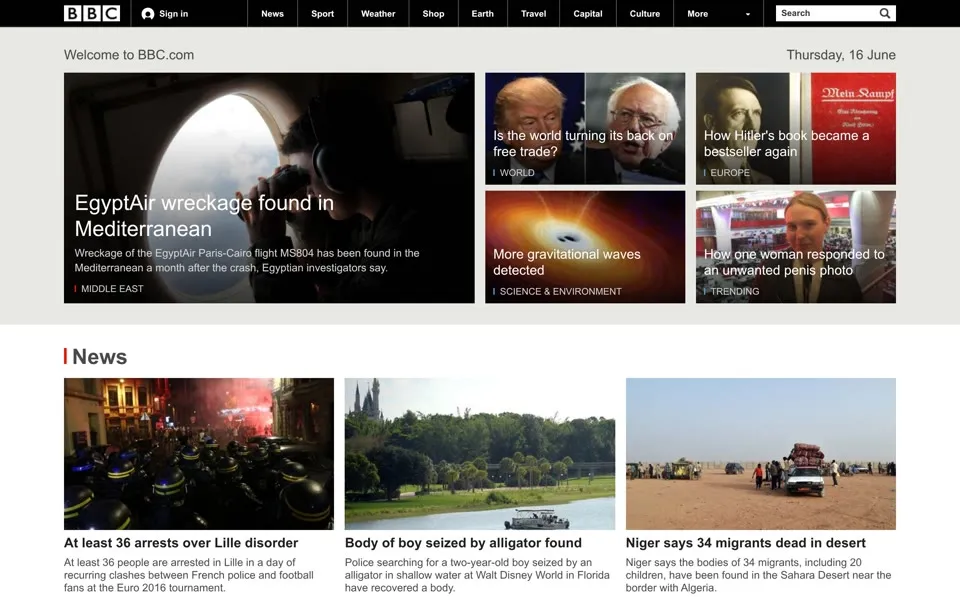
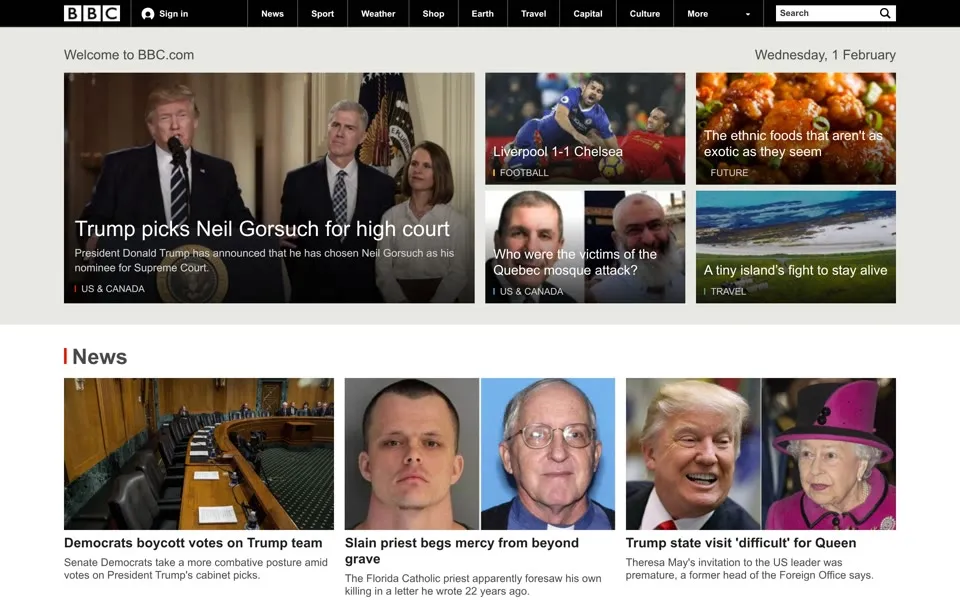
From June 2016 the page says what it is in its first line: Welcome to BBC.com
, with the date on the right, Thursday, 16 June
. Under it is a grid of photo tiles with white headlines, a big one on the left and four smaller ones beside it, each with a section label: WORLD
, EUROPE
, MIDDLE EAST
. Below are rows marked by color: red for News, yellow for Sport, blue for Editor's Picks.
The address in the archive is still http://www.bbc.co.uk/. The greeting is for BBC.com, the international site, and that is the one the crawler was given.
February 2017 has the same greeting and grid. The lead tile is Trump picks Neil Gorsuch for high court
, and its label is US & CANADA
.
2018–2020 “Welcome to the BBC”, and customising again
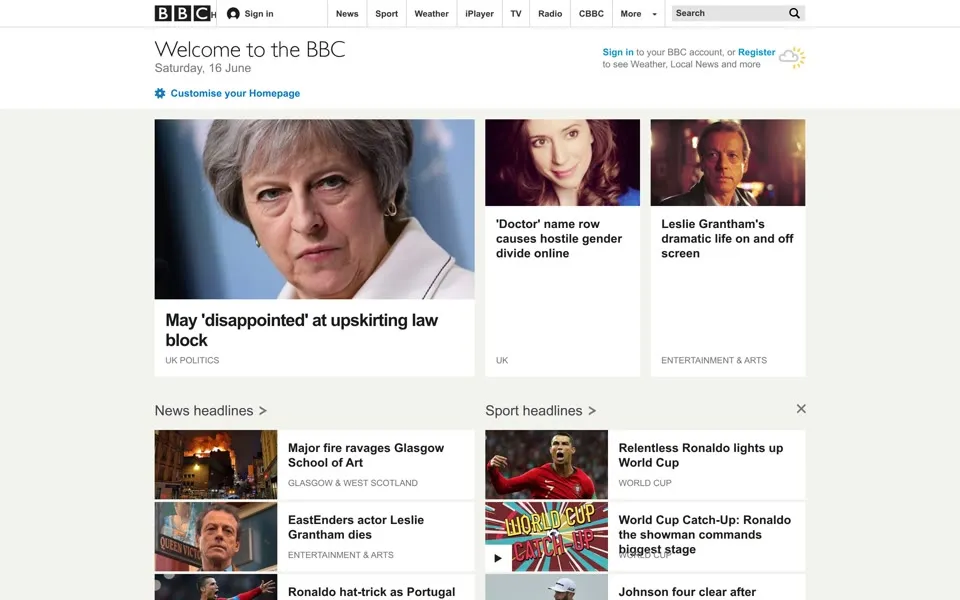
The June 2018 capture has a different greeting: Welcome to the BBC
. This is the British page. Its menu has iPlayer
, TV
, Radio
and CBBC
, and in the top right corner a line invites the visitor to Sign in
, or Register to see Weather, Local News and more
.
Under the greeting is a gear icon and Customise your Homepage
. In November 2011 the BBC said its team was working on ways to bring customisation back. In 2018 there is a link for it. The lead story is May 'disappointed' at upskirting law block
, labeled UK POLITICS
.
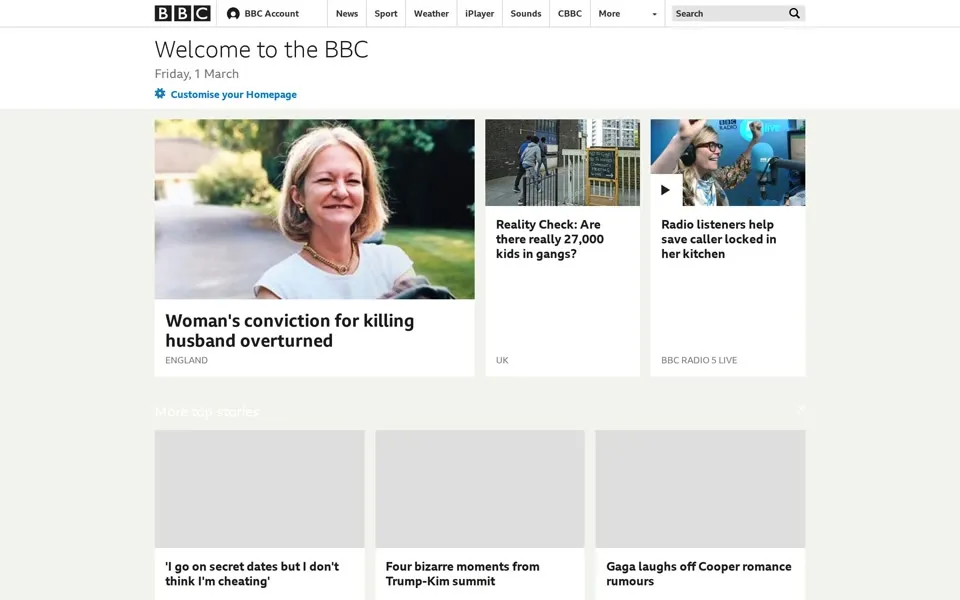
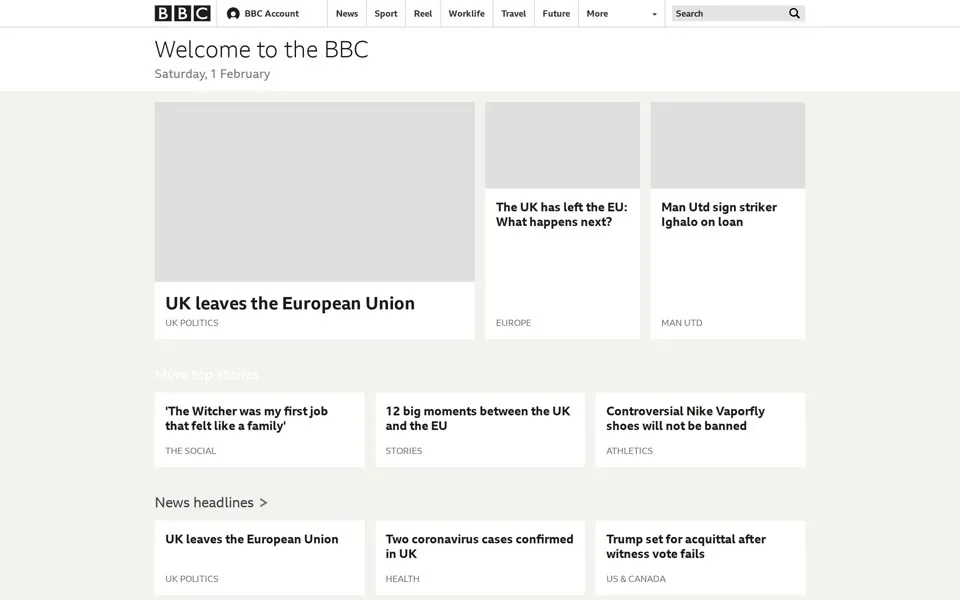
The March 2019 and February 2020 captures keep Welcome to the BBC
, but most of their image areas render as gray boxes. The 2020 capture was made at 00:52 GMT on February 1. Its lead story has no photo, only the headline: UK leaves the European Union
.
2021–2023 BBC.com again
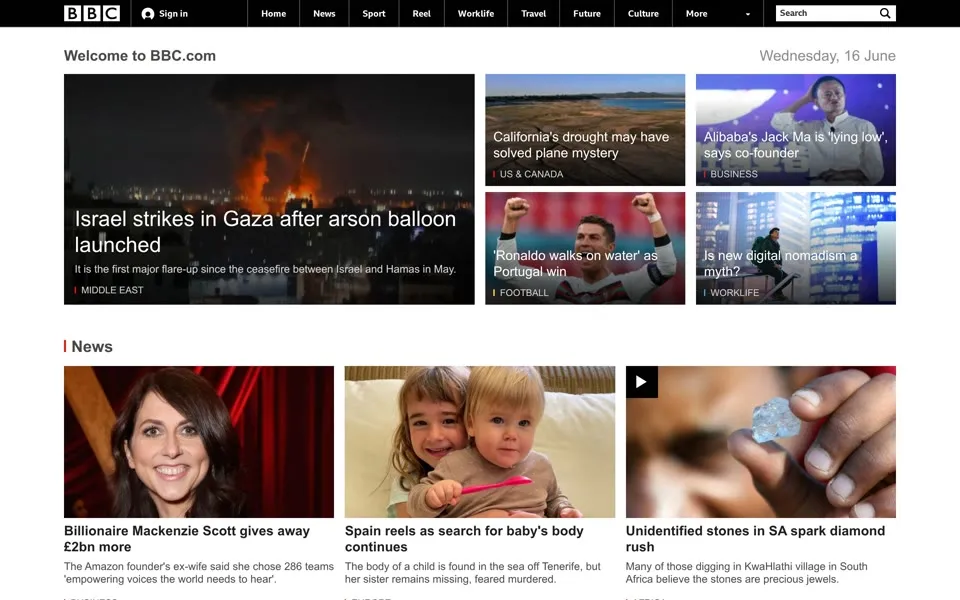
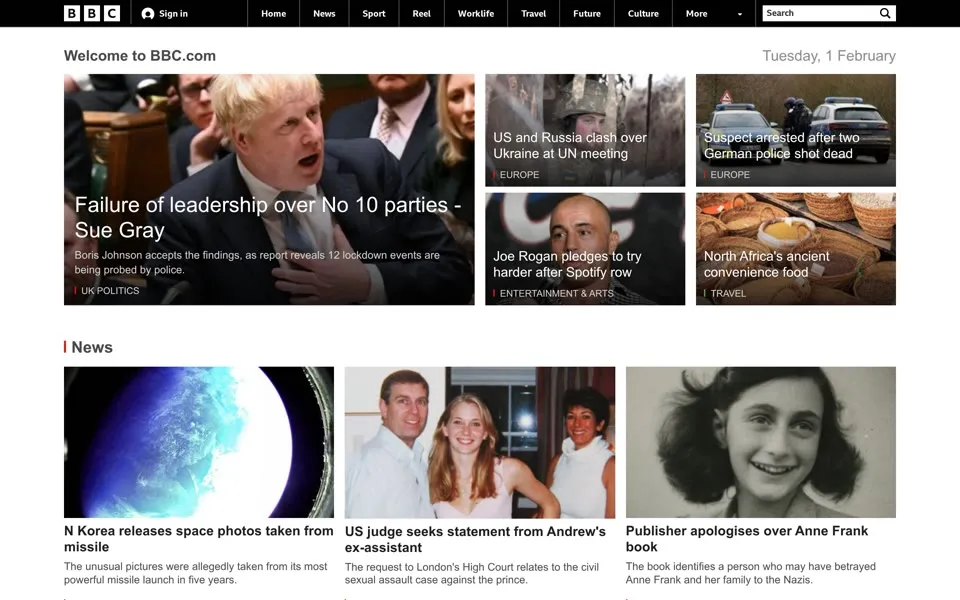
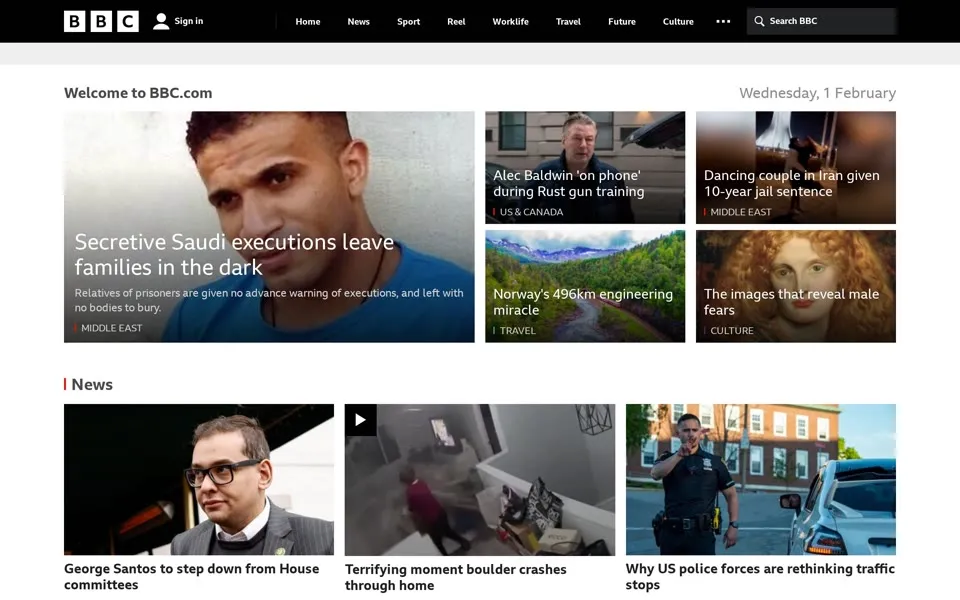
From 2021 the crawler gets BBC.com again. The June 2021, February 2022 and January 31, 2023 captures all open with Welcome to BBC.com
and the 2016 grid of tiles, now with a REEL
row of short videos further down. The 2021 lead tile is Israel strikes in Gaza after arson balloon launched
.
The 2022 lead is Failure of leadership over No 10 parties - Sue Gray
, a British story on the international page. The 2023 page, dated Wednesday, 1 February
on screen, leads with Saudi executions, and its News row opens on George Santos to step down from House committees
.
Welcome to BBC.com. The other three, 2018 to 2020, say
Welcome to the BBC. Same address every time: www.bbc.co.uk.Read on the captures
2024–2026 “Register” becomes “Subscribe”
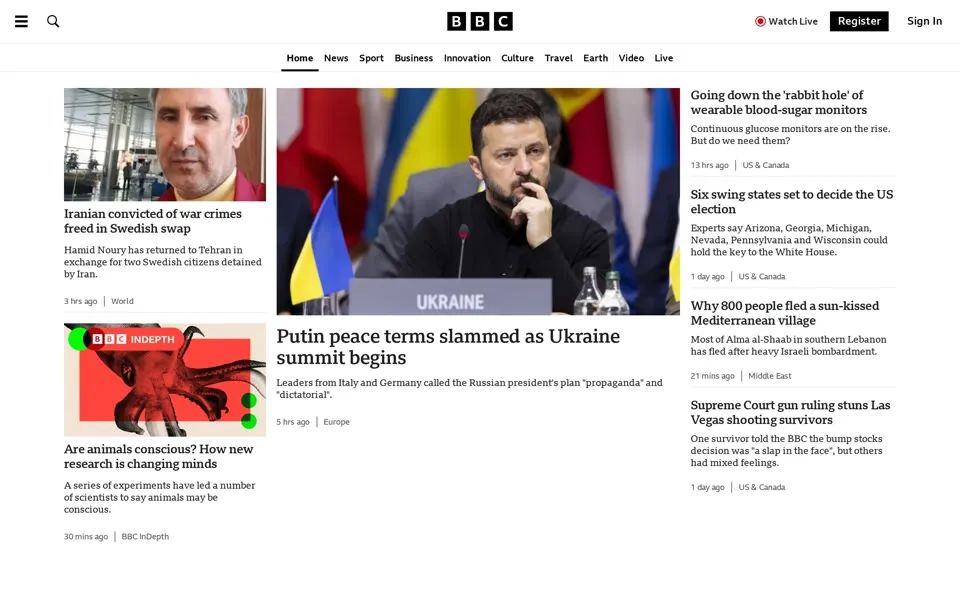
In June 2024 the greeting is gone. The page is white, the BBC blocks sit in the middle of the top bar, and a row of sections runs under them, from Home
, News
and Sport
to Live
. On the right are Watch Live
, a black Register
button and Sign In
. The browser tab reads BBC Home - Breaking News, World News, US News, Sports, Business, Innovation, Climate, Culture, Travel, Video & Audio
.
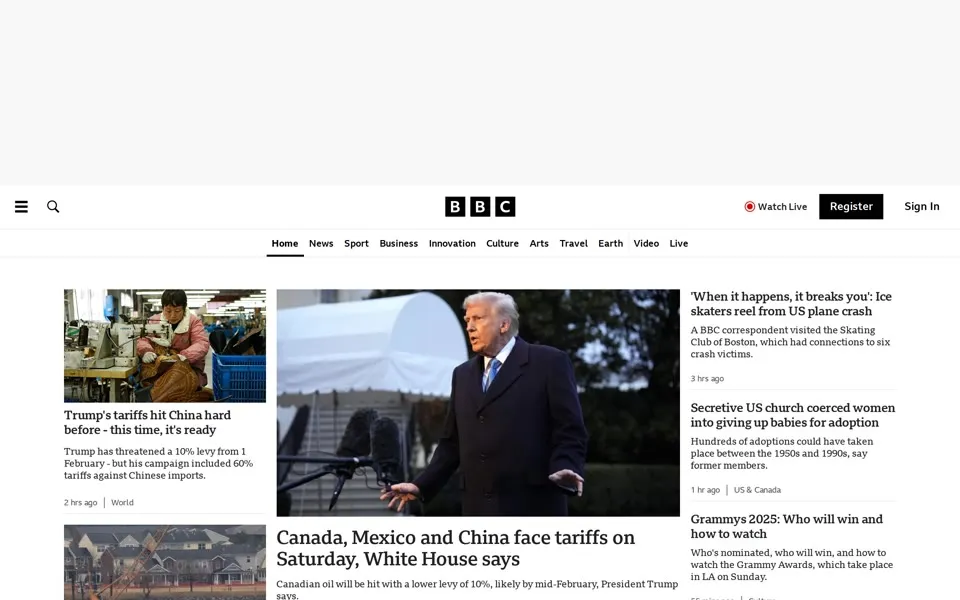
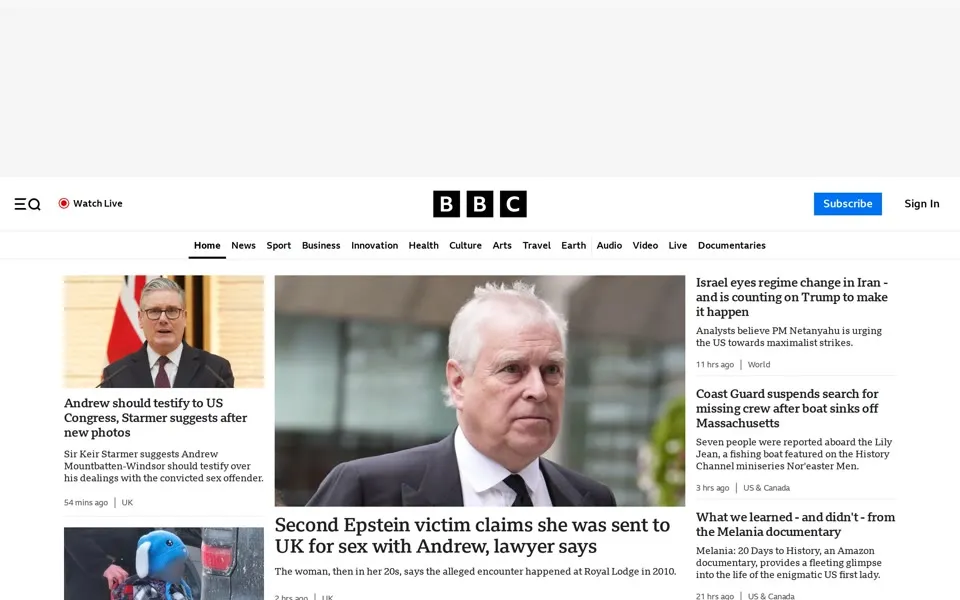
The February 2025 and February 2026 captures keep that layout, with an empty band above the header. One button changes. In 2025 it says Register
. In 2026 it is blue and says Subscribe
.
Between those two captures, on 26 June 2025, BBC.com launched its first website paywall, for users in the US: $8.99 a month or $49.99 a year.[10]
Our oldest capture, from December 1996, shows two buttons, About the BBC
and Programmes
. Thirty years later the archive's visitor finds a row of sections from Home
to Documentaries
and a blue button that asks it to subscribe.
- When was the oldest bbc.co.uk homepage in this story archived?
- The oldest capture here is from December 21, 1996, in the Internet Archive's Wayback Machine. The BBC's homepage in December 1996: a navy page with the BBC blocks and two buttons, “About the BBC” and “Programmes”.
- What does the bbc.co.uk homepage look like in 2026?
- In the newest capture here (February 1, 2026): The BBC homepage in February 2026: a blue Subscribe button beside Sign In and sections from Home to Documentaries.
- How many BBC homepage captures does this story show?
- 31 captures between 1996 and 2026, at most one per year; the timeline above shows which years are included.
- When did bbc.co.uk launch?
- The BBC registered bbc.co.uk in October 1991, and its technical history dates the first www.bbc.co.uk to about April 1994. BBC Online had its full launch in December 1997.
- When did BBCi launch?
- The Guardian reported on 7 November 2001 that the BBC had renamed its online, interactive TV and mobile services BBCi. The June 2002 and June 2003 captures carry the BBCi name.
- What changed on the British BBC homepage on 30 November 2011?
- A new homepage built around a color-coded carousel replaced the page of boxes you could rearrange. The BBC said some beta users didn't like losing the more detailed customisation.
- Why does bbc.co.uk say Welcome to BBC.com?
- In five of the eight captures from 2016 to 2023 the archive's crawler was given BBC.com, the BBC's international page, at the www.bbc.co.uk address. The 2018 to 2020 captures say Welcome to the BBC.
- How did the BBC logo change on its homepage?
- The logo evolution below shows 10 logo versions we picked from the captures, from 1996, 1997, 1998, 2000, 2006, 2008, 2010, 2011, 2016 and 2018. Logos from before 1996, the first capture, aren't included.
 1996Slanted grey BBC letters on navy, three coloured bars
 1997Smaller italic BBC blocks on black
 1998Upright BBC blocks with ONLINE underneath
 2000BBC ONLINE HOMEPAGE banner with light-blue tagline
 2006BBC blocks with a cyan 'home' wordmark
 2008White letters on blue tiles (new homepage)
 2010Blue → red tiles
 2011Red → dark grey framed blocks
 2016Grey → black frame with white letters
 2018Frame dropped: flat black blocks
Each logo is cut from that year's homepage capture (the year is the capture's); click one to see it on the page. Logos from before the first capture (1996) aren't shown, and some are missing where the logo images don't render in our captures. More logo histories.
◀ drag ▶19962026
The oldest capture in this story (1996) over the newest (2026). Drag across the picture.
Which homepage should we open next?
Tell us on the PageRewind YouTube channel, and subscribe for more histories of the pages we used to visit.
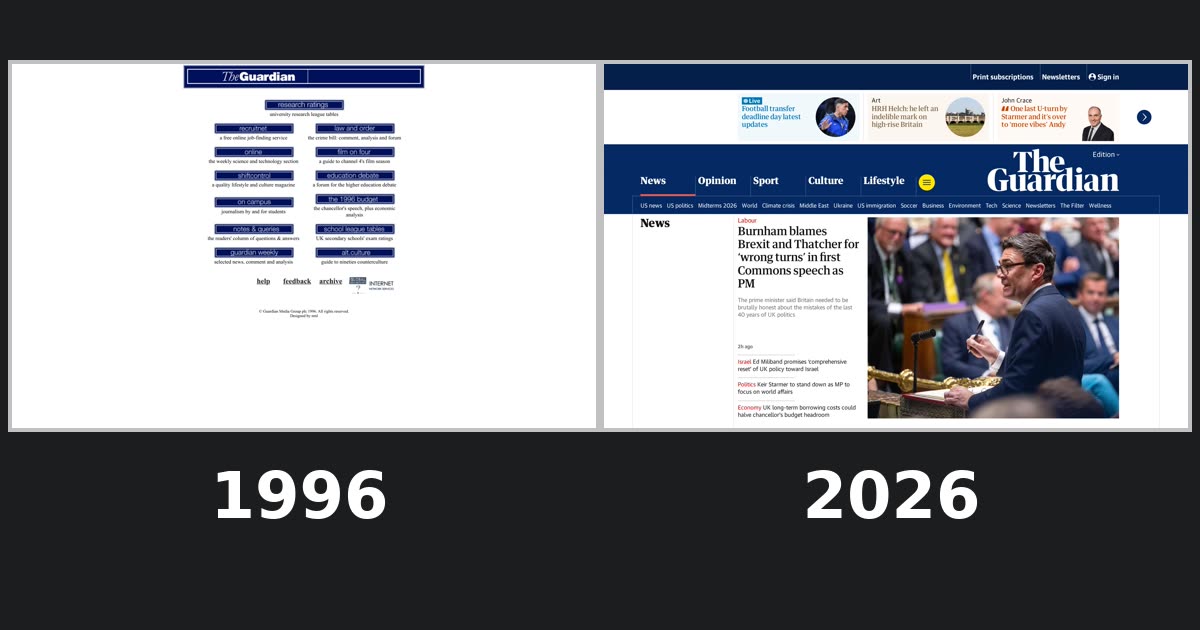 Theguardian.com, 1996–2026From “Guardian Unlimited” back to “The Guardian”
Sources
Each screenshot links to its dated Wayback capture. Observations about layouts and wording refer to those screenshots; lines read from a page's code are identified as such. External history uses the sources below; “(reported)” marks claims the research rates as likely, not confirmed.
- BBC Internet Services · History: the technical chronology of the BBC's internet presence, from the 1991 domain registration to BBC Online's launch in December 1997. Read source ↗
- The Register · BBC blew $375k on bbc.com: the BBC's FOI answer on buying the domain from Boston Business Computing in 1999; October 5, 2005. Read source ↗
- The Guardian, Owen Gibson · The BBC's online, interactive TV and mobile services renamed BBCi; November 7, 2001. Read source ↗
- BBC Internet Blog, Richard Titus · A lick of paint for the BBC homepage; December 13, 2007. Read source ↗
- BBC Trust, Editorial Standards Committee · Appeals bulletin, April 2013 (issued June 2013): “BBC homepage clock”, finding upheld. Read source (PDF) ↗
- The Guardian, Mercedes Bunz · BBC tests new homepage (a carousel and Topic Tracker); March 12, 2010. Read source ↗
- BBC Internet Blog, James Thornett · Redesigning the BBC Online homepage; September 21, 2011. Read source ↗
- BBC Internet Blog, James Thornett · A New Homepage for BBC Online; November 30, 2011. Read source ↗
- BBC · Work plan for 2015/16: “Roll-out responsive Homepage” across tablets and mobile. Read source (PDF) ↗
- Press Gazette, Charlotte Tobitt · BBC.com launches dynamic paywall for US users; June 26, 2025. Read source ↗
We selected one homepage capture of www.bbc.co.uk for every year from 1996 to 2026, 31 in all, most of them from June. For 1997 we used June 16; for 1998, July 3; for 1999, January 28; for 2010, October 15; for 2017, 2020, 2022, 2025 and 2026, the start of February; for 2019, March 1; and for 2023, January 31. Each preview is the first screen of a 1440-pixel-wide still; click it for the captured page, up to 2,700 pixels tall, and its Wayback link. The browser frames are illustrations of the eras.
The BBC served different homepages to visitors in and outside the UK, and the archive's crawler got one or the other. A capture shows what that visitor got, not what every reader saw that year. Some images are absent from the 1998–2002 stills, and blank or gray image areas appear in 2015 and 2018–2021, most of all in 2019 and 2020. Flash elements, such as the 2008–2009 clock, are replayed by an emulator.
PageRewind is independent and is not affiliated with the BBC. Screenshots and trademarks appear for historical commentary; archived pages are provided by the Internet Archive.
 The New York Times homepage history
 ESPN homepage history