In June 2026 the homepage of openai.com asks one question in the middle of a white page: What can I help with?
Under it sits a message box with a grey suggestion, Quiz me on vocabulary
, and a round button the code labels Send prompt to ChatGPT
. On December 11, 2015, the same address led to a blog post. Its first sentence: OpenAI is a non-profit artificial intelligence research company.
Scrub through the captures with the slider, or read on.
OpenAI.com’s homepage went from a 2015 post announcing a non-profit research company to a 2026 page built around a ChatGPT message box, with a draft SEC filing in its news list. Here it is in 12 captures, one per year. Until 2022 the homepage belongs to a research lab: research releases with issue numbers, a mission line about safe artificial general intelligence
, photos for a hiring box. The word non-profit left the page’s description between June 2018 and June 2019. ChatGPT first appears in our captures as one word in a footer list, on the day it launched.
2015 A blog post for a homepage
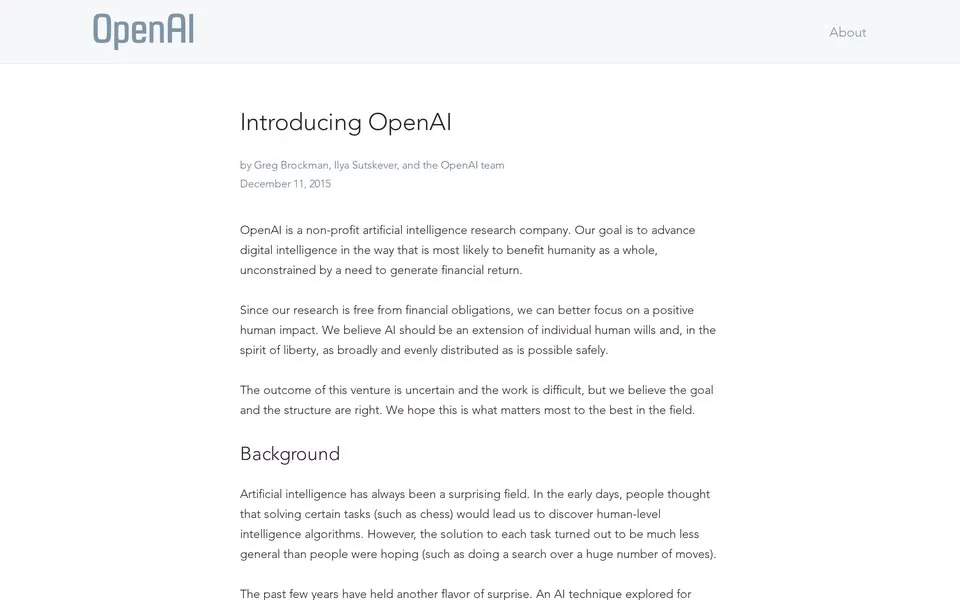
Our oldest capture of openai.com is from launch day, December 11, 2015, and the homepage sends you straight to a blog post: Introducing OpenAI
, by Greg Brockman, Ilya Sutskever, and the OpenAI team
. Above it there is a narrow grey-blue wordmark and an About link. That’s the whole navigation.
The first paragraph sets the terms. The goal is to advance digital intelligence unconstrained by a need to generate financial return.
Researchers will be encouraged to publish, and our patents (if any) will be shared with the world.
[1]
Near the end comes the money, with three of the donors on first-name terms: Sam, Greg, Elon, Reid Hoffman, Jessica Livingston, Peter Thiel, Amazon Web Services (AWS), Infosys, and YC Research are donating to support OpenAI.
The billion in the next sentence was a commitment, not money already paid in.[1] The post signs off with a Twitter handle, @open_ai
, and an email address, info@openai.com
.
In total, these funders have committed $1 billion, although we expect to only spend a tiny fraction of this in the next few years.
The same post names the co-chairs,
Sam Altman and Elon Musk.[1]
2016 Research #1: Generative models
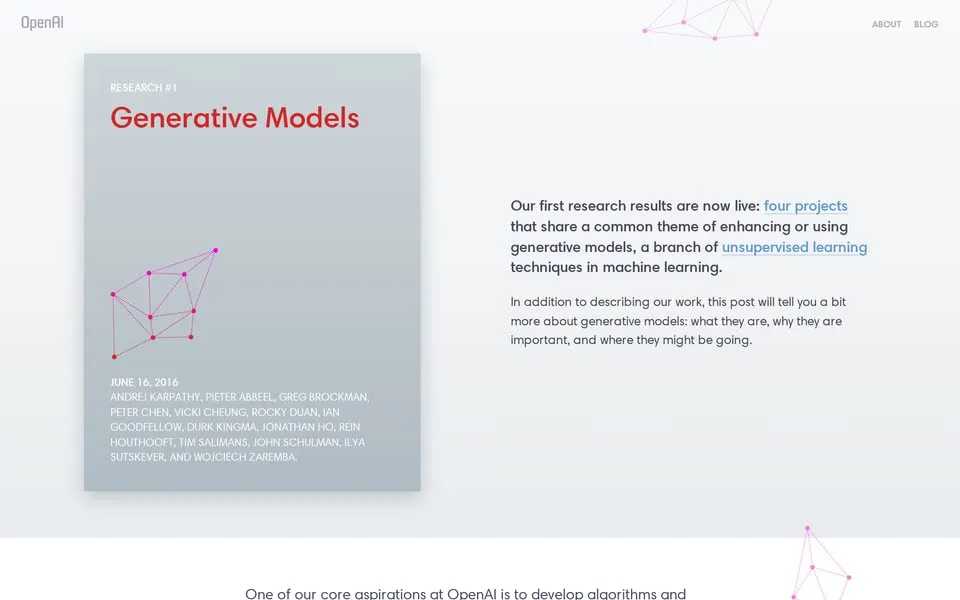
In June 2016 the homepage still leads to a blog post, now the lab’s first research report. The June 17 capture opens on a grey card with a red title, Generative Models
, a small network drawing and the label Research #1
. Fourteen names follow, from Andrej Karpathy to Wojciech Zaremba. The first line: Our first research results are now live: four projects that share a common theme of enhancing or using generative models
.
Scroll down and the article quotes Richard Feynman in pink italics: What I cannot create, I do not understand.
Then comes a grid of sample photos from the ImageNet dataset, the kind of pictures the models were learning to make.
The lab’s other releases that year were playgrounds for software agents. Gym, in public beta from April 27, 2016, offered environments ranging from simulated robots to Atari games.[2] In December, Universe launched with a thousand environments, among them Flash games, browser tasks, slither.io and GTA V.[3]
2017 – 2018 Research releases with issue numbers
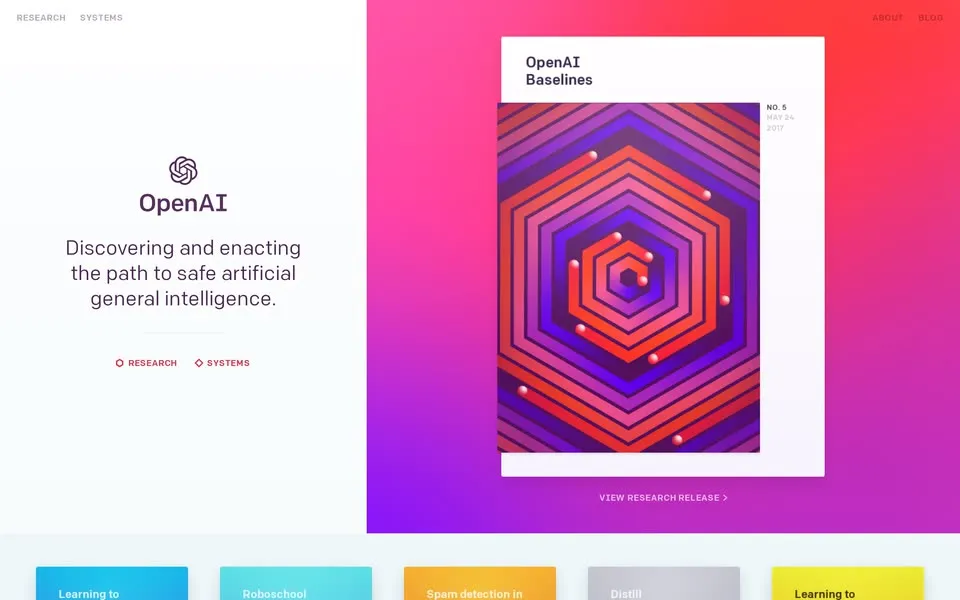
In June 2017 openai.com has a homepage of its own. The left half is white: the blossom symbol, the word OpenAI and one line, Discovering and enacting the path to safe artificial general intelligence.
The right half looks like a magazine cover. A swirling hexagon advertises OpenAI Baselines
, marked No. 5
and dated May 24, 2017.
Under the cover, colored cards link to blog posts such as Roboschool and Spam detection in the physical world
.
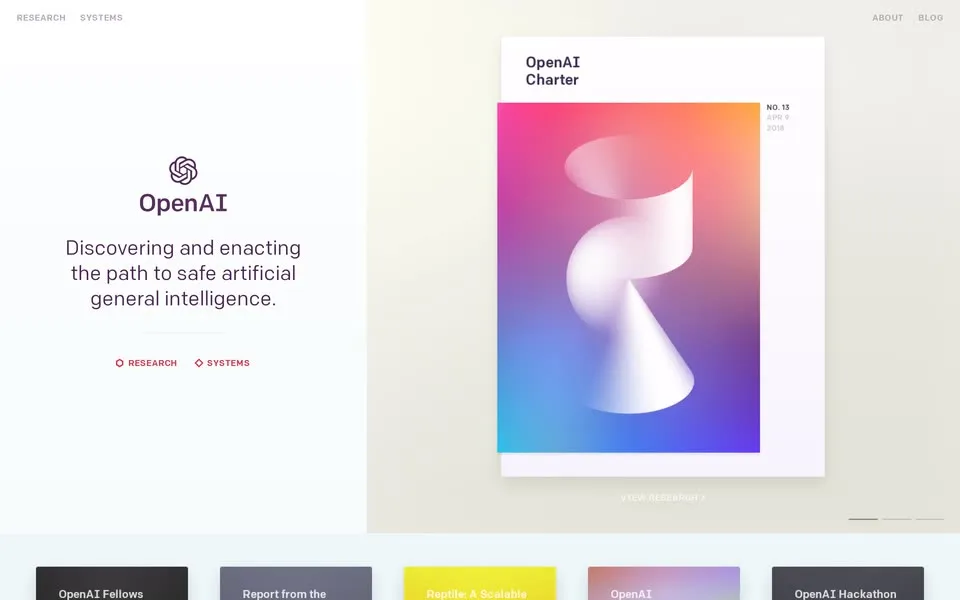
The numbering keeps running. In June 2018 the cover shows a pastel sculpture for the OpenAI Charter
, No. 13
, dated April 9, 2018.
The page’s code holds two more covers for the same spot: Retro Contest
, No. 12, and Ingredients for Robotics Research
, No. 11.
The page’s description, the text in its code meant for search engines and social media, reads OpenAI is a non-profit AI research company, discovering and enacting the path to safe artificial general intelligence.
Ten days later, on June 25, 2018, OpenAI wrote that its Dota 2 bots, OpenAI Five, played 180 years worth of games against itself every day
. The same post describes training on 256 GPUs and 128,000 CPU cores.[4]
2019 A team of a hundred people
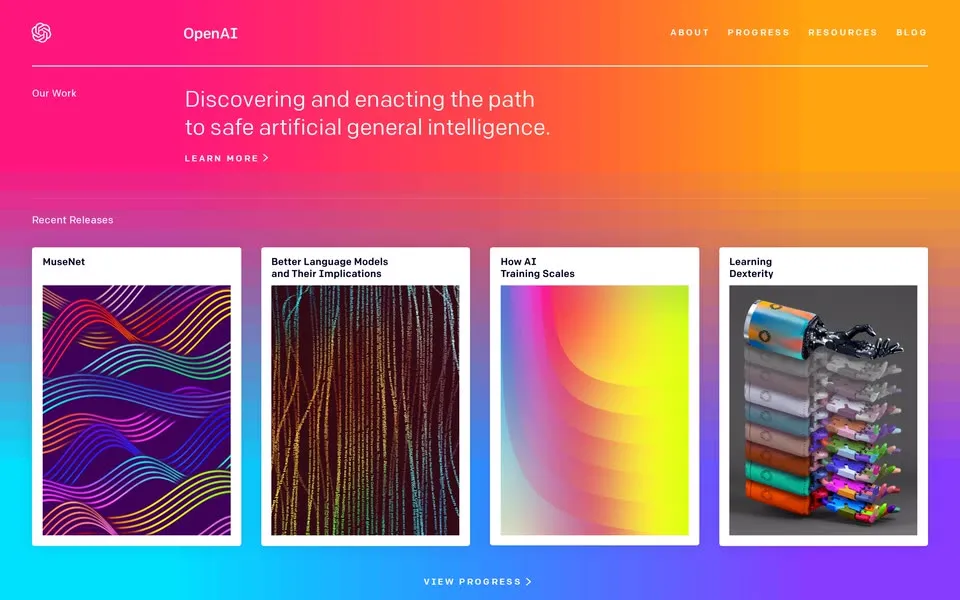
By June 2019 the split page is gone. A gradient runs from orange through pink to purple across the full width, and four white cards sit on it under Recent Releases
: MuseNet, Better Language Models and Their Implications
, How AI Training Scales
and Learning Dexterity
. The blossom and the wordmark now sit apart, both white, at the top left.
The second card is GPT-2. When OpenAI announced it in February, it held back the full trained model over concerns about malicious uses and released a smaller one.[5]
Below the gradient the mission paragraph says something about the lab itself: We’re a team of a hundred people based in San Francisco, California.
At the bottom, Join OpenAI
sits beside five photos of people at work.
One word is missing from the code. A year earlier the page description began OpenAI is a non-profit AI research company
. In June 2019 it reads OpenAI is an AI research company
.
In March 2019 OpenAI had announced OpenAI LP, a capped-profit company. The cap was high: returns for its first round of investors were limited to 100 times their investment.[6]
The Dota bots kept training too. In April they beat the world champions, after about 45,000 years of self-play in ten real-time months.[7]
2020 Research and deployment
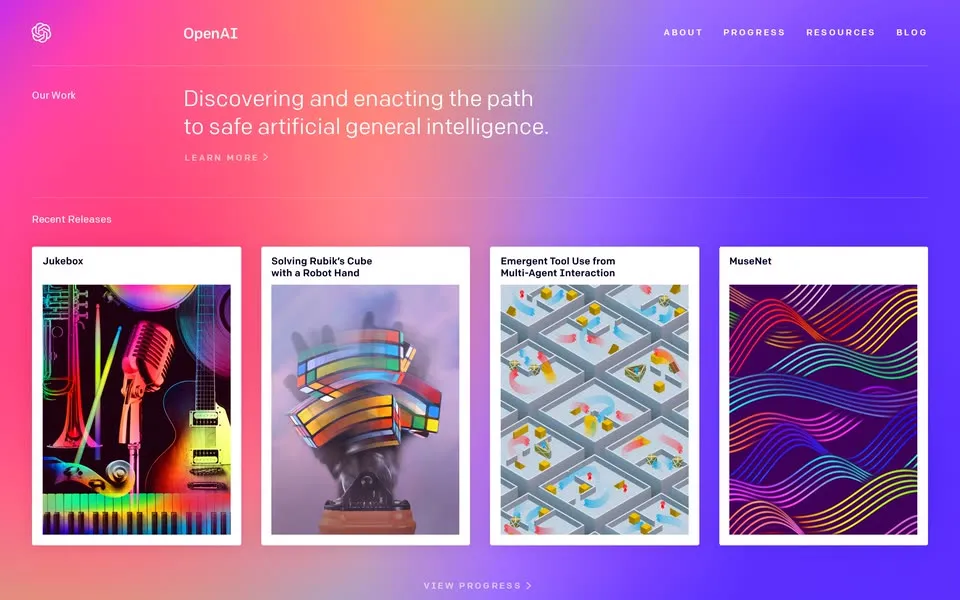
The June 2020 page keeps the gradient and swaps the cards: Jukebox, Solving Rubik’s Cube with a Robot Hand
, Emergent Tool Use from Multi-Agent Interaction
and MuseNet again. One sentence underneath has changed. The lab is now an AI research and deployment company based in San Francisco, California.
The deployment had arrived four days before this capture. The top item under Recent Blog Posts
is dated June 11, 2020 and called simply OpenAI API
. That day OpenAI announced an API for accessing its AI models.[8] The rest of the list is still research and contests: Procgen and MineRL Competitions, AI and Efficiency, Jukebox.
The hiring box at the bottom has a new picture too, a large group photo taken outdoors.
2021 The API moves to the front
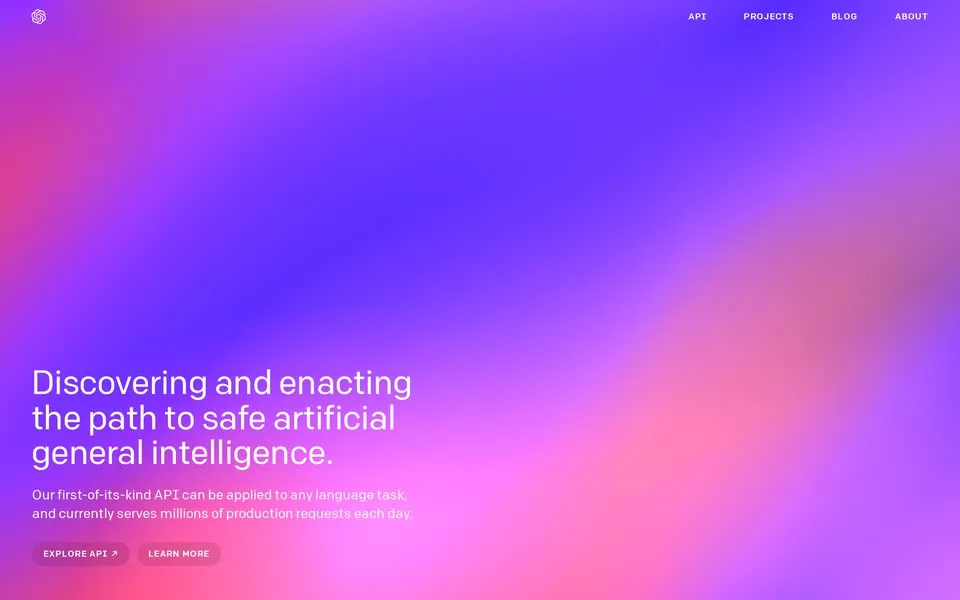
In June 2021 a pink-to-violet gradient fills the whole first screen, and the menu starts with the product: API, Projects, Blog, About. The mission line is still there. Under it, a smaller line makes a pitch: Our first-of-its-kind API can be applied to any language task, and currently serves millions of production requests each day.
Two buttons follow, Explore API
and Learn more
.
The header has lost the word OpenAI. Only the blossom is left in the corner.
Scroll down and the projects grid lists Multimodal Neurons, DALL·E, CLIP, Image GPT, GPT-3, Microscope and Jukebox. DALL·E was five months old: announced in January 2021, it generated images from captions in plain language.[9] In our still, the lowest tiles of the grid stay dark or blank. The saved page’s code also lists a post called OpenAI Startup Fund
, dated May 26, 2021.
2022 ChatGPT, one word in the footer
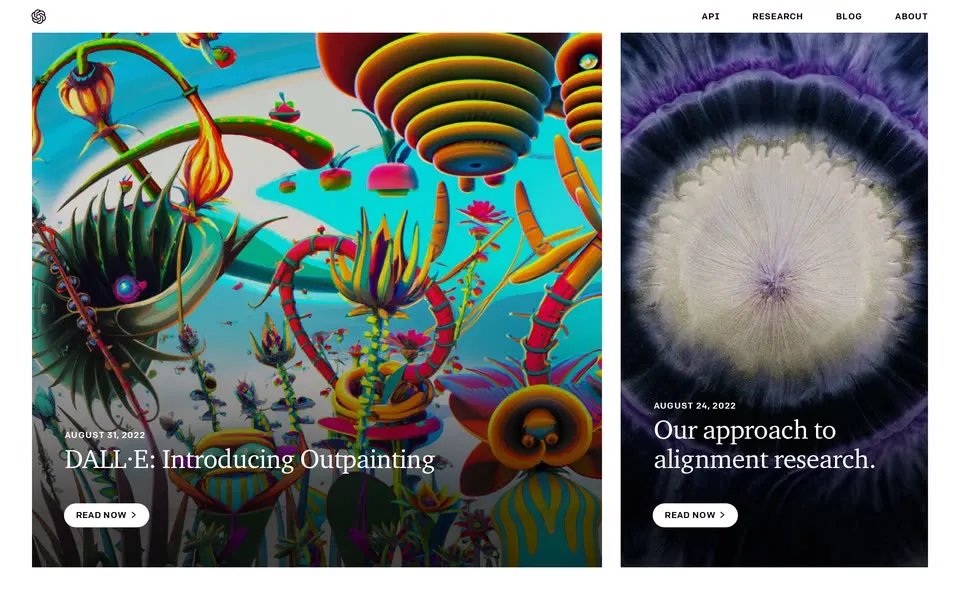
The archive saved this page at 00:56 UTC on December 1, 2022. In San Francisco it was still the afternoon of November 30, the day OpenAI introduced ChatGPT.[10] The top of the homepage hadn’t moved on. Its two big cards are from August: DALL·E: Introducing Outpainting
, over a bright, crowded painting of strange plants, and Our approach to alignment research.
ChatGPT is down in the black footer. The first column, Featured
, lists ChatGPT, DALL·E 2, Whisper, Alignment and Startup Fund. Next to OpenAI © 2015–2022
the footer links to Twitter, YouTube, GitHub, SoundCloud, LinkedIn and Facebook.
The launch post was open about what the new chatbot got wrong, and it was free to try: During the research preview, usage of ChatGPT is free.
[10]
The model is often excessively verbose and overuses certain phrases, such as restating that it’s a language model trained by OpenAI.
For example, given one phrasing of a question, the model can claim to not know the answer, but given a slight rephrase, can answer correctly.[10]
2023 Introducing GPT-4
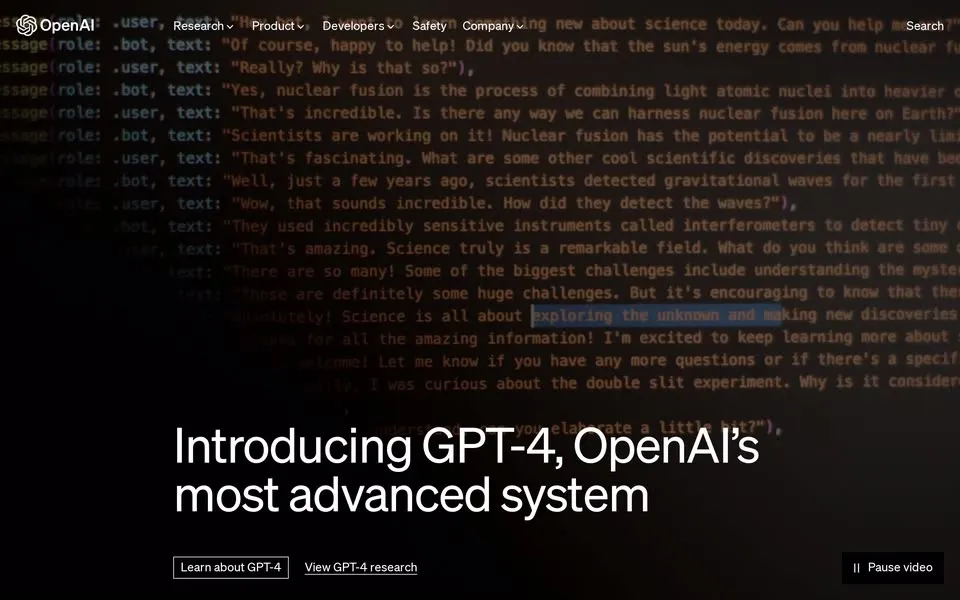
On April 1, 2023 the homepage is dark. A video plays behind the headline Introducing GPT-4, OpenAI’s most advanced system
, and in our still its frame is code: a chat written out as data, one message per line. .user, text: "Really? Why is that so?"
Then .bot, text: "Yes, nuclear fusion is the process
, and on down the screen, each line fainter than the one above.
The page’s code describes a different picture for the same spot: Two people sitting together chatting on individual brick-colored upholstered armchairs in front of an expansive, paned window
. The video changes as it plays. Our capture caught the code, not the armchairs.
OpenAI had announced GPT-4 on March 14, 2023.[12] ChatGPT now has a block of its own below the fold, We’ve trained a model called ChatGPT which interacts in a conversational way.
, with a Try ChatGPT
link. On February 1, OpenAI had announced ChatGPT Plus at $20 a month.[11] The menu has grown to Research, Product, Developers, Safety and Company, and the word OpenAI is back in the header, next to the blossom. Some thumbnails under Latest updates
didn’t load in this replay.
2024 Spring Update
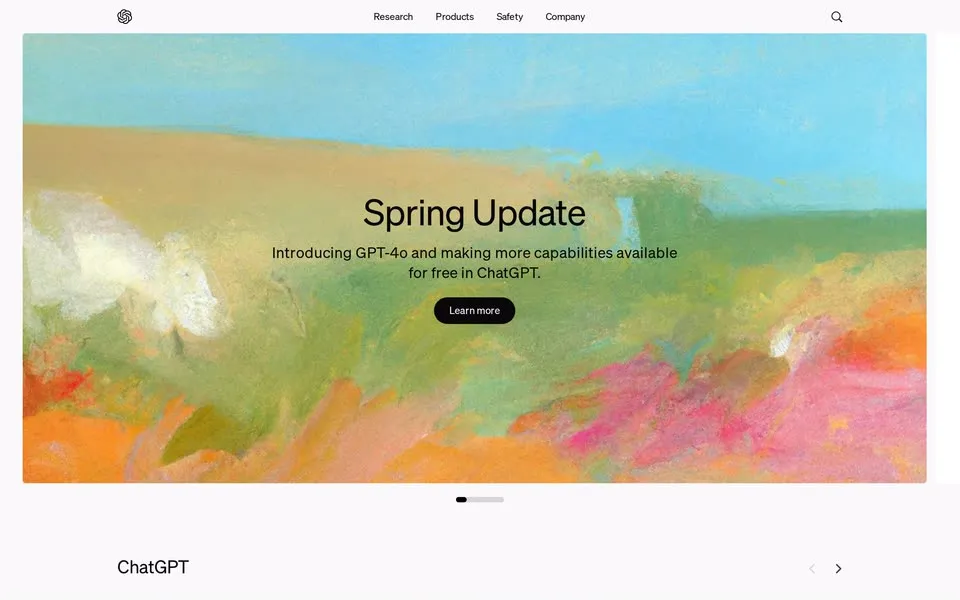
The May 2024 page is white, with rounded corners everywhere. The top card is a pastel painting with two lines: Spring Update
and Introducing GPT-4o and making more capabilities available for free in ChatGPT.
The archive saved it at 00:04 UTC on May 14, still May 13 in San Francisco, the day OpenAI announced GPT-4o. The o stood for omni.[13]
Under the card come rows of tall picture cards, one row each for ChatGPT, Research and For Business.
The code holds more than the still shows. The page’s main heading, not visible in our still, spells the company’s name with a space: Open AI | Creating safe AGI that benefits all of humanity.
The carousel at the top has more slides waiting in the code. One of them, Ask ChatGPT anything
, carries a long list of example requests in six languages, from Quiz me on vocabulary
and Explain nostalgia to a kindergartener
to Was mach ich in Berlin wenn es regnet?
(What do I do in Berlin when it rains?).
2025 12 Days of OpenAI, saved on New Year’s Eve
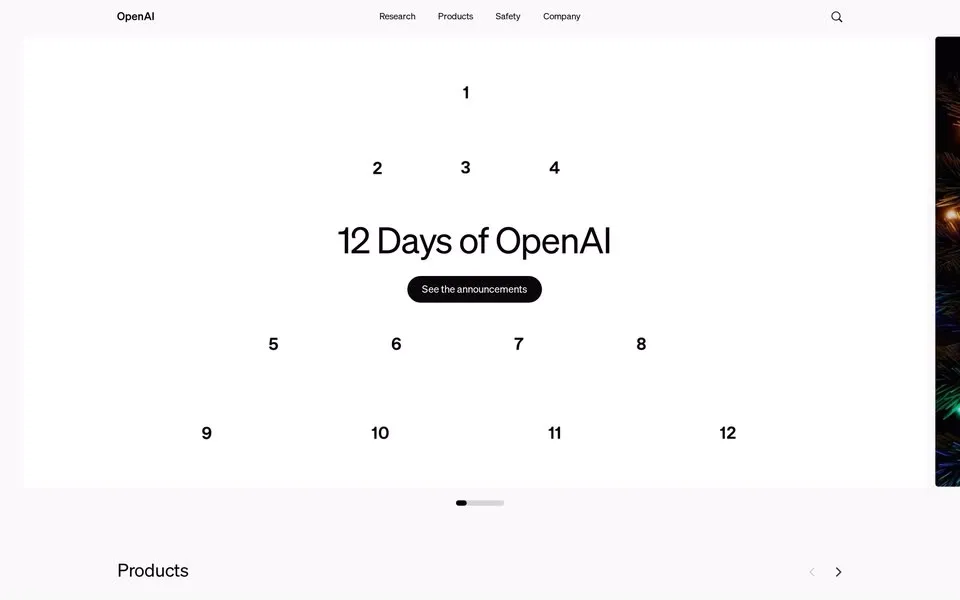
The archive saved this page at 05:56 UTC on January 1, 2025, still the evening of December 31 in San Francisco. The top card is a wide white card scattered with the numbers 1 to 12, around one line, 12 Days of OpenAI
, and a button: See the announcements
. December’s run of launches was still the first thing on the homepage.
The next slide in the code is Sora: Bring your imagination to life from text, image, or video.
In the saved code, the Products row links to Sora, ChatGPT Pro, ChatGPT search and canvas; their labels don’t show in this replay. ChatGPT Pro had been announced on December 5, 2024, at $200 a month.[14]
The saved code contains a footer line, © 2015–2024
, and the list of example requests from 2024 is still there, down to Quais são as chances de Portugal na Euro 2024?
(What are Portugal’s chances at Euro 2024?)
2026 What can I help with?
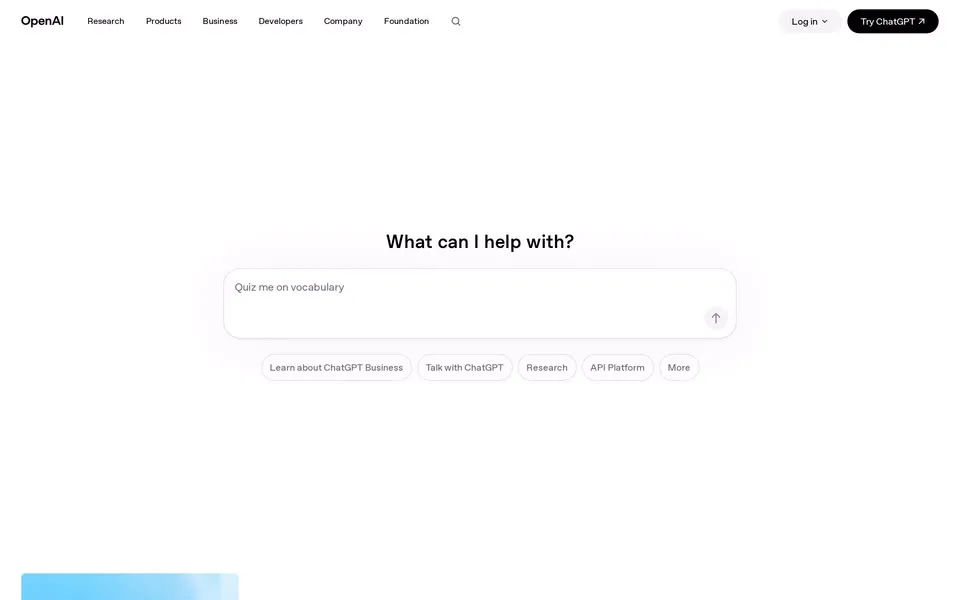
The June 15, 2026 homepage is almost empty at the top. One question, What can I help with?
, a message box with Quiz me on vocabulary
in grey, and a row of small buttons: Learn about ChatGPT Business, Talk with ChatGPT, Research, API Platform, More. The browser tab reads OpenAI | Research & Deployment
. The menu ends with Foundation
and a black Try ChatGPT
button.
The header is plain black lettering, with no blossom. Wallpaper* reported that a refreshed identity reached OpenAI.com on February 4, 2025, with a typeface of its own, OpenAI Sans, and a redrawn blossom.[15] OpenAI’s design guidelines say the wordmark’s O is a perfect circle.[16]
Below the box the page turns into a newsroom: Better memory for a more helpful ChatGPT
, Introducing GPT-5.5
, Introducing ChatGPT Images 2.0
. Two items under Recent news
share a date, June 8, 2026: Confidential submission of draft S-1 to the SEC
and Built to benefit everyone: our plan
.
2015 · Launch post2026 · Message box2015 → 2026 From a non-profit’s post to an SEC filing
The 2015 post promised research unconstrained by a need to generate financial return
and patents shared with the world
. The 2026 homepage lists a confidential draft S-1, a filing with the US Securities and Exchange Commission, between product launches. The word non-profit left the page’s description between our June 2018 and June 2019 captures.
The invitation to write in stayed. The 2015 post ended with an email address, info@openai.com
. In 2026 the page itself waits for a message, and its grey suggestion, Quiz me on vocabulary
, is the line that opened the list of example requests in 2024.
- When was the oldest openai.com homepage in this story archived?
- The oldest capture here is from December 11, 2015, in the Internet Archive's Wayback Machine. openai.com on December 11, 2015, launch day: the homepage redirects to the blog post “Introducing OpenAI”, which calls OpenAI “a non-profit artificial intelligence research company.”
- What does the openai.com homepage look like in 2026?
- In the newest capture here (June 15, 2026): OpenAI’s homepage in June 2026: “What can I help with?” over a ChatGPT message box suggesting “Quiz me on vocabulary”.
- How many OpenAI homepage captures does this story show?
- 12 captures between 2015 and 2026, at most one per year; the timeline above shows which years are included.
- How did the OpenAI logo change on its homepage?
- The logo evolution below shows 6 logo versions we picked from the captures, from 2015, 2017, 2019, 2021, 2023 and 2025. Logos from before 2015, the first capture, aren't included.
 2015Narrow blue-grey wordmark without a symbol.
 2017A purple blossom appears above the wordmark.
 2019The blossom and the wordmark move apart and turn white.
 2021The header keeps only the blossom symbol.
 2023The wordmark returns beside the blossom.
 2025The header switches to a black wordmark without the blossom.
Each logo is cut from that year's homepage capture (the year is the capture's); click one to see it on the page. Logos from before the first capture (2015) aren't shown, and some are missing where the logo images don't render in our captures. More logo histories.
◀ drag ▶20152026
The oldest capture in this story (2015) over the newest (2026). Drag across the picture.
Which homepage should we open next?
Tell us on the PageRewind YouTube channel, and subscribe for more histories of the pages we used to visit.
 Bing.com, 2009–2026From “Live Search is evolving” to “Copilot”.
Sources
Each screenshot links to its dated Wayback capture. Observations about layouts and wording refer to those screenshots; page descriptions, hidden headings, carousel slides and other details read from a page’s code are identified as such. External history uses the sources below.
- OpenAI · Introducing OpenAI: a non-profit research company; patents to be shared; funders committed $1 billion; co-chairs Sam Altman and Elon Musk; December 11, 2015. Read source ↗
- OpenAI · OpenAI Gym Beta: environments from simulated robots to Atari games; April 27, 2016. Read source ↗
- OpenAI · Universe: a thousand environments including Flash games, browser tasks, slither.io and GTA V; December 5, 2016. Read source ↗
- OpenAI · OpenAI Five: 180 years worth of games against itself every day; June 25, 2018. Read source ↗
- OpenAI · Better language models and their implications (GPT-2): the full model withheld at first, a smaller model released; February 14, 2019. Read source ↗
- OpenAI · OpenAI LP: a capped-profit company; first-round returns capped at 100 times the investment; March 11, 2019. Read source ↗
- OpenAI · OpenAI Five defeats Dota 2 world champions: about 45,000 years of self-play in ten real-time months; April 15, 2019. Read source ↗
- OpenAI · OpenAI API: an API for accessing OpenAI’s AI models; June 11, 2020. Read source ↗
- OpenAI · DALL·E: creating images from text captions; January 5, 2021. Read source ↗
- OpenAI · Introducing ChatGPT: free during the research preview; limitations; November 30, 2022. Read source ↗
- OpenAI · Introducing ChatGPT Plus: $20 a month; February 1, 2023. Read source ↗
- OpenAI · GPT-4; March 14, 2023. Read source ↗
- OpenAI · Hello GPT-4o: the o stands for omni; May 13, 2024. Read source ↗
- OpenAI · Introducing ChatGPT Pro: $200 a month; December 5, 2024. Read source ↗
- Wallpaper* · OpenAI’s refreshed identity on OpenAI.com and in ChatGPT: OpenAI Sans, a redesigned blossom (reported); February 4, 2025. Read source ↗
- OpenAI · Brand guidelines: the wordmark in OpenAI Sans, its O a perfect circle; checked October 2026. Read source ↗
We selected one capture of openai.com for every year from 2015 to 2026, 12 in all. In 2015 and 2016 the archived homepage redirected to a blog post, so those two captures show the posts it led to: Introducing OpenAI (December 11, 2015) and Generative Models (June 17, 2016). Most later captures are from mid-June; the others are December 1, 2022, April 1, 2023, May 14, 2024 and January 1, 2025. Each preview is the first screen of a still 1440 CSS pixels wide, captured at 2× resolution; click it for the captured page, up to 2,700 CSS pixels tall, and its Wayback link. The browser frames are illustrations of the eras.
The 2016 and 2025 pages were replayed with JavaScript turned off, because the archived scripts broke the replay; the 2025 carousel shows its first slide. The 2023 hero is a video and our still shows one frame of it. Some project tiles in 2021 and some thumbnails under Latest updates in 2023 did not load. The stills show our signed-out browser replays of the archived captures. Text quoted from a page’s code (page descriptions, hidden headings, other carousel slides, image descriptions and footers below the still) is named as such.
PageRewind is independent and is not affiliated with OpenAI. Screenshots and trademarks appear for historical commentary; archived pages are provided by the Internet Archive.
 GitHub homepage history
 Stack Overflow homepage history