In June 2008, two months after GitHub’s official launch, its homepage opened with two lines of bold type: git repository hosting
and no longer a pain in the ass
.[1] Under them sat a black Sign up now!
button and a page of text that started with Git itself, the new hotness
.
Scrub through the captures with the slider, or read on.
This is the story of github.com’s homepage from 2008 to 2026, told through 19 captures, one per year. Two numbers run through it.
One is a head count that the page printed from 2009: 90,000 coders and climbing
, then people, then developers, up to 83+ million
in 2022. The other is the price of private code, $7/mo.
in 2014 and free by 2021. In between, the text-heavy page turns dark, grows a glowing globe and, by 2026, makes room for AI agents next to the developers. And one link in the 2026 menu leads to a coal mine in the Arctic.
2008 No longer a pain in the ass
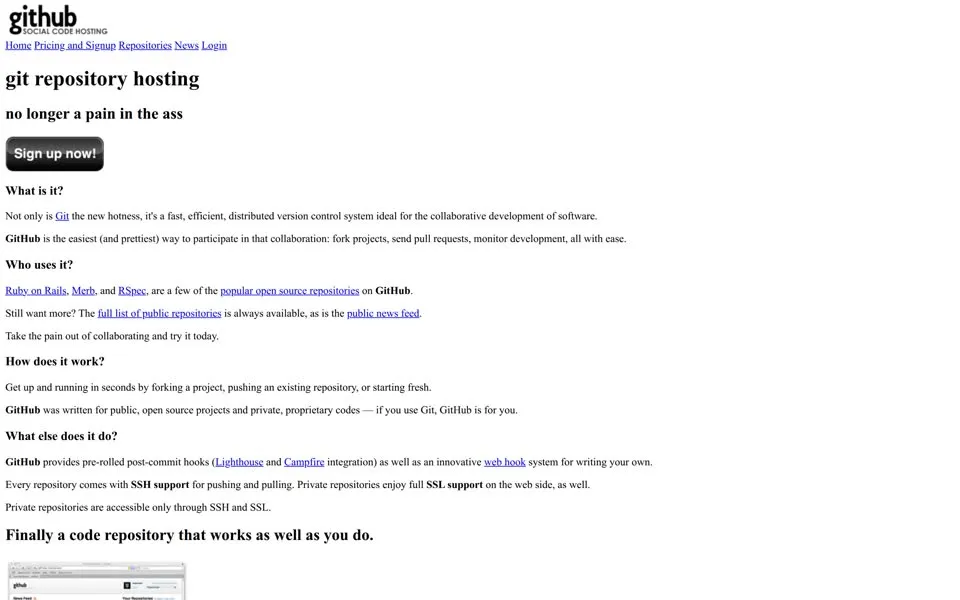
One of the stylesheets of the June 18, 2008 capture didn’t load from the archive, so the still renders as black serif text on white, with a graphical sign-up button. The menu reads Home
, Pricing and Signup
, Repositories
, News
and Login
.
The page explains Git before it explains GitHub. Git is the new hotness
, a fast, efficient, distributed version control system ideal for the collaborative development of software.
GitHub is the easiest (and prettiest) way to participate in that collaboration: fork projects, send pull requests, monitor development, all with ease.
Ruby on Rails, Merb and RSpec are named as projects already hosted there. Three quotes from developers follow, and David Heinemeier Hansson’s starts with Killer apps makes or breaks any platform.
GitHub had gone officially live on April 10, after a beta.[1] Scroll to the bottom and the footer says who ran it: GitHub is Logical Awesome | ©2008
. Under that, next to a red Engine Yard badge, a thank-you: Amazing Rails hosting by our good friends at Engine Yard
.
2009 – 2010 Unleash Your Code
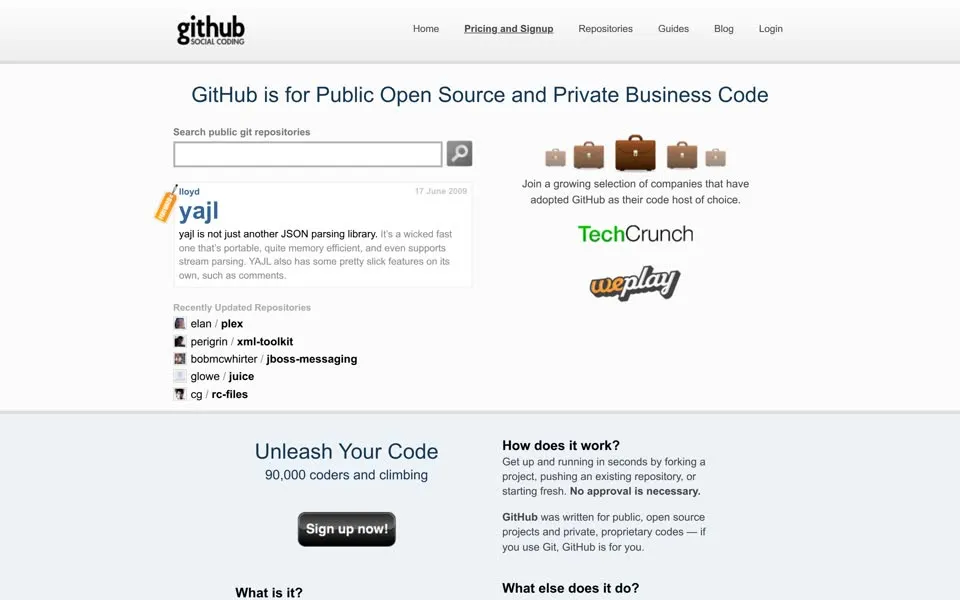
A year later the page has a style and a pitch: GitHub is for Public Open Source and Private Business Code
. The June 2009 capture has a search box for public repositories and a featured project dated 17 June 2009
: yajl, by lloyd, which is not just another JSON parsing library.
Beside it, under Join a growing selection of companies that have adopted GitHub as their code host of choice
, the logos’ alt texts name EngineYard, EMI Group Limited, TechCrunch and WePlay.
A pale blue band makes the first head count: Unleash Your Code
, 90,000 coders and climbing
. Further down, a list of Git videos includes Linus Torvalds visits Google to share his thoughts on git, the source control management system he created two years ago.
The footer still says GitHub™ is Logical Awesome ©2009
.
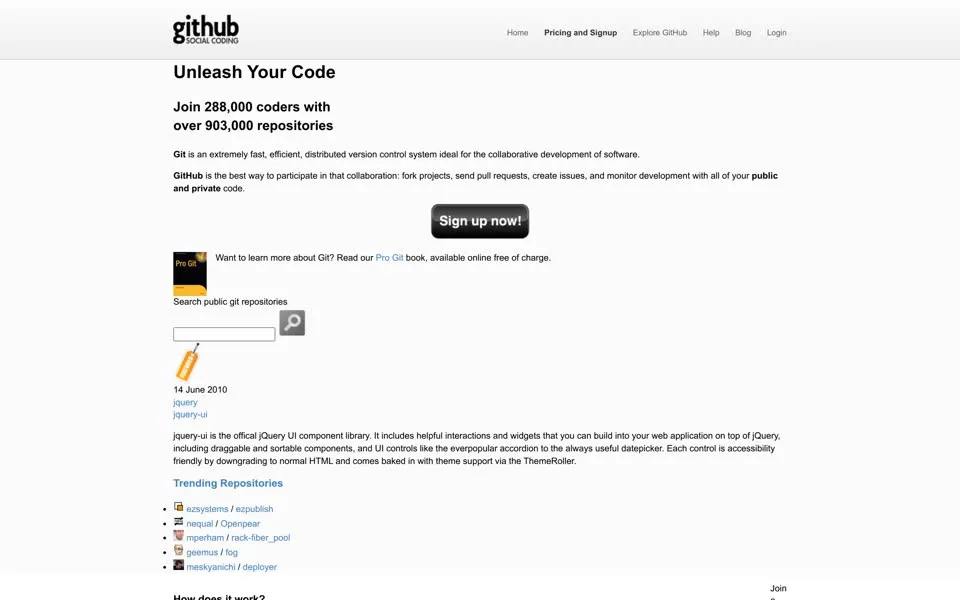
By June 2010 the slogan has moved to the top and the count has more than tripled: Join 288,000 coders with over 903,000 repositories
. The featured project is jquery-ui, and its blurb carries a typo: jquery-ui is the offical jQuery UI component library.
2011 – 2012 git·hub, with a pronunciation guide
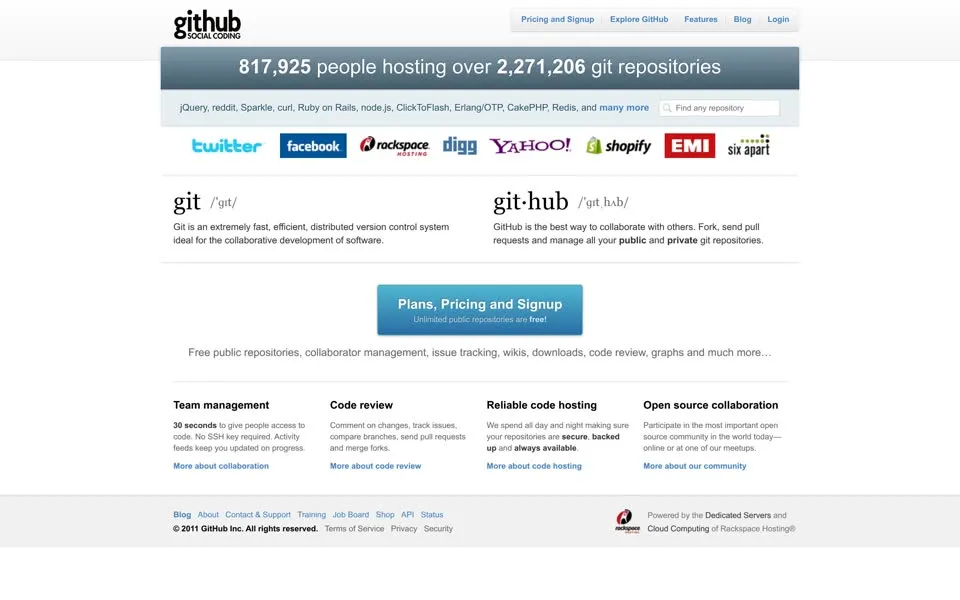
The June 2011 capture puts the count in a gray banner across the top: 817,925 people hosting over 2,271,206 git repositories
. Coders have become people. Under the banner runs a list of hosted projects, jQuery, reddit, Sparkle, curl, Ruby on Rails, node.js, ClickToFlash, Erlang/OTP, CakePHP, Redis, and many more
, and then a row of logos: Twitter, Facebook, Rackspace, Digg, Yahoo!, Shopify, EMI and Six Apart.
Then the page defines itself like a dictionary. On the left, git /'ɡɪt/
. On the right, git·hub /'ɡɪtˌhʌb/
, the best way to collaborate with others.
A blue button reads Plans, Pricing and Signup
, and inside it, under that label: Unlimited public repositories are free!
The footer reads © 2011 GitHub Inc.
, next to Powered by the Dedicated Servers and Cloud Computing of Rackspace Hosting
.
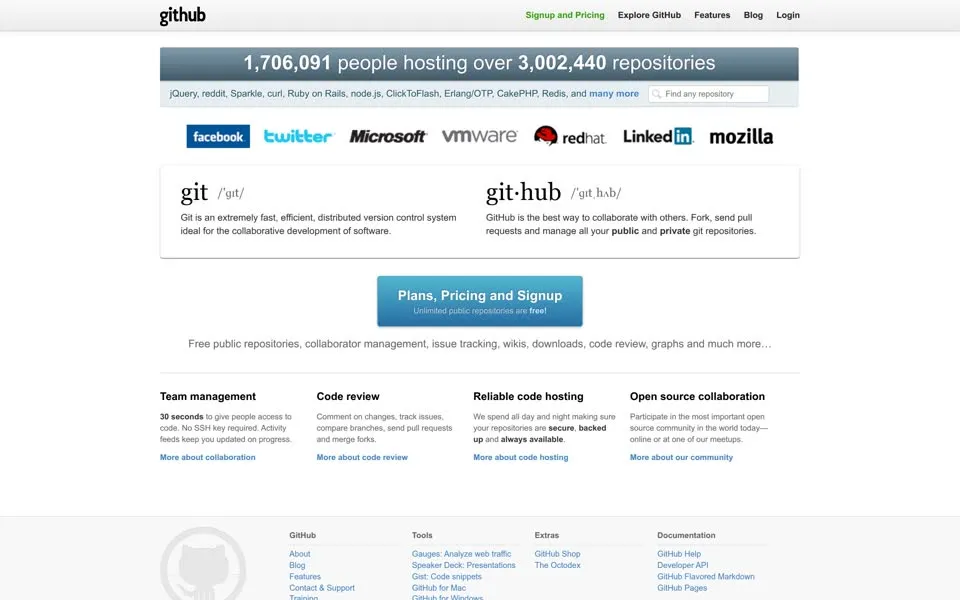
GitHub reached its first million users in September 2011, three months after that capture, and its second million in August 2012.[2] In June 2012 the banner reads 1,706,091 people hosting over 3,002,440 repositories
. The tab says GitHub · Social Coding
, and the logo row has changed: Facebook, Twitter, Microsoft, VMware, Red Hat, LinkedIn and Mozilla. An eBay logo is in the code as well, commented out.
As Kanye West said: > We're living the future so > the present is our past. The same lines are in the June 2012 capture.2013 Build software better, together
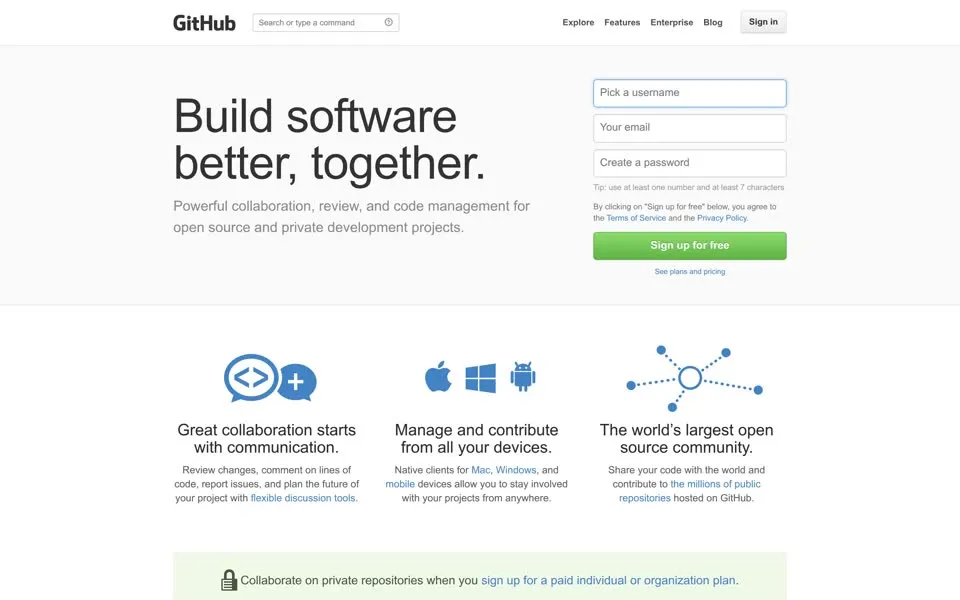
GitHub shipped a new identity on April 16, 2013: an updated logo, an official mark and an updated Octocat.[3] The June 22, 2013 capture shows the new capitalized GitHub
wordmark at the top left of a light page with a lot of white space. The headline is Build software better, together.
The browser tab says it too.
The sign-up form is now part of the first screen: Pick a username
, Your email
, Create a password
and a green Sign up for free
button. Under the password field sits a gray tip, Tip: use at least one number and at least 7 characters.
The counter is gone.
Three icons explain the product. Great collaboration starts with communication.
Manage and contribute from all your devices.
The world’s largest open source community.
A green box below them states the condition for private code: Collaborate on private repositories when you sign up for a paid individual or organization plan
.
2014 – 2015 Upgraded plans start at $7/mo.
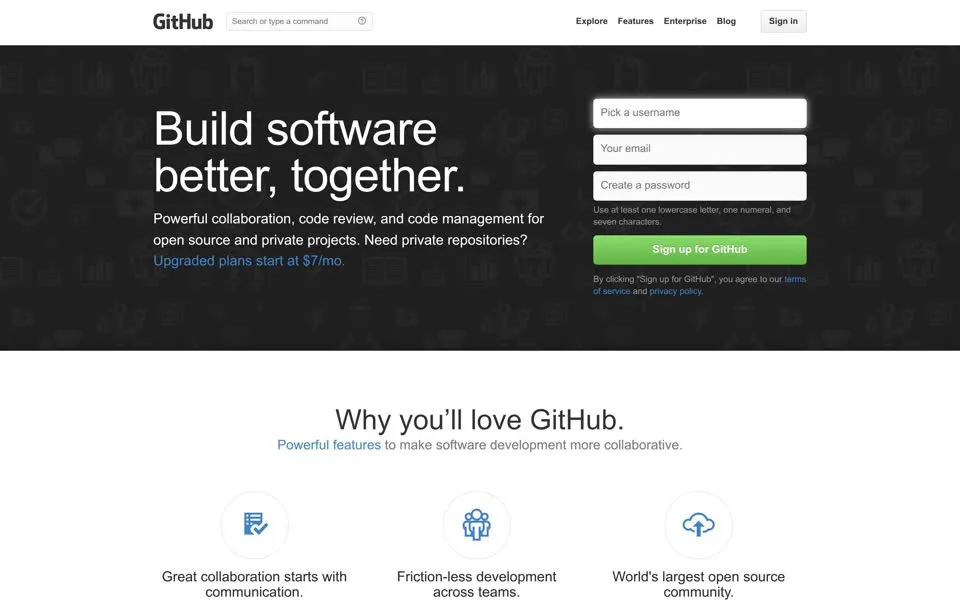
In our January 1, 2014 capture the header has turned dark. The headline is the same, and a blue line has been added under it: Need private repositories? Upgraded plans start at $7/mo.
The capture was made at 04:28 UTC on January 1, and the footer in its code still says © 2013
.
Halfway down, The power of GitHub on your desktop.
offers two downloads. GitHub for Mac Requires OS X 10.7+
. GitHub for Windows is For Windows XP, 7, & 8
.
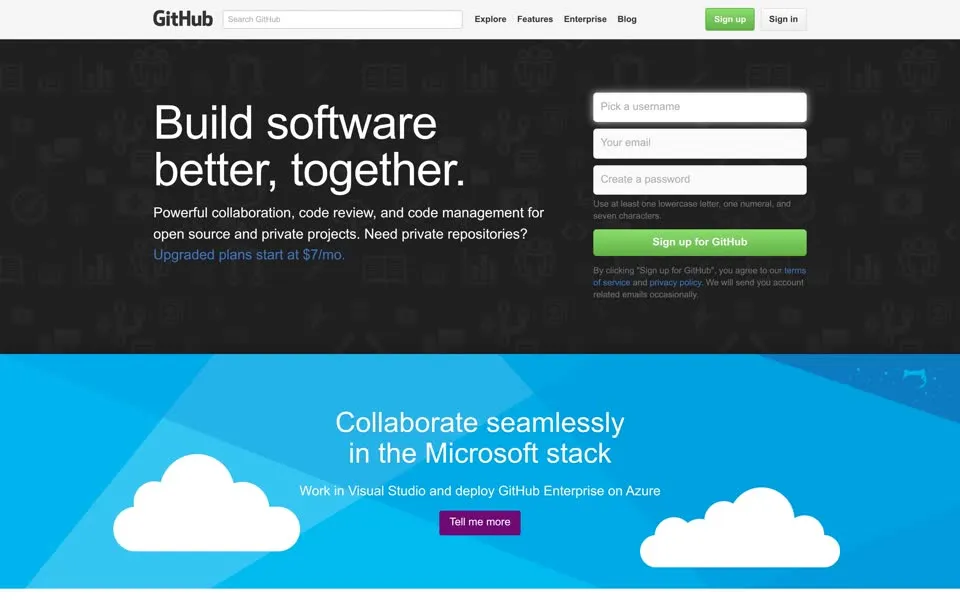
In the June 2015 capture that line reads For Windows Vista, 7, 8, & 8.1
, and XP is gone. A blue banner with cartoon clouds now sits under the header, aimed at teams in the Microsoft stack
: Work in Visual Studio and deploy GitHub Enterprise on Azure
. Three months earlier, on March 26, a DDoS attack had begun that GitHub called the largest in its history at that time.[4]
Tip: use at least one number and at least 7 characters.
2014
Use at least one lowercase letter, one numeral, and seven characters.
2016
Use at least one letter, one numeral, and seven characters.
2019
Make sure it's at least 15 characters OR at least 8 characters including a number and a lowercase letter.
The gray hint under the password field on the homepage, at the first capture that shows each wording. From 2021 the homepage asks only for an email address.
2016 How people build software
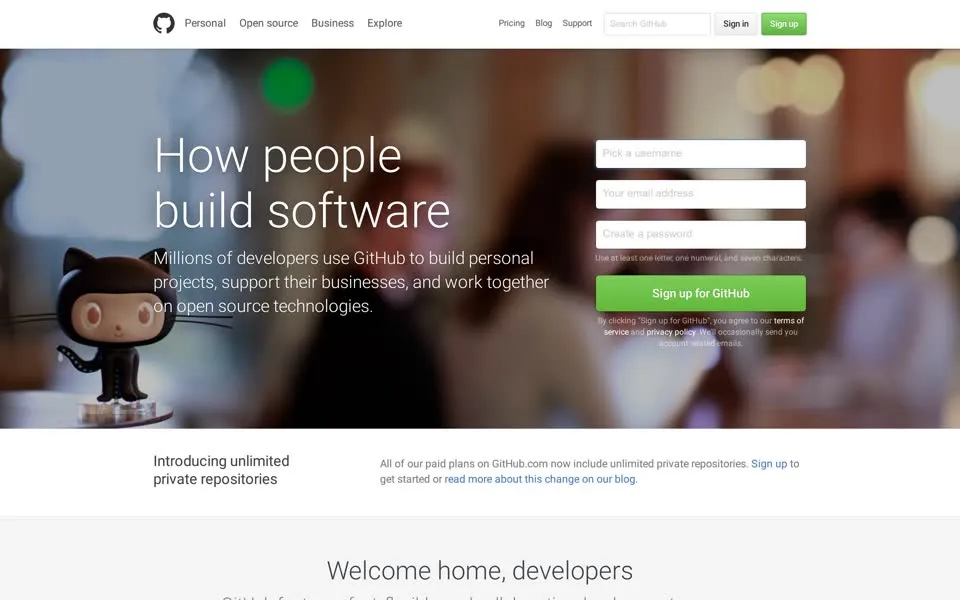
The June 2016 page opens on a photo of a small black Octocat figure, under How people build software
. The wordmark has left the top left corner. Only the cat-silhouette mark remains, which GitHub’s brand guide calls the Invertocat, to tell it apart from Mona, the mascot.[5] The menu splits the audience into Personal
, Open source
and Business
.
Under the photo: Introducing unlimited private repositories
, All of our paid plans on GitHub.com now include unlimited private repositories.
GitHub had announced the change on May 11, 2016, with a Personal plan at $7 a month.[6] The bottom of the page says it again: Public projects are always free. Work together across unlimited private repositories for $7 / month.
Just above that line, a mock-up of an organization profile shows NASA, with the caption GitHub is proud to host projects and organizations like NASA.
2017 – 2018 Built for developers
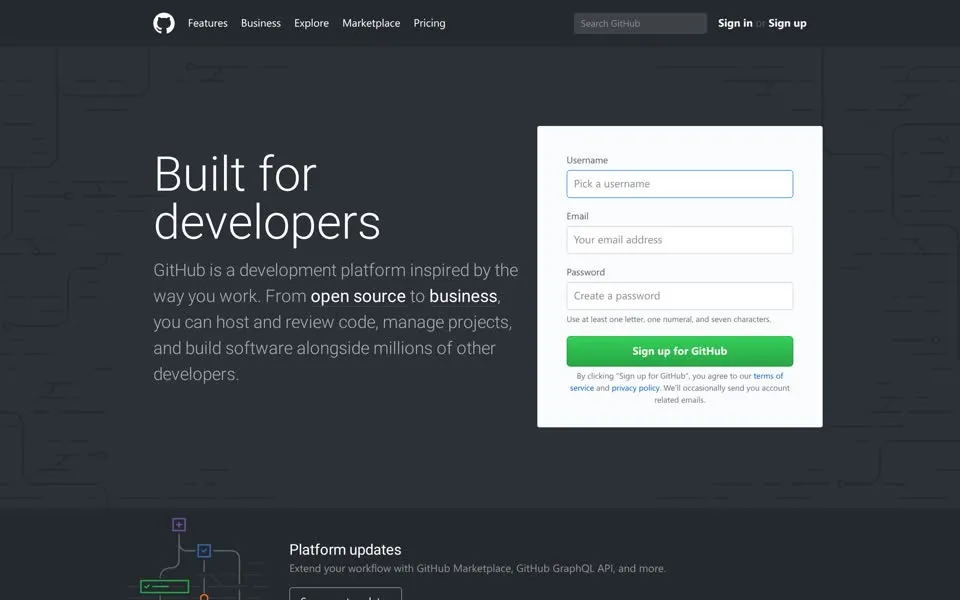
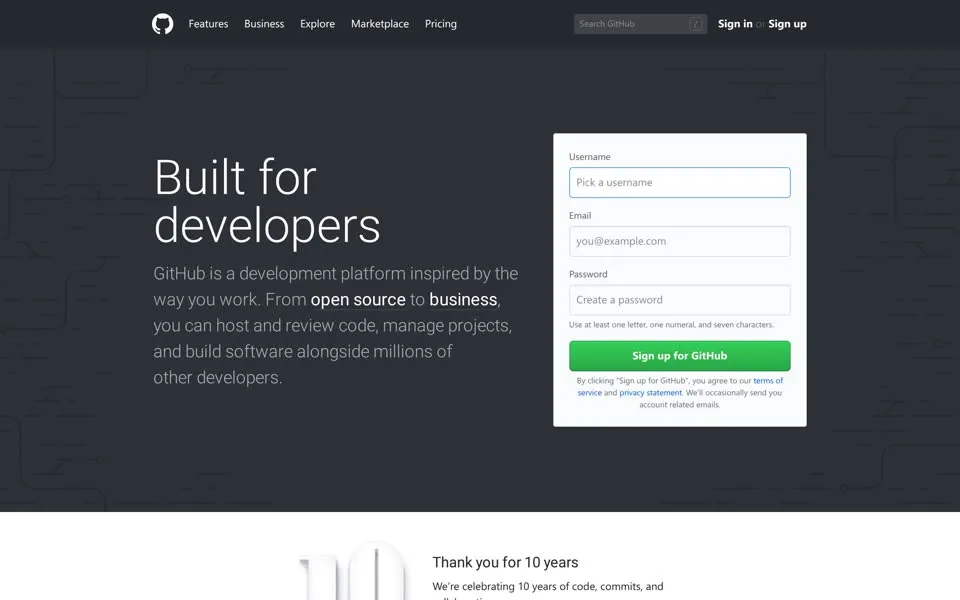
Our captures from 2017 to 2020 share one headline, Built for developers
, on dark gray, with the sign-up form in a white card on the right. The type is thin in 2017 and 2018 and heavier in 2019 and 2020.
In the June 2017 capture the line under it ends build software alongside millions of other developers.
The tab makes a new claim, The world's leading software development platform · GitHub
. Further down, the security section is headed Boxes? Check.
The June 15, 2018 capture adds a strip with a big silver 10: Thank you for 10 years
, We’re celebrating 10 years of code, commits, and collaboration.
Under it, More than 1.8 million businesses and organizations use GitHub
stands over a row of logos from Airbnb to Walmart.
Eleven days before this capture, on June 4, Microsoft announced it would buy GitHub for $7.5 billion in Microsoft stock.[8] The page doesn’t mention it. In the text of all 19 captures the word Microsoft appears twice, in the 2012 logo row and in the 2015 banner.
2019 – 2020 Now free for teams
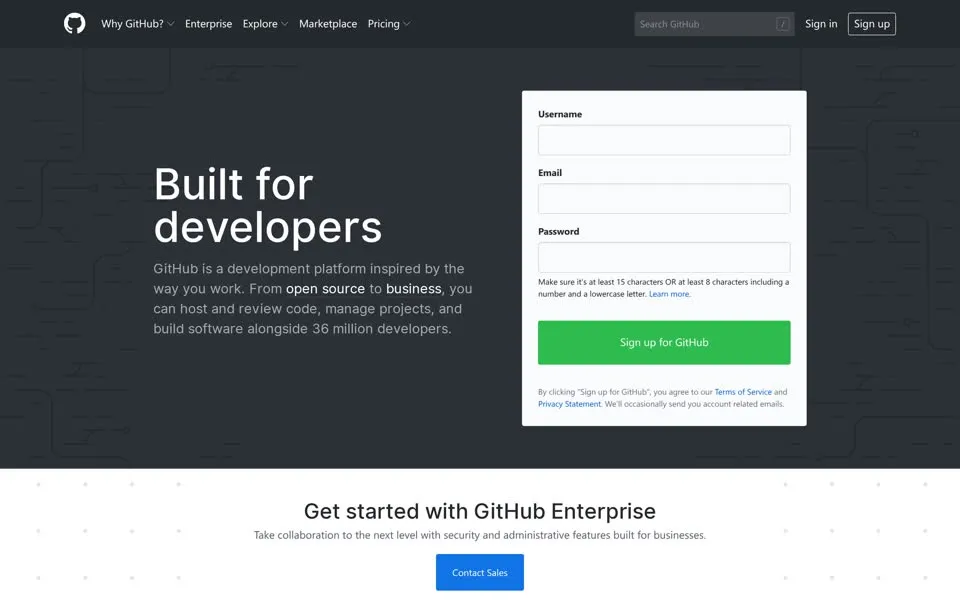
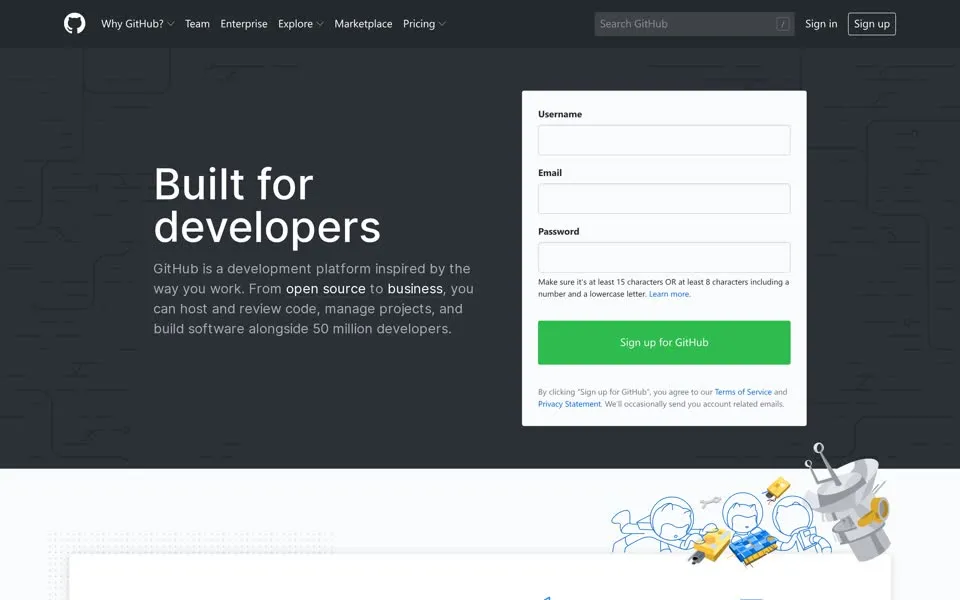
In June 2019 the line under Built for developers
has a number again: build software alongside 36 million developers.
The password hint asks for at least 15 characters, or at least 8 including a number and a lowercase letter. Below the header, Get started with GitHub Enterprise
sits above a video panel from the GitHub Satellite conference.
GitHub Free had gained unlimited private repositories on January 7, 2019, with up to three collaborators per repository.[9] On April 14, 2020 that limit went, and GitHub Team dropped from $9 to $4 per user per month.[10]
The 2020 capture above says so in a dark blue strip: GitHub is now free for teams
, GitHub Free gives teams private repositories with unlimited collaborators at no cost. GitHub Team is now reduced to $4 per user/month.
The head count reads 50 million developers
. Near the bottom of the still, a yellow robot appears above two laptops.
What the homepage said about the price of private code, in the captures shown here.
2021 – 2022 A globe made of pull requests
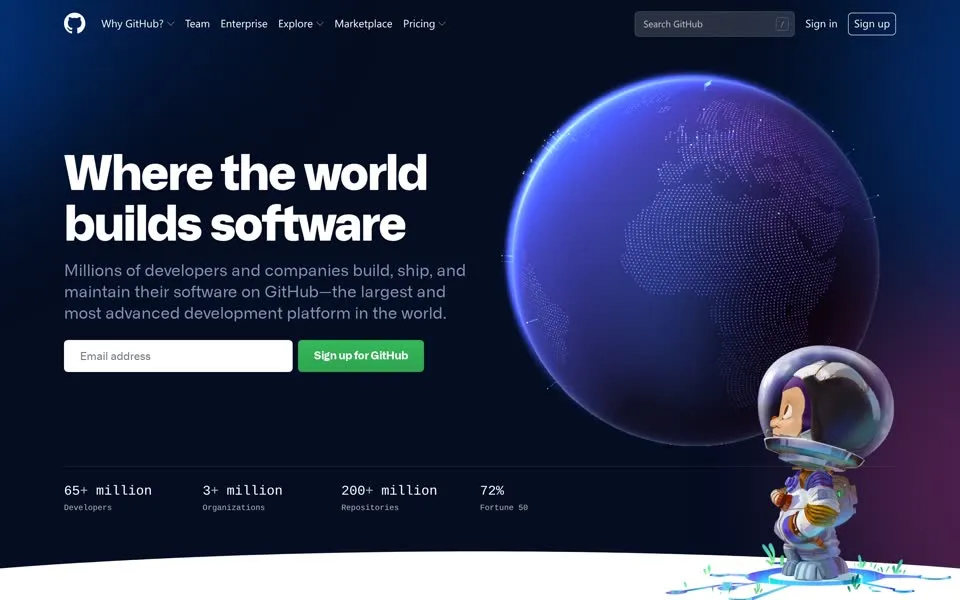
The June 2021 capture is a new page, and its centerpiece is drawn from real work. A glowing globe fills the right half of a dark blue sky. GitHub said its spikes and arcs came from recent pull requests: blue spikes for open ones, pink arcs for merged ones. Its builders used no textures, and the globe lowered its visual quality when it failed to maintain 55.5 frames a second over the previous 50 frames.[11]
Mona the Octocat stands beside it in a space suit, and the image’s alt text reads Mona looking at GitHub activity across the globe
. The redesign brought back detailed drawings of Mona after years of simpler outline illustrations.[12] The headline is Where the world builds software
, and four counters sit under the sign-up field: 65+ million
developers, 3+ million
organizations, 200+ million
repositories and 72%
of the Fortune 50.
Lower down, Give your code a home in the cloud
ends with Host it all for free with unlimited public and private repositories.
In the code, the demo project is an Octocat Classifier
, which is used to determine whether a given image contains an Octocat.
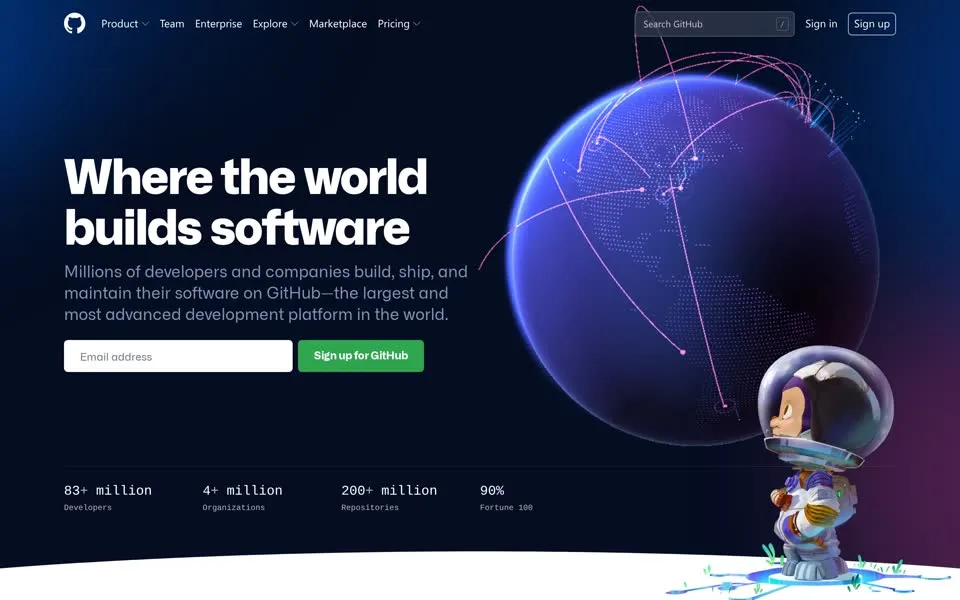
In June 2022 the globe and the headline remain, and the numbers have moved: 83+ million
developers, 4+ million
organizations, and 90%
of the Fortune 100.
The head count on each capture that shows one, in the page’s own word for its users. Years without a figure on the still are left out.
2023 – 2024 Let’s build from here
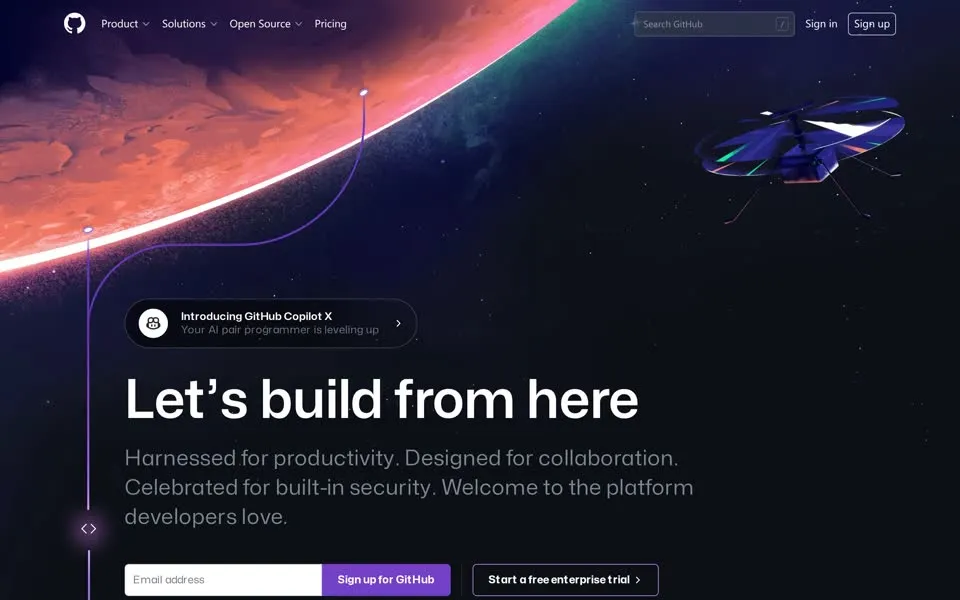
The June 2023 capture swaps the globe for the surface of a red planet, with a small flying craft in the sky.
Above the headline, a dark pill links to Introducing GitHub Copilot X
, Your AI pair programmer is leveling up
. The headline is Let’s build from here
, followed by Harnessed for productivity. Designed for collaboration. Celebrated for built-in security. Welcome to the platform developers love.
Copilot had started as a technical preview on June 29, 2021,[13] and went on sale a year later at $10 a month or $100 a year.[14] In January 2023 GitHub announced more than 100 million developers, two years ahead of the goal it had set for 2025.[15]
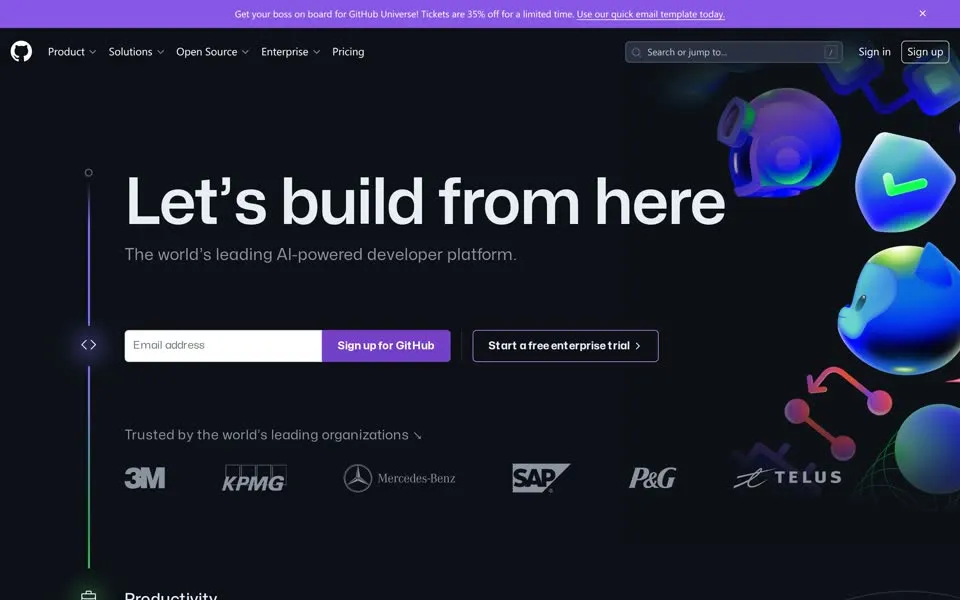
By June 2024 the headline is the same and the line under it is new: The world’s leading AI-powered developer platform.
A thin bar at the very top, easy to miss, says Get your boss on board for GitHub Universe! Tickets are 35% off for a limited time.
Below the header, Accelerate innovation
opens a section about AI. The page’s code says Copilot empowers developers to complete tasks 55% faster
, and near the bottom, Over 100 million developers call GitHub home
.
2025 – 2026 Developers, agents, and code
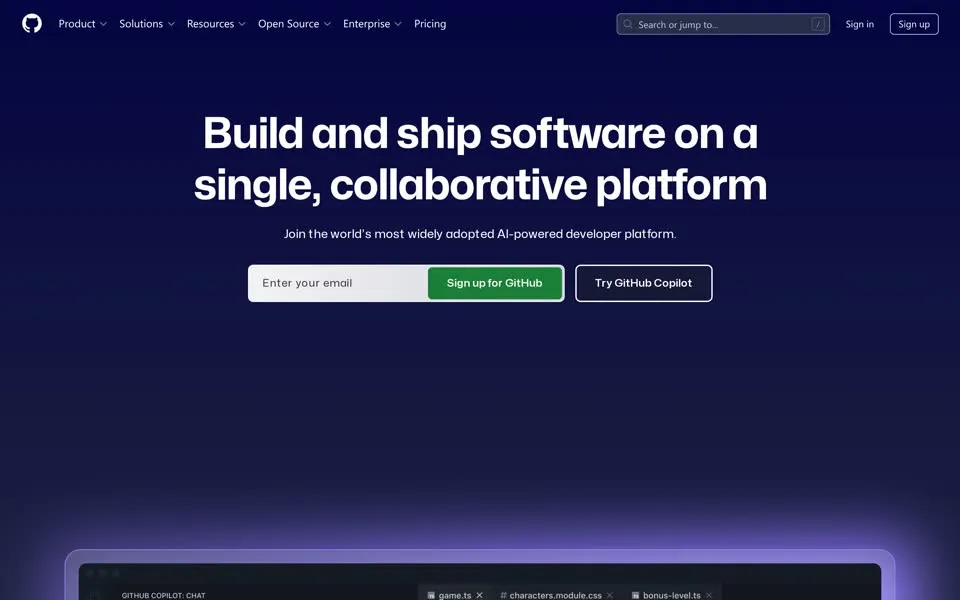
The June 2025 capture centers the headline and the sign-up controls. The headline reads Build and ship software on a single, collaborative platform
, then Join the world’s most widely adopted AI-powered developer platform.
Next to the email field are two buttons, Sign up for GitHub
and Try GitHub Copilot
. Under them, a code editor shows a demo of Copilot Chat.
Near the bottom of the code, last year’s line has lost its number: Millions of developers and businesses call GitHub home
.
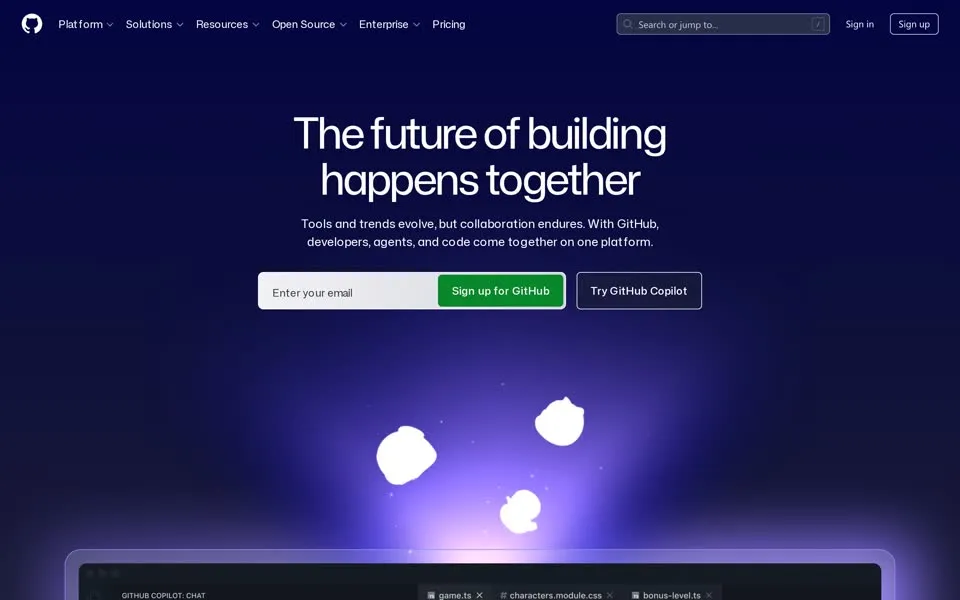
The June 2026 page keeps the layout and both buttons. The tab says Change is constant. GitHub keeps you ahead.
The headline says The future of building happens together
, and the line under it names who builds: developers, agents, and code come together on one platform.
The menu in the code offers a GitHub Copilot app
to Direct agents from issue to merge
.
2020 → 2026 Archive Program: 1,000 years on film
One entry in that 2026 menu looks out of place: Archive Program
. On February 2, 2020, GitHub took a snapshot of every active public repository. Stars counted too: a repository with at least 250 of them went in, however long it had been quiet.[16]
The snapshot was written to hardened film designed to last 1,000 years and stored in a decommissioned coal mine deep beneath an Arctic mountain in Svalbard.[16][17]
Next to them, a
Tech Tree,
a human-readable selection of works describing software, computers, and their foundational technologies, and full-text copies of Wikipedia and Stack Overflow.[18]
What GitHub said the finished vault holds, in its blog post of September 20, 2022.
2008 → 2026 Sign up now!
The button on the June 2008 homepage said Sign up now!
, under a promise that Git hosting was no longer a pain in the ass
. In June 2026 the buttons beside the email field say Sign up for GitHub
and Try GitHub Copilot
.
In 2009 the page counted 90,000 coders and climbing
. In October 2025 GitHub’s own yearly report counted more than 180 million developers.[19]
- When was the oldest github.com homepage in this story archived?
- The oldest capture here is from June 18, 2008, in the Internet Archive's Wayback Machine. GitHub’s homepage in June 2008, rendered largely unstyled: text under “git repository hosting” and “no longer a pain in the ass”, and a “Sign up now!” button.
- What does the github.com homepage look like in 2026?
- In the newest capture here (June 15, 2026): GitHub in June 2026: “The future of building happens together”, with developers, agents and code on one platform.
- How many GitHub homepage captures does this story show?
- 19 captures between 2008 and 2026, at most one per year; the timeline above shows which years are included.
- How did the GitHub logo change on its homepage?
- The logo evolution below shows 5 logo versions we picked from the captures, from 2008, 2009, 2012, 2013 and 2016. Logos from before 2008, the first capture, aren't included.
 2008Lowercase wordmark with the tagline 'social code hosting'
 2009Tagline changes to 'social coding'
 2012Tagline dropped, lowercase wordmark alone
 2013New capitalised GitHub wordmark (April 2013 identity refresh)
 2016Wordmark gone from the header, only the Octocat mark remains
Each logo is cut from that year's homepage capture (the year is the capture's); click one to see it on the page. Logos from before the first capture (2008) aren't shown, and some are missing where the logo images don't render in our captures. More logo histories.
◀ drag ▶20082026
The oldest capture in this story (2008) over the newest (2026). Drag across the picture.
Which homepage should we open next?
Tell us on the PageRewind YouTube channel, and subscribe for more histories of the pages we used to visit.
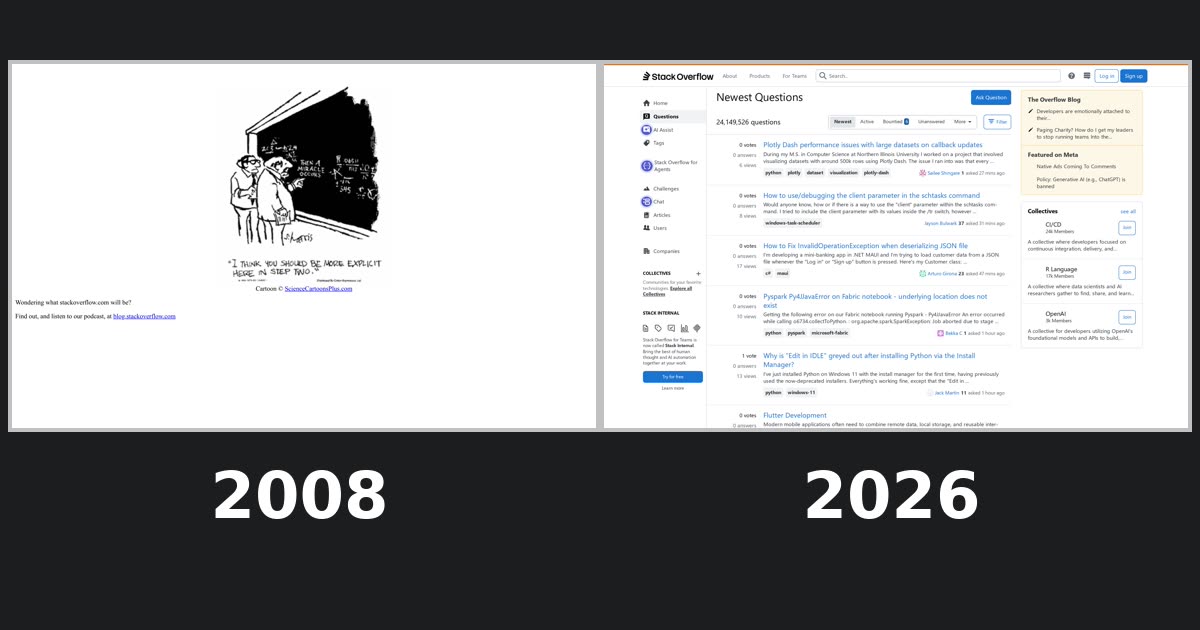 Stackoverflow.com, 2008–2026From “Then a miracle occurs” to 24,149,526 questions.
Sources
Each screenshot links to its dated Wayback capture. Observations about layouts and wording refer to those screenshots; lines read from a page’s code are identified as such. External history uses the sources below.
- The GitHub Blog · We launched: “GitHub is officially live. Thanks for the awesome beta everyone.”; April 10, 2008. Read source ↗
- The GitHub Blog · Three million users: the first million joined “In September of 2011”, the “second million in August 2012”; January 16, 2013. Read source ↗
- The GitHub Blog · New GitHub logo: an “updated logo, an official mark, and an Octocat”; April 16, 2013. Read source ↗
- The GitHub Blog · Large scale DDoS attack on github.com: “the largest DDoS (distributed denial of service) attack in github.com’s history”; “The attack began around 2AM UTC on Thursday, March 26”; March 27, 2015. Read source ↗
- GitHub Brand Toolkit · Logo: “We call our logo pictogram the Invertocat”, separate from Mona and the mascot illustrations; accessed October 9, 2026. Read source ↗
- The GitHub Blog · Introducing unlimited private repositories: “Personal: $7/month”; May 11, 2016. Read source ↗
- The GitHub Blog · February 28th DDoS incident report: unavailable “from 17:21 to 17:26 UTC and intermittently unavailable from 17:26 to 17:30 UTC”; the attack “peaked at 1.35Tbps”; “for each byte sent by the attacker, up to 51KB is sent toward the target”; March 1, 2018. Read source ↗
- Microsoft · Microsoft to acquire GitHub for $7.5 billion: “for $7.5 billion in Microsoft stock.”; June 4, 2018. Read source ↗
- The GitHub Blog · New year, new GitHub: “GitHub Free now includes unlimited private repositories”, “up to three collaborators per repository for free”; January 7, 2019. Read source ↗
- The GitHub Blog · Changelog, April 14, 2020: “unlimited private repositories with unlimited collaborators”; “GitHub Team pricing is reduced from $9 per user/month to $4 per user/month”. Read source ↗
- The GitHub Blog · How we built the GitHub globe: “data of recent pull requests”, “blue spikes for open pull requests, and pink arcs for merged pull requests”, “We don’t use any textures”; December 21, 2020. Read source ↗
- The GitHub Blog · How we designed and wrote the narrative for our homepage: GitHub had moved “to the easier and faster to produce outline octocats”; the new page “prominently featured our mascot, Mona the Octocat”; February 11, 2021. Read source ↗
- The GitHub Blog · Introducing GitHub Copilot: “launching a technical preview of GitHub Copilot”; June 29, 2021. Read source ↗
- The GitHub Blog · GitHub Copilot is generally available to all developers: “$10 USD/month or $100 USD/year”; June 21, 2022. Read source ↗
- The GitHub Blog · 100 million developers and counting: “more than 100 million developers using GitHub”; January 25, 2023. Read source ↗
- The GitHub Blog · The Arctic Code Vault starts production: “On 02/02/2020 we took a snapshot of every active public repository”, “At least 250 stars, regardless of when their most recent activity occurred”, “we’ll return to Svalbard”; February 3, 2020. Read source ↗
- GitHub Archive Program · Archived “to hardened film designed to last for 1,000 years, and stored in the GitHub Arctic Code Vault in a decommissioned coal mine deep beneath an Arctic mountain”; accessed October 9, 2026. Read source ↗
- The GitHub Blog · Putting the vault in GitHub’s Arctic Code Vault: “188 reels of hardened archival film”; September 20, 2022. Read source ↗
- The GitHub Blog · Octoverse 2025: “180 million-plus developers now work and build on GitHub.”; October 28, 2025. Read source ↗
We selected one homepage capture of github.com for every year from 2008 to 2026, 19 in all, each from June except 2014, where we used January 1. Each preview is the first screen of a 1440-pixel-wide still; click it for the captured page, up to 2,700 pixels tall, and its Wayback link. The browser frames are illustrations of the eras. Quotes come from the stills and from the text of the same captures; for 2017 the text was read from a capture made later the same day.
The archive’s crawler visits as a logged-out user. In the 2008 capture a stylesheet didn’t load from the archive, so the still renders largely unstyled; stylesheets also failed to load in the 2022 to 2026 captures, though those pages look intact. The 2010 still has displaced content and large blank areas, and the 2021 to 2024 stills have large areas of empty dark space below the first screen. We hid the Wayback toolbar.
PageRewind is independent and is not affiliated with GitHub. Screenshots and trademarks appear for historical commentary; archived pages are provided by the Internet Archive.
 Bing homepage history
 Dropbox homepage history