IMDb’s oldest archived homepage, from November 1996, opens with a simple question: What was that movie they were both in?
Four large links offered a way in. Over the next thirty years the page turned into a daily movie paper, then a trailer screen, and this rewind follows it through 28 captures, small print and all. By 2026 the opening screen is black. A trailer gets the biggest picture, and three more videos wait beside it.
▶ Watch the 3:04 videoDrag the slider to flip through the selected years, or read on.
1996 A question, four links, and search by email
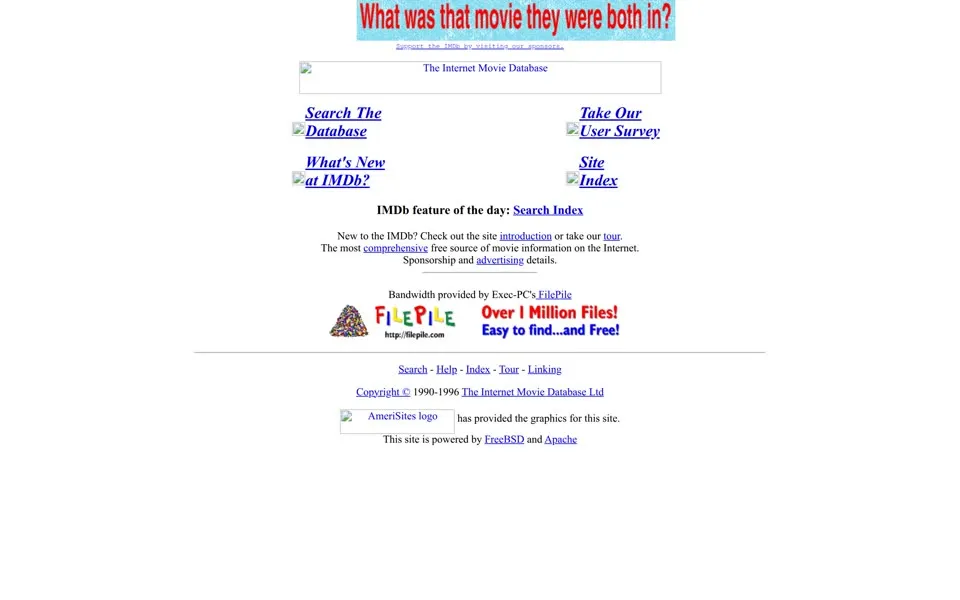
The red banner asks What was that movie they were both in?
Below the logo area, four italic links lead to search, a user survey, updates and the site index. A database homepage: it hands you routes in and lets you pick.
The project is older than this page. In October 1990 Col Needham posted Unix shell scripts for searching the film-credit lists people shared on the Usenet group rec.arts.movies, and in January 1996 it became Internet Movie Database Ltd.1 The copyright line on the capture carries both years: 1990–1996.
Before IMDb had a website, it already answered by mail. In 1993 you could email it a search request and get the results mailed back, so you no longer had to keep your own copy of the database.1
Needham’s own viewing list began on paper. He logged his VHS viewing in a paper diary, then in a database on his home computer, so he could count things like his Hitchcock films. In a 2023 interview he credited his IMDb ratings list with keeping count: as of May 3, 2023 he had watched 14,845 different films, and the 50-plus times he has seen his favorite, Vertigo, count as one.2
Its alternative text remains in the small outlined box. The question banner loads from a separate copy of the image archived on December 25, 1996. It is an IMDb house ad, not a third-party product promotion.
The footer reads like a little set of credits. It names Exec-PC’s FilePile as the bandwidth provider and AmeriSites for the graphics, and the capture text adds FreeBSD and Apache. Next to the invitation to explore is a request to help fund the site by visiting its sponsors.
1997 – 1998 Amazon calls in 1997
Our selection has no homepage captures from 1997 to 1999, but the company changed hands in that gap. Col Needham has told how it started. In December 1997 Amazon invited him to a meeting, and he hoped it was about extending the ads Amazon had just started running on IMDb. At the time Amazon sold only books and had never bought another company. The meeting was about buying IMDb.2
Amazon announced the acquisition in April 1998 and tied it to its plans for selling video online.3 The next capture in this story, from November 2000, shows what that looked like on the homepage.
2000 – 2001 Install RealPlayer first
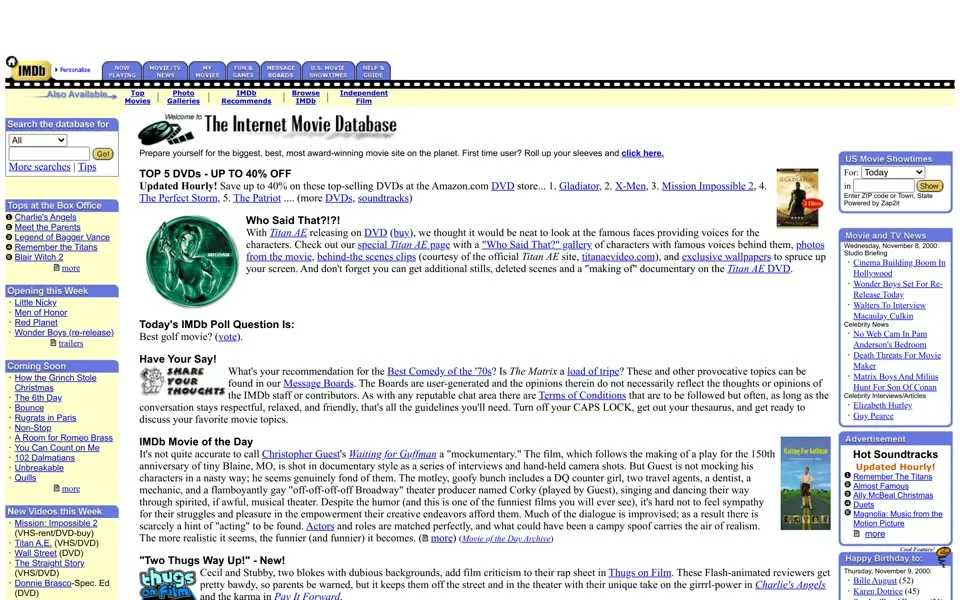
By November 2000 the page has a film-strip edge, blue navigation tabs, a yellow left sidebar and white, blue-bordered boxes on the right. Search now promises several kinds of answers: titles, people, characters, quotations, biographies and plots. And the side columns, with box office lists, release dates, showtimes and new home-video releases, turn a search tool into a cinema guide.
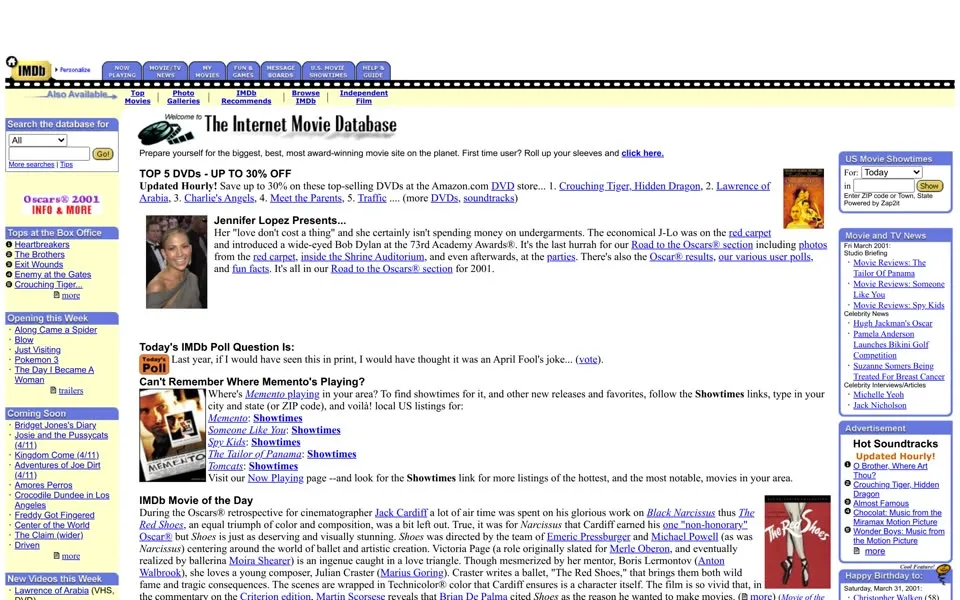
The center is editorial. A poll asks readers to pick a golf movie, a long Movie of the Day review discusses Waiting for Guffman, and a message-board invitation asks whether The Matrix deserves its reputation. Further down come animated critics called Cecil and Stubby and a movie quotation to identify. The 2001 capture keeps the formula: its main feature covers the Oscars, and another helps people find local screenings of Memento. Reasons to come back, even with no credit to look up.
The footer names the owner: An Amazon.com company.
A DVD offer near the top links to Amazon’s store, and soundtracks and shopping links are woven through the movie paper.
Find an answer
Search by title, person, character, quote or plot. Browse the Top 250 and film credits.
Come back tomorrow
A daily poll, a movie review, birthdays, trivia, news and discussions.
Video is already on this page, just not where you would look. A small Movie Trailers box sits in the right column, and its text spells out the deal: the trailers come from Film.com, and you have to download RealPlayer to play them. To watch these Film.com trailers you needed another program first.
The note under the trailer links in the November 2000 capture. By our April 2006 capture a trailer list sits in the center column, and by 2012 three trailers open the page.
2002 – 2005 An IMDbPro pitch on the free page
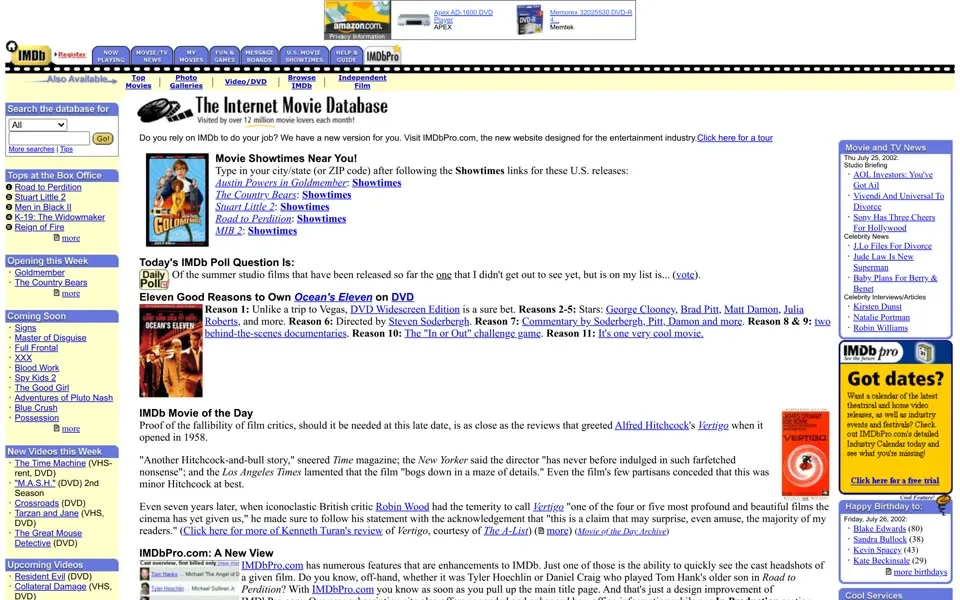
The structure holds while the contents grow. In 2002 the page promotes IMDbPro to people whose work depends on film information, and a second feature explains its cast photos, production tracking and industry calendar. The public homepage is now also the way into a paid professional service.
In 2003 the pitch is about agent and company contact details. Local showtimes can arrive by email every Friday. By 2004 the left sidebar even has its own web-search box, sitting under IMDb’s database search. Small additions, same frame. The layout doesn’t start over each year.
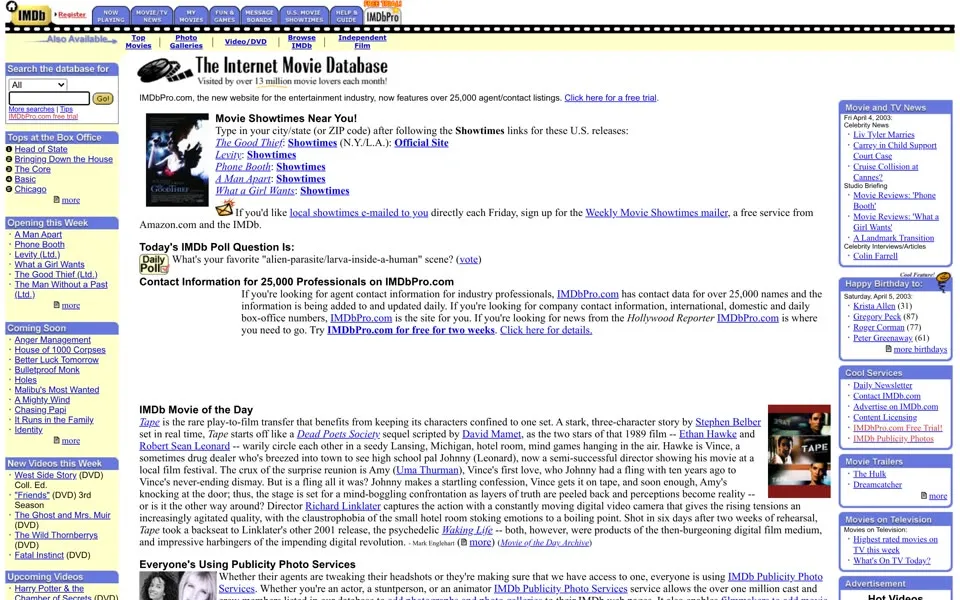
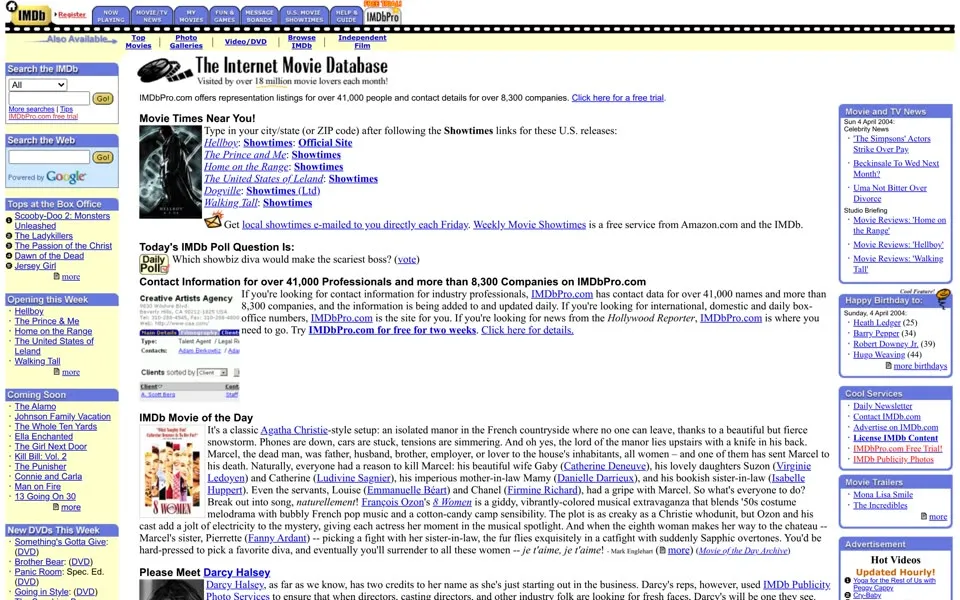
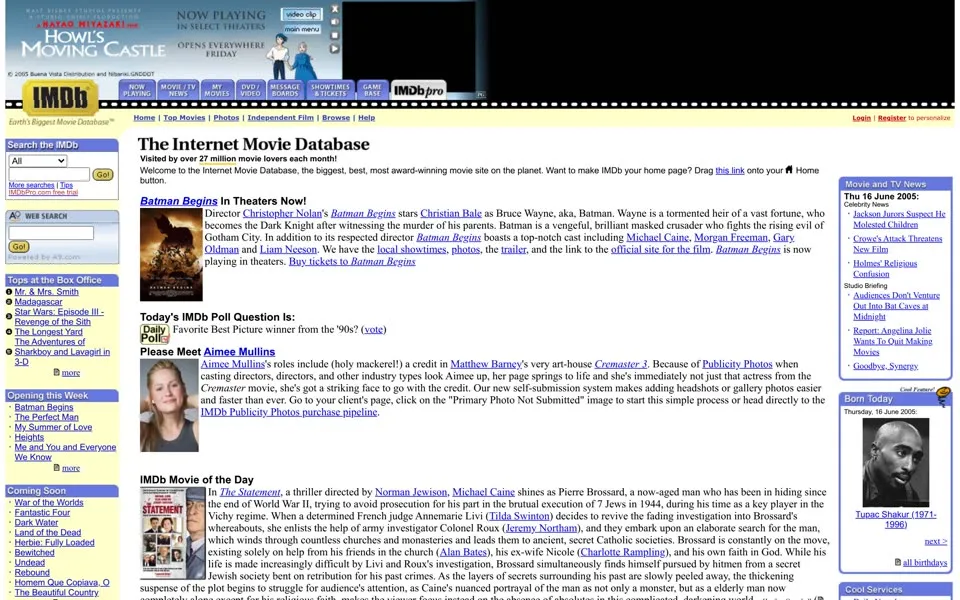
By June 2005 the yellow IMDb badge is bigger, with a claim about the size of the database underneath. Batman Begins gets the opening feature. The poll, the Movie of the Day and the publicity-photo promotions are all still there, and further down an Ask a Filmmaker feature answers practical questions about writing, camera work and documentaries. One long center column serves film fans and film workers at the same time.
2006 – 2009 Trailer links and a TV grid called IMDb TV
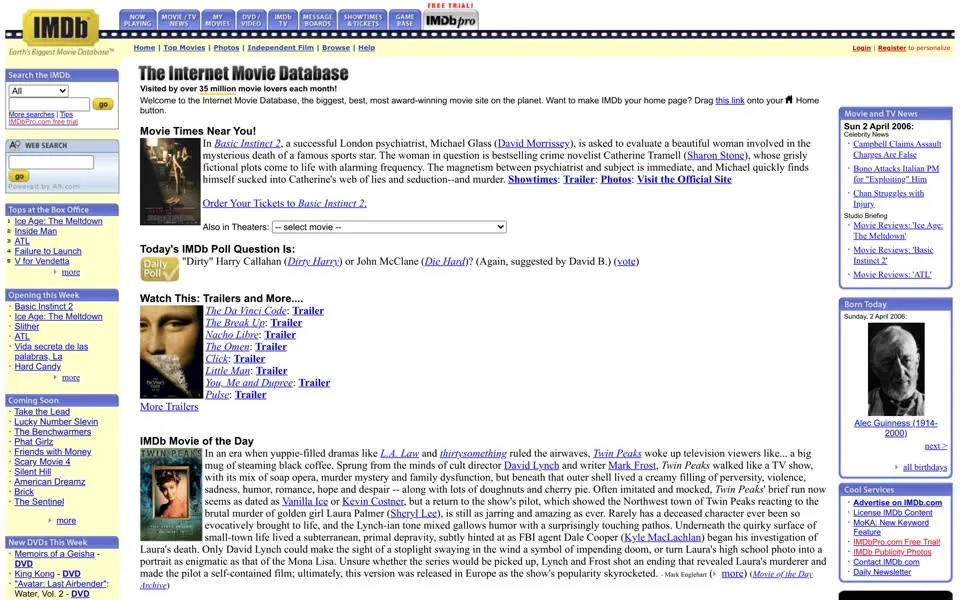
In April 2006, eight trailer links sit under Watch This: Trailers and More
in the middle of the page. No big video images yet. It is a plain list, next to the poll and the long paragraphs. What changed is where it sits: trailers have moved into the main reading path.
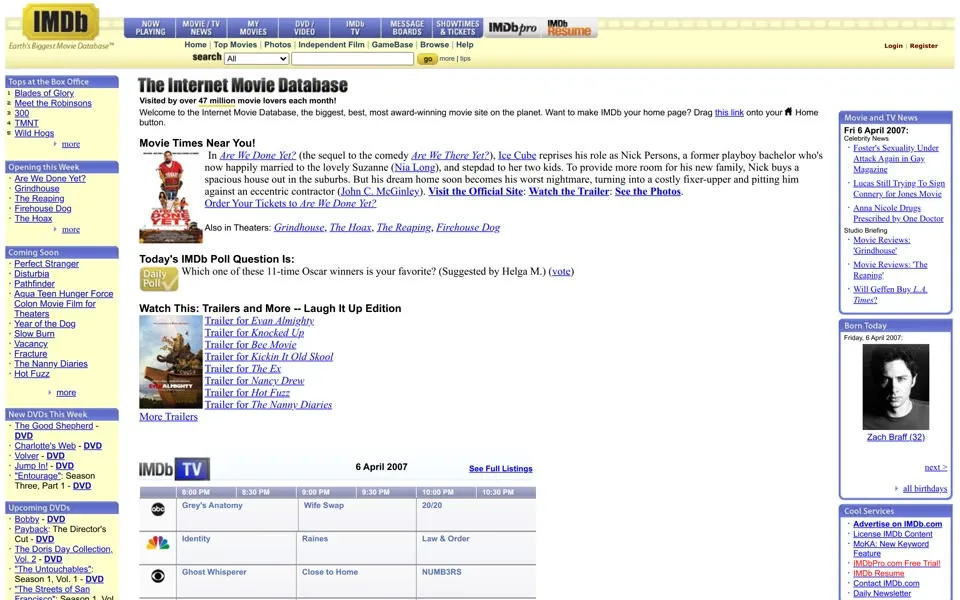
The April 2007 capture also shows a TV schedule. The box headed IMDb TV has channels down one side and half-hour slots across the top, and its own date says April 6 while the archive timestamp says April 7. In this capture, IMDb TV means a grid you read to find something on television.
In 2008 a feature invites registered users to help write a film’s FAQ, and the TV grid and trailer links carry on. By April 2009 the video invitation is louder. A bold headline points to new videos and trailers, thumbnails tell a featurette from a TV episode, and the left column has a New Videos widget. Below them, show recaps come with spoiler warnings.
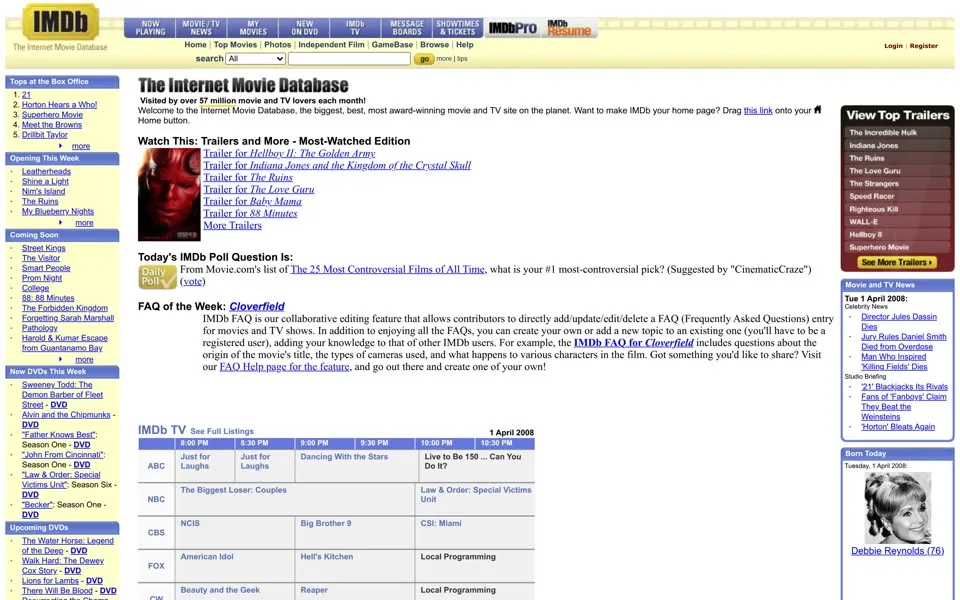
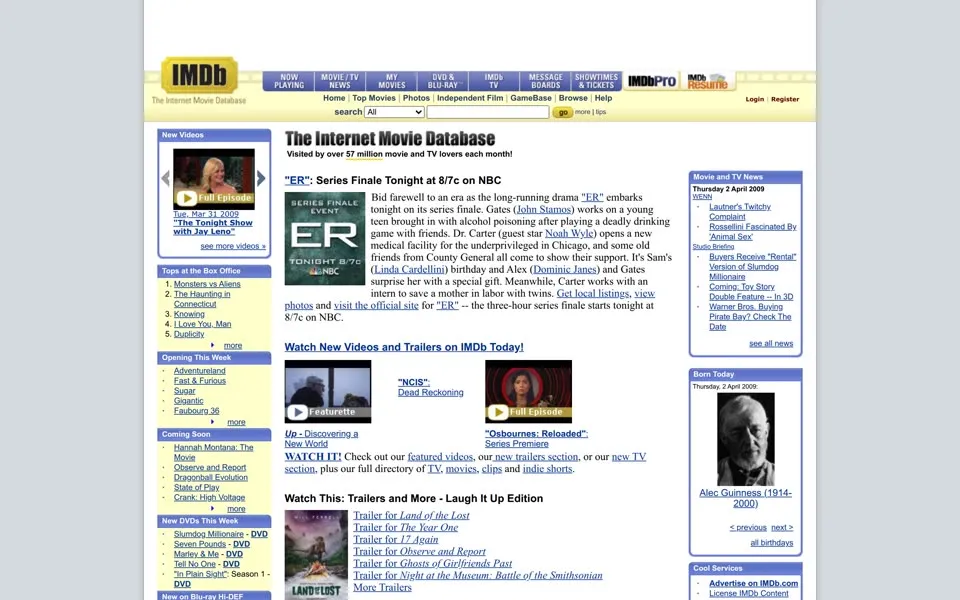
The long name is still the biggest heading. The film strip is still there. But things you can watch are moving up the page, and pictures and play buttons are pushing out some of the prose. The shift to video starts inside the old layout.
2010 – 2011 A dark bar and a bigger first picture
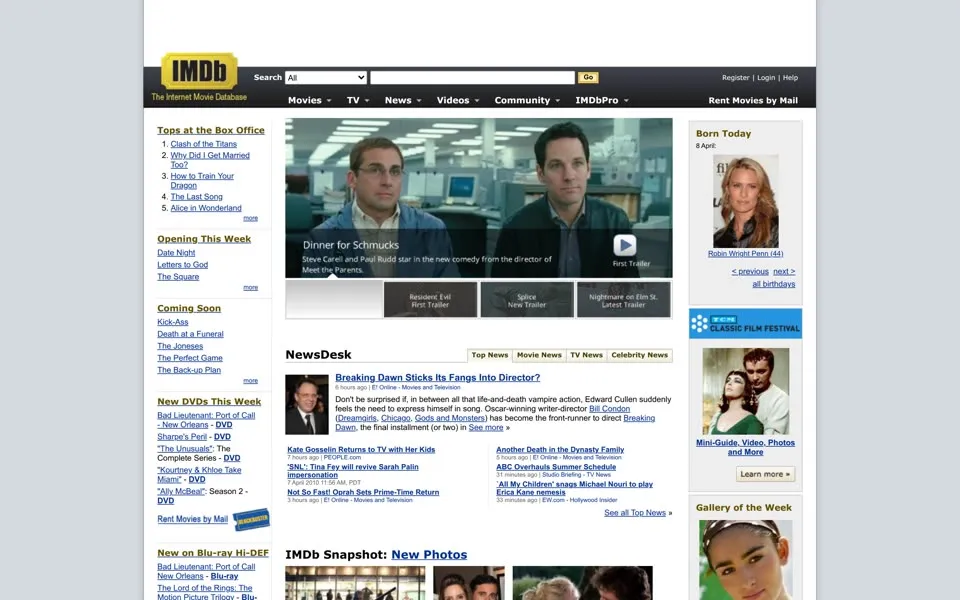
The April 2010 capture swaps the film-strip header for a compact dark bar. The yellow badge sits on the left, the full name shrinks to a small line beneath it, and a Dinner for Schmucks trailer leads the center column. News, photos and TV listings carry on below, on a white page.
We can say the new header is visible by 2010. We can’t date the redesign to that year: the research found it on a December 2009 capture.4 The April 2009 page above still has the old one.
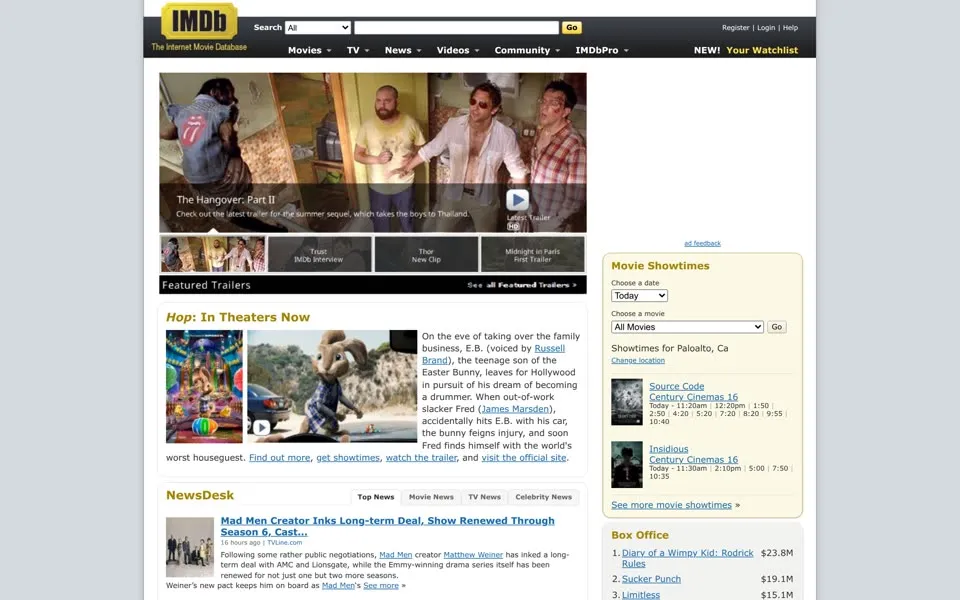
In 2011 the opening trailer is wider, and a NEW! Your Watchlist
link sits in the header. Tucked into the capture text is a recruiting pitch whose formula combines entertainment, huge datasets and hard programming problems. The trailer is now the front door. The database still describes itself as an engineering problem.
2012 – 2013 Three videos across the top
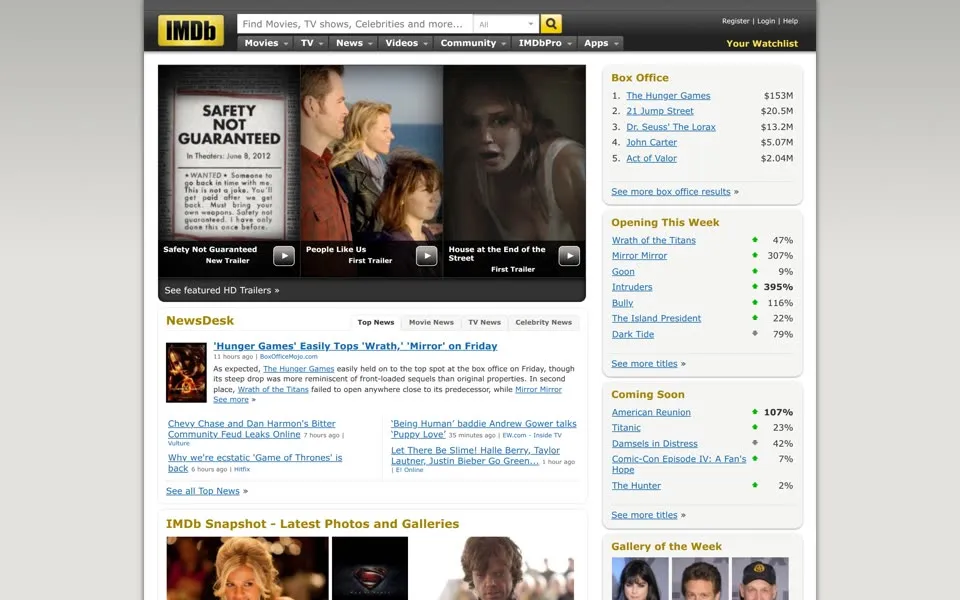
In April 2012 three separate trailer tiles share the top: Safety Not Guaranteed, People Like Us and House at the End of the Street. The logo stands alone. A small link leads into the HD trailer collection, the right column collects box office results and new releases, and the center below the videos keeps its news and galleries.
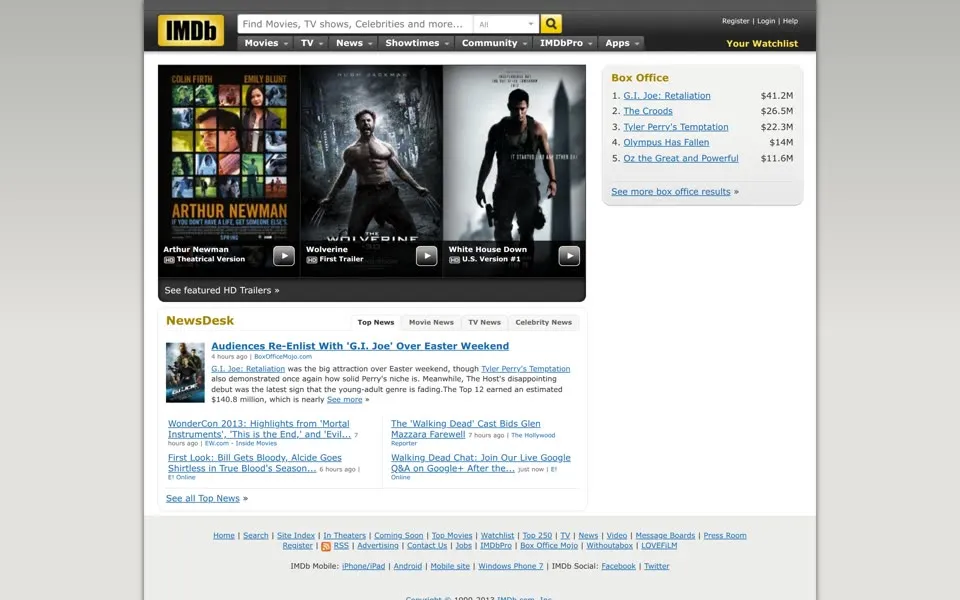
The full database name survives in the 2012 browser title. By 2013 the tab just says IMDb, plus movies, television and celebrities. This capture renders a short page, with three tiles and a small news block running straight into the footer. That is what the saved copy shows, not proof that IMDb cut the whole homepage down to that length.
2014 – 2016 Mad Men, Doom and Top Gear in the trailer row
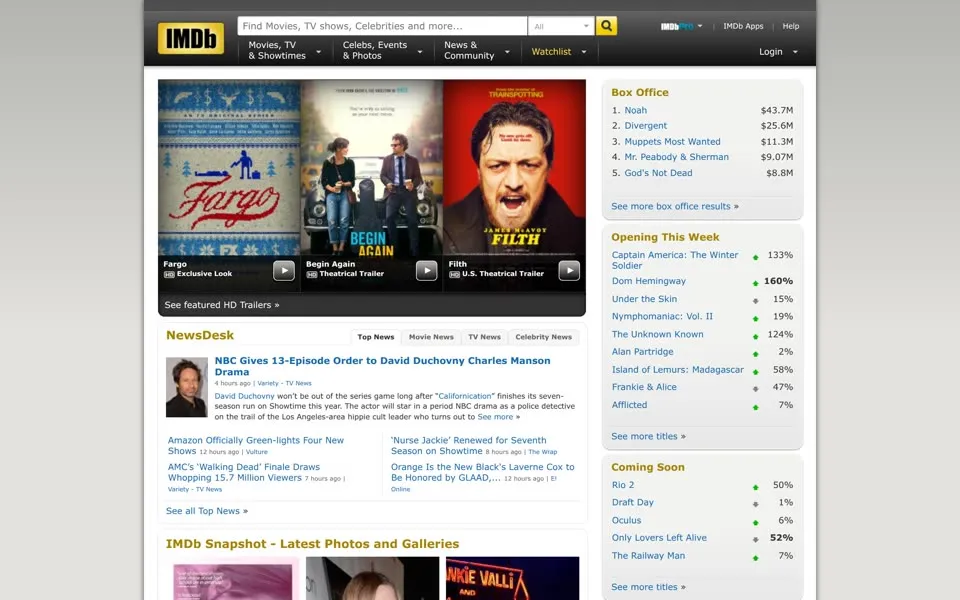
The trio stays while its titles change. In 2014 it is Fargo, Begin Again and Filth. The navigation in the capture text groups movies and showtimes, celebrities and photos, and news and community, and some of those entries belong to drop-down menus. So they are routes the code offers. They weren’t all visible in the closed header.
In 2015 a Mad Men interview sits next to Mad Max: Fury Road and Spy. The first tile is already labeled IMDb: What to Watch
, so recommendations belong to this white-page era too. In 2016 the same row holds a game trailer for Doom, a Top Gear preview and The Lego Batman Movie. The tiles now carry interviews, television and games as well as film trailers.
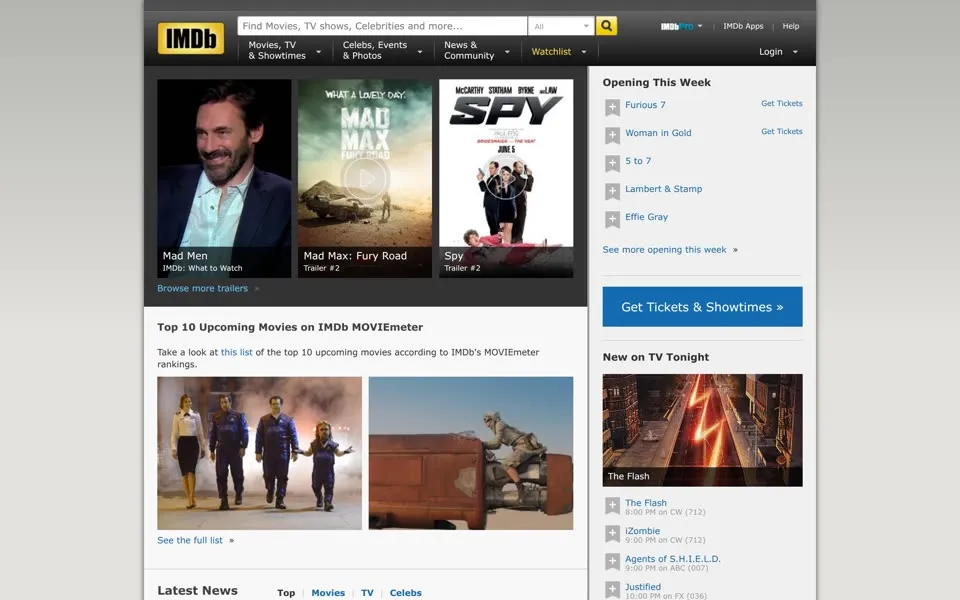
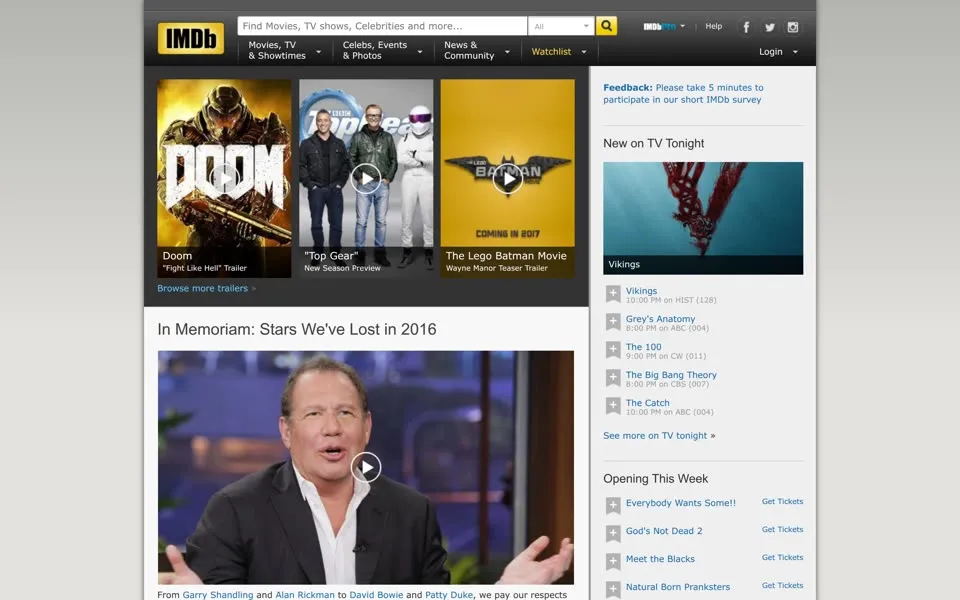
A few trailer links.
Trailers among the articles.
A trailer above the news.
Three videos across the top.
2017 – 2019 The message boards go dark, IMDb TV returns
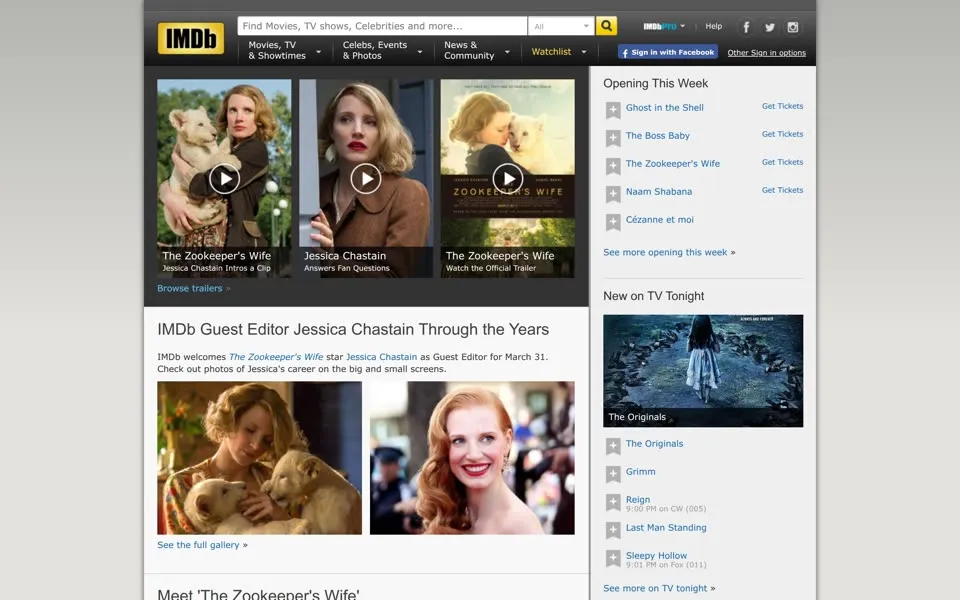
All three opening tiles in the April 2017 capture concern Jessica Chastain and The Zookeeper’s Wife: a clip, fan questions and a trailer. Her guest-editor feature continues below. This is an editorial front page with a video masthead.
One of the old portal’s destinations is gone. The message boards that asked about The Matrix in 2000 closed on February 20, 2017, and private messages and the Friends list went with them, because both were part of the boards system. Reviews, ratings and lists stayed.5 The page still looks much like earlier years, which makes this change easy to miss next to a new color or a new header.
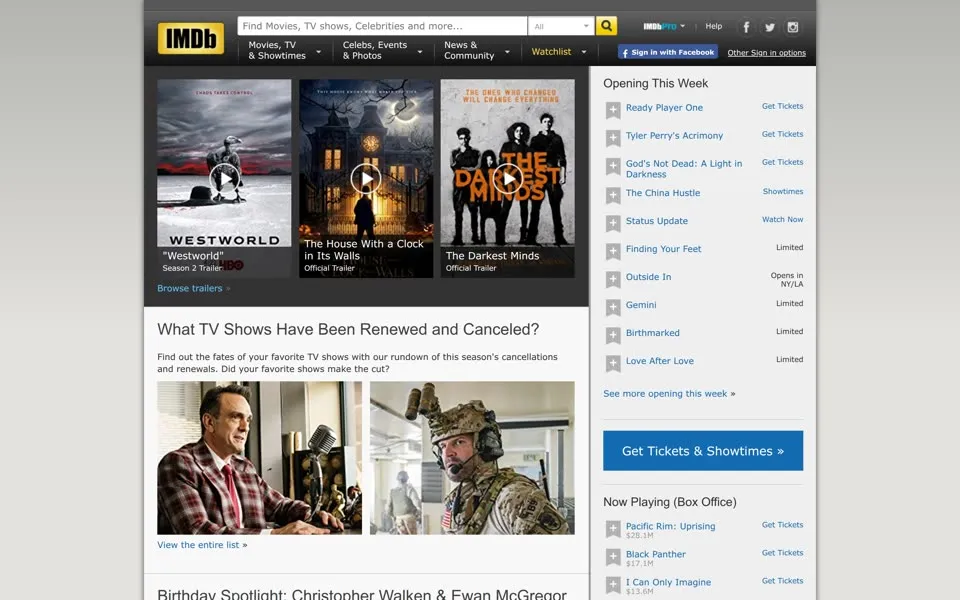
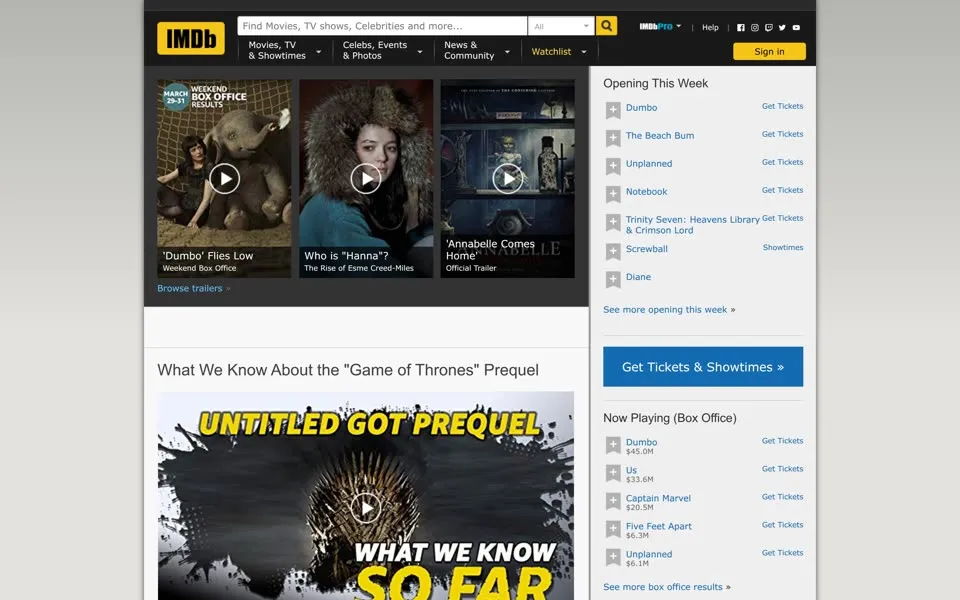
In 2018 the three videos lead into a list of TV renewals and cancellations, then birthday galleries and film features. Further down, the text asks you to sign in and rate titles so recommendations can appear. A guide with a personal layer.
In April 2019 the opening tiles cover Dumbo, Hanna and Annabelle Comes Home, and the familiar blue showtimes button is still on the right. The capture text also mentions IMDb Freedive, launched in January 2019: full films and series, free with ads, in the United States. You could watch Memento or Fringe on IMDb without a subscription.6 That June it was renamed IMDb TV. Same name as the 2007 channel grid. Very different thing.
2020 The lights go down
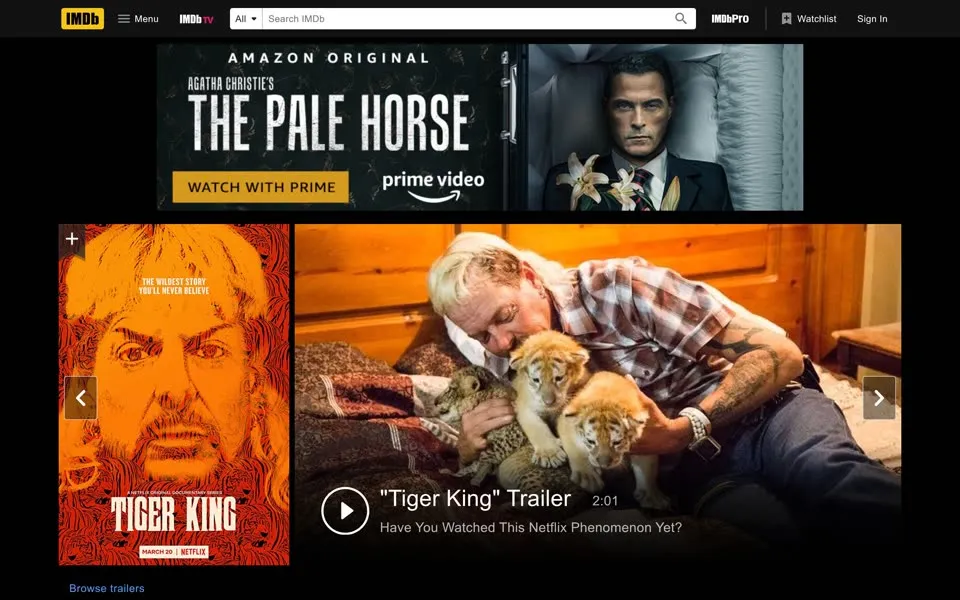
By April 2020 the white paper has turned into a black screen. A big Tiger King tile leads the page, under an advertisement for Prime Video’s The Pale Horse. The menus have folded behind a single Menu button, with search still in the header next to the logo.
The switch happened before this screenshot. The research found a white homepage on January 1, 2020 and a dark one on February 1.7 By April it has settled: one large video at the top, then yellow section headings, horizontal rows of pictures and recommendations.
The browser title changes too. It no longer just announces ratings and reviews for new films and TV; it also offers help finding where to watch them. Further down, the heading What to watch
introduces film cards with ratings and viewing options. That wording had already appeared on the 2015 page. What is new is how much of the screen it gets.
Earlier IMDb TV
The 2007 module is a grid of TV channels and broadcast times.
IMDb TV in 2020
The header now links to the free streaming service renamed in June 2019.6
2021 – 2025 One main video, three waiting
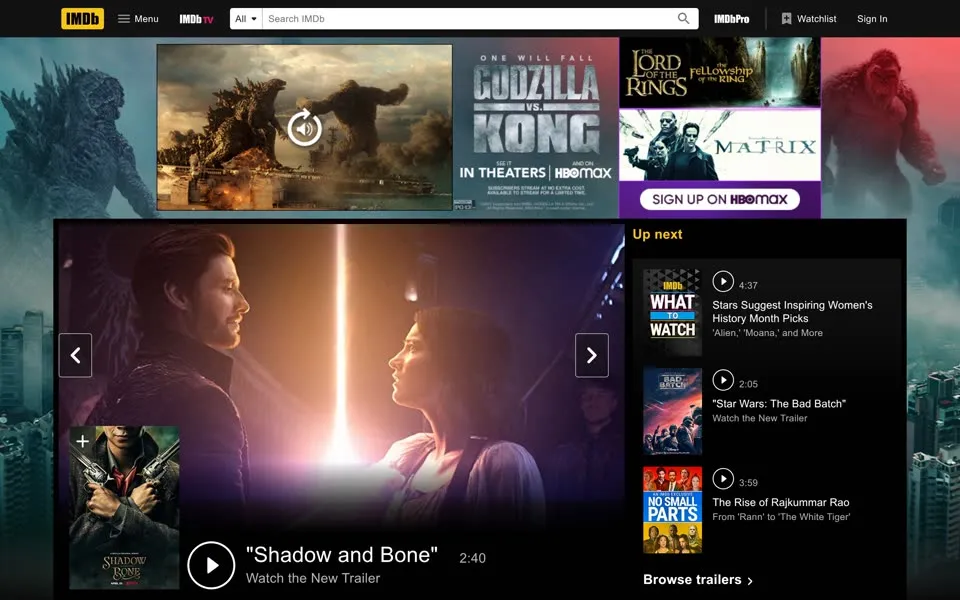
The April 2021 capture shows a queue. Next to the Shadow and Bone trailer, an Up next
column holds three smaller videos with play buttons and running times, and a link underneath opens the full trailer collection. The top of the page now reads like a TV schedule of its own. Something to play, then something to play after it.
Below it, the personal features can be empty. The Watchlist section asks you to sign in, and the other rows recommend videos and things to watch. No personal watchlist is displayed, because an archive visit is not signed in.
The arrangement holds whatever the subject. In June 2022 a Jurassic World Dominion cast interview takes the big tile; in March 2023 it is a conversation about Cocaine Bear; in April 2024 a video lists popular Korean dramas; and the October 2025 capture shows the Gen V cast playing a game. A slot that once held trailer links now carries IMDb’s own interviews and editorial videos.
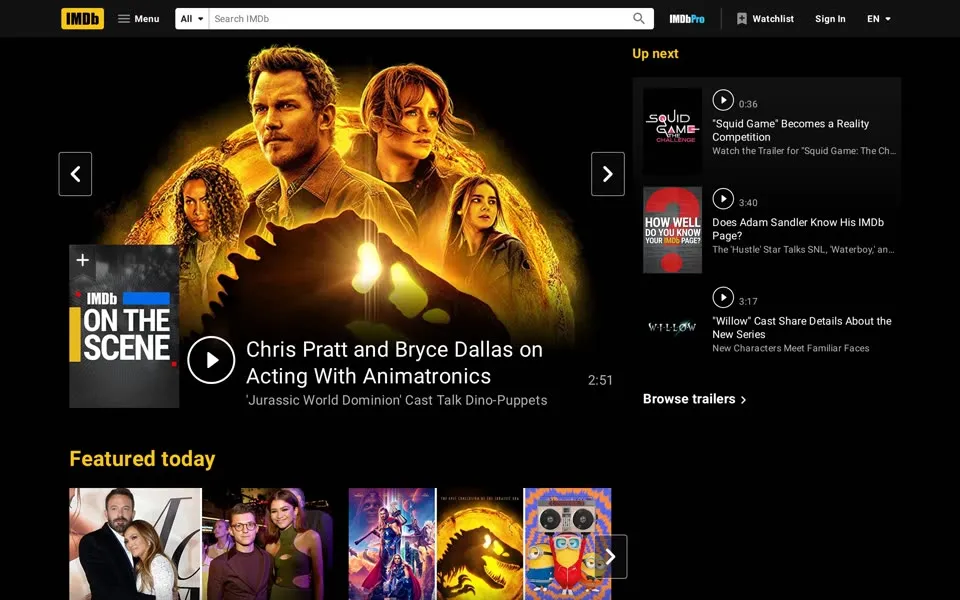
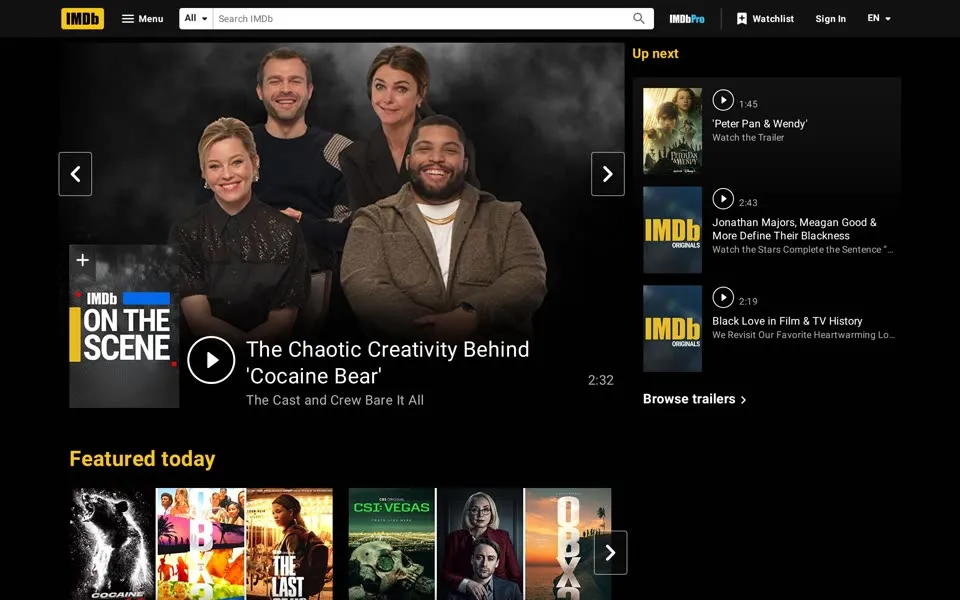
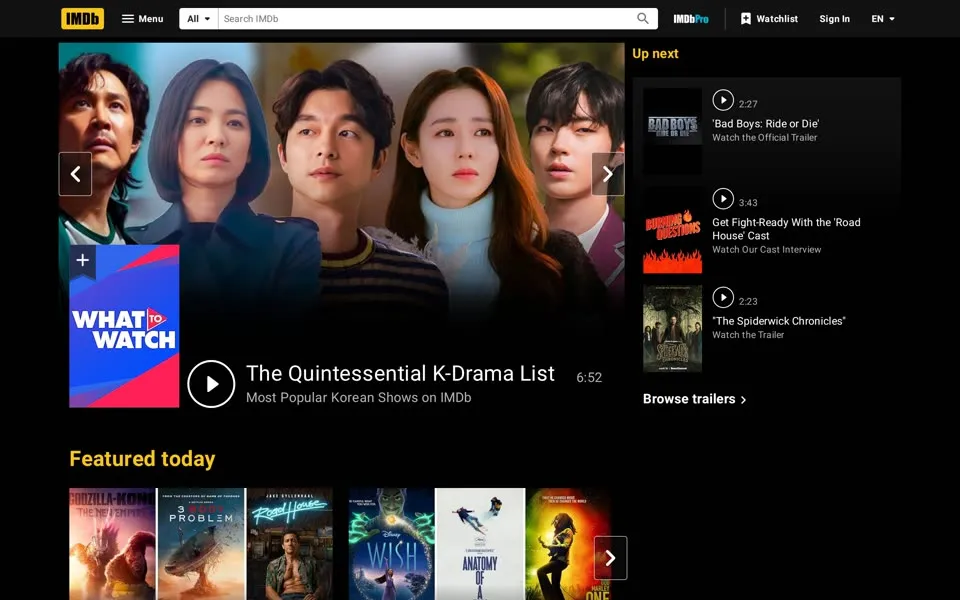
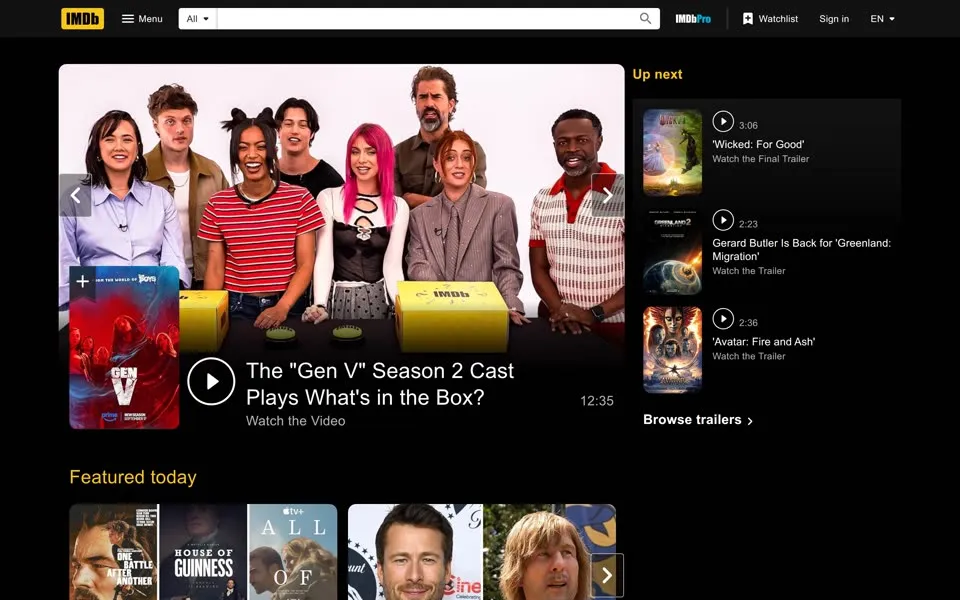
The queue, the yellow headings and the black background repeat in every one of these captures, loading spinners and empty recommendation rows included.
2026 The question now is what to watch
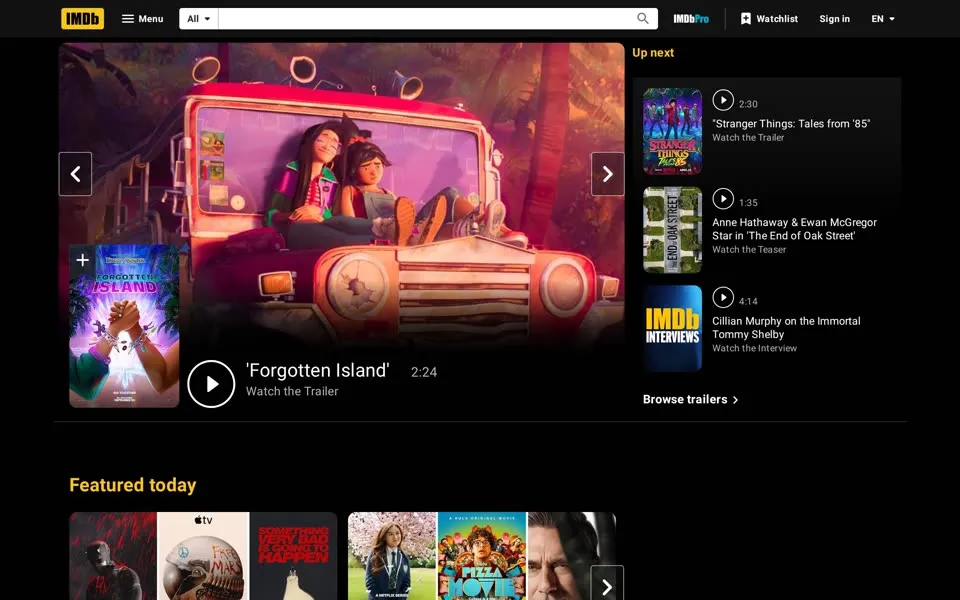
In the April 2026 capture of IMDb’s homepage, Forgotten Island fills the main tile and three videos wait in the side queue. Below, Featured today groups the editors’ picks and What to watch
pulls you further down the page. Search is still at the top. It just isn’t the main idea anymore.
The small print makes one more useful comparison. In 1996 the footer credited the systems and suppliers that kept the site online. In the 2026 capture text it points to the app, IMDbPro and data licensing, next to the Amazon-company line. The database hasn’t gone anywhere. It is now wrapped in a much bigger viewing guide.
Drag the handle to compare the first and last captures. The dates are November 19, 1996 and April 1, 2026.
1996 · ThenApril 2026In 1996, the front page helped you find a film. In 2026, it opens by giving you something to play.imdb.com · the selected captures, 1996 → 2026
The video
The same rewind in 3:04, narrated, on the PageRewind YouTube channel.
- When was the oldest imdb.com homepage in this story archived?
- The oldest capture here is from November 19, 1996, in the Internet Archive's Wayback Machine. Four large links, a question about a movie, and a small footer crediting the people and software behind the site.
- What does the imdb.com homepage look like in 2026?
- In the newest capture here (April 1, 2026): Forgotten Island leads a large trailer tile, beside three more videos and Browse trailers.
- How many IMDb homepage captures does this story show?
- 28 captures between 1996 and 2026, at most one per year; the timeline above shows which years are included.
- How did the IMDb logo change on its homepage?
- The logo evolution below shows 4 logo versions we picked from the captures, from 2000, 2007, 2012 and 2020. Logos from before 1996, the first capture, aren't included.
 2000IMDb on a film strip, with the home icon
 2007Big yellow plate, Earth's Biggest Movie Database
 2012Glossy yellow IMDb on the dark bar
 2020Flat yellow IMDb on black
Each logo is cut from that year's homepage capture (the year is the capture's); click one to see it on the page. Logos from before the first capture (1996) aren't shown, and some are missing where the logo images don't render in our captures. More logo histories.
◀ drag ▶19962026
The oldest capture in this story (1996) over the newest (2026). Drag across the picture.
Which homepage should we rewind next?
Tell us in the YouTube comments, or explore another story.
 Spacejam.com, 1996–2026Space Jam, from “click” to “1996 SITE”.
Sources
Descriptions refer to the screenshot shown. Additional wording comes from extracted capture text and is identified as such. Click a screenshot for the full page or its date for the Wayback capture. External dates and events are linked below.
- IMDb Help · IMDb History, archived October 20, 2006. The 1990 search scripts, the 1993 email search and the January 1996 incorporation. Archived history ↗
- About Amazon, Col Needham interview, May 8, 2023: the VHS diary, his film count and the December 1997 meeting invitation. Interview ↗
- Amazon, acquisition announcement, April 27, 1998. Amazon press release ↗
- Internet Archive, IMDb homepage, December 7, 2009: the dark header before the 2010 capture. December 2009 capture ↗
- TechCrunch, report on the message-board closure, February 3, 2017, and IMDb Help, Boards Closure FAQ (undated): the February 20 date, private messages and the Friends list. Closure announcement ↗ · Closure FAQ ↗
- TechCrunch, Freedive launch, January 10, 2019, and IMDb TV rename, June 17, 2019, and IMDb’s Freedive press release, January 10, 2019 (titles such as Memento and Fringe). Launch ↗ · Rename ↗ · Press release ↗
- Internet Archive, IMDb homepage captures of January 1, 2020 ↗ and February 1, 2020 ↗. White and dark layouts bracket the change; these two extra captures are linked evidence, outside the year slider.
How this was made. This selection contains 28 Wayback homepage captures: 1996, and one for each year from 2000 to 2026; it has no captures for 1997–1999. The page also includes 2008, 2011 and 2016, which the video leaves out. Dates and browser titles come from the saved capture records. Missing images, short pages, empty personal sections and loading indicators stay in the stills. They are observations of the saved captures, not proof of how the live page looked.
Expanded views are resized copies of the saved screenshots, which stop at 2,700 CSS pixels, so longer pages are cut off at the bottom. Text extracts can contain hidden menus or different carousel slides; those are distinguished from what the screenshot shows. The selected 2026 frame is an April archive capture. Narration and music in the video are made with ElevenLabs. PageRewind is independent and not affiliated with IMDb or Amazon.
 Disney homepage history
 Nickelodeon homepage history