In July 2003, Friendster drew friendship as a little network of faces. Lines connected one person to the next, and the text explained how to meet someone through people you already knew. Users soon stretched that idea: the fictional profiles Ali G and Burning Man each collected more than 10,000 friends.[1]
Scrub through the captures, or follow the story below.
Friendster's homepage history from 2002 to 2026 follows a changing invitation: join a private circle, browse strangers, play games, then start again with real-life friends. These 18 captures show the forms, photographs and buttons changing around that promise. Along the way came an exporter for old memories, a Facebook login button and a comeback paid for with Bitcoin and another domain.
The friends who weren't people: how fictional profiles opened up the network.
Save your memories before the games: the 2011 plan to remove photos and blogs.
A domain traded for a comeback: how the address returned to social networking.
2002 A code before you could join
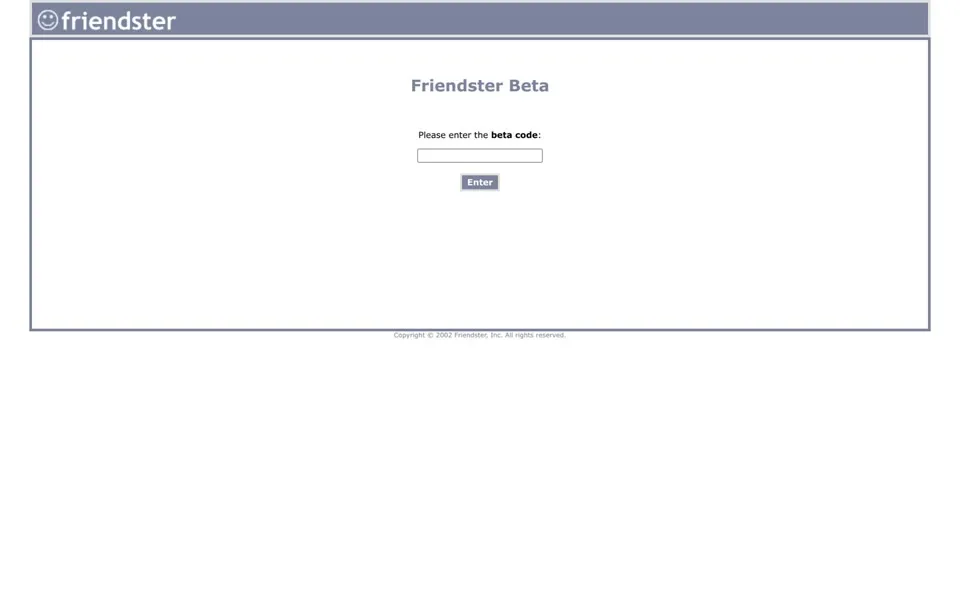
The oldest Friendster capture in this collection, November 2002, asks for a beta code. A small field and an Enter button sit under Friendster Beta
; the dark header holds a white wordmark and an outlined smiling face. The footer already says Friendster, Inc. This invitation-only screen predates the public beta, which Salon dates to March 2003.[2]
2003–2004 The friends who weren't people
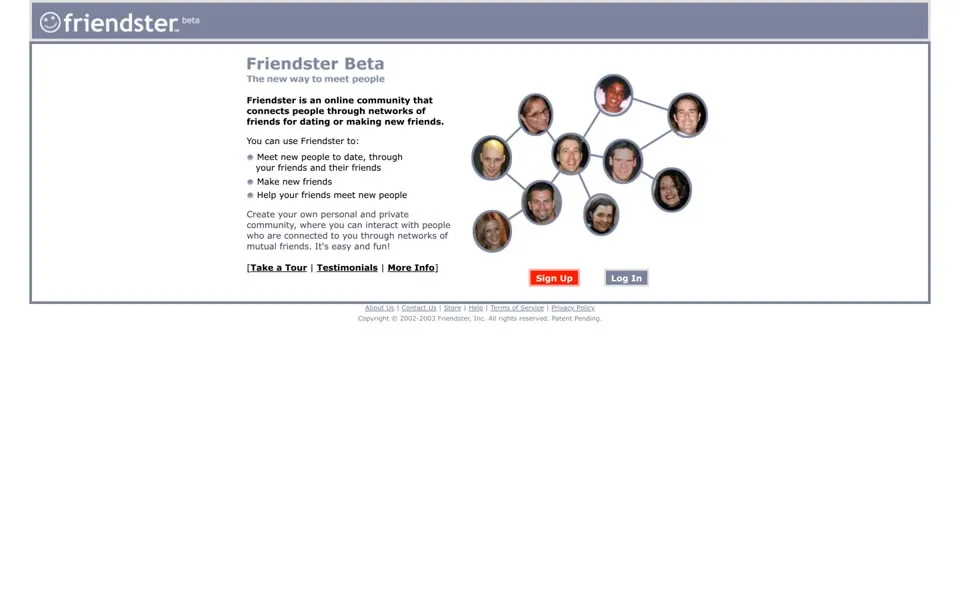
Friendster's July 2003 homepage explains the network before asking you to enter it. The face diagram sits beside a short introduction, followed by links for a tour, testimonials and more information. Dating comes first in the list of uses. Making friends and helping friends meet other people follow it.
That friendly diagram had a limit: users could see only four degrees out from their own profiles. Researcher danah boyd describes how adding a popular fictional account, a Fakester, widened the network you could see.[3] A joke profile could also be a shortcut.
Friendster once put a popularity ranking on members' homepages. By the time that feature disappeared, boyd records, Burning Man and Ali G each had more than 10,000 friends. The company deleted fictional accounts; users formed the Fakester Revolution, and profile farms recreated deleted characters.[1] The rankings lived on members' own pages, so the signed-out homepages here never show them.
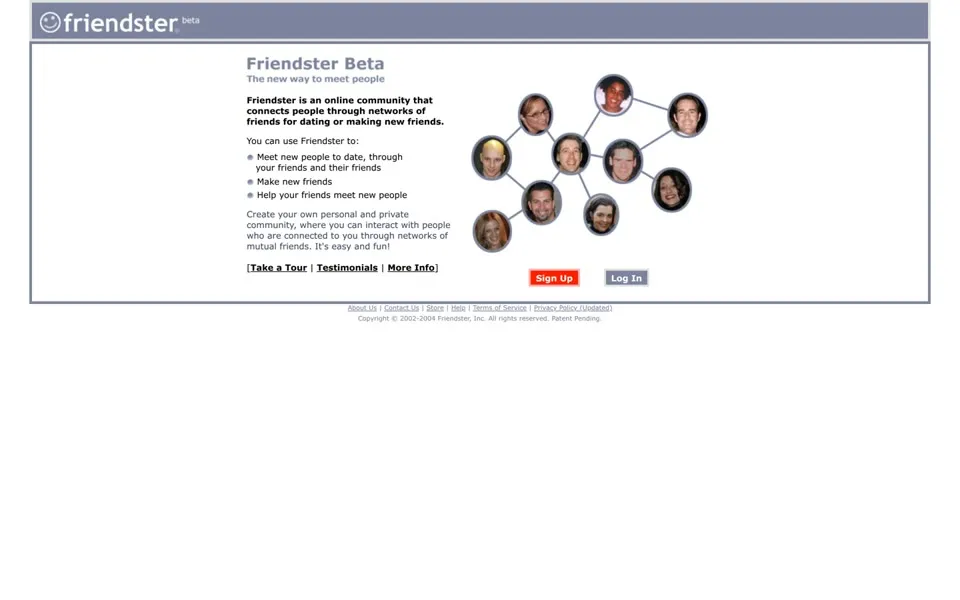
The June 2004 homepage keeps the diagram and the two small entry buttons. Below the introduction, the footer includes a Store link and Patent Pending.
The drawing makes the network look manageable. The characters collecting thousands of friends were already using it on a different scale.
2005 “Organize your social life”
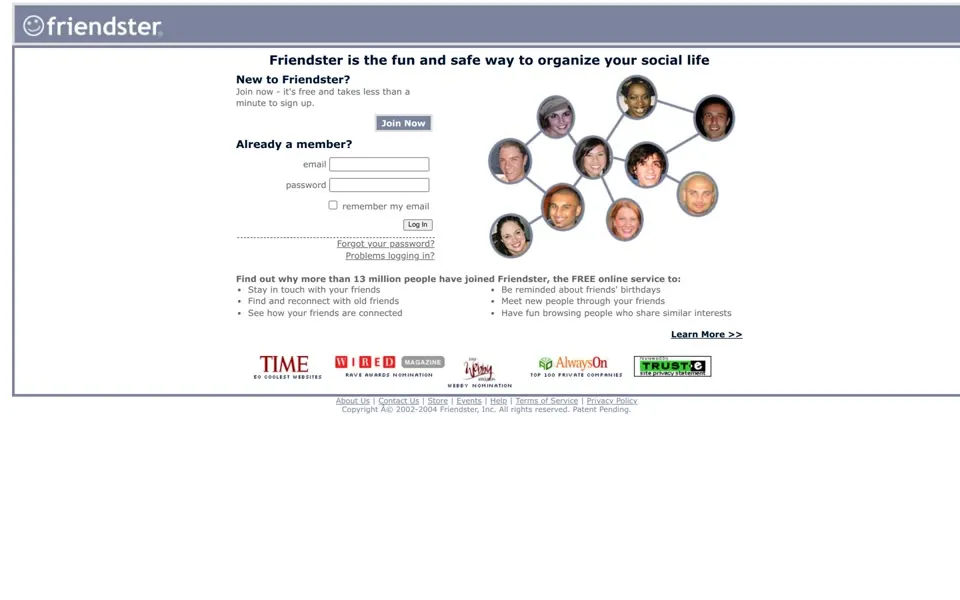
Friendster's January 2005 homepage puts organize your social life
just below the dark header. The face network survives, but the left column now gives members an email-and-password form. Underneath, the page lists things you might actually come back to do: find old friends, check how people are connected, remember birthdays, meet someone through a friend and browse shared interests.
The bottom row is a set of endorsements. TIME, Wired and Webby badges sit beside a TRUSTe privacy seal. Their image descriptions in the capture's HTML name the awards and privacy statement. That row gives a new visitor another reason to hand over an email address.
There had already been a chance to sell the site. The New York Times reported that founder Jonathan Abrams rejected an offer of about $30 million from Google and chose venture funding; Friendster took $13 million from Kleiner Perkins and Benchmark.[4] Here, the invitation to join is still small enough to fit beside a diagram.
2006–2008 The diagram becomes a directory
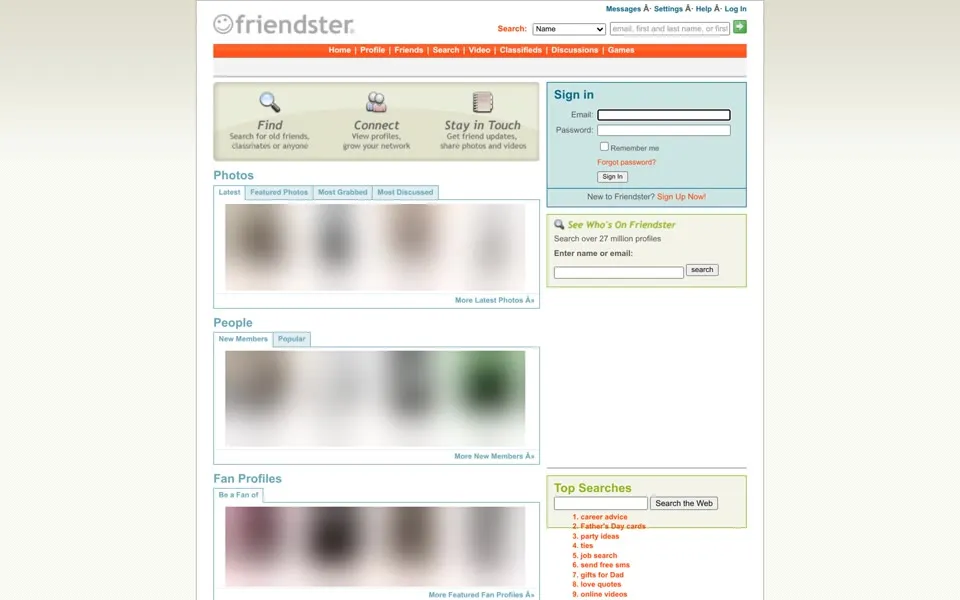
Friendster's June 2006 homepage is full of people before you log in. Photos lead into People and Fan Profiles, while Blogs & Reviews continues below the first screen. A sign-in panel occupies the right column. The little face diagram has given way to rows of actual member content, so we have blurred private members' pictures and identifying text in these reproductions.
The strip above the rows says Find
, Connect
and Stay in Touch
. The neighboring search box advertises more than 27 million profiles. Across the top, the navigation leads to Home, Profile, Friends, Search, Video, Classifieds, Discussions and Games, while the photo tabs below let visitors choose Latest, Featured Photos, Most Grabbed or Most Discussed and the People section divides New Members from Popular profiles. Farther down, Top Searches includes Father's Day cards, gifts for Dad and ties. This capture is dated June 13: even the small search suggestions carry a moment in the calendar.
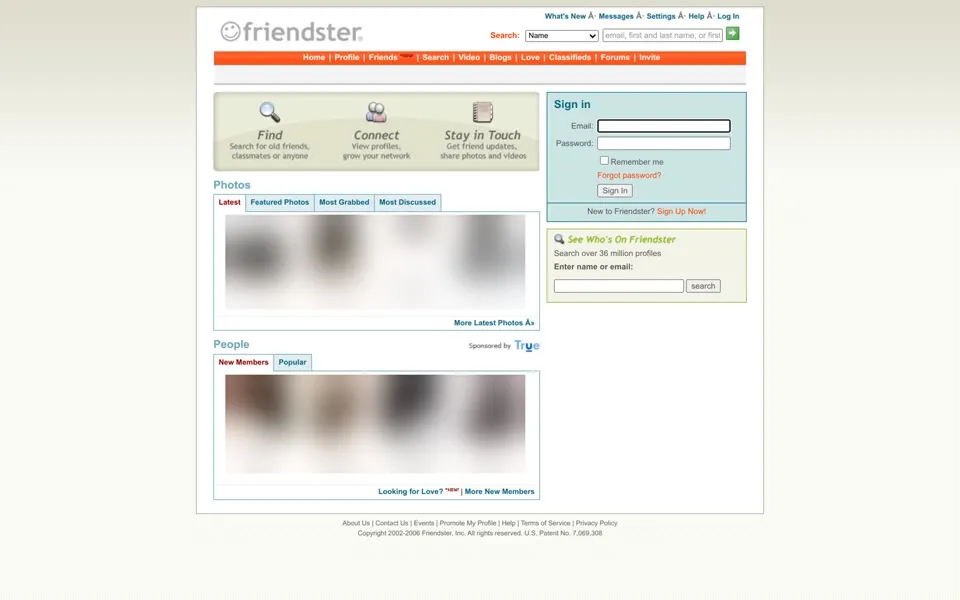
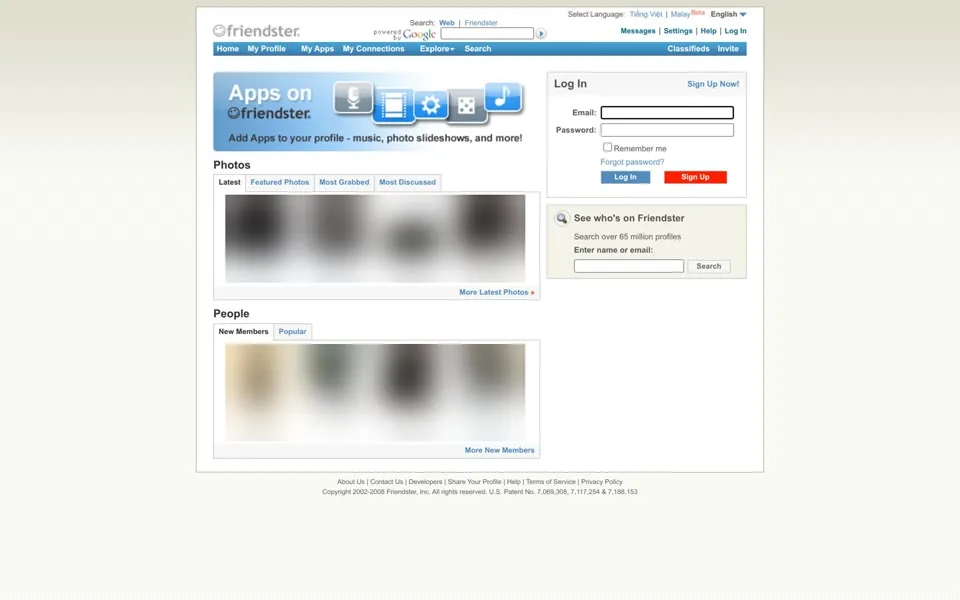
The 2007 capture keeps the directory; in 2008, Apps on Friendster
takes over the banner above it.
The footer changes from Patent Pending.
in June 2006 to U.S. Patent No. 7,069,308 in January 2007. The patent record dates that grant to June 27, 2006, two weeks after our earlier capture.[5]
2009–2011 From blue forms to a green cloud
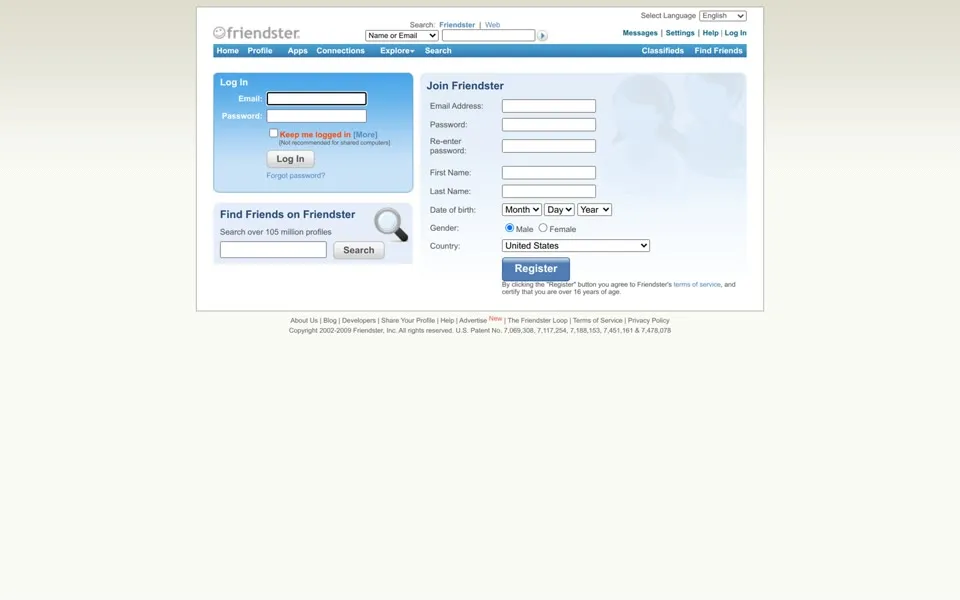
Friendster's June 2009 homepage clears away the member rows. A blue panel puts login and friend search on the left, with a much larger registration form on the right. At the bottom of that form, registering means accepting the terms and certifying that you are over 16. The page is asking for a new account again.
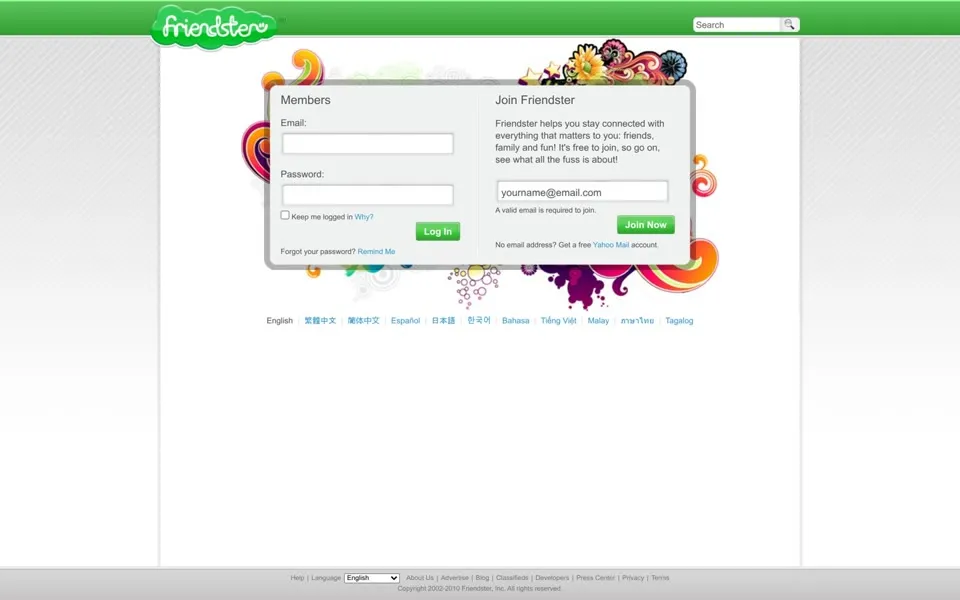
The next capture changes the logo as well. A white handwritten wordmark sits on a green cloud, surrounded by colored curls and doodles. TechCrunch reported the Connecting Smiles
redesign in December 2009.[6] The 2010 page has one practical suggestion beneath Join Friendster: visitors without an email address can get a free Yahoo Mail account.
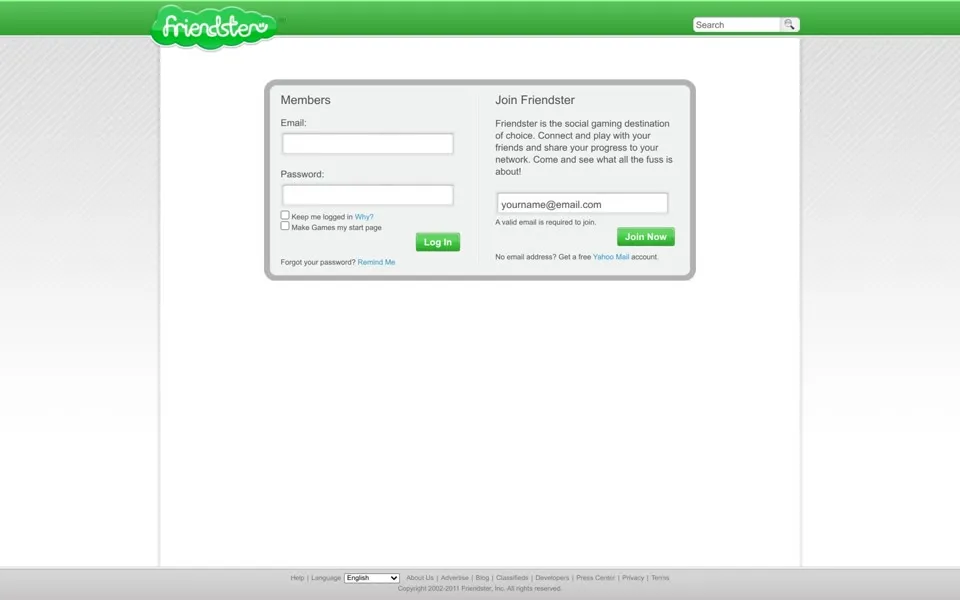
Friendster's audience had shifted too. In the December 2009 acquisition announcement, the company said more than 90% of daily traffic came from Asia, alongside more than 75 million registered users.[7] In our June 2011 capture, the decorative surround is gone. The join panel now calls Friendster the social gaming destination of choice
, invites visitors to connect and play with friends, and asks them to share their progress with their network, while a checkbox on the left offers to make Games the start page.
The change reached into people's saved memories. On April 26, 2011, TechCrunch reported a plan to remove photos, blogs, comments and groups, with an exporter that could download material or move it to Flickr or Multiply. Accounts and friend lists were supposed to remain.[8] May 31 was the initially announced deadline; these captures do not establish the final deletion date.
2013–2014 Friendster signs in with Facebook
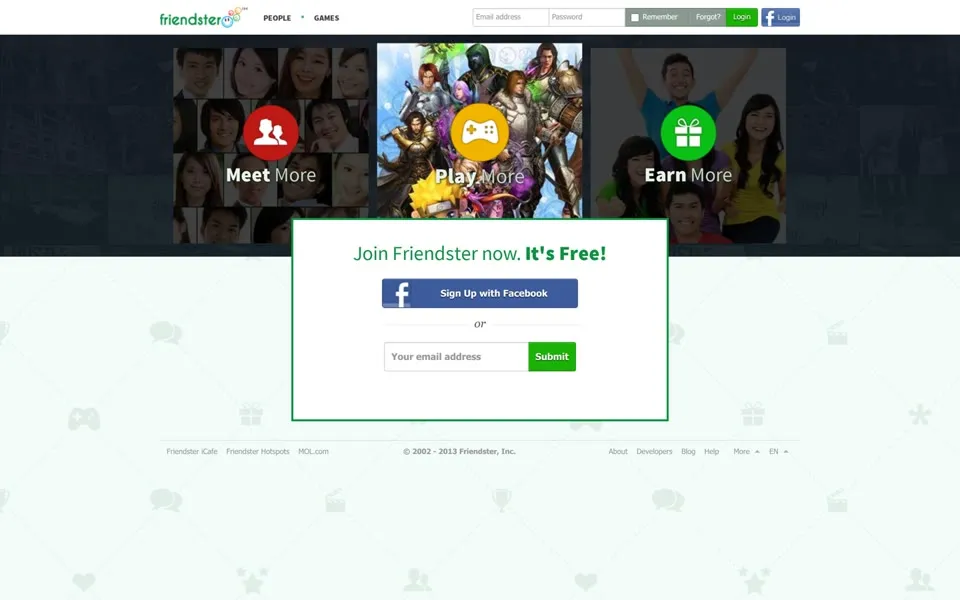
Friendster's June 2013 homepage has a different set of instructions: Meet More
, Play More
and Earn More
. Red, yellow and green circles hover over a game-art banner. The signup box underneath offers Facebook as the way in. That blue button now sits where the old network once explained friends of friends.
TechCrunch had reported the games relaunch, including Facebook Connect, on June 29, 2011.[9] The 2013 capture makes the arrangement visible. Its browser title is Friendster.com - Living the Game
. We hid an archived form-validation notice to keep the signup panel readable.
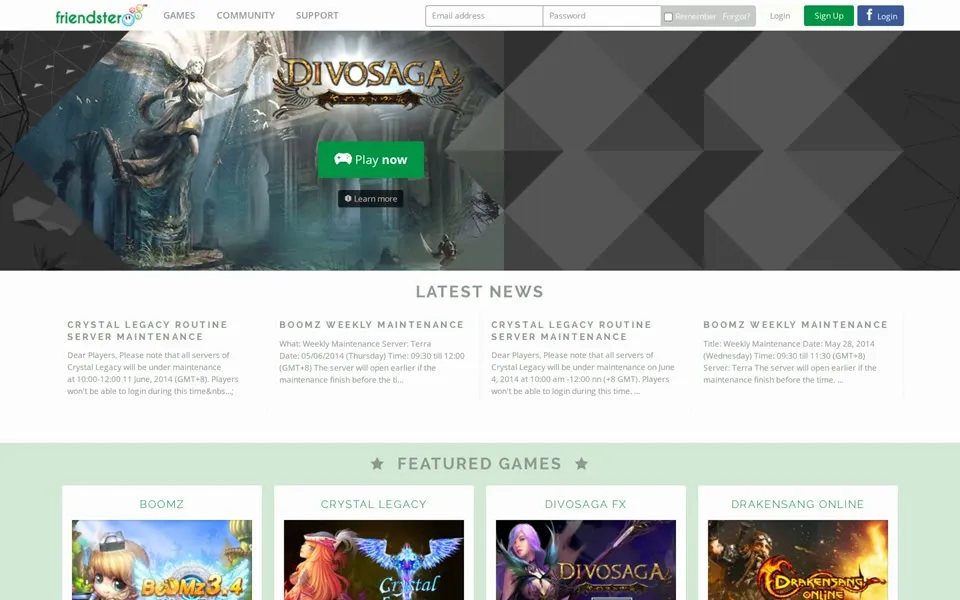
By June 2014, Friendster's homepage is a games portal from top to bottom. A DIVOSAGA banner has a Play now button; latest-news columns report game maintenance, and featured games lead into a much longer All Games grid. Scroll to the bottom and the footer points to Friendster iCafe, Friendster Hotspots and MOL.com. The featured row lists Boomz, Crystal Legacy, Divosaga FX, Drakensang Online, Darkorbit, Lord of Ages, Dungeon Inquisitor and Sushido above an All Games grid that also includes Voodoo Potions, Jewel Pursuit, Kapi Hospital, Cyberdunk, and Funnily Poker. There are 38 tiles in that lower grid.
2015–2020 A yellow note takes over
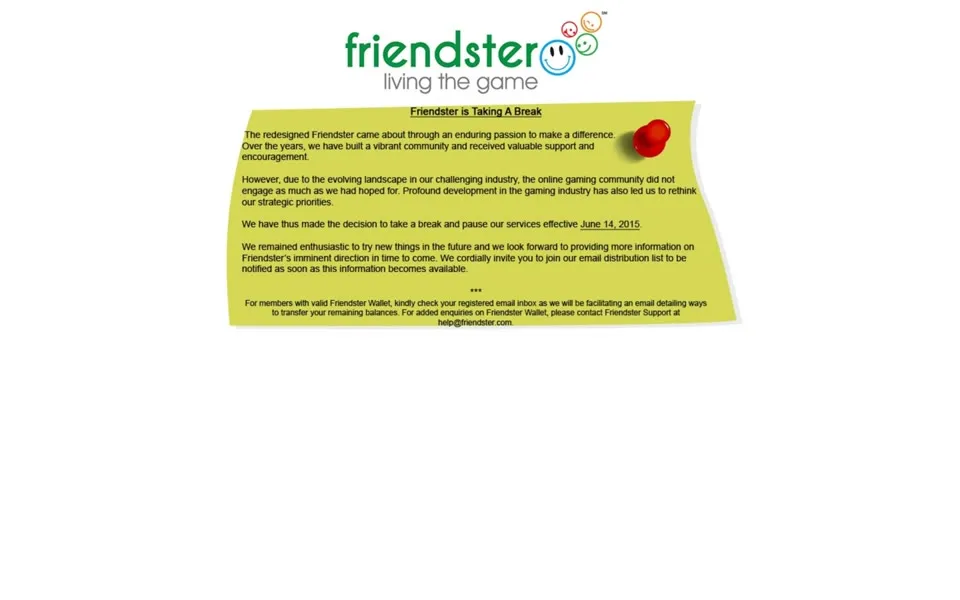
Friendster's June 2015 homepage replaces the game grid with a yellow note, pinned at one corner. Its heading says Friendster is Taking A Break
. The notice dates the service pause to June 14, 2015 and directs remaining Friendster Wallet questions to a support address. The green logo still carries living the game
, but the note below it has become the whole reason to open the page.
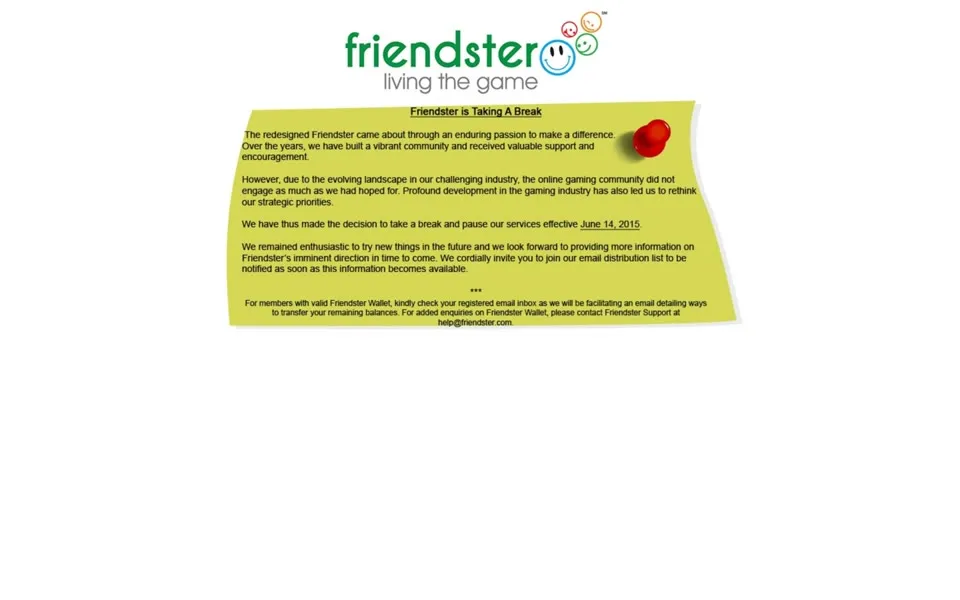
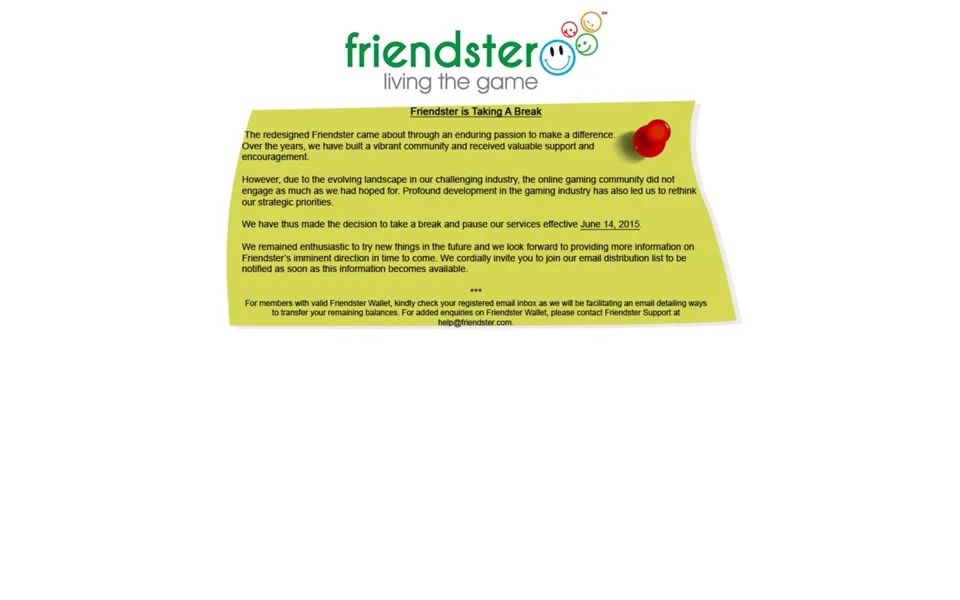
The same notice is still there in our 2019 and 2020 captures, archived from the site's index page: years after the games had gone, the address still showed the goodbye. The capture gaps between these dates are explained below. By 2024, the address would be asking for email addresses again.
2024–2025 “Bringing it Back to the People”
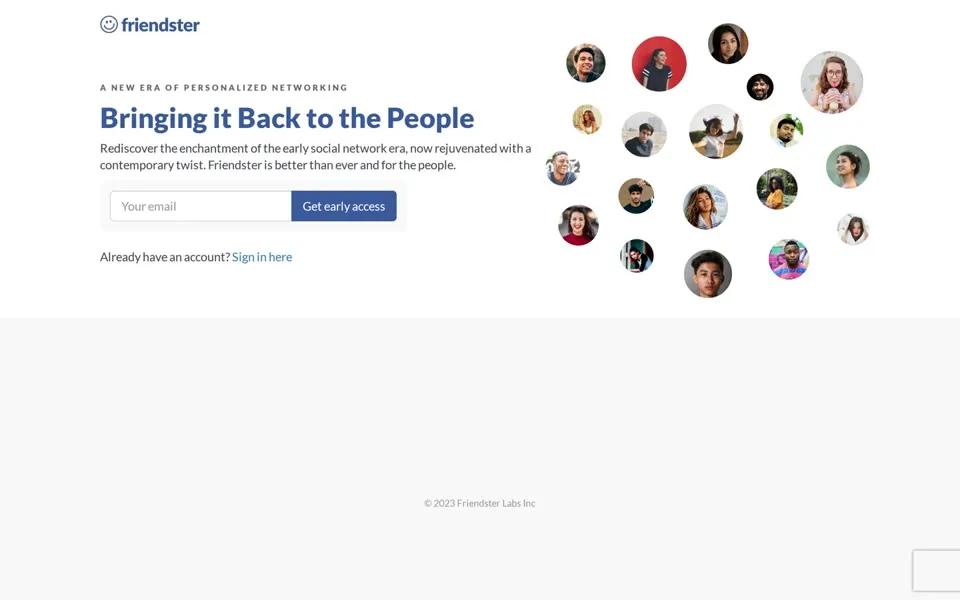
Friendster's June 2024 homepage returns to a circle of faces, this time floating beside an early-access email field. A blue smiley sits beside a bold lowercase wordmark. Bringing it Back to the People
is the headline; underneath, the page promises a contemporary version of the early social network.
The address itself had changed hands. In his April 2026 account of the purchase, Mike Carson says he paid $20,000 in Bitcoin and traded another domain that made about $9,000 a year in advertising revenue.[10] The other address was part of the price. The account's publication date does not date the transaction.
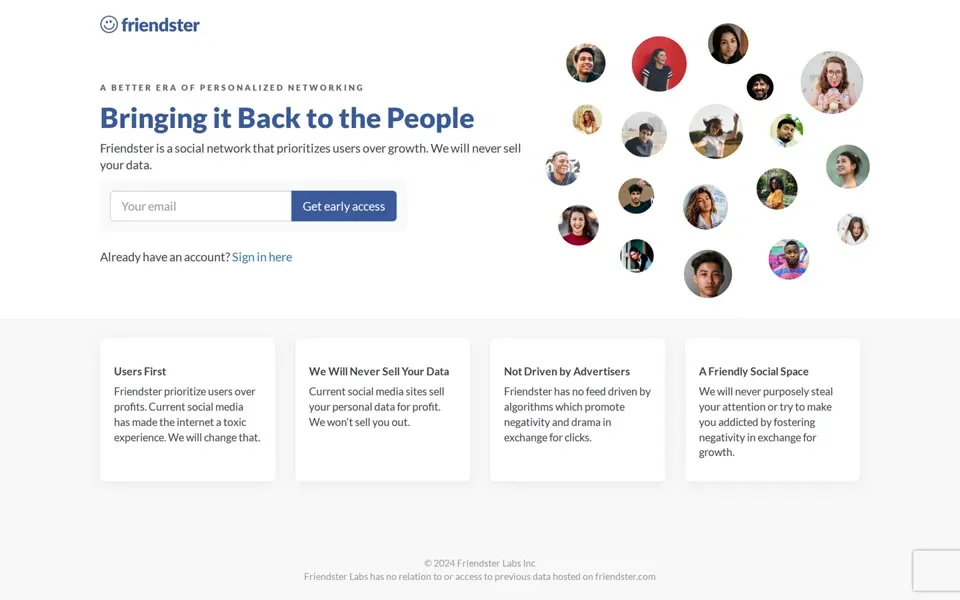
The 2025 Friendster page adds four cards about users, data, advertisers and a friendly social space. Its small print draws a firm boundary: Friendster Labs has no relation to or access to previous data hosted on friendster.com
. The old address and smiley are back. The old photos are not being offered back with them.
2026 Add your friends in person
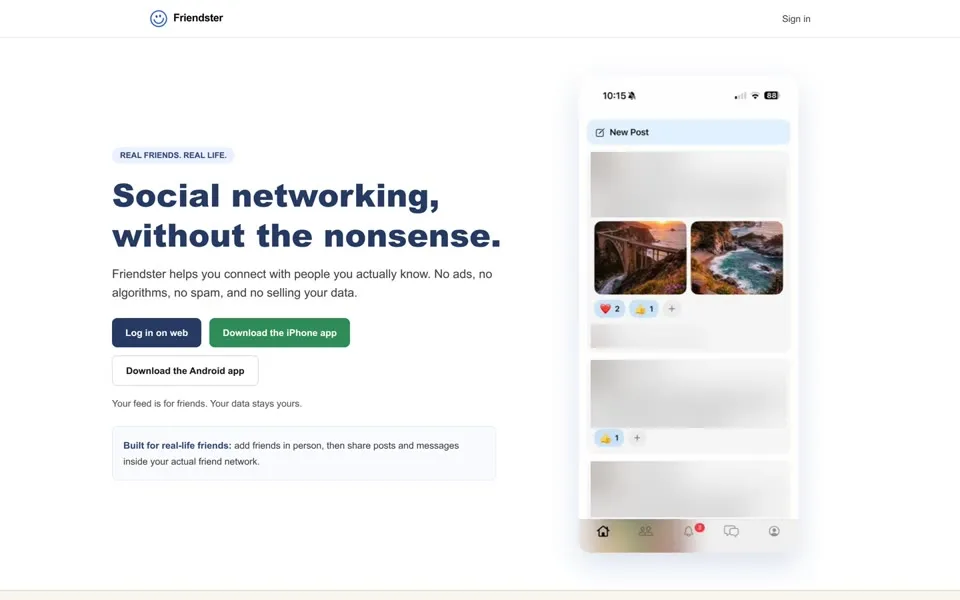
Friendster's live homepage on October 18, 2026 opens with Real friends. Real life.
Above a pair of app-download buttons, the larger heading promises Social networking, without the nonsense.
The wordmark has a capital F and black lettering; a blue smiley remains. A phone mockup shows a friends' feed alongside the invitation.
The page says to add friends in person, then share posts and messages inside that network. Farther down, four panels promise Friends only, No ads, No spam and Privacy first. These are the current operator's claims, not an audit of the apps. The footer identifies Friendster Labs Inc, and the download links point to iPhone and Android apps.
The 2003 diagram drew a line from your face to a friend, then to someone you might meet. The new page asks you to make that connection in person first. Twenty-three years after that diagram, Friendster is explaining who belongs in your circle again.
- When was the oldest friendster.com homepage in this story archived?
- The oldest capture here is from November 20, 2002, in the Internet Archive's Wayback Machine. Friendster beta asks for an invitation code beneath its white wordmark and smiley.
- What does the friendster.com homepage look like in 2026?
- In the newest capture here (live): Friendster’s live homepage promotes real-life friends, no ads or algorithms, and iPhone and Android apps; mockup identities are blurred.
- How many Friendster homepage captures does this story show?
- 18 captures between 2002 and 2026, at most one per year; the timeline above shows which years are included.
- How did the Friendster logo change on its homepage?
- The logo evolution below shows 6 logo versions we picked from the captures, from 2002, 2006, 2010, 2013, 2024 and 2026. Logos from before 2002, the first capture, aren't included.
 2002White lowercase wordmark beside an outlined smiley
 2006Smiley and wordmark turn gray
 2010Handwritten white wordmark on a green cloud
 2013Green wordmark with a cluster of colorful smileys
 2024Blue smiley and bold blue lowercase wordmark
 2026Black wordmark with a capital F and a blue smiley
Each logo is cut from that year's homepage capture (the year is the capture's); click one to see it on the page. Logos from before the first capture (2002) aren't shown, and some are missing where the logo images don't render in our captures. More logo histories.
◀ drag ▶20022026
November 2002: an invitation code for Friendster Beta. October 18, 2026: the live homepage invites real-life friends to use the web and mobile apps. Drag across the picture.
Which homepage should we open next?
Find more homepage histories on the PageRewind channel.
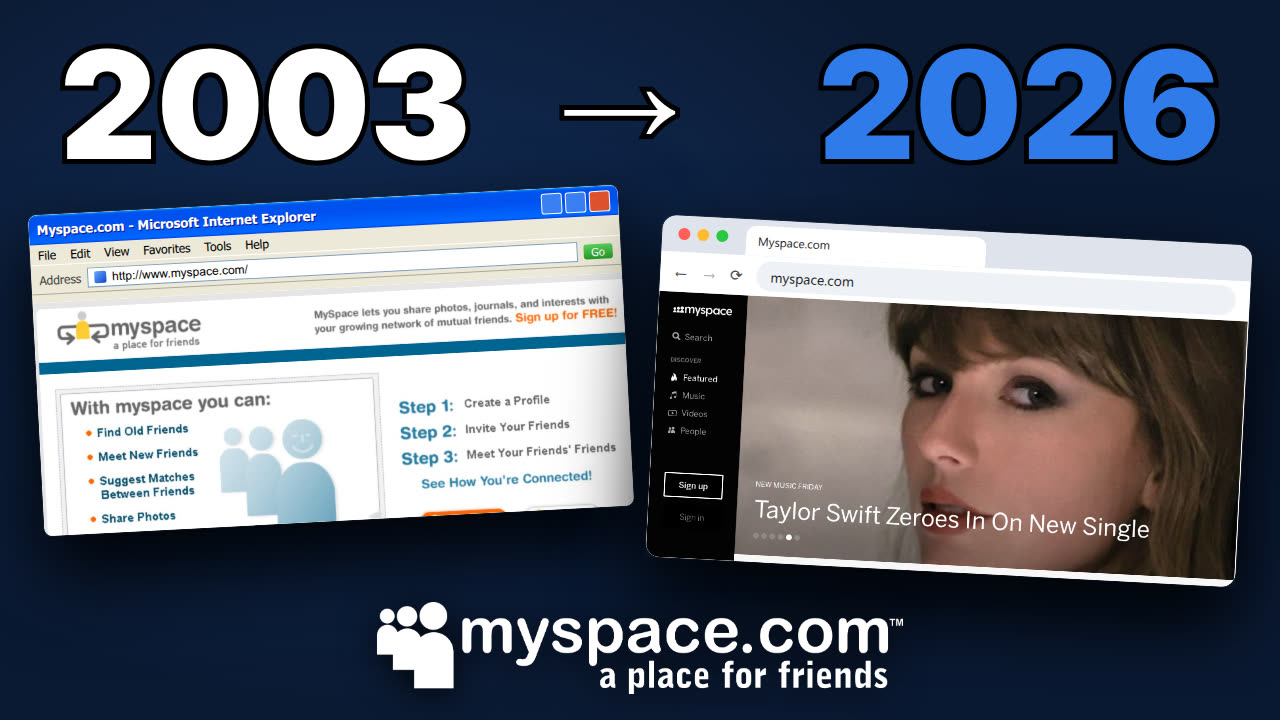 Myspace.com, 2003–2026From “a place for friends” to “Featured Content on Myspace”
Sources
Homepage wording comes from the dated captures alongside the text. Open a screenshot for the full-page image and its archive link. The final capture is from the live site on October 18, 2026. External history is sourced below; single-report claims are attributed to their publication.
- danah boyd and Jeffrey Heer, “Profiles as Conversation: Networked Identity Performance on Friendster”, HICSS, 2006. Research paper ↗The popularity ranking, Ali G and Burning Man, deleted Fakesters and profile farms.
- Salon, “Faking out Friendster”, August 14, 2003. Salon ↗Dates the public beta to March 2003, distinct from the invitation-code screen shown here.
- danah boyd, “None of this is real”, chapter preprint. Chapter ↗The four-degree limit and how popular Fakesters expanded the visible network.
- The New York Times News Service, reprinted in the Taipei Times, October 15, 2006. Taipei Times ↗Google's approximately $30 million offer and the $13 million venture investment.
- U.S. patent US7069308B2, Google Patents mirror. Patent record ↗Grant date: June 27, 2006. The footer wording is read from our own 2006 and 2007 captures.
- TechCrunch, report on Friendster’s redesign, December 3, 2009. TechCrunch ↗Contemporary report of the redesign and Connecting Smiles identity.
- MOL Global and Friendster, acquisition announcement reproduced by TechCrunch, December 9, 2009. Announcement ↗The companies' figures for Asian daily traffic and registered users.
- TechCrunch, report on the planned deletion of Friendster content, April 26, 2011. TechCrunch ↗The initially announced May 31 deadline, exporter destinations and the account data intended to remain.
- TechCrunch, “From Social Network Pioneer To Yet Another Gaming Site: Friendster Reboots”, June 29, 2011. TechCrunch ↗The games relaunch and Facebook Connect.
- Mike Carson, “I bought Friendster for $30k. Here's what I'm doing with it”, April 26, 2026. Carson's account ↗The $20,000 Bitcoin payment and a second domain traded as part of the purchase. The headline amount is not an all-cash price.
How this was made. Seventeen selected Wayback captures and one live-site capture, spanning 2002–2026. We omit 2012 because essential styling was missing; 2016–2018 and 2021 because archive redirects or replay dates led elsewhere; 2022 because the page was near-empty; and 2023 because we encountered an error or an ad-block wall. The 2019 and 2020 captures use the direct homepage index. This is a sample, not a record of every redesign.
Private member pictures, names and identifying text have been blurred, including examples in the current phone mockup. We hid selected archive overlays and the 2013 form-validation notice. The 2014 full page includes the games catalogue and footer. The 2006–2007 captures retain some text-encoding artifacts, and a small empty widget remains in the lower-right corner of the 2024–2025 pages. The old Abrams profile URL now replays an obsolete-bookmark message in its available 2004–2006 captures, so this story has no profile-page series.
PageRewind is independent and is not affiliated with Friendster or Friendster Labs Inc. Names and logos belong to their respective owners.
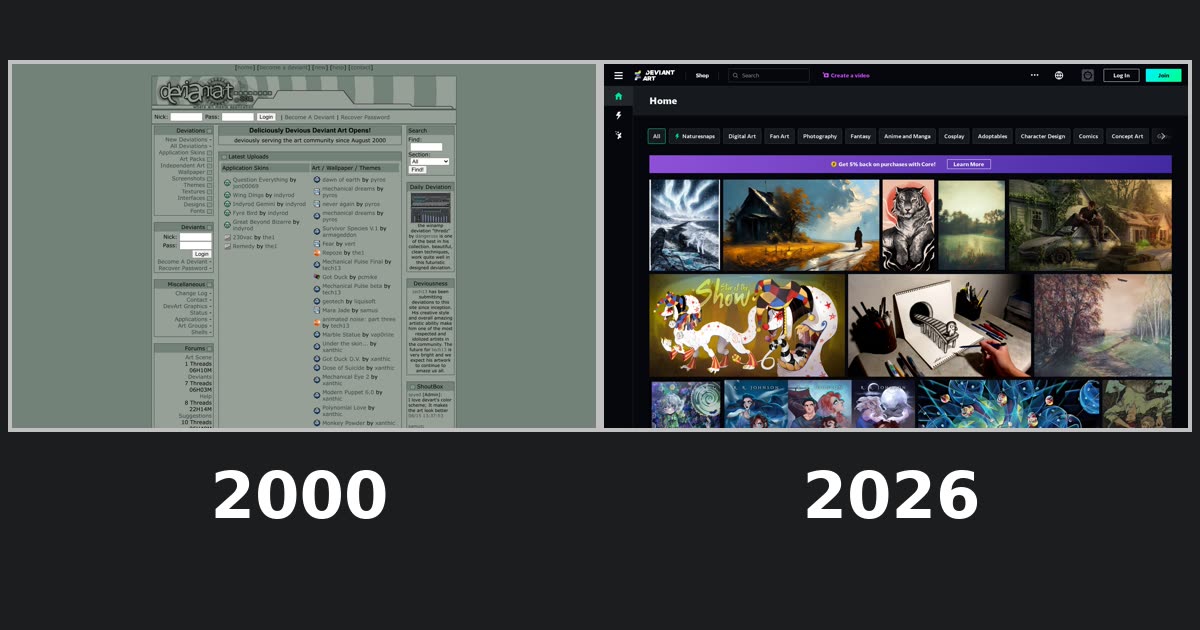 DeviantArt homepage history
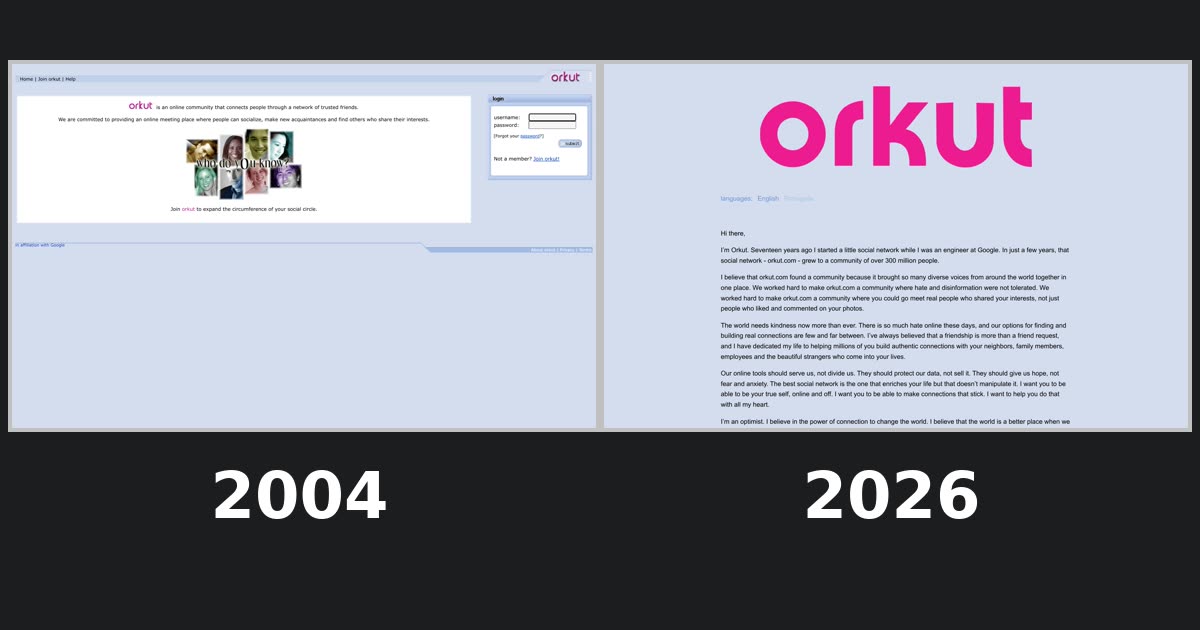 Orkut homepage history