In November 1996, GameSpot put an invitation above its row of yellow letter discs: try the Low-Band Version!
The promise underneath was simple: Fewer Graphics, Faster Pages, Works with All Major Browsers
. A demo for Star Control 3 waited below.
GameSpot's homepage history from 1996 to 2026 follows a page built around getting games onto a PC, then around getting stories onto a screen. The download lists grew into a dense console-and-PC portal; a 2013 rebuild replaced that machinery with large pictures and a layout for phones. Behind the new design, editors were also fixing a stranger problem: publishing an article could take longer than writing it. The new FAQ even had to promise that readers could finally type the word class
.[2]
Scrub through the captures, or follow the story below.
1996–1997 A faster page, if you need one
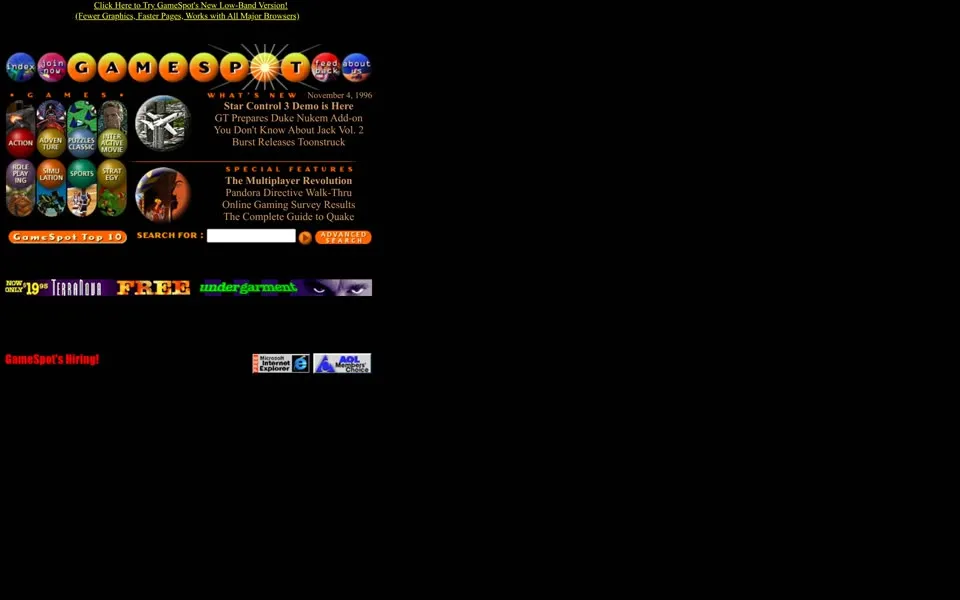
GameSpot's November 1996 homepage has game genres inside bright buttons on black: action and adventure sit beside puzzles, interactive movies, role-playing games, simulation, sports and strategy, while the news column advertises a Star Control 3 demo and a Duke Nukem add-on. Much of the page is made from pictures. Even the letters in the name have their own discs.
The Low-Band link sits above all of it. Visitors could choose fewer graphics before loading into the rest of GameSpot. Near the bottom of the first screen, a hiring notice shares space with Internet Explorer and AOL badges. The browser was part of the pitch too.
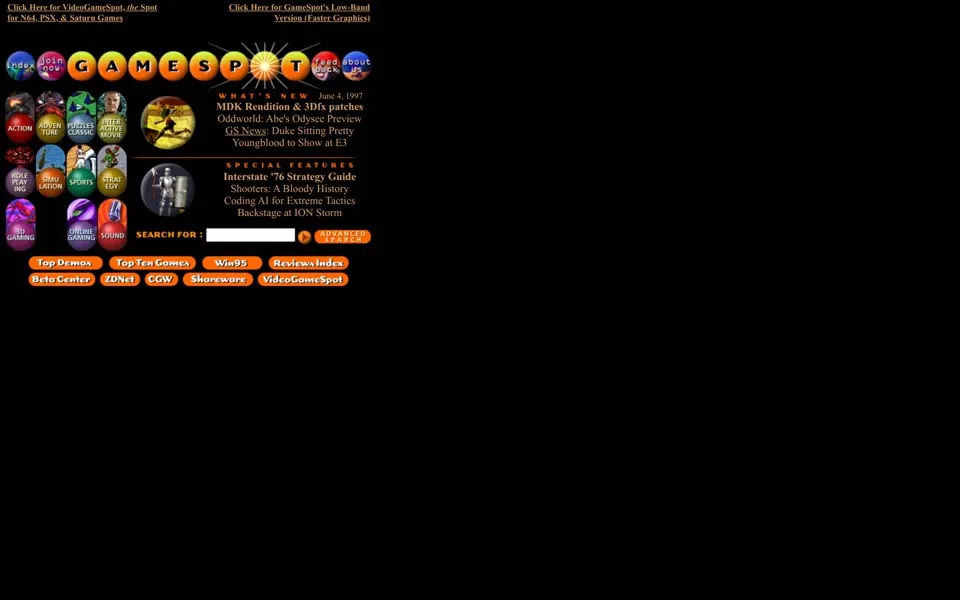
GameSpot launched on May 1, 1996, according to its eighteenth-birthday article.[1] This capture is from November 5, with November 4 printed on the page. By June 1997, the compact layout has gained rows of orange navigation buttons; the Low-Band invitation remains.
1998–1999 A VRML map and a Macintosh vote
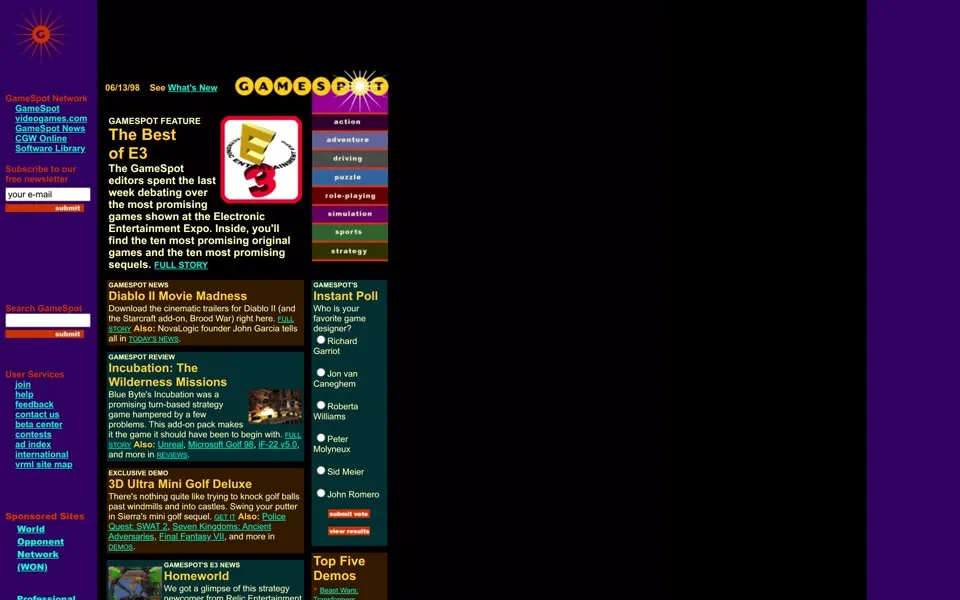
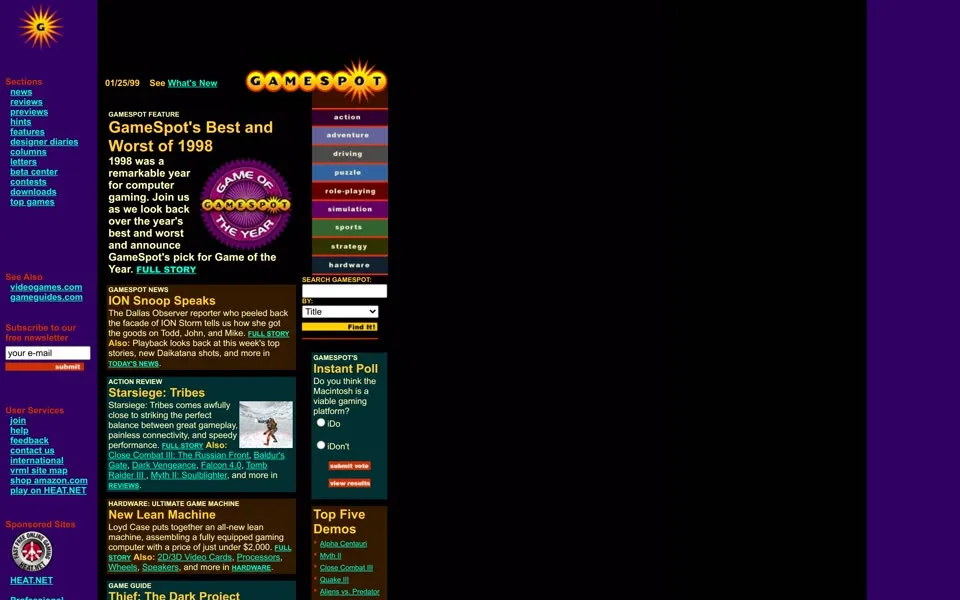
GameSpot's January 1999 homepage packs a PC magazine into three columns. A purple sidebar lists sections, the middle stacks stories on colored blocks, and the right side holds a poll and five demos. The lead looks back.
A vrml site map
link appears among the user services. The same list includes shop amazon.com
and an invitation to play on HEAT.NET. A map in a 3D format gets the same-sized link as help and feedback.
The Macintosh poll asks whether the computer is a viable gaming platform, with iDo
and iDon't
as answers; just above it, the search box asks for a game title and a yellow button tells the visitor to Find It!
. Just below, Alpha Centauri, Myth II, Close Combat III, Quake III and Aliens vs. Predator make up the demo list; farther left, a hardware article describes a complete gaming PC for just under $2,000.
The June 1998 capture already uses the purple sidebar and narrow story columns. In both years the small links do much of the work: game guides, hints, patches and downloads give readers reasons to leave the lead story and keep browsing.
Do you think the Macintosh is a viable gaming platform?
Answer choices:
iDo/
iDon't.
Wording from the January 25 capture.
2000–2005 PC games meet the console menu
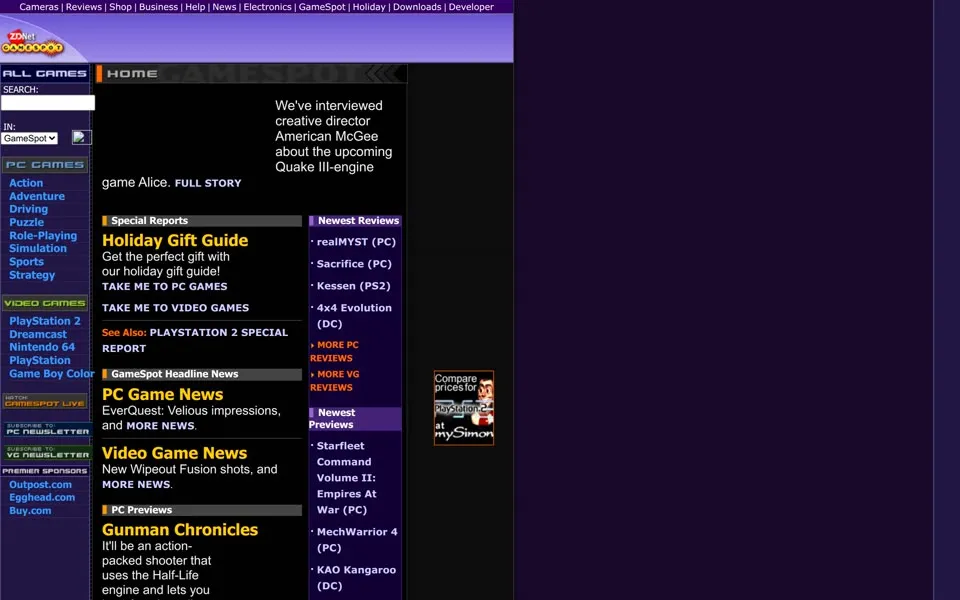
GameSpot's November 2000 homepage has ZDNet navigation above its purple columns. An Alice interview appears above a holiday gift guide; PC news shares the middle with video game news, reviews and free game guides, while the search box offers GameSpot, ZDNet or the web, and the right-hand column lists recent reviews and new releases. There is plenty to click.
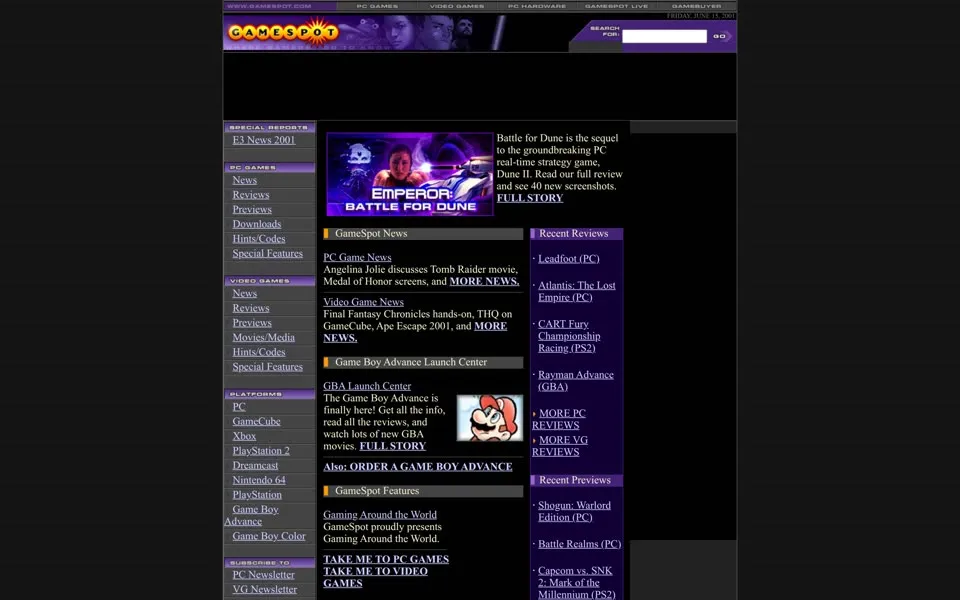
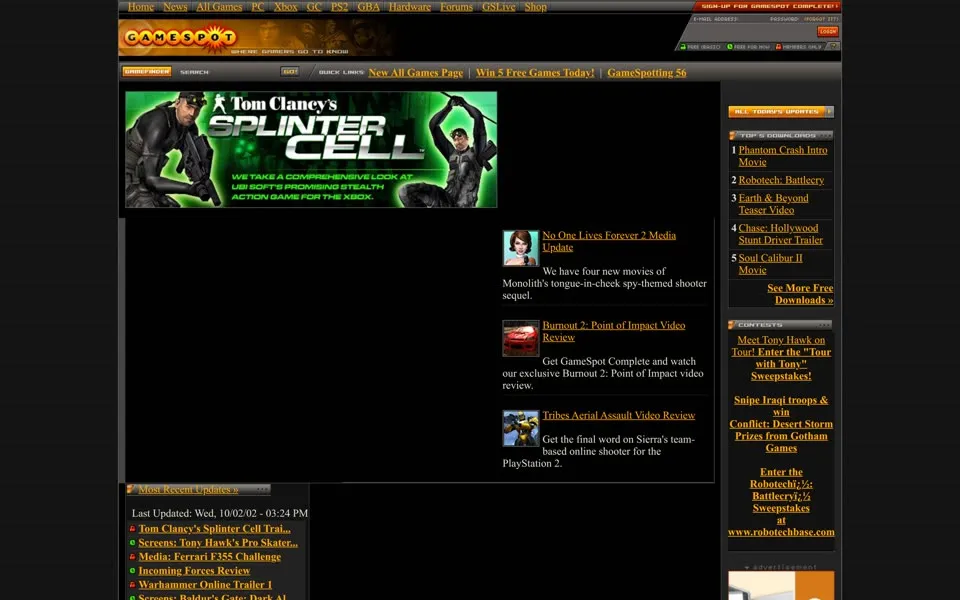
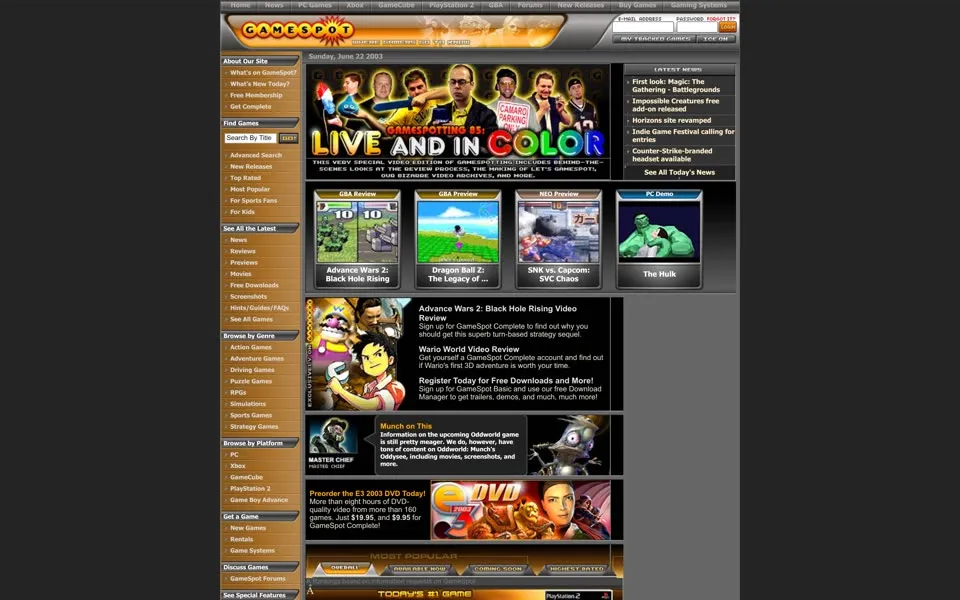
By 2002, gold navigation surrounds a black page, and a Splinter Cell banner sits over the news; the 2003 page puts console names down the left and scores in a ranking on the right, with membership links waiting above the platform list. Readers can pick a platform before picking a story, with PC games alongside PlayStation 2, Xbox, GameCube and Game Boy Advance.
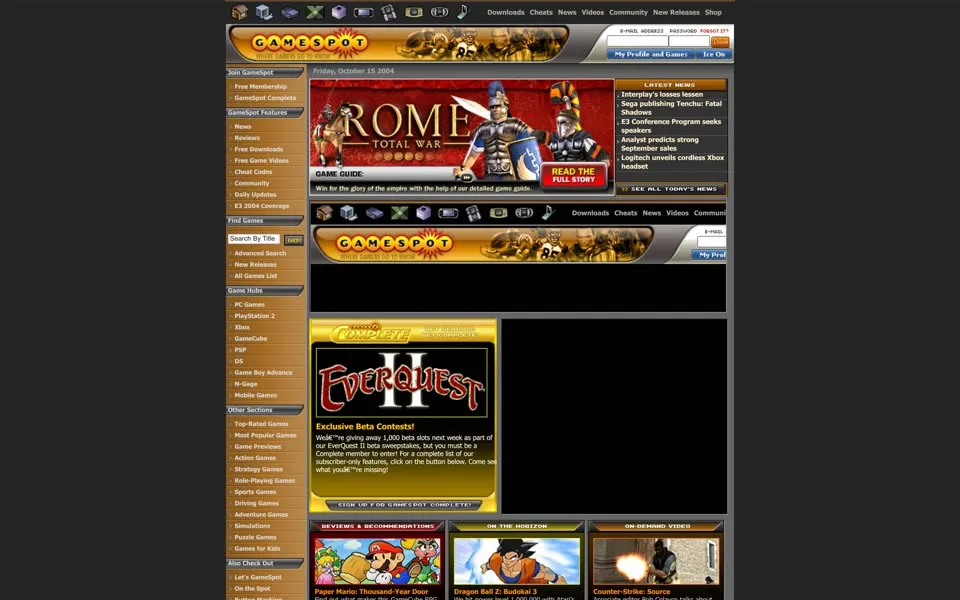
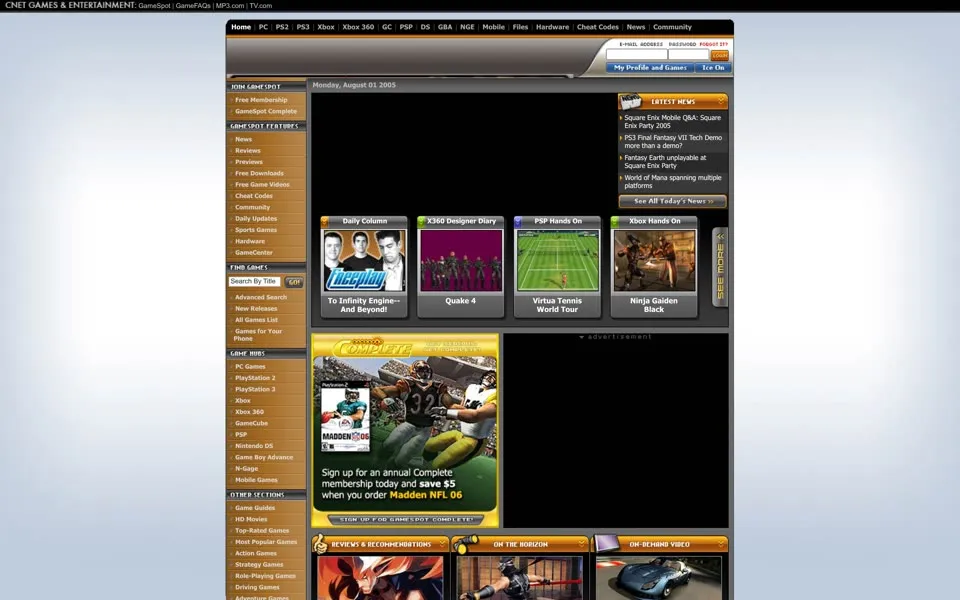
The October 2004 page has another small instruction behind its EverQuest II promotion: entry to the beta sweepstakes requires Complete membership. Free membership and the paid tier both have links in the left menu. Downloads and access to games still help sell the service. Header images are missing in 2000; the 2002 and 2005 frames also lack lead media, and 2005 lacks its header logo.
2006–2009 A schedule beside the reviews

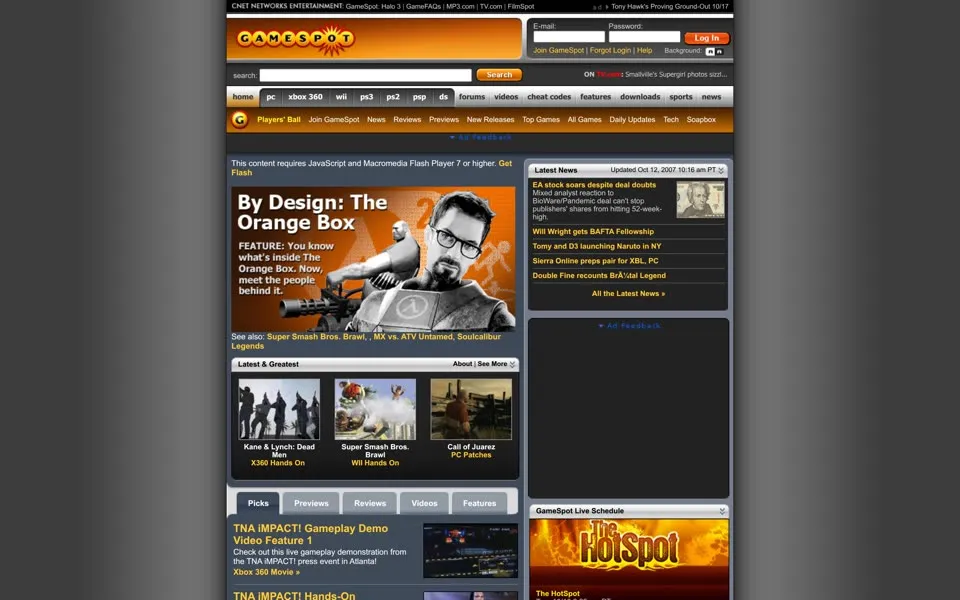
GameSpot's October 2007 homepage leads with The Orange Box in a wide orange panel. The navigation still sorts games by console, but the page below makes room for programs and readers as well as reviews. A right-hand column carries more stories while smaller panels fill the center.
Look below the lead and the page gives times for The HotSpot and On The Spot, while a reader-blog section invites visitors into what other GameSpot users are saying and thumbnails carry the eye from one panel into the next. The page keeps going. Reading a review is one stop in a page with a broadcast schedule attached.
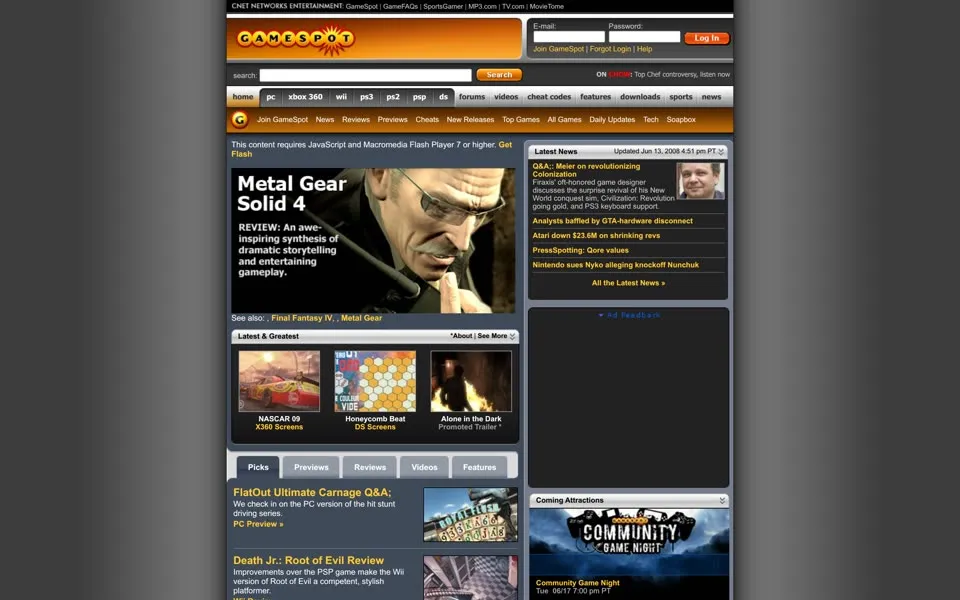
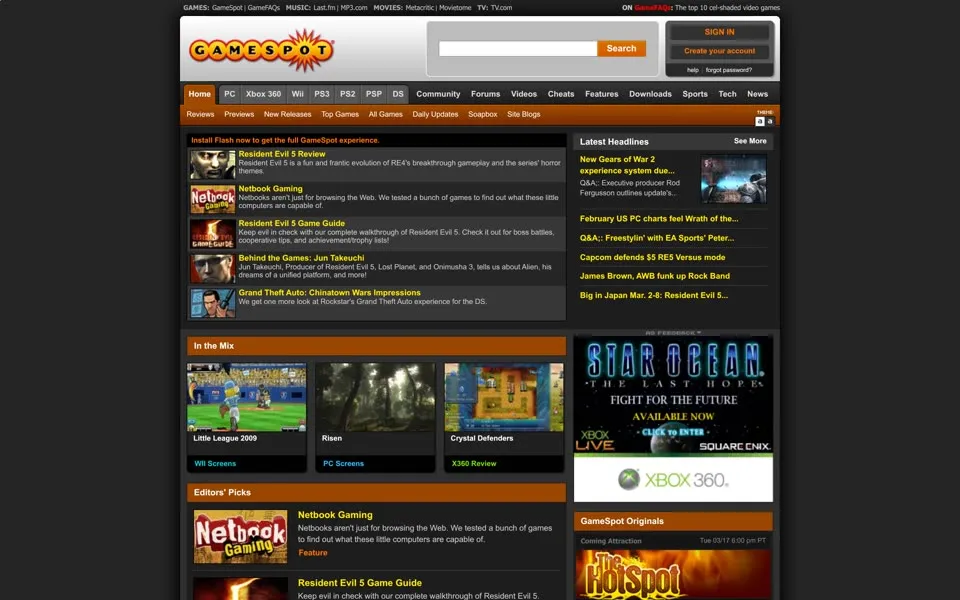
The June 2008 capture gives Metal Gear Solid 4 the lead. By March 2009, orange section bars separate a darker, more tightly packed feed, with small screenshots beside story links and rows of media below. The familiar yellow letter discs remain in the header while the columns keep changing underneath.
2010–2012 The background turns white
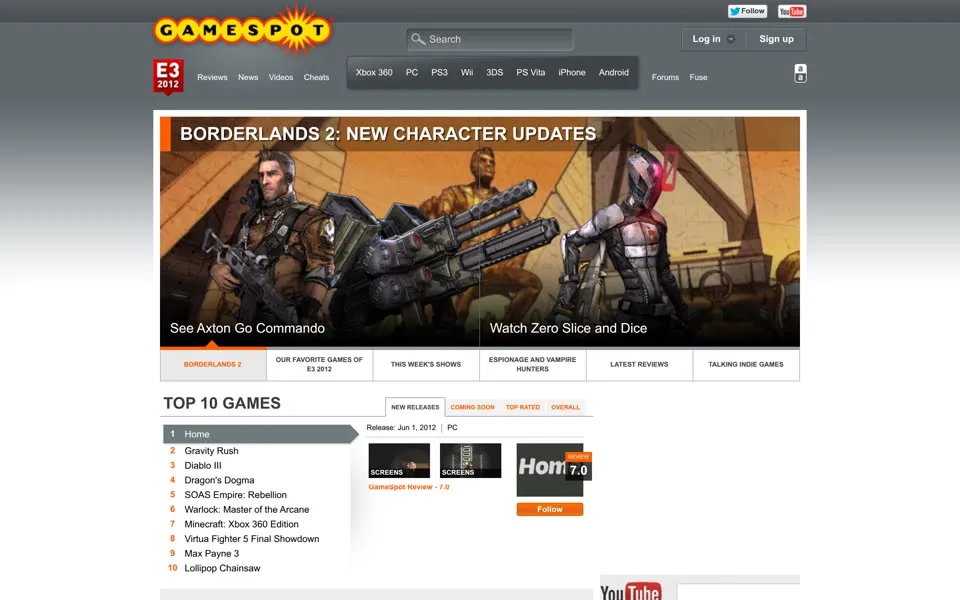
GameSpot's June 2012 homepage puts Borderlands 2 above a mostly white page. A grey header holds the logo and platform links; below the large picture, a Top 10 Games
list offers different ways to sort the games. The browser title still puts reviews and news first.
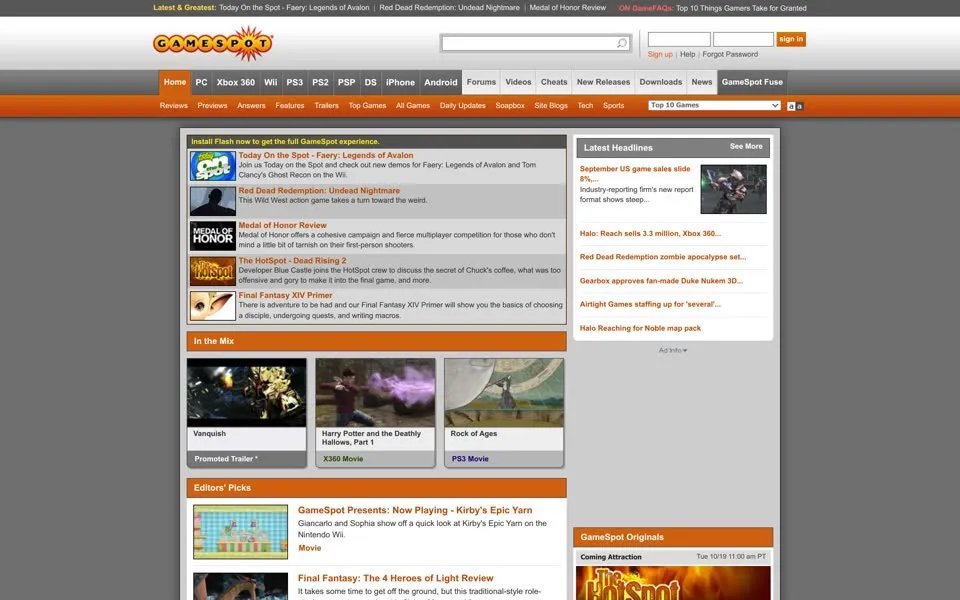
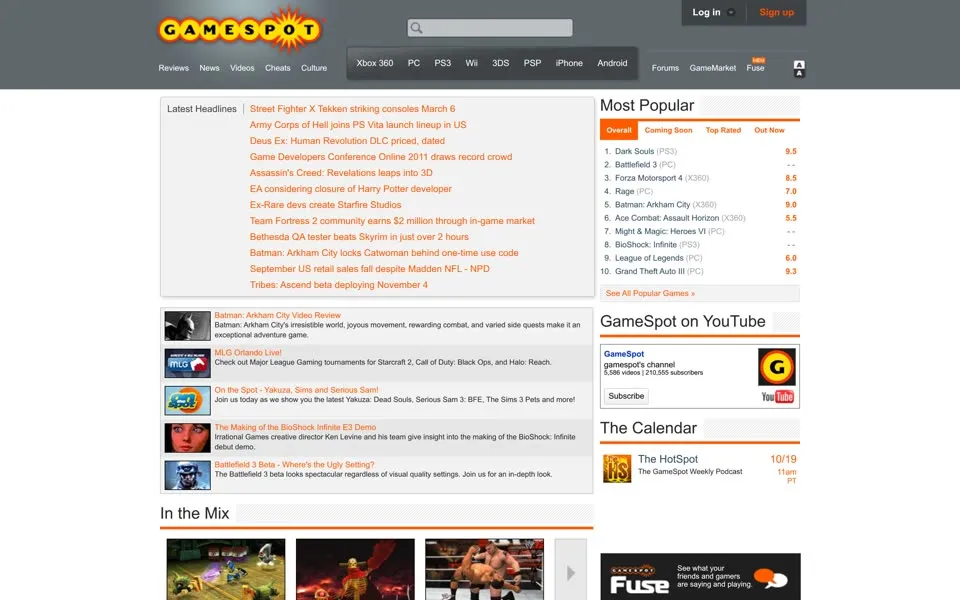
The transition is visible in the previous two captures. October 2010 keeps an orange bar over a pale story feed. October 2011 has a grey header and a right column labeled Most Popular
, followed by GameSpot on YouTube
and The Calendar
. Some lead media is missing from that replay.
In 2012, an E3 badge shares the navigation with the platform names, while a Top 10 Games list and links to GameSpot on YouTube sit below the Borderlands 2 picture, where the page returns to ranking games and following shows. The white background stays. These lighter captures precede the full rebuild described the following year.
2013 Publishing took longer than writing
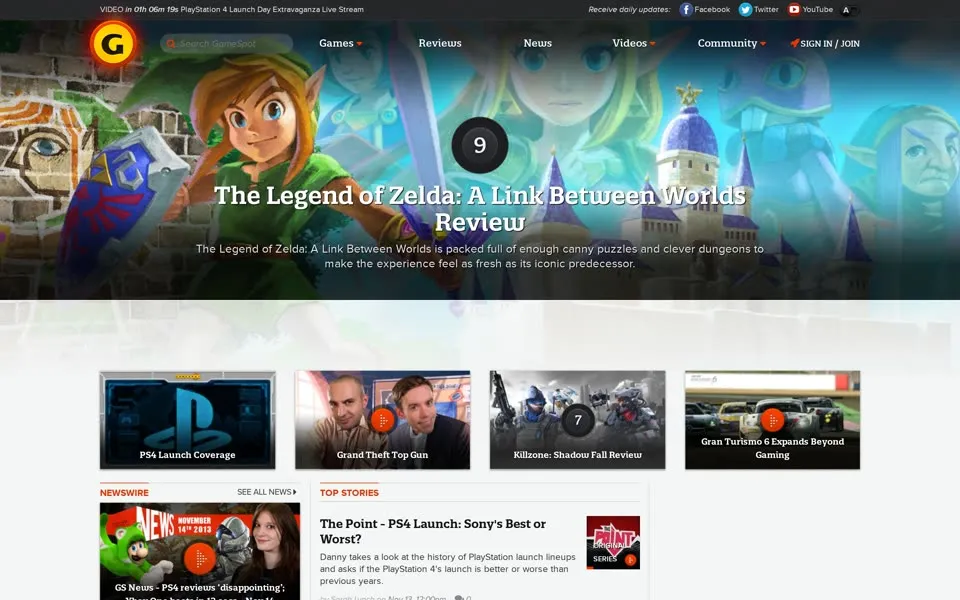
GameSpot's November 2013 homepage stretches a Zelda review across the top. The Legend of Zelda: A Link Between Worlds sits beneath a score of 9, and a glowing G replaces the old row of letter discs in the header. Under the hero, picture cards lead into a long white story feed and a large GTA Diaries panel.
Editors had sometimes spent more time getting an article or review published than writing it. GameSpot's October 9 redesign FAQ blamed aging tools and explained the rebuild.[2] The new layout worked across desktops, tablets and phones.
One question in that FAQ reads Can I use words like “class?”
The answer: Yes! You will no longer have difficulty saying words like “class,” or “style,” or whatever. I can’t believe that I just had to type that.
[2] The FAQ never says what had gone wrong. Two ordinary words got their own entry in the list of questions about the redesign.
Review scores lost their half-points for new reviews. Older scores stayed as published.[2] The 9 over Zelda fits that simpler scale. Down the page, review cards keep numbers visible beside the pictures, even as the rest of the design gives more room to headlines.
2014–2019 E3 takes over the front page
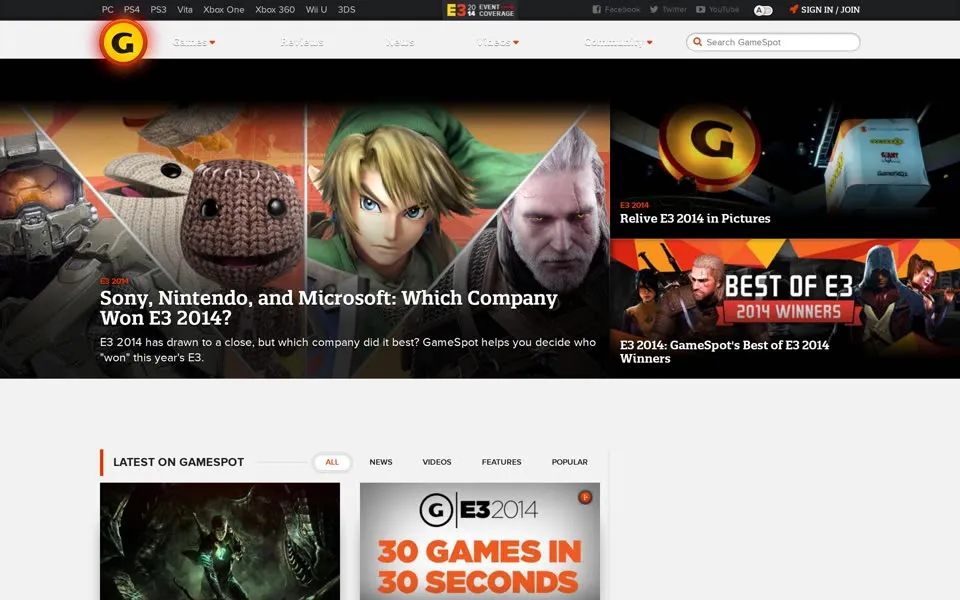
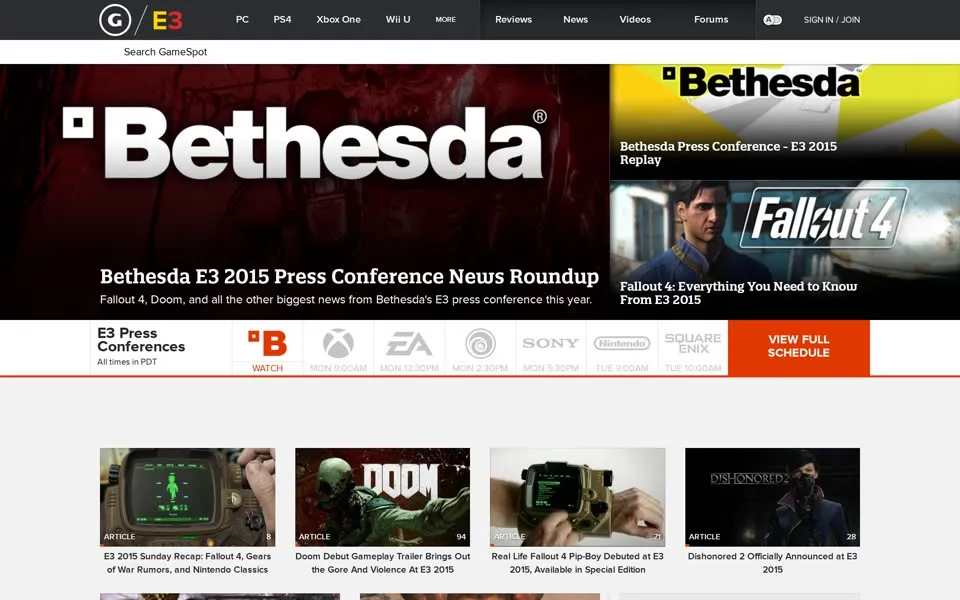
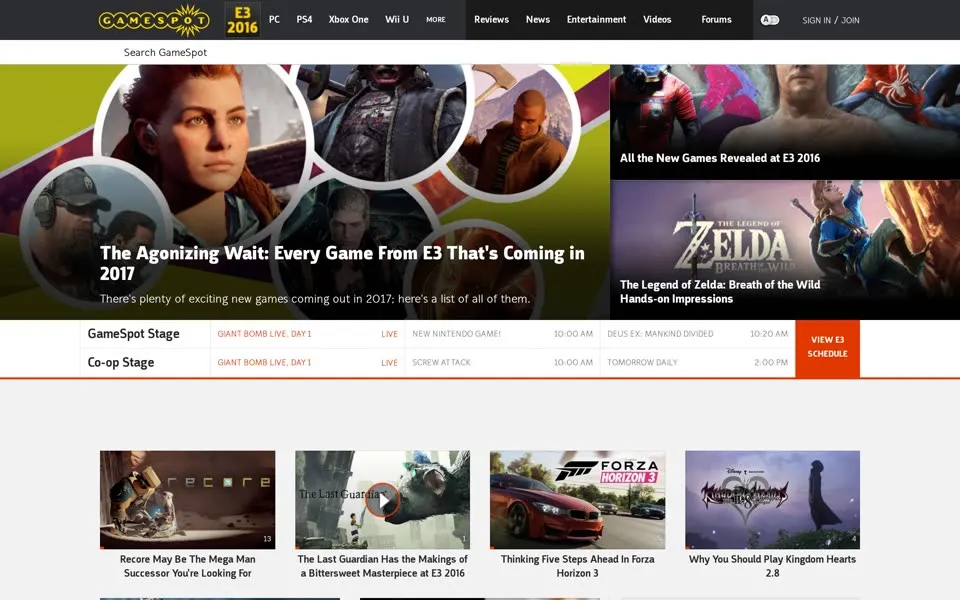
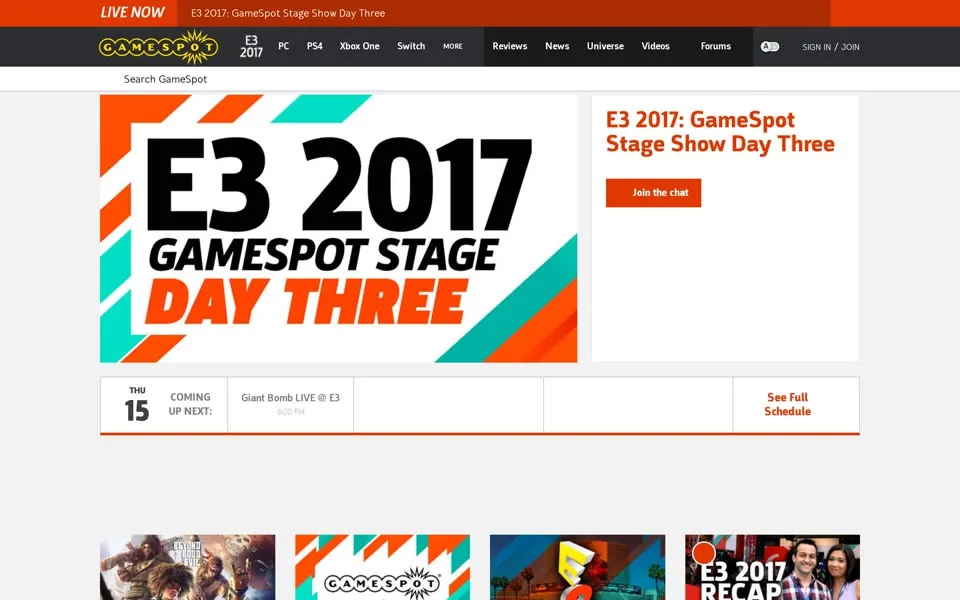
GameSpot's June 2017 homepage opens with a large E3 stage graphic and a Day Three label. The story feed waits below a broadcast panel and schedule. The page is an entrance to a show.
File downloads had been dropped in the 2013 rebuild; GameSpot's FAQ cited platforms such as Steam and a move toward streaming.[2] In these June captures, conference coverage now fills much of the space once occupied by dense rows of links.
The 2014 page asks which company won E3; Bethesda fills the 2015 lead, and 2016 arranges big pictures beside smaller stories, all above a row of conference links that lets a reader pick a company and leave the main feed. Each June has a show. Captures from June often catch this event layout, so the sequence samples conference coverage as well as design changes.
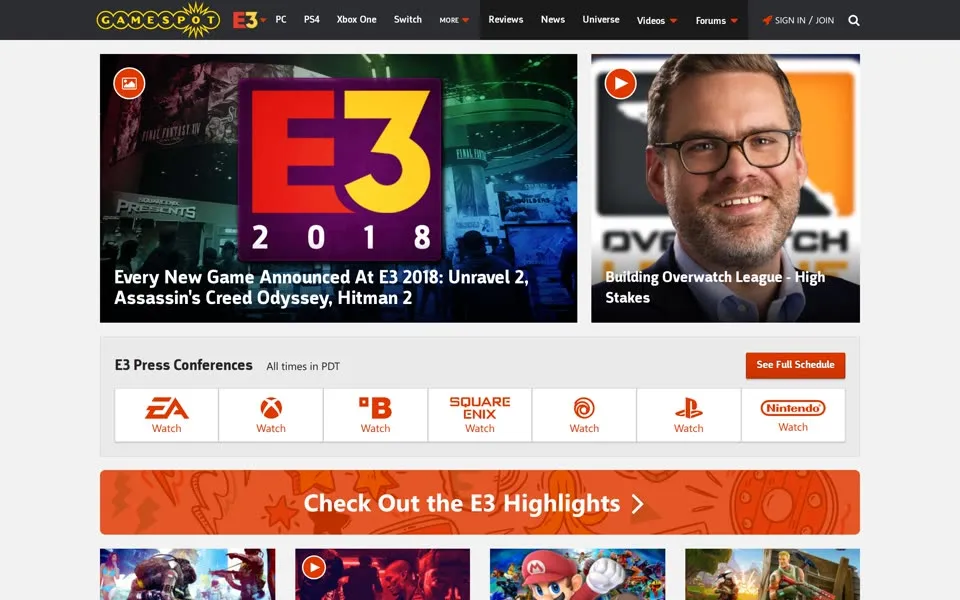
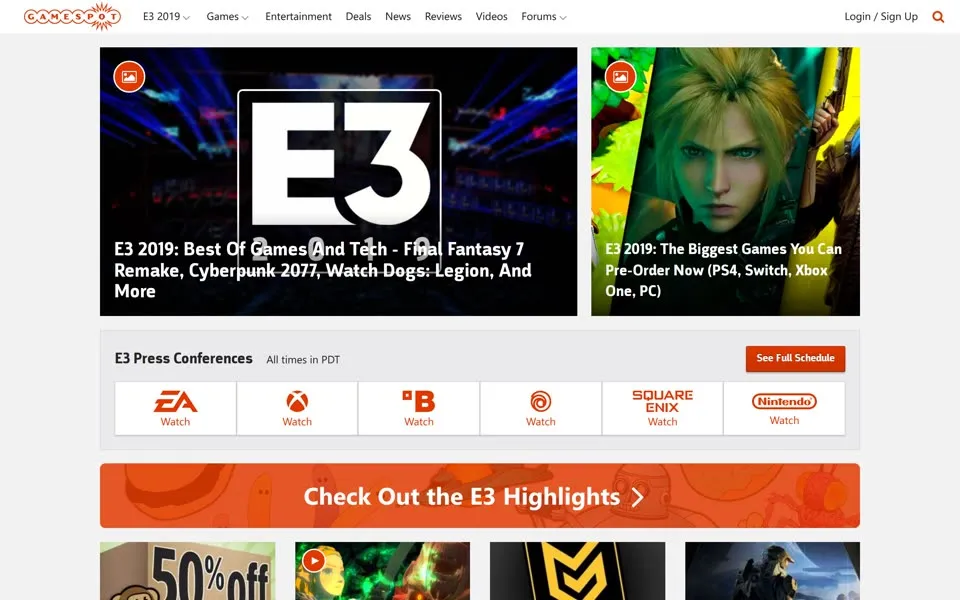
In 2018 and 2019, conference links and an orange highlights banner sit under the lead pictures. The reader can jump by company or go straight into the highlights. The broad white page stays; the event supplies its colors.
2020–2021 Play For All shares the lead
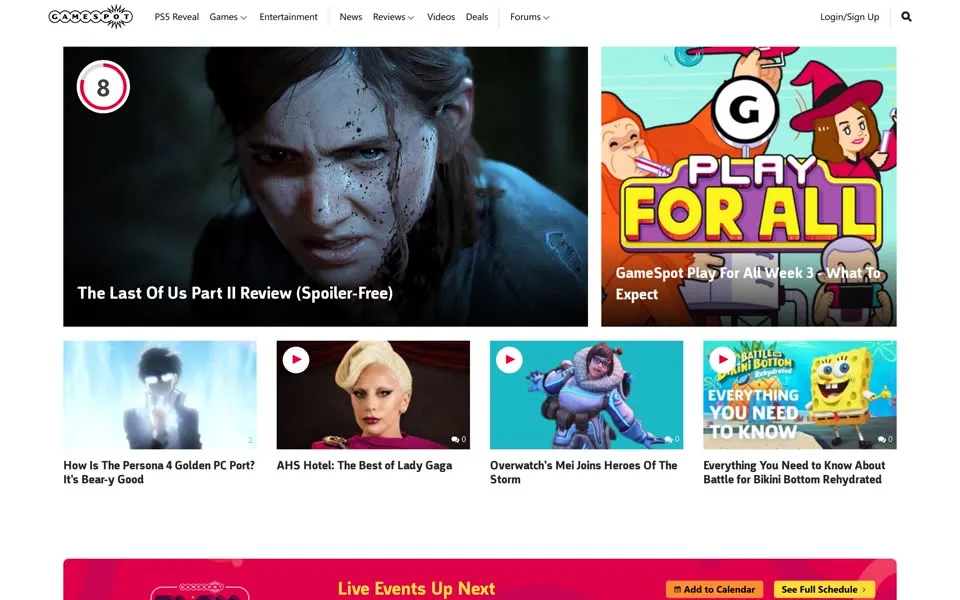
GameSpot's June 2020 homepage puts The Last of Us Part II beside Play For All. One half of the lead carries the review and its score of 8; the other announces the third week of GameSpot's program. A row of smaller stories sits immediately underneath.
Farther down, a pink panel lists live events. This is the broadcast schedule in a different wrapper, with a large program name and room to see what is coming next. Reviews still get a number near the top of their pictures.
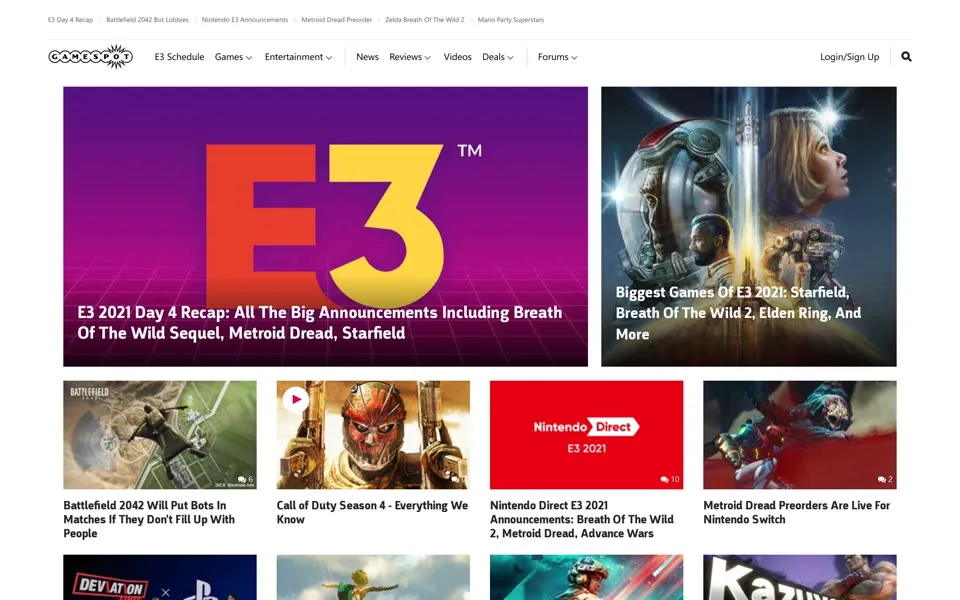
GameSpot's June 2021 page returns to an E3 recap, beside another large game image and two rows of smaller tiles. The outline wordmark now occupies little space in the header. Underneath, the Play For All signup strip asks readers to watch streams and more from the summer event, before the latest stories begin.
2022–2026 Two big stories, then the grid
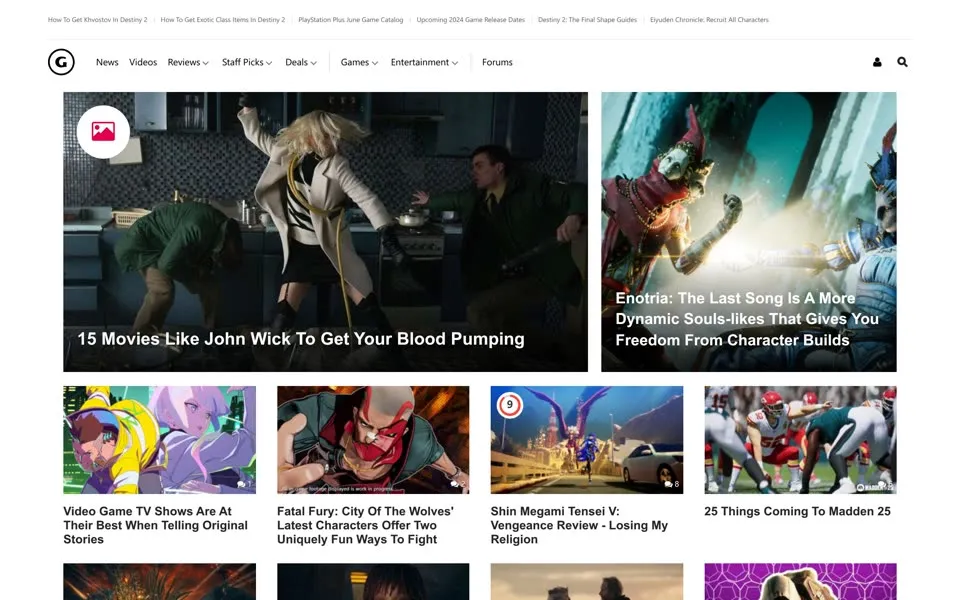
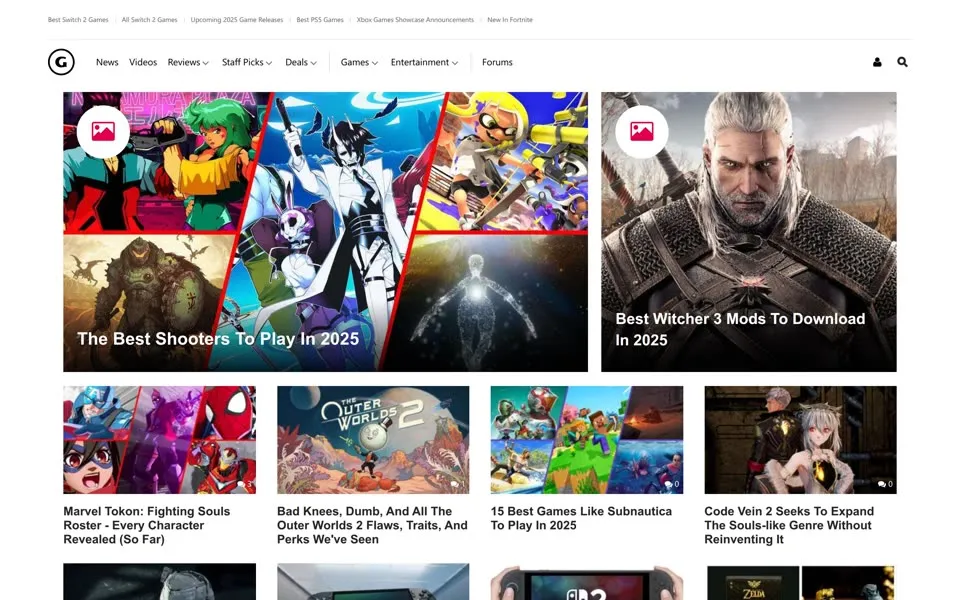
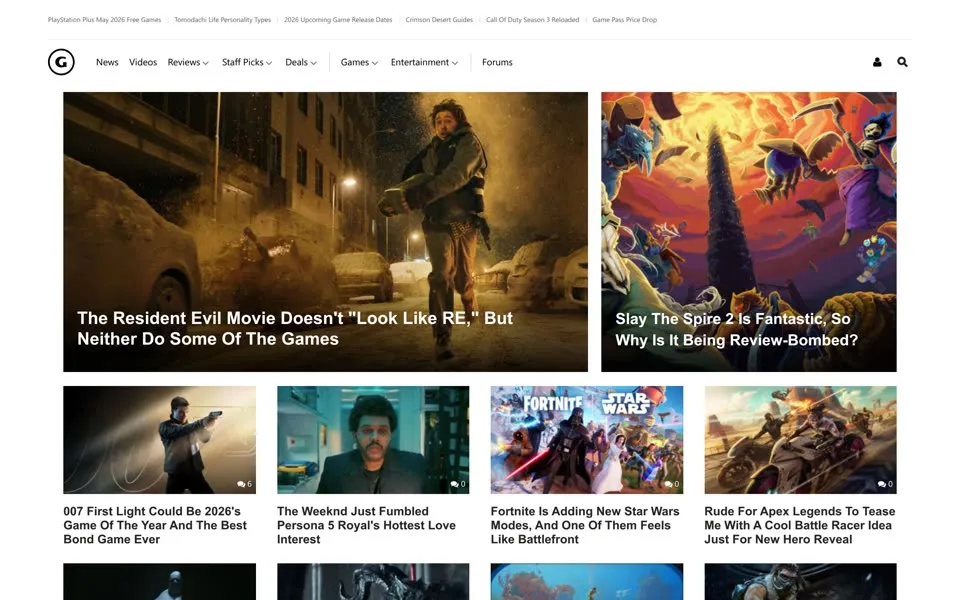
GameSpot's May 2026 homepage gives its two largest pictures to a Resident Evil movie story and Slay the Spire 2. Two rows of smaller tiles follow. The compact circled G leaves most of the first screen to pictures and headlines.
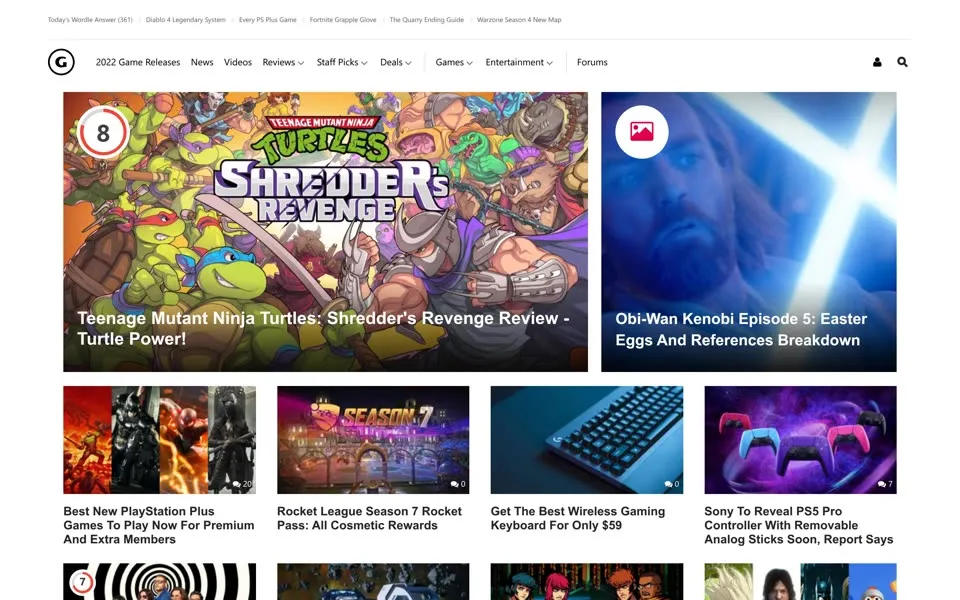
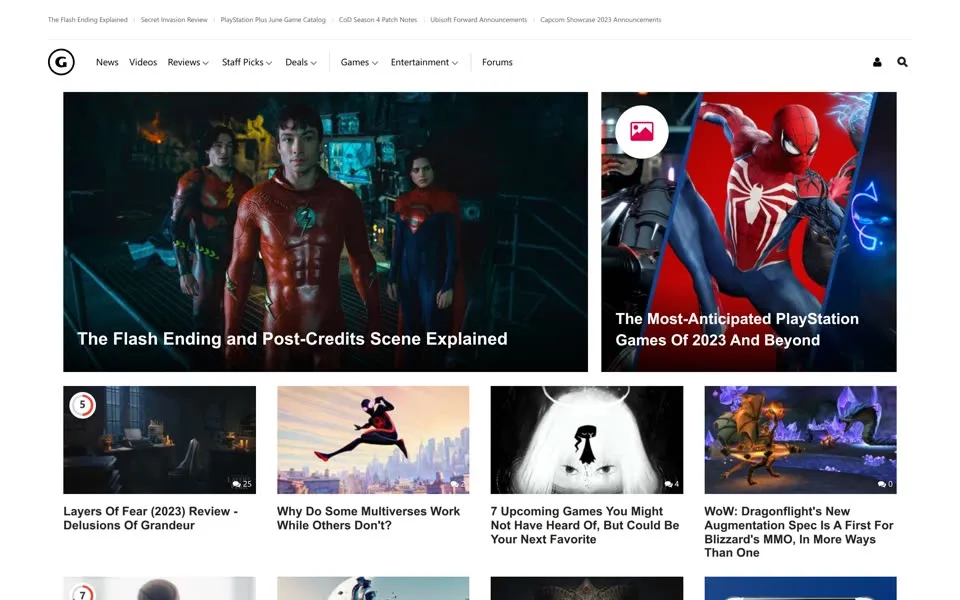
The June 2022 capture puts Teenage Mutant Ninja Turtles beside Obi-Wan Kenobi; a year later, The Flash and Spider-Man share the lead, and by 2025 a shooters list sits beside Witcher 3 mods above two more rows of smaller pictures. The grid holds. Gaming and entertainment stories share the same arrangement.
Scroll past the first grid in 2026 and separate Game Deals and Tech Deals rows appear before the latest feed. The archived page text credits Fandom, which announced its purchase of GameSpot with six other brands in October 2022.[3] That date belongs to the ownership story; these captures show the layout continuing around it.
The 1996 page offered fewer pictures to make browsing faster. Thirty years later, the first screen is almost all pictures. The demo list is gone. Choose a story.
- When was the oldest gamespot.com homepage in this story archived?
- The oldest capture here is from November 5, 1996, in the Internet Archive's Wayback Machine. GameSpot's 1996 homepage: Black, image-led PC gaming homepage with yellow letter-disc logo and a Low-Band option.
- What does the gamespot.com homepage look like in 2026?
- In the newest capture here (May 1, 2026): GameSpot's 2026 homepage: Resident Evil and Slay the Spire 2 lead the May 2026 news mosaic beneath a compact circled-G header.
- How many GameSpot homepage captures does this story show?
- 31 captures between 1996 and 2026, at most one per year; the timeline above shows which years are included.
- How did the GameSpot logo change on its homepage?
- The logo evolution below shows 10 logo versions we picked from the captures, from 1996, 1998, 1999, 2011, 2013, 2015, 2016, 2019, 2020 and 2022. Logos from before 1996, the first capture, aren't included.
 1996Shaded yellow spheres with a white sunburst O.
 1998Flatter yellow discs keep the white sunburst.
 1999Red outlines and an orange sunburst frame the letters.
 2011The yellow wordmark becomes flatter and brighter.
 2013A glowing G symbol replaces the full name in the header.
 2015The navigation switches to a white circled G.
 2016The full wordmark returns as a yellow outline.
 2019The outlined wordmark switches from yellow to orange.
 2020The outlined wordmark turns black.
 2022A black circled G replaces the full name in navigation.
Each logo is cut from that year's homepage capture (the year is the capture's); click one to see it on the page. Logos from before the first capture (1996) aren't shown, and some are missing where the logo images don't render in our captures. More logo histories.
◀ drag ▶19962026
The oldest capture in this story (1996) over the newest (2026). Drag across the picture.
Which homepage should we open next?
Find more homepage histories on the PageRewind channel.
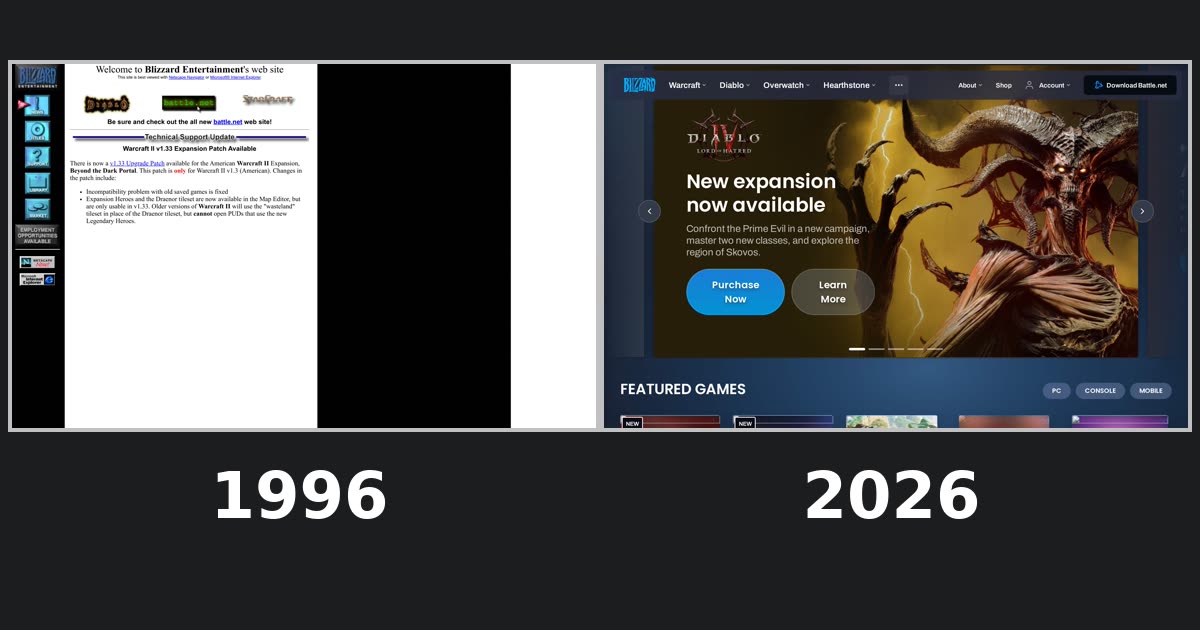 Blizzard.com, 1996–2026From “Warcraft II v1.33” to “New expansion now available”
Sources
Homepage wording comes from the dated captures shown here. Click a screenshot for its full page and Wayback link. The external sources below explain the launch, the rebuild and the ownership change.
- GameSpot, “GameSpot Is 18! What Else Was Happening In Games 18 Years Ago?”, May 1, 2014. GameSpot birthday article ↗Source for the May 1, 1996 launch date.
- GameSpot, Lark Anderson, “The New GameSpot FAQ”, October 9, 2013. The New GameSpot FAQ ↗Source for the publishing tools, class/style fix, responsive rebuild, score scale and file downloads. The FAQ's date does not establish the exact rollout day.
- Fandom, acquisition announcement, October 3, 2022. Fandom announcement ↗Source for the purchase of seven brands, including GameSpot.
How this was made. One selected archived homepage per year, 1996–2026: 31 Wayback replays. This is a sample of the page over time. Many June captures show E3 coverage. Some images and media are missing, particularly header images in 2000 and lead media in 2002, 2005 and 2011; smaller gaps remain elsewhere.
Selected cookie banners, advertising spaces and obsolete Flash elements were hidden during capture. The latest frame is archived May 1, 2026. It shows the archived site.
A planned Ocarina of Time review-page comparison is omitted because archive replays could not be captured reliably.
Each logo date marks a selected capture showing that design; it does not establish a launch date.
PageRewind is independent and not affiliated with GameSpot. GameSpot names and logos belong to their respective owners.
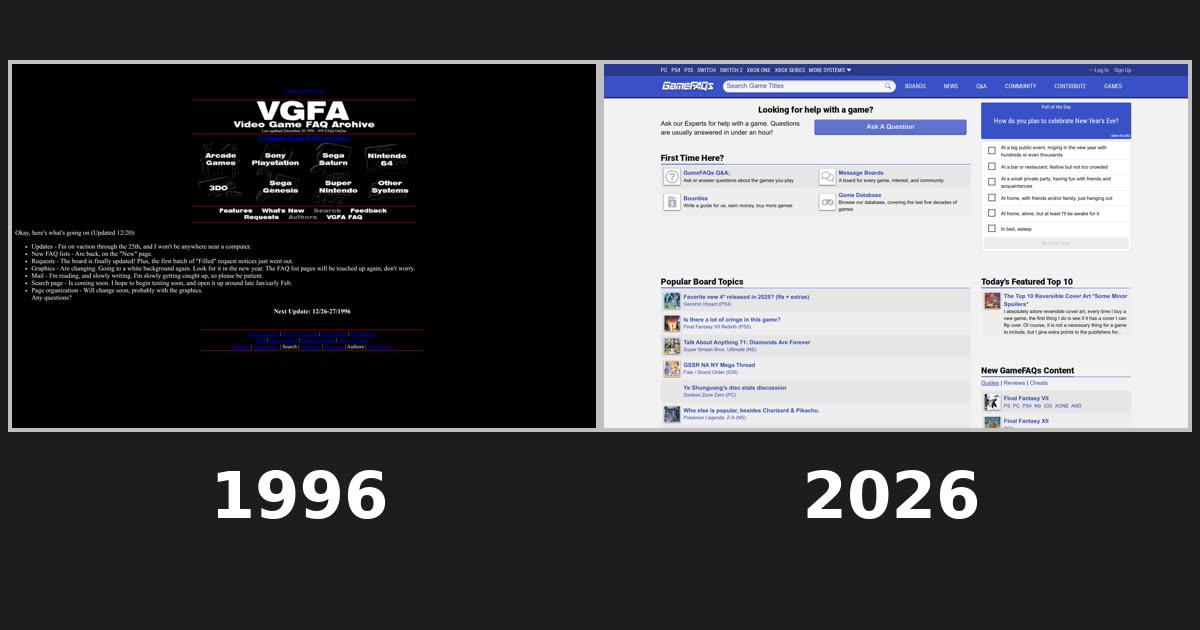 GameFAQs homepage history
 Nintendo homepage history